




About this worksheet
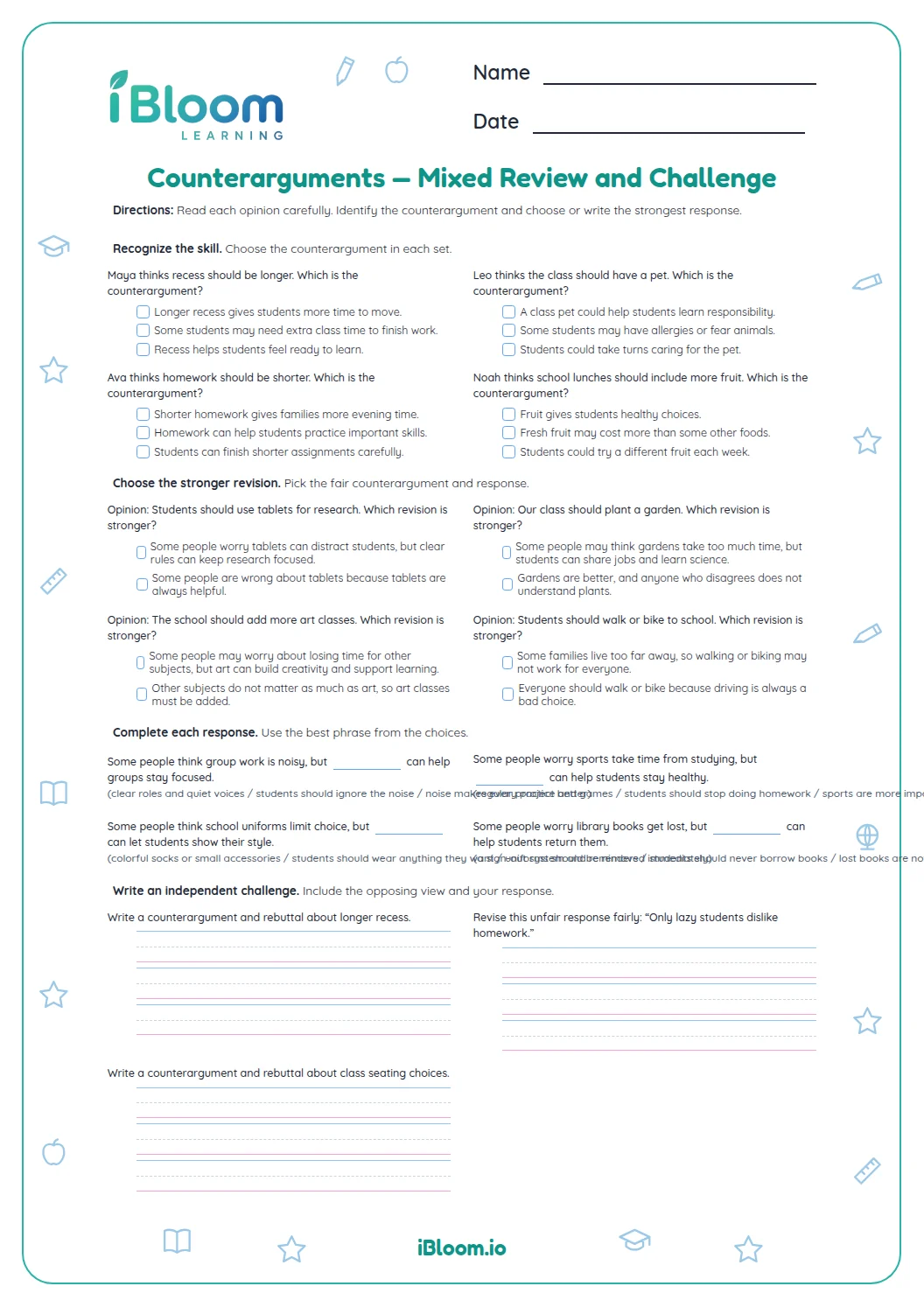
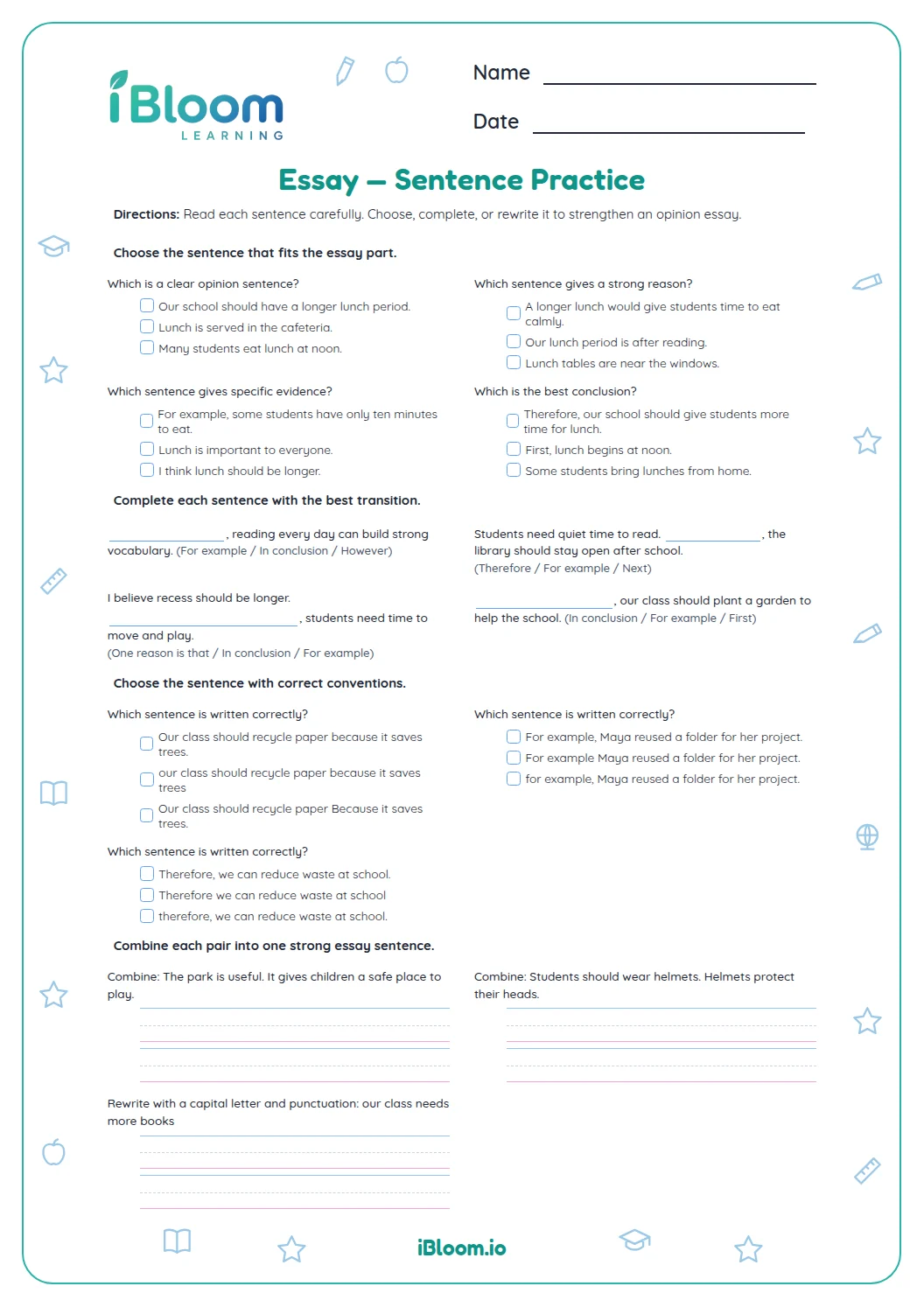
This free printable Grade 4 worksheet teaches students to recognize and write counterarguments. Across 14 questions, students spot a reasonable concern, revise unfair statements, and pair concerns with replies that give reasons or solutions. It practices CCSS W.4.1 through opinion writing that supports a point of view with reasons and information. A separate key offers sample answers.
Aligned to W.4.1
What will learners practice in counterarguments?
The three parts build an exchange step by step. Part A identifies another reasonable view. Part B edits unfair concerns and weak replies. Part C asks students to write both sides and connect a reply to the concern.
- 1Question 2: Which reply answers this concern? “A reading corner will make the room crowded.”
- 2“We can place it in the unused corner beside the shelves.” This reply addresses the concern about space.
- Spot the other view
- Edit a fair exchange
- Write both sides
How can learners work through counterarguments?
The three parts build an exchange step by step. Part A identifies another reasonable view. Part B edits unfair concerns and weak replies. Part C asks students to write both sides and connect a reply to the concern.
- 1Question 2: Which reply answers this concern? “A reading corner will make the room crowded.”
- 2“We can place it in the unused corner beside the shelves.” This reply addresses the concern about space.
How can an adult support this counterarguments practice?
The reply should address the specific concern. If someone worries a reading corner will crowd the room, suggesting an unused corner beside the shelves responds to the space concern more directly than simply saying reading is good.
How to use this worksheet
- 1Read the opinion and identify the concern someone might raise.
- 2Check that the concern is fair rather than insulting or exaggerated.
- 3Make the reply answer that exact concern.
- 4Add a reason or a practical solution to strengthen the reply.
- 5Reread the exchange to check that both sides connect.
Common mistakes and quick fixes
The mistake
Treating an insult as a counterargument.
The fix
State a concern about the idea or its effects, not a person’s motives.
The mistake
Replying with an unrelated benefit.
The fix
Answer the concern named in the exchange.
The mistake
Saying “that is wrong” without support.
The fix
Give a reason or a workable solution.
Common Core alignment
This worksheet gives students focused practice with the writing work named in this standard.
support an opinion with reasons and information
On this sheet: Learners revise counterarguments so they fairly state another view and respond to it.
Show the official wordingHide the official wording
Write opinion pieces on topics or texts, supporting a point of view with reasons and information.
What to practice next
Make more practice
Further reading
Questions parents and teachers ask
What is a counterargument in this worksheet?
A counterargument names a reasonable concern or another view about an opinion. Students identify one, improve unfair statements, and write replies that answer the concern with a relevant reason or solution. Check that the reply responds to the concern rather than repeating the opinion.
How many questions and pages are included?
There are 14 questions in three parts. The worksheet spans four pages, followed by a four-page key. The parts move from spotting another view, to editing an exchange, to writing both sides of a new exchange. Check that the reply responds to the concern rather than repeating the opinion.
How can a reply answer a counterargument?
The reply should address the specific concern. If someone worries a reading corner will crowd the room, suggesting an unused corner beside the shelves responds to the space concern more directly than simply saying reading is good. Check that the reply responds to the concern rather than repeating the opinion.
Are the written answers supposed to match the key exactly?
No. The key provides sample responses. Students may suggest a different concern or reply if it is fair, connected to the opinion, and supported by a reason or practical solution. Check that the reply responds to the concern rather than repeating the opinion.
How long might this worksheet take?
About 20 minutes is a reasonable starting point. The multiple-choice questions are brief, while the later items ask students to revise and write exchanges. Allow more time if students draft and reread their replies. Check that the reply responds to the concern rather than repeating the opinion.