




About this worksheet
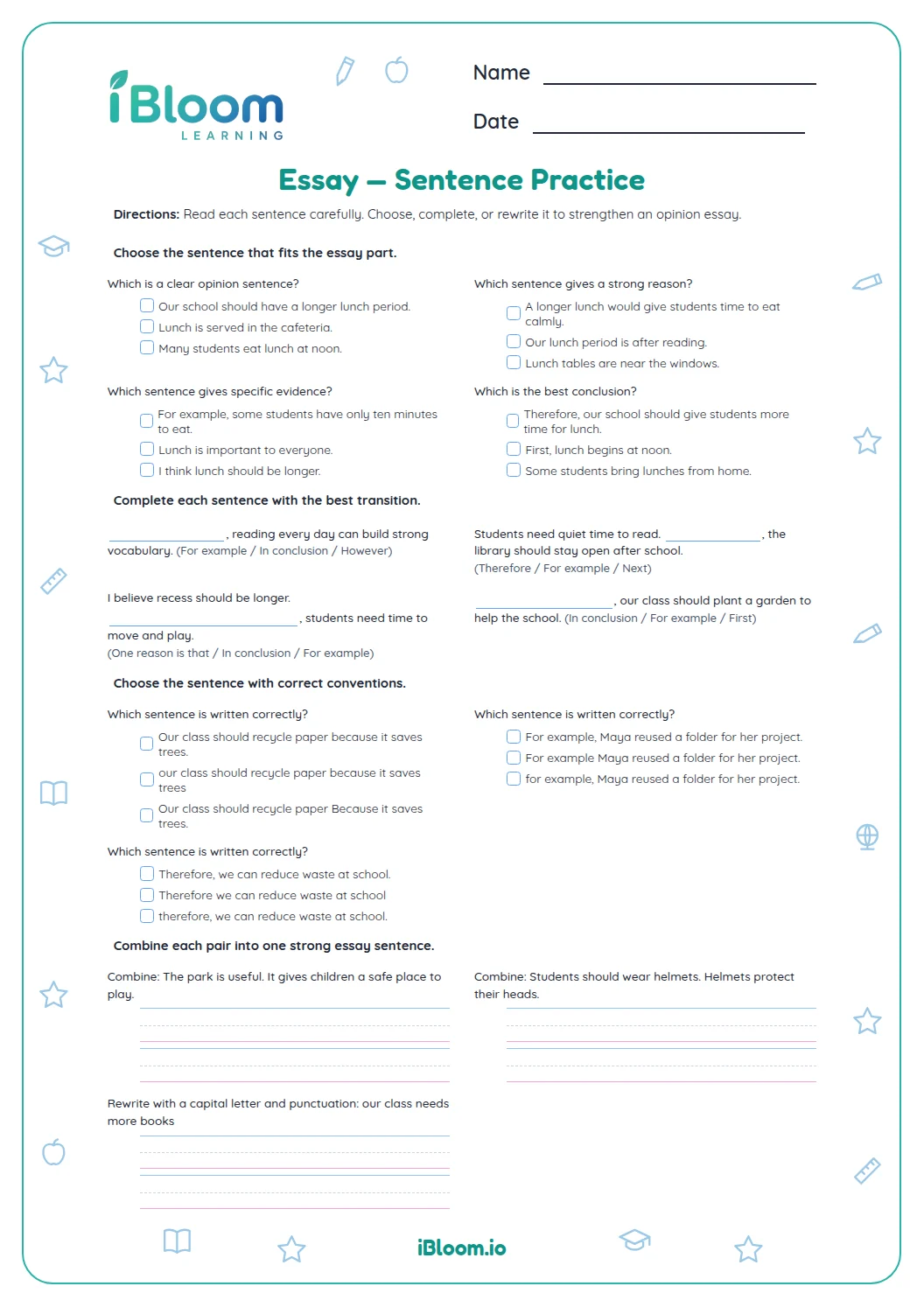
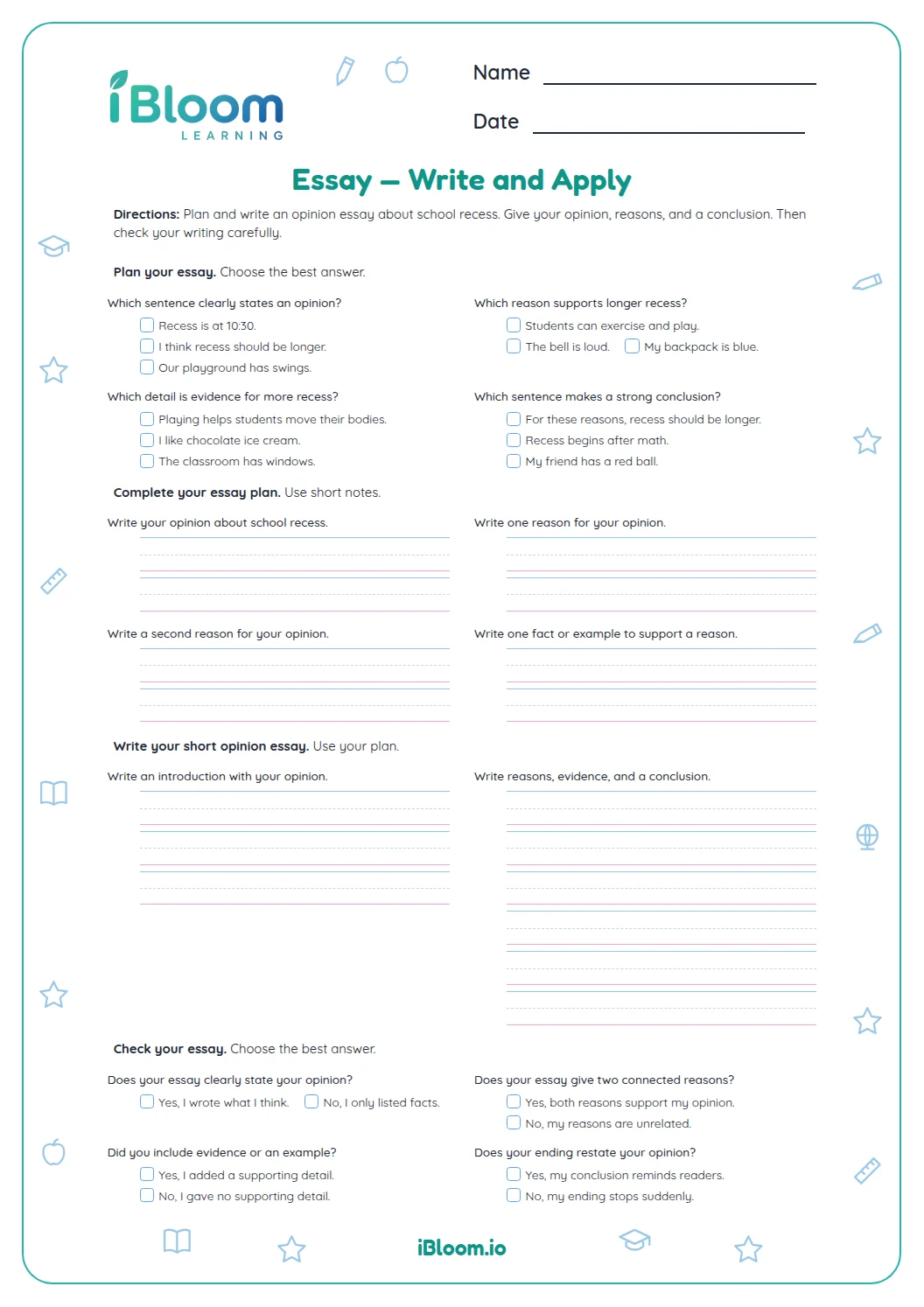
This free Grade 4 worksheet helps students recognize how an opinion essay is built. Across 14 short examples, students identify claims, reasons, evidence, explanations, linking phrases, counterarguments, responses, hooks, and conclusions. It practices CCSS W.4.1 by focusing on how a point of view is supported and organized; a separate answer key is included.
Aligned to W.4.1
What does a claim do?
A claim states the writer’s position. A reason gives a supporting why, while evidence adds a detail a reader can check. The first six items use short school and garden examples to distinguish those jobs.
- 1“Beans grew 12 inches in the class garden.” is evidence: it gives a measurable detail.
How does evidence support a reason?
Evidence gives a concrete example or result; an explanation tells how that detail supports the point. The worksheet also asks students to identify a linking phrase and distinguish a counterargument from a response. These roles help readers follow the writer’s thinking.
- 1“Students measured plant growth each Friday” is evidence. “This lets students compare changes over time” explains why the measurement matters.
How do the opening and ending guide a reader?
A hook draws interest, while a conclusion brings the opinion and its reasons together. The last items identify these roles and notice when a transition such as “However” signals a different viewpoint.
How to use this worksheet
- 1Read each example as a complete thought before naming its role.
- 2Ask whether the sentence states a position, gives a why, or supplies a checkable detail.
- 3For explanations, look for language that connects a detail back to the point.
- 4In Part C, decide whether the sentence opens, responds to another view, or wraps up.
- 5Check the key and explain which words led you to each label.
Common mistakes and quick fixes
The mistake
Calling a measurable detail a reason.
The fix
Ask whether it says why the writer believes the claim or gives information that supports a reason.
The mistake
Mixing up evidence and explanation.
The fix
Evidence reports what happened; an explanation says what that detail helps the reader understand.
The mistake
Treating a counterargument and response as the same viewpoint.
The fix
A counterargument presents another view; the response answers it.
Curriculum alignment
This worksheet practices the following Common Core skill.
Write opinion pieces supported by reasons and information.
On this sheet: The worksheet asks students to identify claims, reasons, supporting evidence, transitions and conclusions.
Show the official wordingHide the official wording
Write opinion pieces on topics or texts, supporting a point of view with reasons and information.
What to practice next
Make more practice
Further reading
Questions parents and teachers ask
What is an opinion essay claim?
A claim is the writer’s position on a topic. In this worksheet, “School should start later because students need sleep” states a claim and gives a reason. Students compare similar short examples to recognize the position and the support around it.
What is the difference between a reason and evidence?
A reason tells why someone supports a claim. Evidence supplies a concrete fact or example that supports the reason. “Recess gives students time to move” is a reason; a measured result or observed detail can serve as evidence in an essay.
How is an explanation different from evidence?
Evidence gives a specific detail, such as students measuring plant growth each Friday. An explanation connects that detail to the writer’s point, as in “This lets students compare changes over time.” The worksheet asks students to identify each role in short examples.
What is a counterargument?
A counterargument states a different view from the writer’s claim. A response answers that view and brings the reader back to the writer’s position. Questions 9 and 10 pair those roles so students can see how they work together in context.
How many questions are included?
The worksheet has 14 questions in three parts. Students identify parts of an opinion essay, connect reasons with supporting details, and recognize how an essay is organized. The two-page printable has a separate two-page answer key with answers for all items.
Can students use this before writing an opinion essay?
Yes. Recognizing what a claim, reason, evidence, explanation, and conclusion do gives students language for planning their own writing. After the page, ask the student to write one claim and add a reason with a concrete supporting detail in class or at home.