




About this worksheet
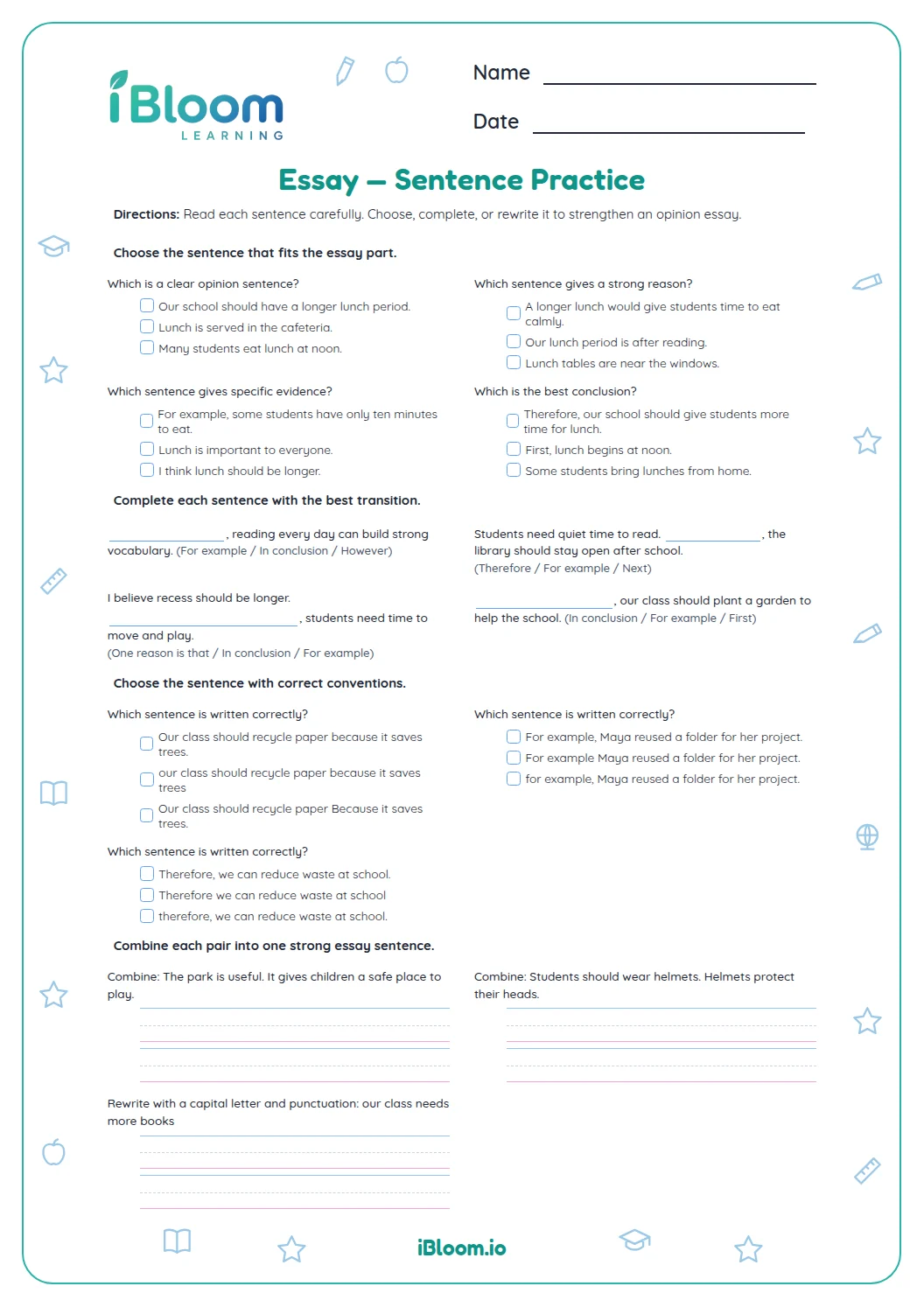
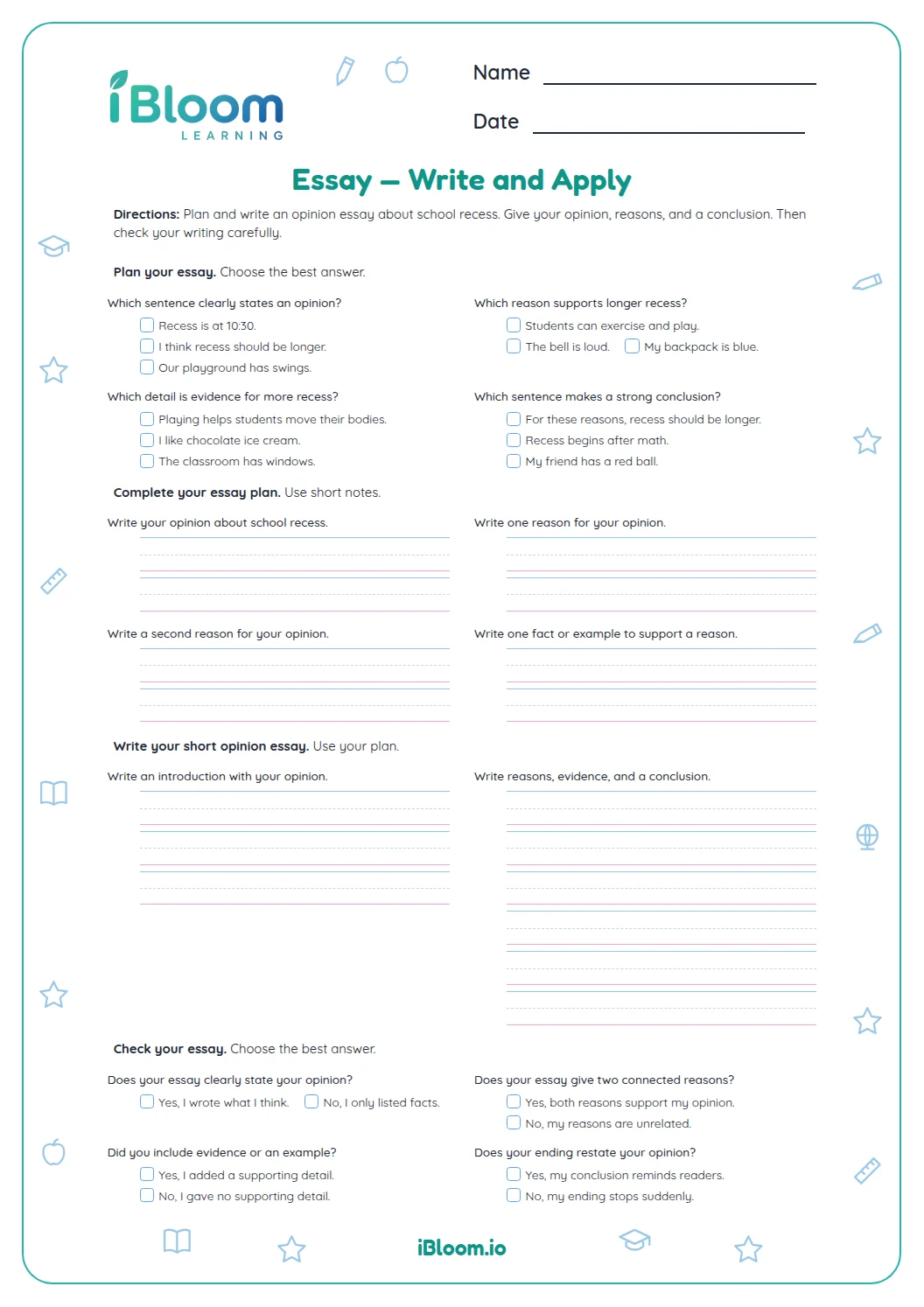
This Grade 4 opinion-writing worksheet helps students recognize and complete parts of an opinion essay. The 15 questions move from naming an opinion, reason, detail, and conclusion to supplying words that make reasons and evidence clearer. Later prompts apply those parts to school and community topics. The sheet has two printable pages and a separate answer key. It connects to CCSS W.4.1 through its practice with opinions supported by reasons and information.
Aligned to W.4.1
Which essay parts do students review?
Part A reviews the building blocks of an opinion essay: an opinion states what the writer believes, a reason explains why, a detail gives support, and a conclusion reminds readers of the opinion. The questions use these terms in short sentences.
- 1“Our class needs a reading corner” states what the writer believes, so it is an opinion.
How do reasons and details support a claim?
A reason tells why a writer holds an opinion. A detail or example makes that reason more specific. In the reading-corner sentence, a quiet place to read gives a practical reason for the suggestion.
- 1“Students need a quiet place to ___ in a reading corner.” → read
How can a writer signal a conclusion?
Phrases such as “For these reasons” and “In the end” help signal that the writer is wrapping up. The final section asks students to complete conclusion phrases and connect ideas in a logical order.
How can students apply the parts after finishing?
Ask the student to turn one completed idea into a short opinion: state a school improvement, give a reason, and add a concrete detail. That extension uses the same building blocks practiced in the worksheet.
How to use this worksheet
- 1Read the full sentence before filling a blank.
- 2Decide whether it names a belief, explains why, gives support, or wraps up.
- 3Use the surrounding words to select the word that completes the idea.
- 4Reread the sentence with the answer in place.
- 5Check the key, then explain how one reason supports an opinion.
Common mistakes and quick fixes
The mistake
Mixing up an opinion and a reason.
The fix
Ask whether the sentence tells what the writer believes or why the writer believes it.
The mistake
Using a detail that does not support the reason.
The fix
Check that the example gives information about the stated reason.
The mistake
Treating a conclusion as a new reason.
The fix
Use the conclusion to return to the opinion and bring the essay to a close.
Common Core alignment
This practice connects the reading and writing work on the page to the named grade-level standard.
State an opinion and support it with reasons and information.
On this sheet: The questions ask students to practice this skill directly.
Show the official wordingHide the official wording
Write opinion pieces on topics or texts, supporting a point of view with reasons and information.
What to practice next
Make more practice
Further reading
Questions parents and teachers ask
What is the difference between an opinion and a reason?
An opinion states what a writer believes, while a reason explains why the writer believes it. “Our class needs a reading corner” gives an opinion. A quiet place to read explains one reason that could support that opinion.
How does a detail help support an opinion?
A detail gives a concrete example or information connected to a reason. For instance, saying students can measure plant growth each week supports the idea that a class garden can help students learn science. The detail should make the reason clearer.
What does a conclusion do in an opinion essay?
A conclusion reminds readers of the writer’s opinion and brings the piece to a close. Signal phrases such as “For these reasons” and “In the end” can help show that the writer is wrapping up rather than starting a new point.
How many questions are on the worksheet?
There are 15 questions across three parts: 14 short fill-ins about opinion parts, reasons, details, and conclusions, plus one choice about supporting a claim. The two-page worksheet has a separate answer key with the requested responses. Students can compare their chosen detail with the reason it supports.
What can a student write after completing the sheet?
Choose one suggestion from the worksheet, such as adding shade at recess. Write the opinion, add a reason for it, and include a specific detail. This gives the student a chance to use the same parts together in a short argument.