

About this worksheet
This Grade 4 worksheet builds confidence with opinion writing through recognition, revision, and brief composition. Students distinguish opinions from facts, match a point of view with relevant reasons, strengthen a weak reason, and write focused responses of their own. The practice supports Common Core W.4.1 by asking students to support a point of view with reasons and information.
Aligned to W.4.1
How can you spot an opinion?
An opinion tells what a writer thinks or prefers. A fact can be checked, such as the number of tables in a library. A writer can use facts as support for an opinion.
- 1“The library has 12 tables” can be checked, so it is a fact.
- 2“The library is the nicest room” expresses a judgment, so it is an opinion.
What makes a reason useful?
A reason explains why the writer holds an opinion. It should connect directly to the point of view. “A garden lets us study plants” supports a class garden more clearly than “gardens are good.”
A specific example or fact can make a reason more convincing. Questions 2, 6, and 8 ask students to notice relevant support.
How can students build a short response?
Start with an opinion sentence. Add one or more reasons, examples, or facts that explain the view. Finish by restating the point in a fresh way when the task asks for a closing.
The writing questions accept different ideas; the key supplies models that show a clear opinion and connected support.
How can you use this worksheet?
- 1Read the goal in each question before scanning the choices.
- 2Ask whether a statement can be checked or expresses a view.
- 3For a reason, check that it answers “why?” about the opinion.
- 4In written responses, state the opinion first.
- 5Add a reason or specific information that connects to it.
- 6Use the model answers as examples, not the only acceptable wording.
What mistakes should learners watch for?
The mistake
Choosing a true fact when asked for an opinion.
The fix
Ask whether the sentence can be checked or whether it tells what someone thinks.
The mistake
Adding a reason that does not explain the opinion.
The fix
Use “because” and make sure the words after it answer why.
The mistake
Repeating the opinion without giving support.
The fix
Add a reason, example, or fact that a reader can connect to the point of view.
Common Core alignment
This worksheet gives focused practice with the named skill.
Write opinions supported by reasons and information.
On this sheet: Students identify opinions and supporting reasons, then write an opinion with reasons or information.
Show the official wordingHide the official wording
Write opinion pieces on topics or texts, supporting a point of view with reasons and information.
What to practice next
Make more practice
Further reading
Questions parents and teachers ask
What skills does this mixed review practice?
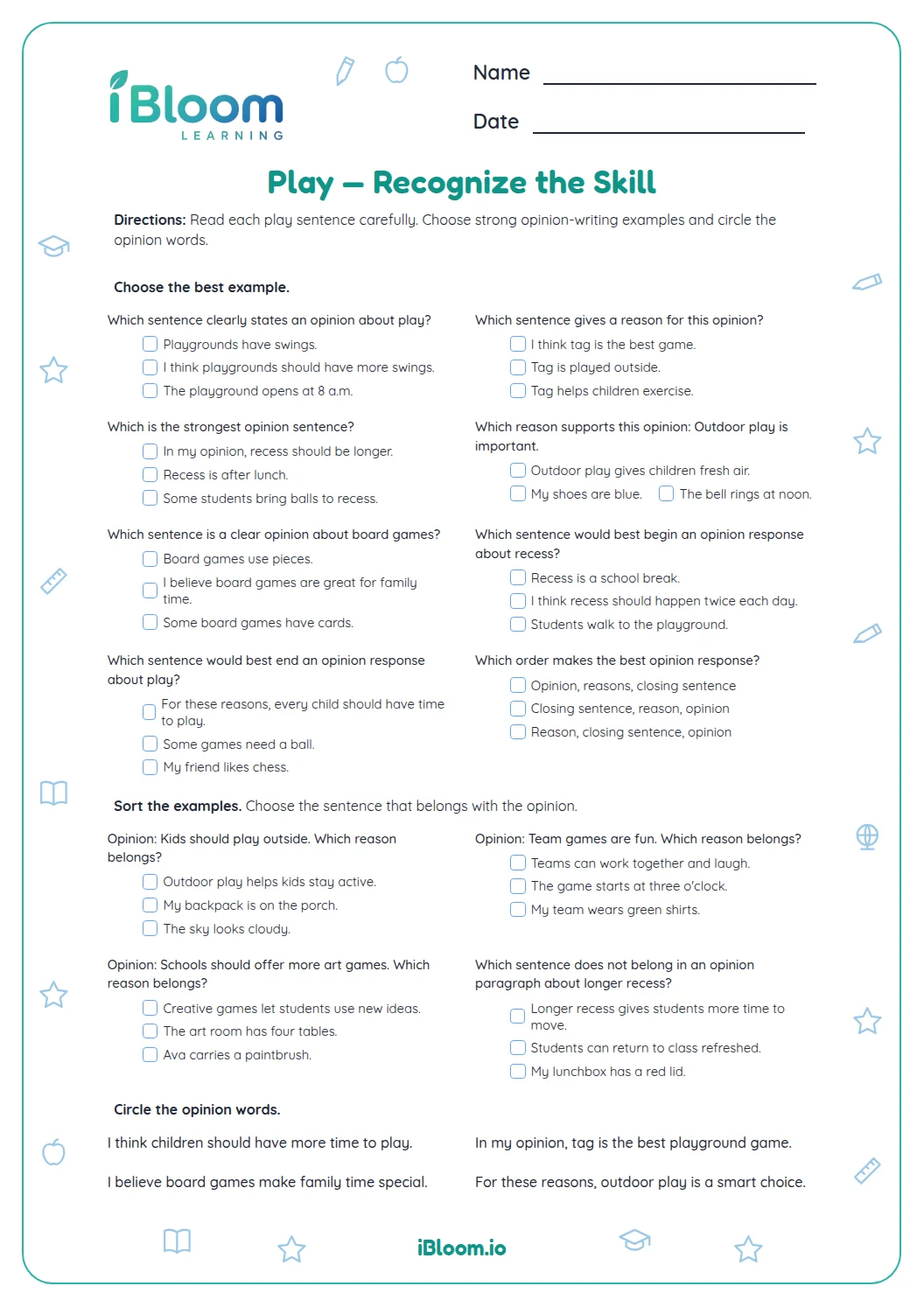
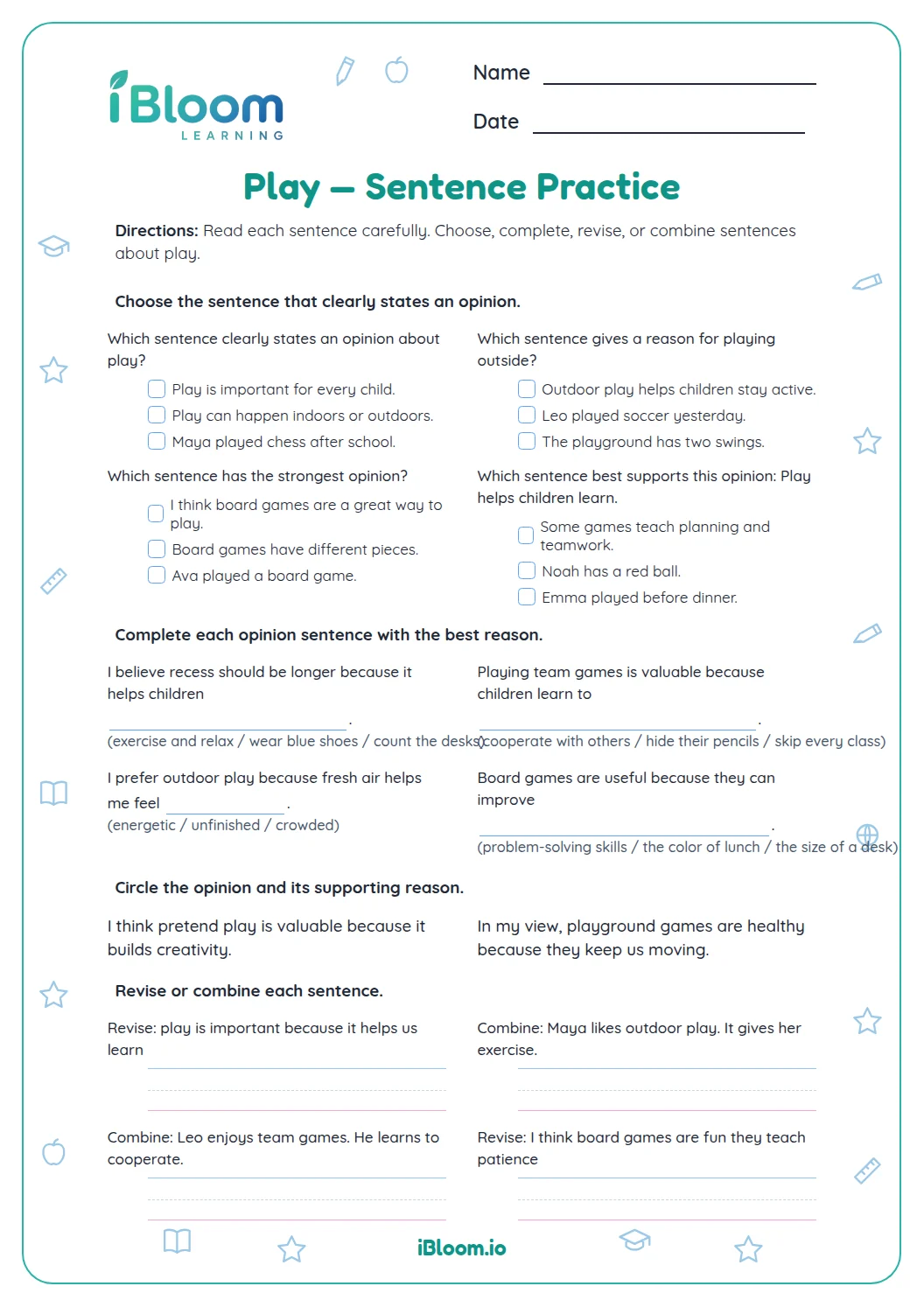
There are thirteen questions: eight multiple-choice items, three written responses, and two short-answer items. Students identify opinions and relevant support, then write short responses of their own. The key lists the choices and gives sample wording for open responses.
How many questions are included?
An opinion expresses a point of view, such as “I prefer outdoor reading.” A fact can be checked, such as the number of tables in a library. Writers can use facts as information that supports an opinion, as the library question demonstrates.
What is the difference between an opinion and a fact?
A strong reason explains why the writer holds the opinion and stays connected to the topic. Saying a garden lets students observe plant growth supports adding a class garden; saying it is “good” does not explain why the writer favors it.
What makes a reason strong?
Yes. One prompt names a weekly game choice, while another lets students choose a school improvement they care about. The key’s samples model clear opinions and related support, but other responses are appropriate when the reason or example fits the writer’s view.
Can students choose different topics for the writing prompts?
The multiple-choice items focus on identifying an opinion, choosing related support, and improving a weak reason or ending. The written prompts ask students to apply those moves in their own words. The answer key offers models rather than limiting students to one opinion.