
About this worksheet
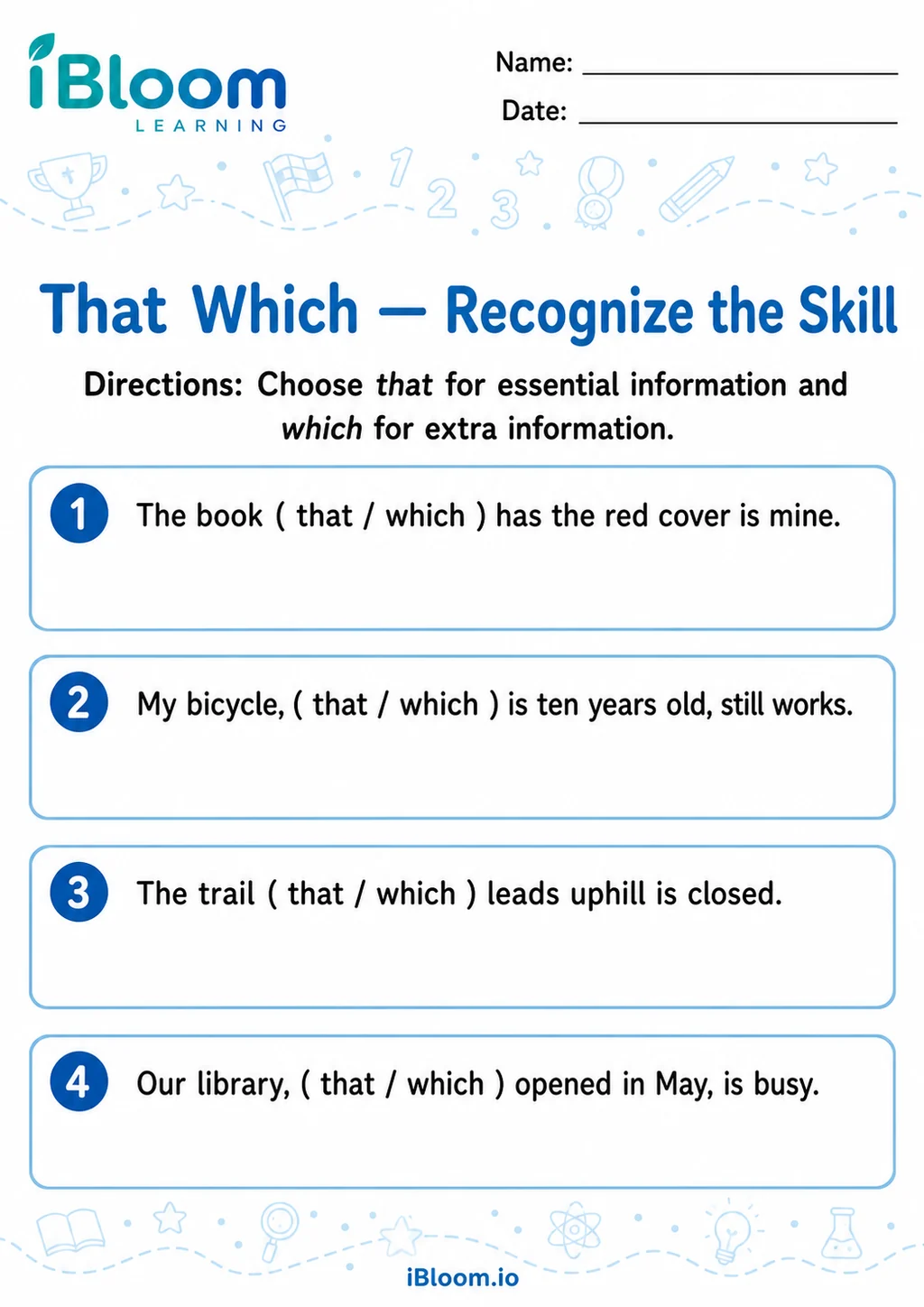
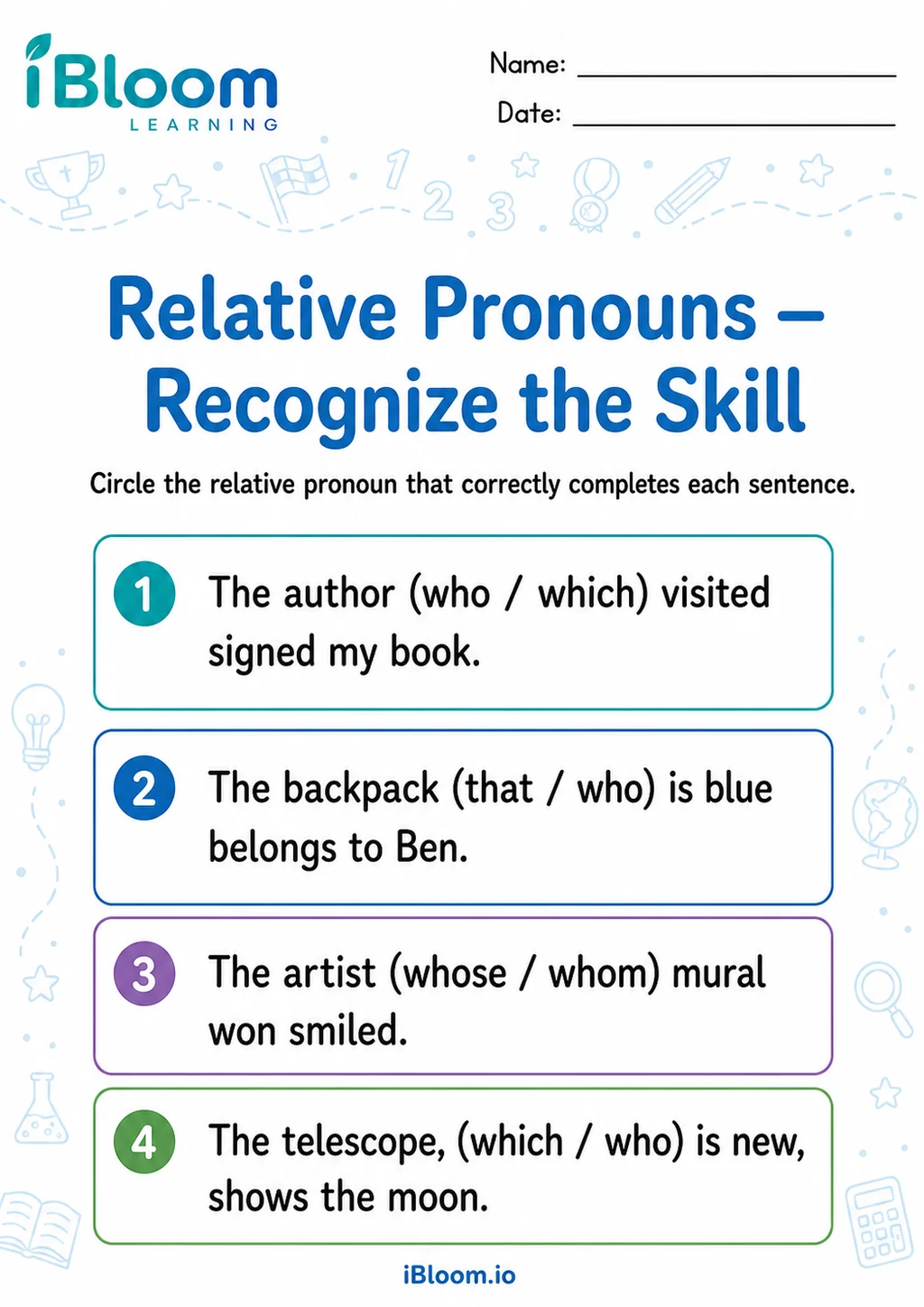
This Grade 4 grammar worksheet practices the relative pronouns that and which, supporting CCSS L.4.1.a. Children choose a pronoun in sentences, notice how commas mark extra information, complete clauses, and write their own examples. The 14 questions are grouped into three parts across two worksheet pages, with a separate two-page key that models the open responses. The activities build on the old sheet’s focus on essential clauses with that and extra-detail clauses with which.
Aligned to L.4.1.a
How do that and which work in a sentence?
Part A contrasts clauses that identify which person or thing is meant with clauses that add a side detail. The worksheet uses that for essential information and which for extra detail set off by commas. The standard reference is CCSS L.4.1.a.
In “The shoes that fit well are by the door,” the clause identifies which shoes. In “Our class pet, which is a rabbit, likes carrots,” the commas enclose an added detail.
How can you choose the right relative pronoun?
First ask whether the clause is needed to identify the noun. If it is, choose that. If it adds extra information and can be lifted out without changing which noun is meant, use which and set the clause off with commas.
- 1The book, ___ has a blue cover, is mine.
- 2The clause adds a detail, so use which: The book, which has a blue cover, is mine.
What will children write on the worksheet?
Part B completes five clauses with that or which. In Part C, children write essential and extra-detail clauses of their own. The key gives sample sentences; a different sentence is correct when it follows the requested clause pattern and punctuation.
How to use this worksheet
- 1Read the whole sentence and identify the noun described by the clause.
- 2Ask whether the clause identifies the noun or adds a side detail.
- 3Use that for essential information and which for extra detail.
- 4Check that commas enclose the extra-detail clause.
- 5Write complete sentences for Part C and compare them with the sample answers.
Common slips and quick fixes
The mistake
Adding commas around an essential that clause.
The fix
Keep the identifying clause with the noun: “The shoes that fit are here.”
The mistake
Leaving commas out around an extra-detail which clause.
The fix
Set off the added information: “The shoes, which are new, fit well.”
The mistake
Using a clause that does not clearly describe a noun.
The fix
Place the clause beside the noun it describes and reread the sentence.
Common Core alignment
Use relative pronouns that and which to connect clauses.
On this sheet: The practice items select and apply that and which as relative pronouns.
Show the official wordingHide the official wording
Use relative pronouns (who, whose, whom, which, that) and relative adverbs (where, when, why).
What to practice next
Make more practice
Further reading
Questions parents and teachers ask
What is an essential clause?
An essential clause gives information needed to identify the noun. In “The kite that flew highest won,” the clause tells which kite won, so it is not set off with commas. Part A asks students to recognize this use of that.
Why does which have commas around it here?
In this worksheet, which introduces extra information that is not needed to identify the noun. Commas mark the beginning and end of that added detail, as in “The book, which has a blue cover, is mine.” The commas show that the clause can be removed without changing which book is meant.
How many questions are on the worksheet?
There are 14 questions in three parts: six choices, five clause blanks, and three sentence-writing prompts. The parts move from recognizing the pattern to completing and creating relative clauses. The worksheet moves from selected answers to independent use of the clause pattern.
Are sample answers included for the writing prompts?
Yes. The two-page answer key gives a sample for each open response. Children may write different sentences; accept a complete sentence that uses the requested essential or extra-detail clause and punctuates it correctly. For the open prompts, check both the clause meaning and the punctuation around it.
Which standard does the worksheet practice?
The page lists CCSS L.4.1.a, which includes using relative pronouns such as which and that. The questions ask children to choose, complete, and write clauses using those pronouns. The standard wording includes additional relative pronouns, while this page focuses on that and which.