
About this worksheet
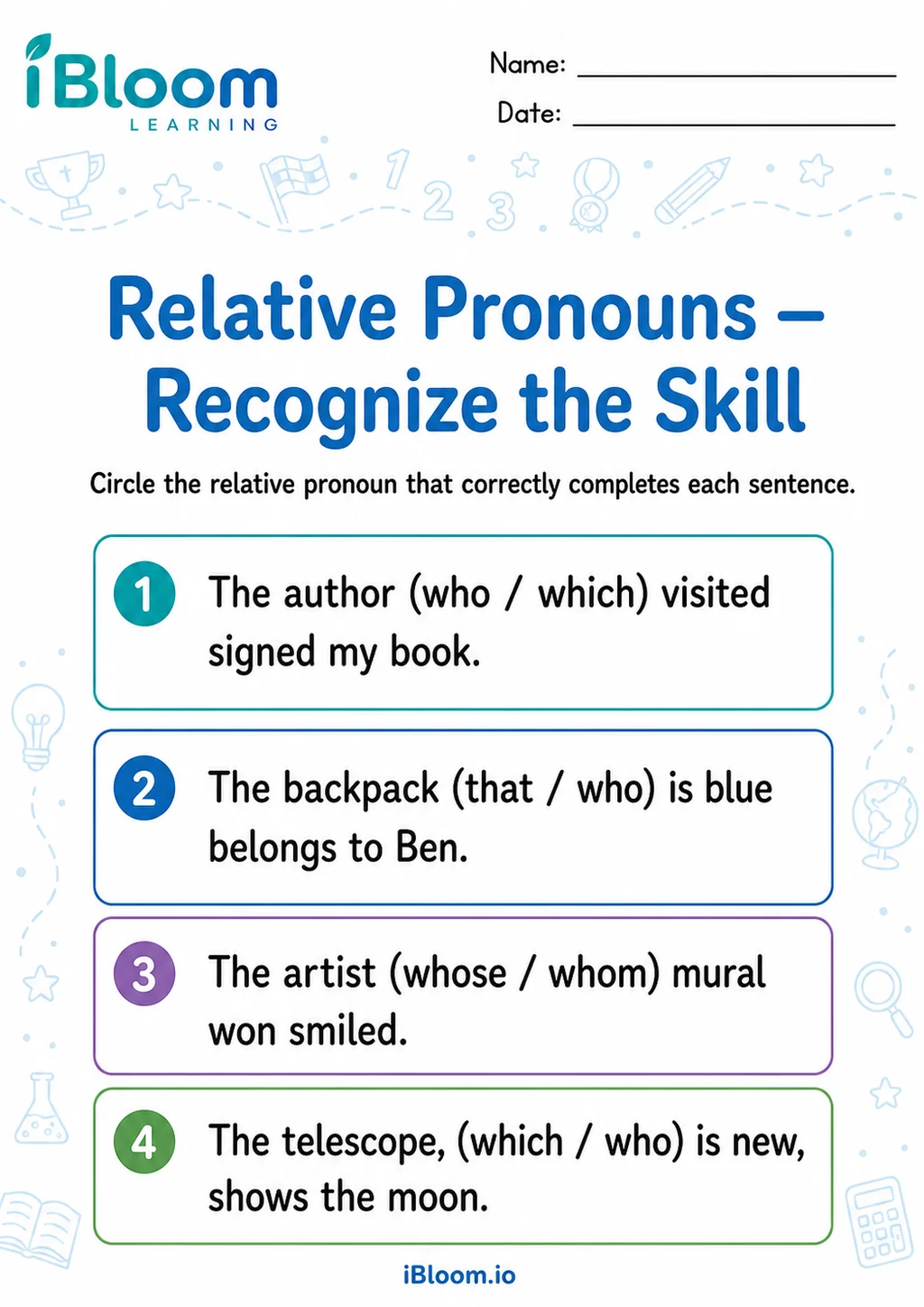
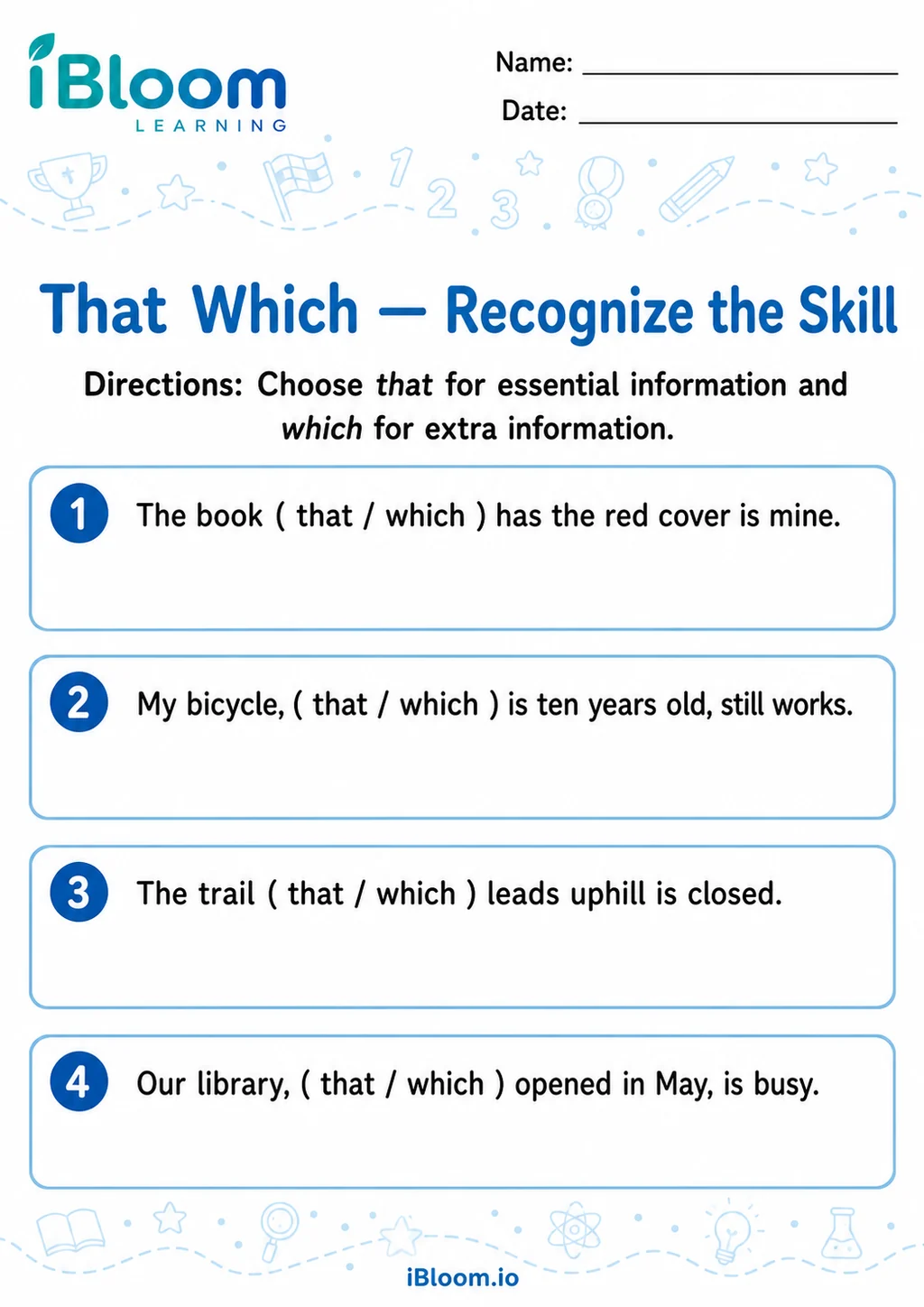
This free Grade 4 worksheet helps students choose who, whom, or whose and use the choice in their own writing. Part A gives eight sentences with missing relative pronouns: students distinguish the person doing an action, the object of a preposition, and a person connected to a possession. Part B asks for one original sentence each with who, whose, and whom. It practices CCSS L.4.1a through relative pronouns in complete sentences. The separate answer key includes model responses for the three writing tasks.
Aligned to L.4.1a
What job does each pronoun do?
Who names the person performing the action in its clause. Whom is an object, as in “to whom” or “with whom.” Whose links a person to something that belongs to or is associated with that person.
Part A uses all three in relative clauses. Students choose only from who, whom, and whose, reading the words on both sides of the blank before deciding.
How can a child check a whom answer?
Turn the clause into a short sentence using he or him, or she or her. If the person receives the action or follows a preposition, the object form helps identify whom.
- 1The friend to ___ I sent a note lives nearby.
- 2I sent a note to him.
- 3Him is the object of to.
- 4The missing pronoun is whom.
What makes the three original sentences successful?
Questions 9–11 ask for a helper sentence with who, a classmate sentence with whose, and a friend sentence with to whom. Each pronoun must introduce a detail about the person, and each response needs a complete main thought.
For example, “The classmate whose kite flew highest smiled” contains both an ownership detail and a main action. The key gives models, but students can choose different people, objects, and actions.
How to use this worksheet
- 1Review who for a subject, whom for an object, and whose for possession.
- 2Read the first completion item together and identify who performs the action in the clause.
- 3Let the student finish Part A, checking prepositions such as to, with, and for.
- 4Ask the student to say each original sentence aloud before writing it in Part B.
- 5Check the eight fixed answers, then read the original sentences for the requested pronoun and a complete main thought.
Mistakes to check together
The mistake
Choosing whom in “the student ___ carried the books.”
The fix
The student performs carried in that clause, so choose who.
The mistake
Writing who’s before painting to show ownership.
The fix
Who’s means who is or who has. Whose shows that the painting belongs to the artist.
The mistake
Writing only “The helper who carried my bag.”
The fix
That is a noun with an added detail. Finish the main thought, such as “The helper who carried my bag waved.”
Common Core alignment
Choose and write relative pronouns that connect details to a person.
On this sheet: All eight completion items use relative pronouns, and all three writing tasks ask students to use them in original sentences.
Show the official wordingHide the official wording
Use relative pronouns (who, whose, whom, which, that) and relative adverbs (where, when, why).
What to practice next
Make more practice
Further reading
Questions parents and teachers ask
Are who, whom, and whose used as question words here?
The eight completion items use them as relative pronouns within statements. Each pronoun adds information about a person, such as the student who carried books or the artist whose painting won. The three original writing tasks ask students to use the same sentence pattern in their own words.
When should a child choose whom on this sheet?
Choose whom when it is the object of the preposition directly before the blank. This sheet includes to whom, with whom, and for whom. Rephrase the detail using him or her to check: “I sent a note to him” supports “the friend to whom I sent a note.”
How is whose different from who’s?
Whose shows possession, while who’s is a contraction of who is or who has. In “The artist whose painting won waved,” the painting is associated with the artist. Replacing whose with who is would break the sentence. Have the child try that substitution when checking an ownership answer.
Do the original sentences need to match the answer key?
No. The key gives sample sentences because students choose their own details. Write about a helper with who, a classmate and a possession with whose, and a friend with to whom. Check the requested pronoun’s job and whether each sentence expresses a complete thought.
Can I use the page as a short writing lesson?
Yes. Start with the eight completion items to compare the three pronoun jobs, then use the last three questions for original writing. Ask students to underline the detail introduced by who, whom, or whose. Finally, read each sentence without that detail to check that its main thought is complete.