




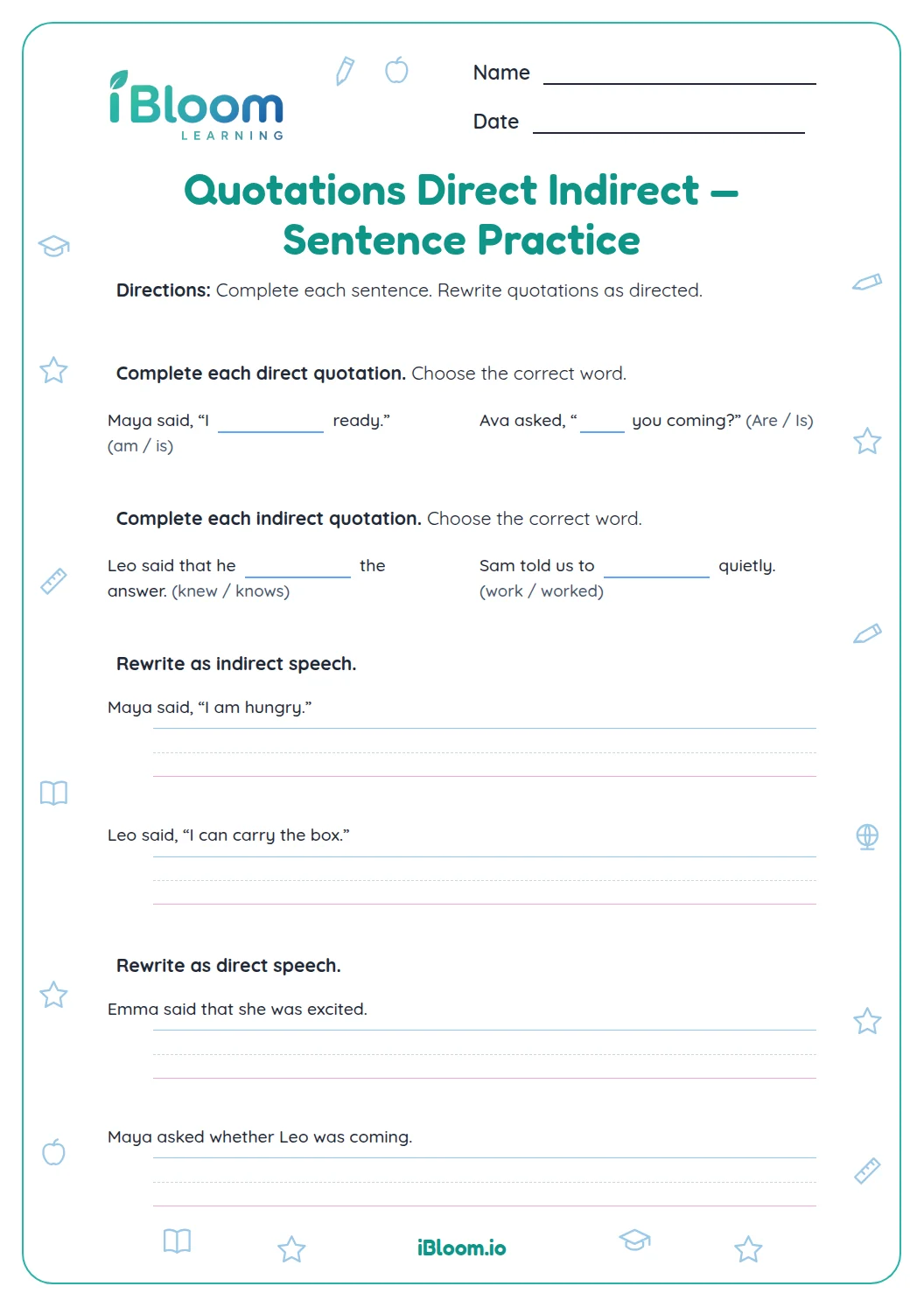
About this worksheet
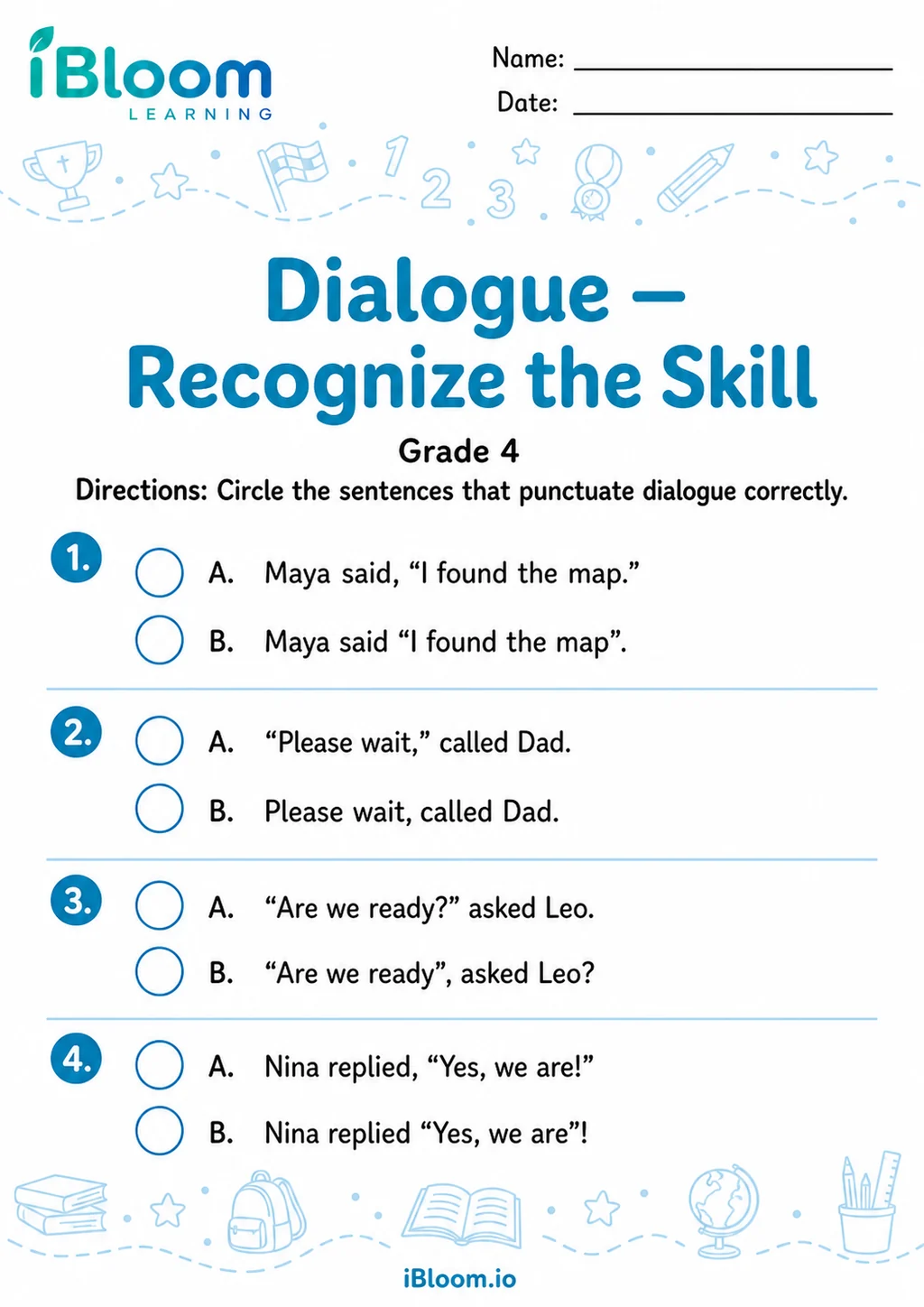
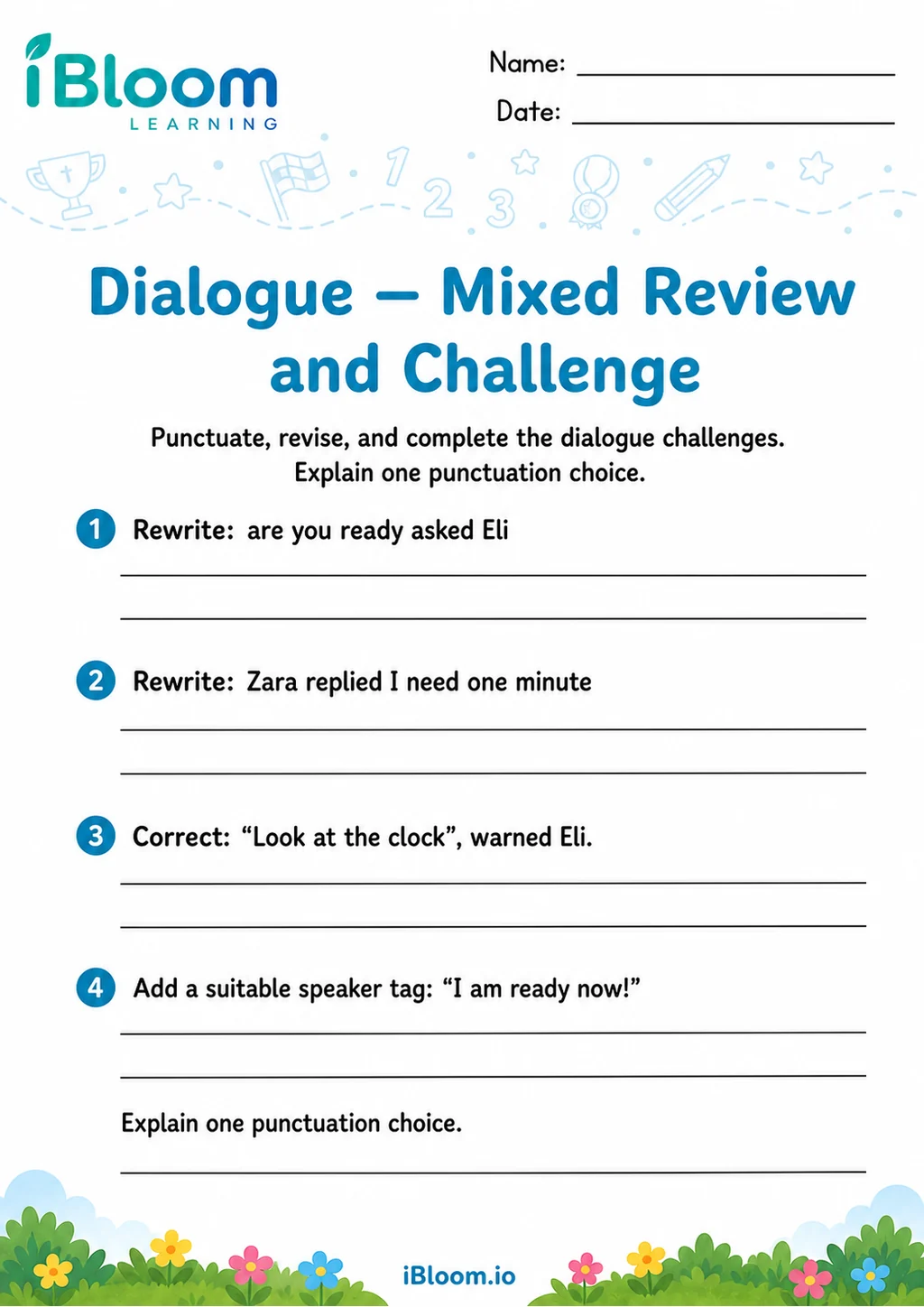
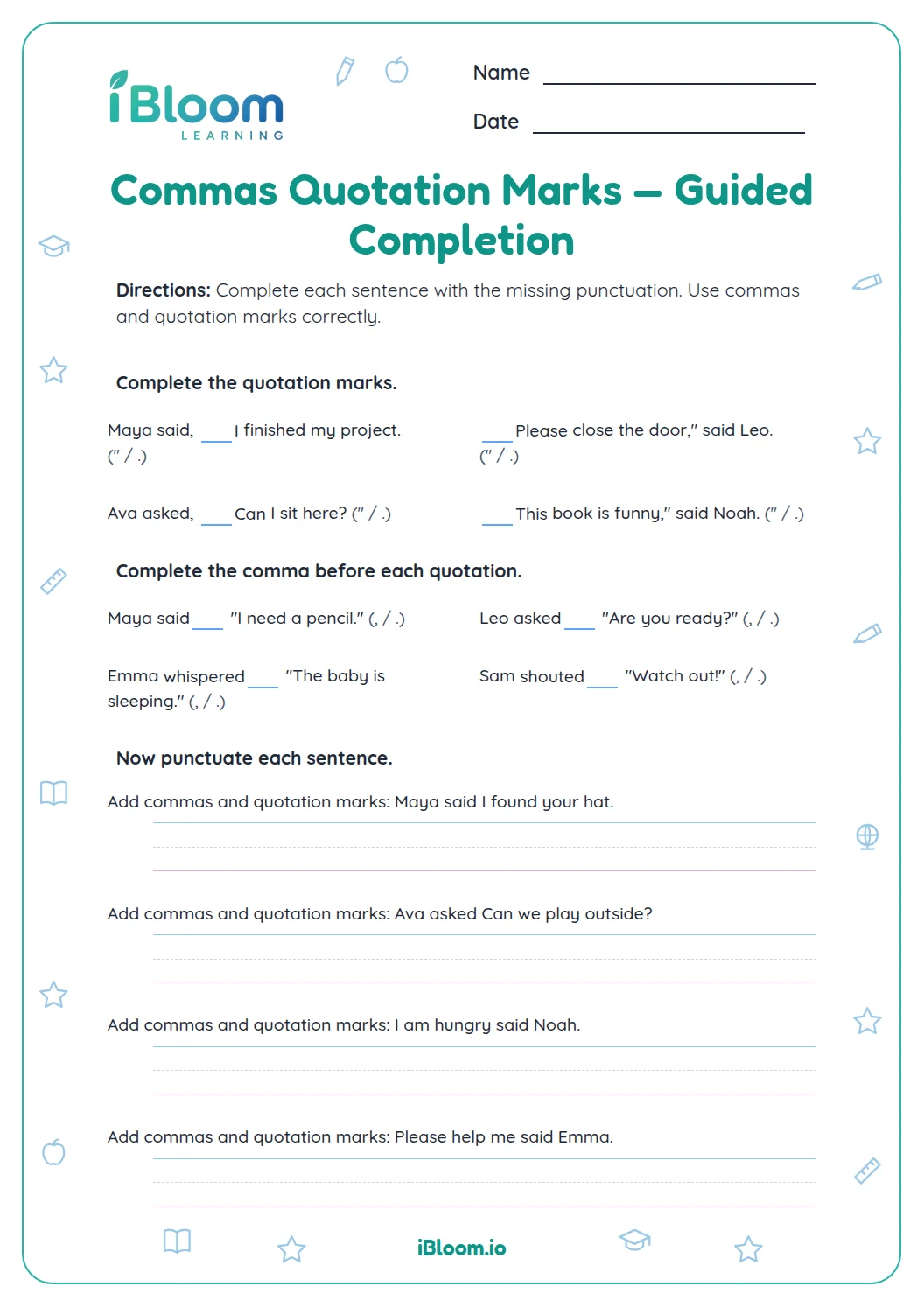
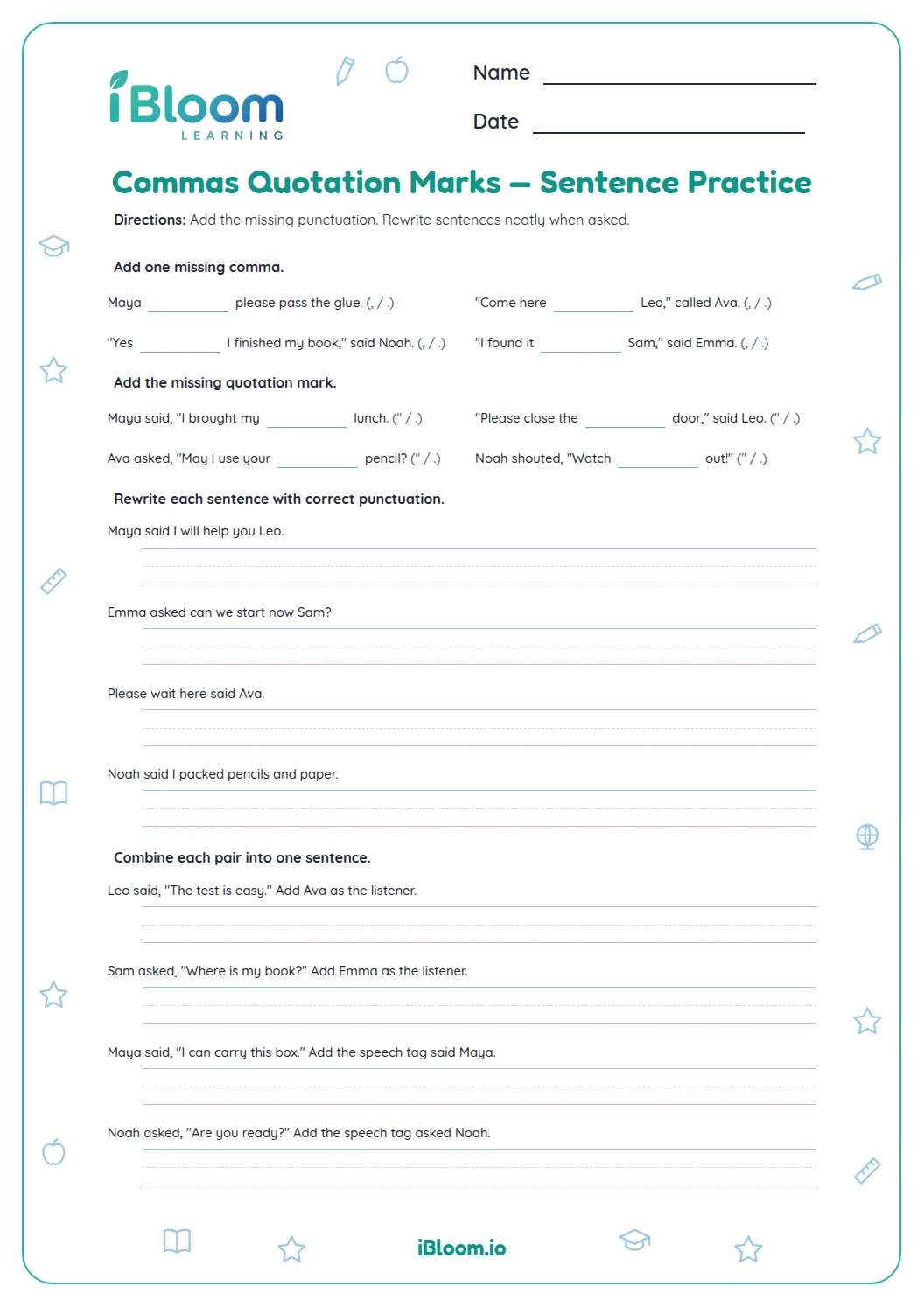
This Grade 4 worksheet builds dialogue punctuation through 14 short items. Students choose corrected versions of lines with tags before or after speech, statements, questions, and exclamations, then choose a corrected version of one line. The prompts use everyday settings and do not rely on the trail illustration in the old sheet. A separate answer key shows the correct punctuation.
Aligned to L.4.2b
Where do quotation marks and commas go?
Quotation marks go around the exact words a speaker says. When the tag follows a statement, place a comma inside the closing quotation mark: “We found the map,” said Jordan. When the tag comes first, place a comma after it: Jordan said, “We found the map.”
- 1Maya asked, “Where is the museum?”
Where does a question mark or exclamation point go?
A question mark or exclamation point goes inside the quotation marks when it belongs to the spoken words. The tag remains outside the quotation marks. The worksheet asks students to distinguish those marks from a comma or period.
What does this guided practice include?
The 14 items include 12 compact punctuation choices and two rewrites. They cover statements, questions, exclamations, and tags before or after dialogue.
How to use this worksheet
- 1Find the words spoken aloud and the speaker tag.
- 2Choose whether the tag comes before or after the quoted words.
- 3Check whether the spoken words are a statement, question, or exclamation.
- 4Place commas and end marks inside or outside quotation marks as needed.
- 5Rewrite the final lines, then compare each answer with the key.
Dialogue punctuation mistakes and fixes
The mistake
Putting the speaking tag inside quotation marks.
The fix
Use quotation marks only around the exact spoken words.
The mistake
Putting a comma outside the closing quotation mark before a tag.
The fix
For a statement followed by a tag, put the comma inside the quotation marks.
The mistake
Using a period for a spoken question.
The fix
Put the question mark inside the closing quotation mark when the words ask a question.
Common Core alignment
This page practices Grade 4 conventions for punctuating dialogue, including quotation marks and commas around direct speech.
Use commas and quotation marks to mark direct speech and quotations from a text.
On this sheet: The worksheet gives students guided practice applying this skill in context.
Show the official wordingHide the official wording
Use commas and quotation marks to mark direct speech and quotations from a text.
What to practice next
Make more practice
Further reading
Questions parents and teachers ask
Do quotation marks include the speaking tag?
No. Quotation marks surround only the words spoken aloud. The speaking tag tells who spoke or how the words were said. In “We found the map,” said Jordan, said Jordan stays outside the quotation marks. Students use this distinction in the choice items and final rewrites.
Where does punctuation go with a spoken question?
Put the question mark inside the closing quotation mark when the spoken words are a question. If the tag comes first, place a comma after the tag: Maya asked, “Where is the museum?” The worksheet includes questions in both tag positions.
How do I punctuate a tag after a statement?
Place a comma inside the closing quotation mark before a tag that follows a spoken statement: “We found the map,” said Jordan. Capitalize the first spoken word, but keep the tag lowercase unless it begins a new sentence. The sheet asks students to choose and write correct versions.
What if a speaker exclaims?
Use an exclamation point inside the quotation marks when it belongs to the spoken words, as in “Watch out!” shouted Kim. The tag remains outside. Students compare exclamation points with commas and periods in the dialogue choices, then apply the rule in the rewrite items.
How many questions are on the worksheet?
There are 14 items: 13 compact punctuation checks and one line to rewrite. Together they practice statements, questions, exclamations, and speaking tags before or after dialogue. The answer key gives the correct punctuation for each choice and a model rewrite.