



About this worksheet
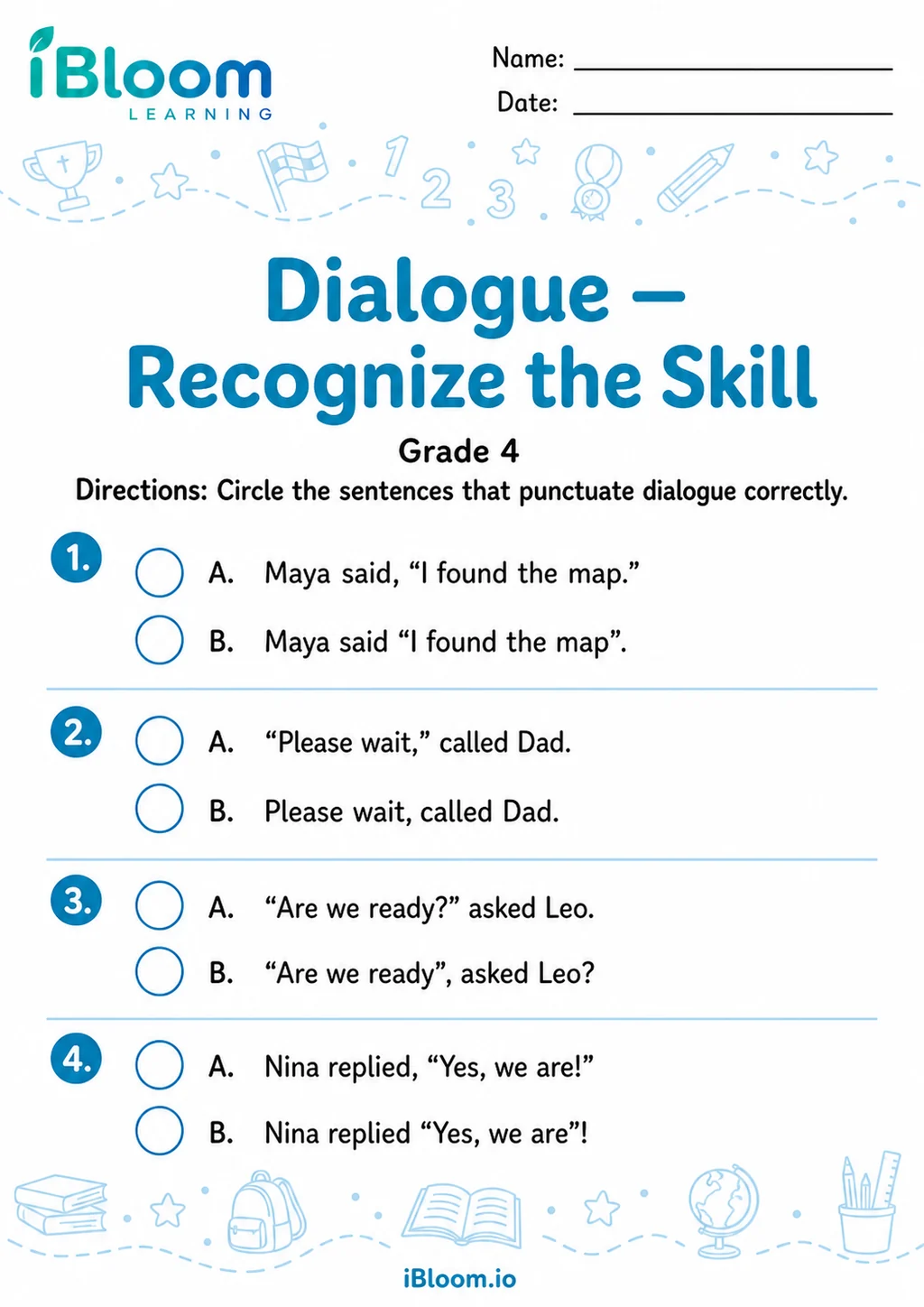
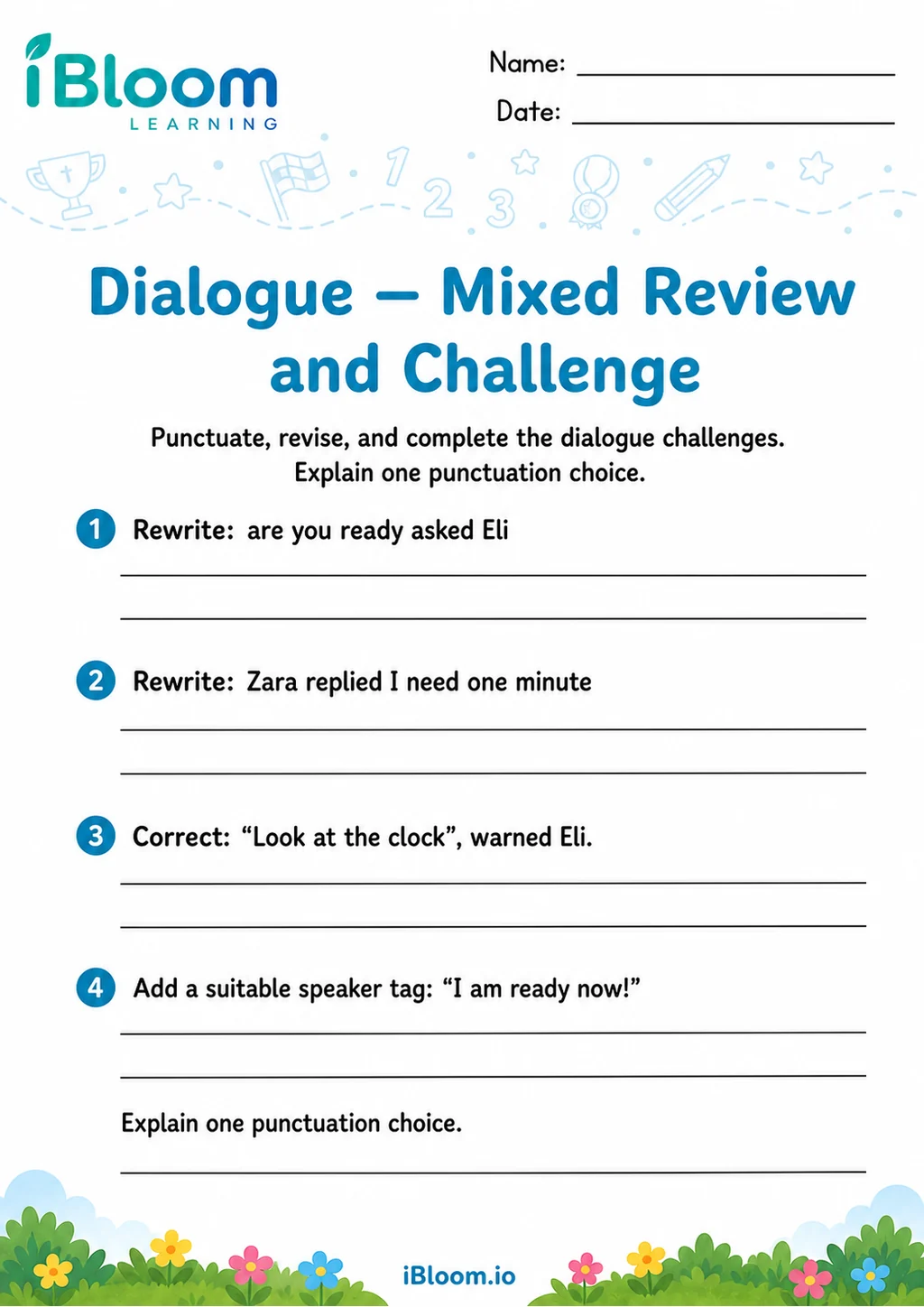
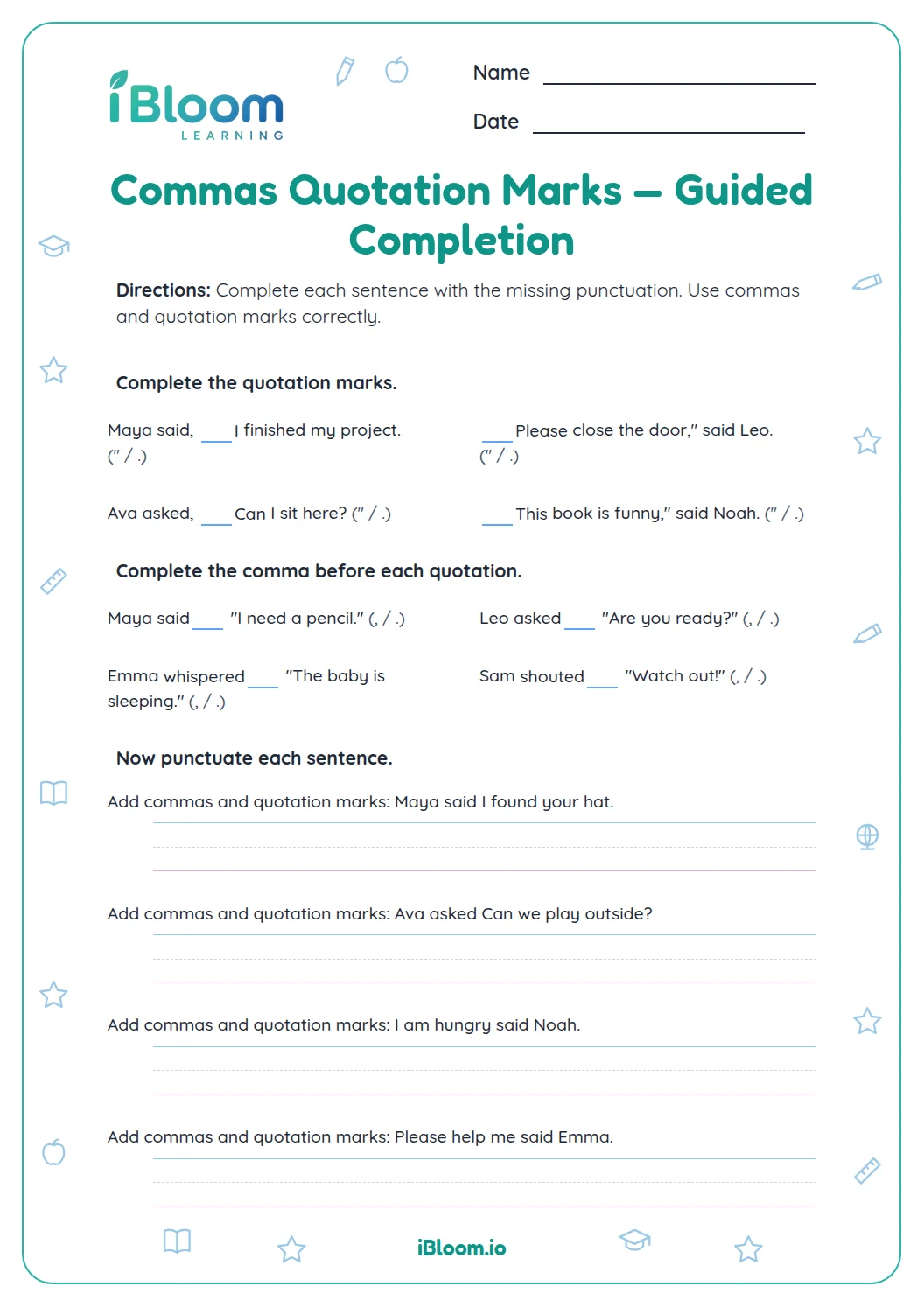
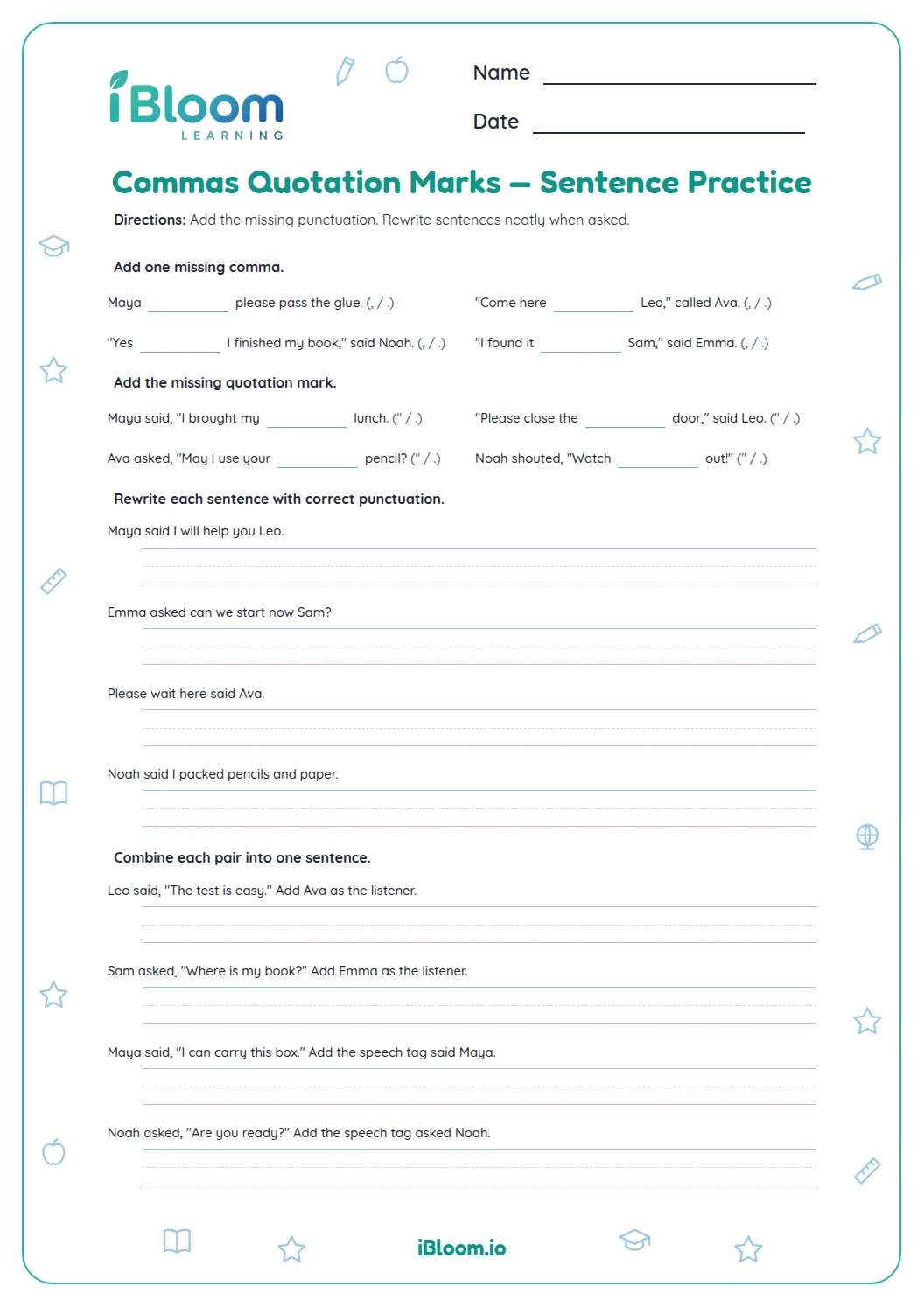
This Grade 4 dialogue worksheet gives students 14 spoken lines with speaker tags. They rewrite each line using quotation marks, commas where the tag introduces or follows the speech, and the correct period, question mark, or exclamation point inside the closing quotation mark. The examples include tags before, after, and between speech and speaker names. A separate answer key shows one correctly punctuated version of each line.
Aligned to L.4.2b
Where do quotation marks and commas go?
Put quotation marks around the exact spoken words. When a speaker tag comes first, place a comma before the opening quotation mark. When the tag follows, keep the question mark or exclamation point inside the quotation marks.
- 1Ben said | I packed the snacks. → Ben said, “I packed the snacks.”
How to use this worksheet
- 1Find the spoken words and the speaker tag.
- 2Put quotation marks around only the spoken words.
- 3If the tag comes first, add a comma before the quotation.
- 4Keep the spoken sentence’s period, question mark, or exclamation point inside the closing quote.
- 5Reread the complete sentence and check the key.
Common mistakes and quick fixes
The mistake
Leaving out quotation marks.
The fix
Put them around the spoken words.
The mistake
Putting a question mark after the quotation.
The fix
Keep it inside when the speech is a question.
The mistake
Forgetting the comma after an introductory tag.
The fix
Write “Ben said, ‘…’” with the comma before the quote.
Students mark direct speech with commas and quotation marks.
Use commas and quotation marks to punctuate the dialogue lines.
On this sheet:
Show the official wordingHide the official wording
Use commas and quotation marks to mark direct speech and quotations from a text.
What to practice next
Further reading
Questions parents and teachers ask
What punctuation does this worksheet practice?
Students add quotation marks and punctuation to direct speech. The lines include statements, questions, and exclamations, so students must keep the matching end mark with the spoken words inside the quotation marks. The spoken words change from line to line, so students practice more than one end mark.
Where does the comma go when a speaker tag comes first?
Place a comma after the introductory speaker tag and before the opening quotation mark. For example, write Ben said, “I packed the snacks.” The comma separates the tag from the dialogue that follows. The speaker tag is part of the sentence, but it does not belong inside the quotation marks.
Does the question mark go inside the quotation marks?
Yes. When the spoken words form a question, place the question mark before the closing quotation mark, as in “Did you bring water?” asked Priya. The mark belongs to the spoken question. The spoken words are the question here, so the question mark stays inside their quotation marks.
How many lines are included?
The worksheet has 14 dialogue lines. Speaker tags appear before or after the spoken words, and students rewrite each complete sentence with quotation marks, commas where needed, and the correct end punctuation. Students should copy the whole line, including the speaker, rather than punctuation alone.
Is an answer key included?
Yes. The separate key provides a correctly punctuated version of every line. Some dialogue can be punctuated with the speaker tag in a different position, but the key gives one clear model for each prompt. Use the answer key to check the comma, quotation marks, and end punctuation together.