








About this worksheet
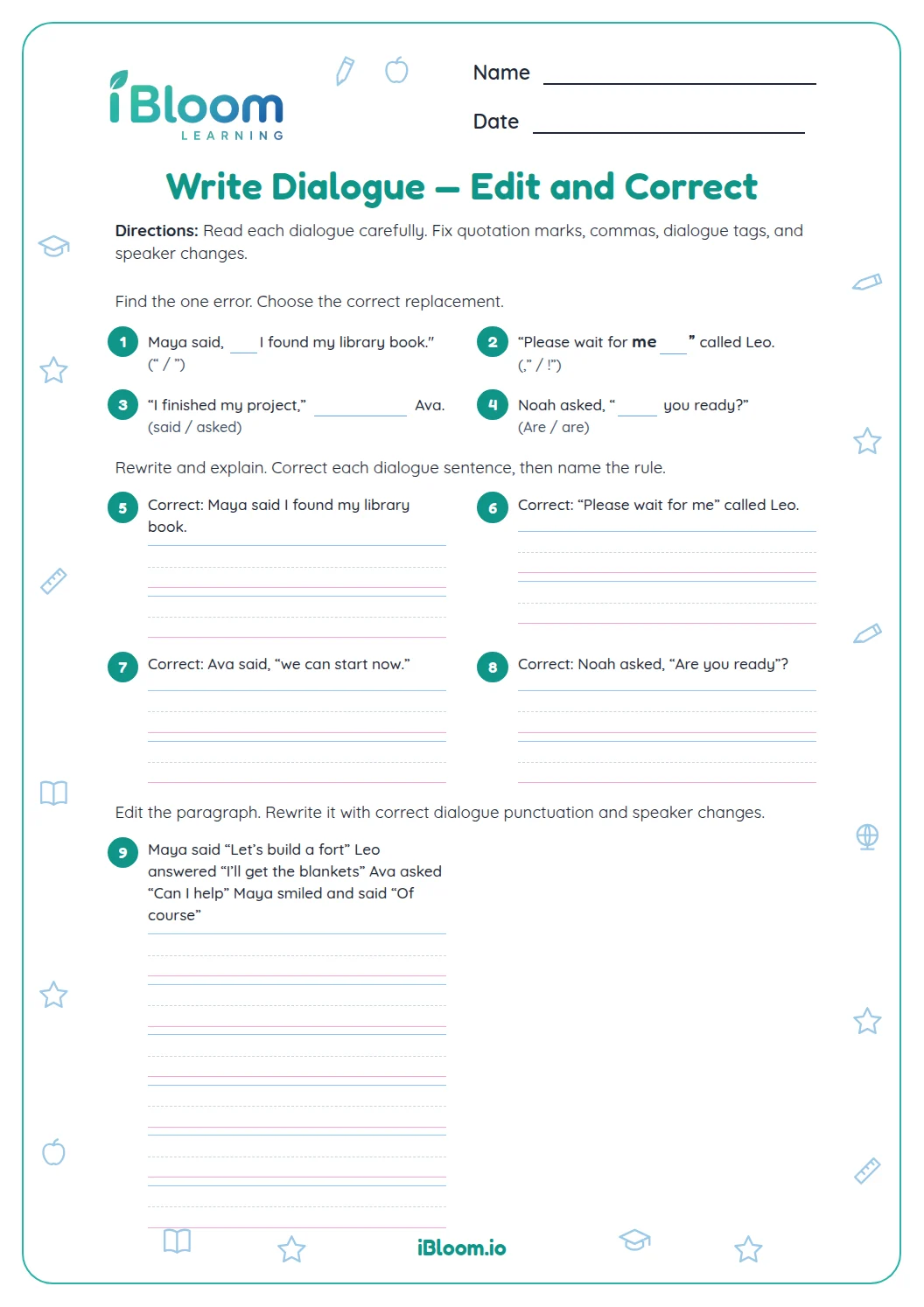
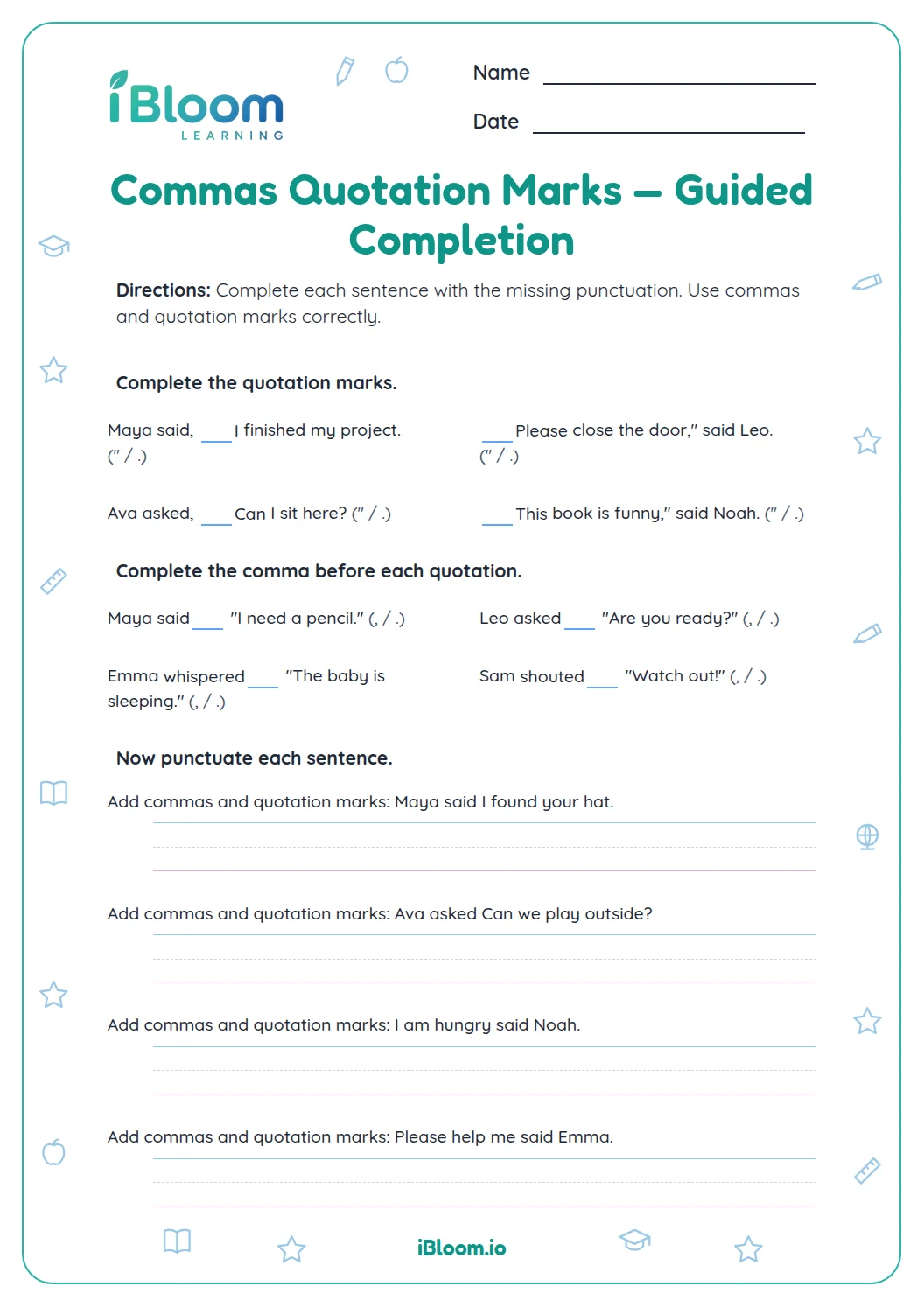
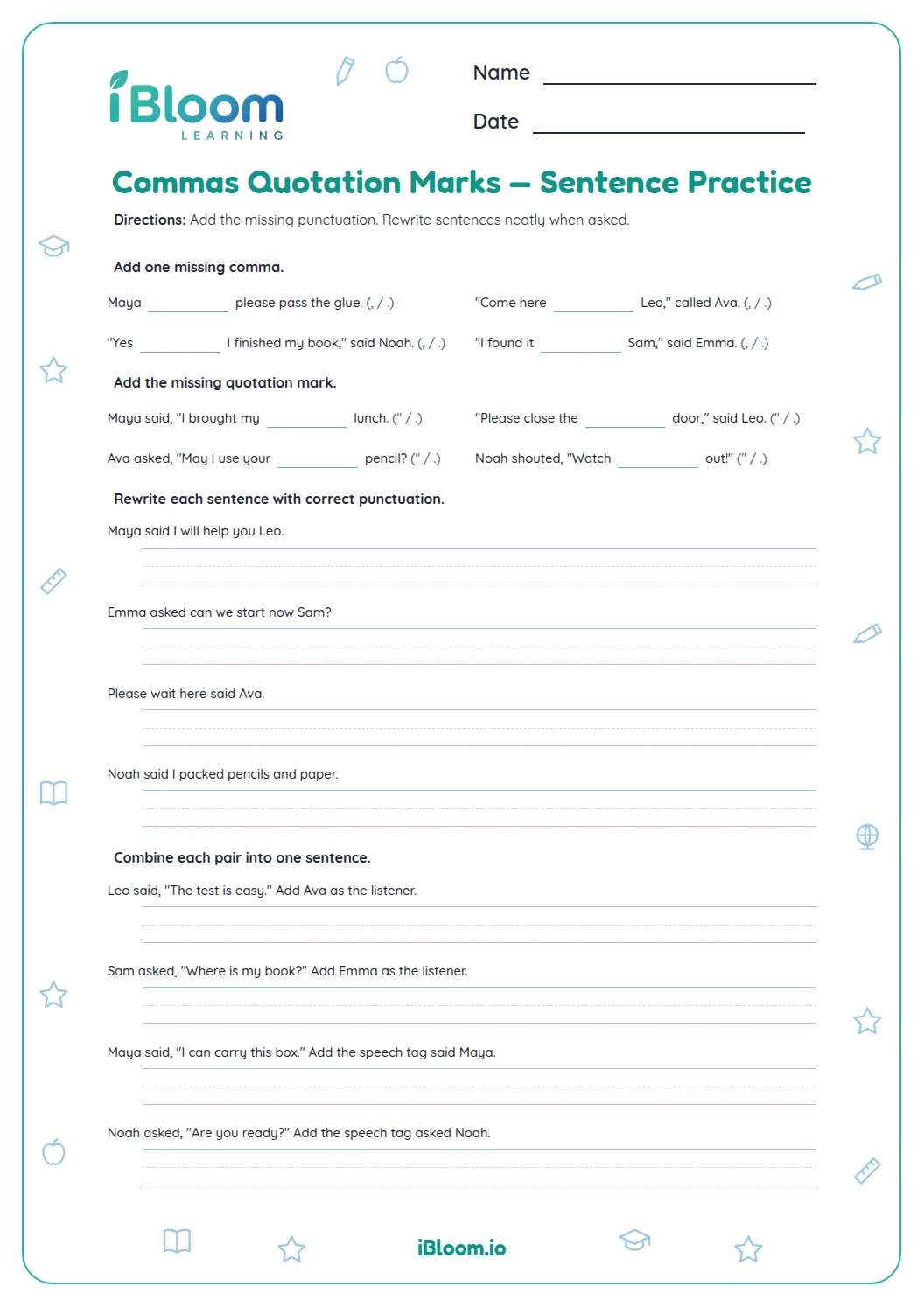
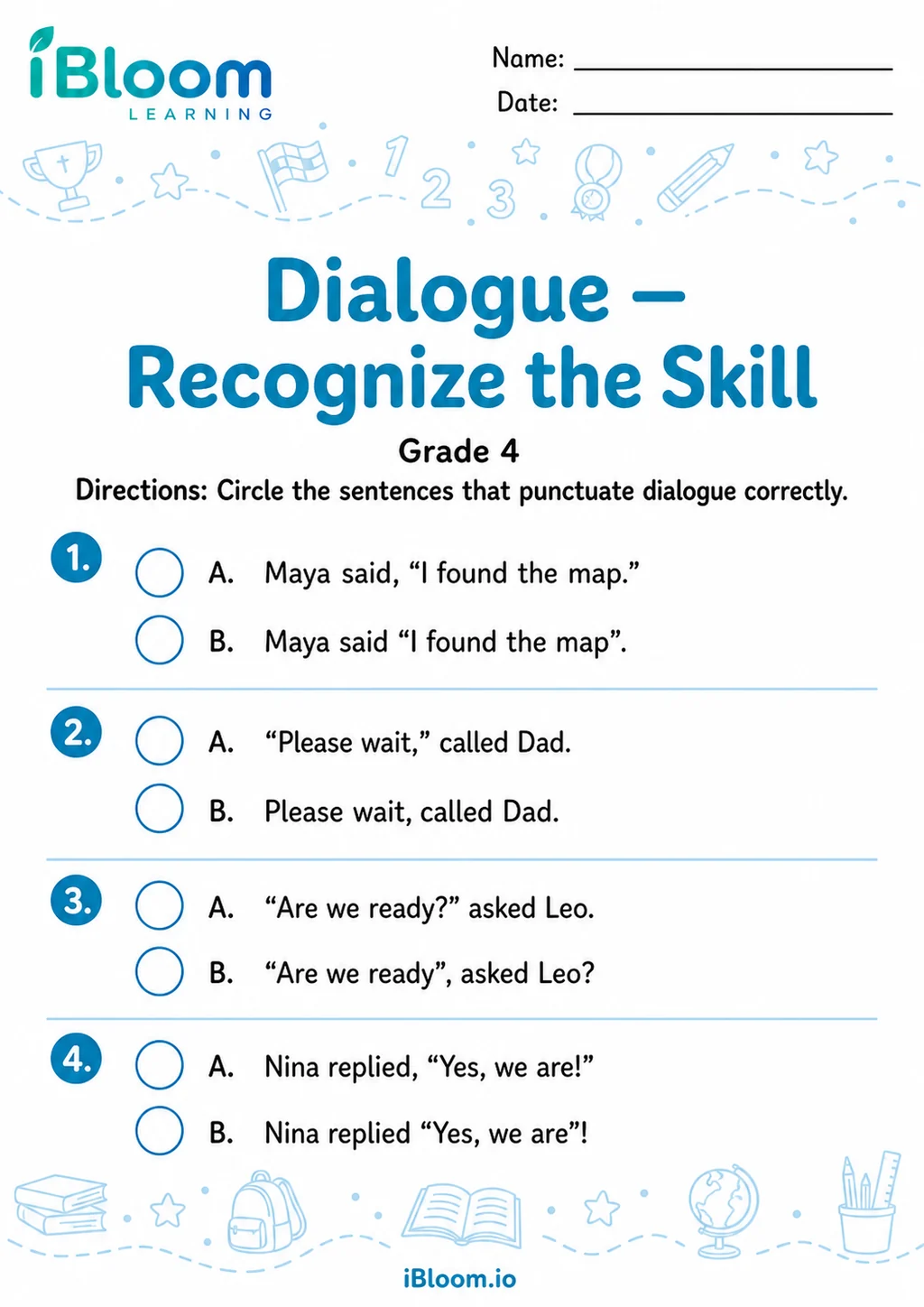
This free printable worksheet gives Grade 4 students ten sentences to turn into correctly punctuated dialogue. In Part A, children add quotation marks, a comma and the right end mark to five sentences where the speaker comes first. In Part B, they move the speaker to the front of three sentences that begin with a quote. In Part C, they join two short sentences into one that includes a spoken line. The practice supports Common Core L.4.2.b, using commas and quotation marks to mark direct speech. An answer key shows every sentence written out.
Aligned to L.4.2.b
What is on this dialogue worksheet?
Every question asks children to write a sentence out in full, so they practice the marks the way they will use them in a story. The speakers are classmates, and the lines are things a Grade 4 student might really say, such as asking to borrow a pencil or calling out a warning.
The three parts get harder in order. Part A starts with the speaker first and only adds punctuation. Part B asks children to rearrange a sentence that starts with a quote. Part C asks them to combine two sentences without losing a single mark.
- Part A: add quotation marks, a comma and an end mark (questions 1 to 5)
- Part B: rewrite with the speaker first (questions 6 to 8)
- Part C: join two sentences with and (questions 9 and 10)
- Answer key shows each finished sentence
Where do the comma, quotation marks and end mark go?
When the speaker comes first, a comma follows the word that tells how the person spoke, such as said or asked. Then the quotation marks open before the first spoken word, and the spoken words start with a capital letter. The end mark, whether a period, question mark or exclamation point, goes inside the closing quotation marks.
Questions 2 and 3 end with a question mark and an exclamation point. Both marks belong to the speaker’s words, so they stay at the end of the quote and the closing quotation marks go after them, never before.
- 11) Priya said I found my library book. → Priya said, “I found my library book.”
- 22) Leo asked Can I borrow your pencil? → Leo asked, “Can I borrow your pencil?”
- 33) Noah shouted Watch out for the puddle! → Noah shouted, “Watch out for the puddle!”
What changes when the speaker moves to the front?
In Part B each sentence begins with the quote, and the speaker’s name comes after it. In those sentences the comma sits inside the closing quotation marks, where a period would normally go. When children move the speaker to the front, that comma disappears from the end of the quote and a new one appears after said or asked.
A question mark or exclamation point does not change. Question 7 starts with “Where is my coat?” asked Ben, and the finished sentence still ends with a question mark inside the quotation marks.
- 16) “I can help,” said Ava. → Ava said, “I can help.” (the comma moves to after said; a period ends the quote)
- 27) “Where is my coat?” asked Ben. → Ben asked, “Where is my coat?” (the question mark stays inside)
How do you join a sentence with a quote?
The two sentences in Part C each describe one thing Emma or Mr. Lee did. Joining them with and means dropping the second subject, She or He, and keeping the spoken words exactly as they were. The finished sentence has the comma, the capital letter and the end mark inside the quotation marks, just like the sentences in Part A.
Because the speaker’s words cannot change, children cannot rewrite them to fit. They have to rebuild only the part outside the quotation marks.
How to use this worksheet at home or in class
- 1Read the three part headings aloud so children know what each part asks for before they start writing.
- 2Do question 1 together. Ask which words the person actually said, and put the quotation marks around only those words.
- 3Let your child finish Part A on their own, writing each full sentence on the lines.
- 4For Part B, have your child underline the speaker’s name in each sentence before moving it.
- 5Check every sentence against the answer key, tapping each mark with a pencil: comma, opening marks, capital, end mark, closing marks.
- 6Ask for one new sentence in which a character speaks, and check it for the same marks.
Common mistakes and quick fixes
The mistake
Putting the end mark outside the closing quotation marks, as in Priya said, “I found my library book”.
The fix
Show that the period belongs to the spoken words. Have your child read the quote aloud and hear where the voice stops, then put the mark inside the quotation marks.
The mistake
Leaving the comma out after said or asked, as in Leo asked “Can I borrow your pencil?”
The fix
Tell your child that the comma tells the reader a speaker is about to be quoted. Say the comma is like a short pause before the person speaks.
The mistake
Keeping the comma at the end of the quote after moving the speaker, as in Ava said, “I can help,”
The fix
When the speaker comes first, the quote is the end of the sentence, so it needs its own ending. Replace the comma inside the quotation marks with a period.
Common Core alignment
Most US states teach punctuation with the Common Core standards or a close state version. This Grade 4 standard names the skill the whole page practices.
Use commas and quotation marks to show what a person says.
On this sheet: All ten sentences ask children to place commas, quotation marks and end marks around direct speech.
Show the official wordingHide the official wording
Use commas and quotation marks to mark direct speech and quotations from a text.
What to practice next
Make more practice
Further reading
Questions parents and teachers ask
Why does the end mark go inside the quotation marks?
In American English, the period, question mark or exclamation point that ends the spoken words goes inside the closing quotation marks. The mark belongs to what the speaker said. Question 2, Leo asked, “Can I borrow your pencil?” shows this: the question mark is the speaker’s, so it sits inside.
Do I need a comma after said every time?
A comma is used when the speaker comes first and the quote follows, as in Priya said, “I found my library book.” If the speaker comes last, the comma goes inside the quote instead. That is why Part B asks children to move the comma when they move the speaker to the front.
Why does the quote begin with a capital letter?
A new spoken sentence begins with a capital letter, even in the middle of a sentence. In question 4, Ava whispered, “The baby is asleep.” The word The is capitalized because it starts what Ava says. A capital is easy to skip when writing quickly, so the answer key shows each one.
Is this worksheet too hard for Grade 4?
Part A should feel comfortable for most Grade 4 writers, because the speaker already comes first. Part B takes more care because the comma and the quote change places. Part C is the hardest, since children must rebuild the sentence while keeping the marks. Do question 1 of each part together.
Can a child write a different correct answer?
Yes, in Part C. Children could write Emma waved and called, “Goodbye!” or Emma waved, and she called, “Goodbye!” Both are punctuated correctly, but the worksheet directs children to join with and so the answer key has one clear model. Check that the marks match, not only the words.
What should my child do after this worksheet?
Ask your child to write a three-line conversation between two friends, using said and asked at least once each. Then check each line for the comma, quotation marks and end mark. The Quotation Marks and Dialogue worksheets give more practice with longer exchanges between characters.