



About this worksheet
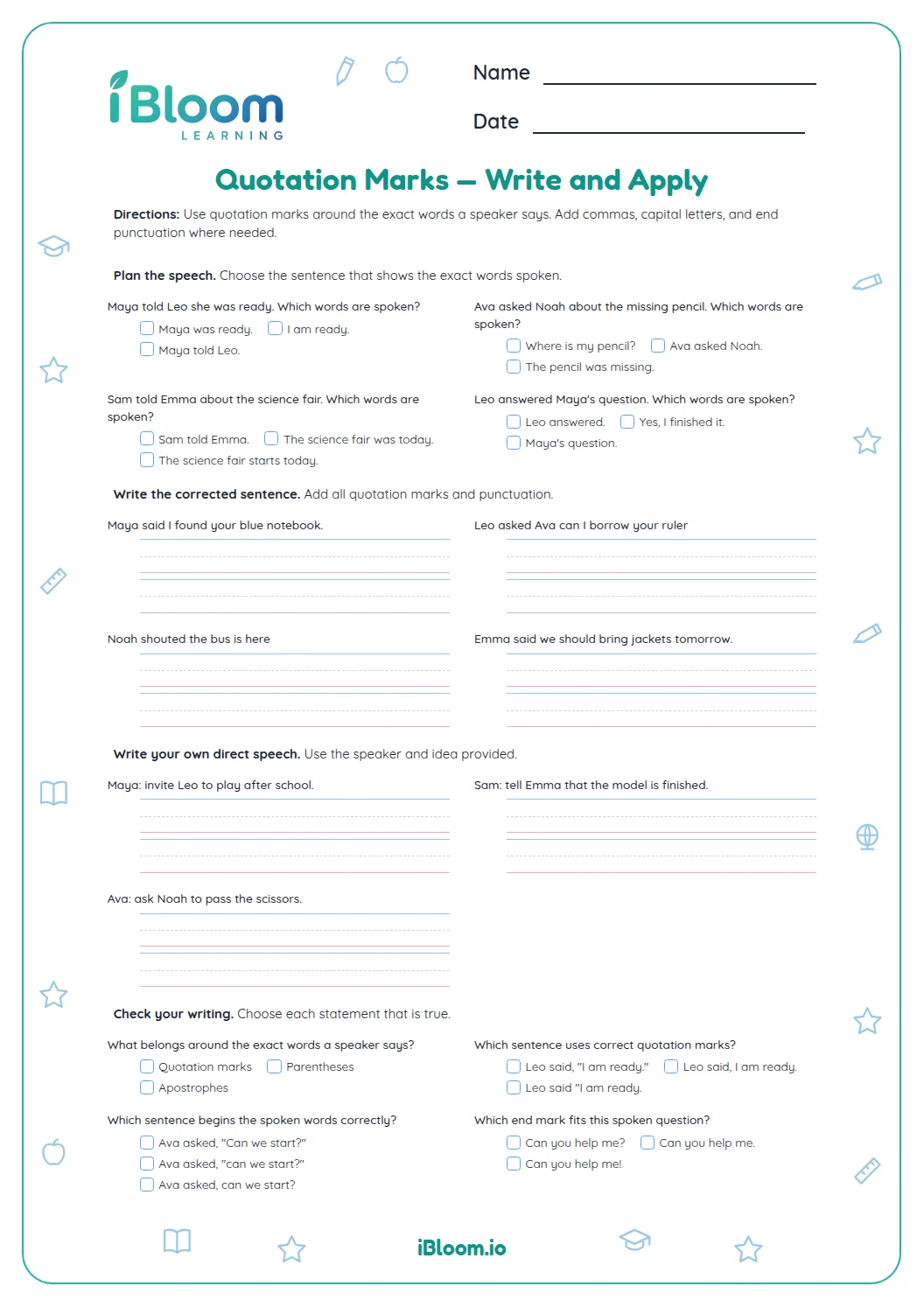
This Grade 4 printable gives learners 14 dialogue sentences to edit. They practice placing quotation marks around a speaker’s exact words, capitalizing the first spoken word, and keeping commas, periods, question marks, or exclamation points in the right place. The separate answer key provides corrected models, and the page practices CCSS L.4.2.b.
Aligned to L.4.2.b
What does the first part ask learners to do?
The first eight items present dialogue with a punctuation, capitalization, or quotation-mark error. Learners rewrite each sentence so the spoken words and speaker tag are punctuated correctly.
- 1Edit this dialogue: maya said, “the nest is empty.”
- 2Answer: Maya said, “The nest is empty.”
What changes in the second part?
The final six items also need editing. Learners add quotation marks and repair punctuation or capitalization; the answer key shows a corrected version of each sentence.
How should punctuation fit inside quotation marks?
Place the punctuation that belongs to the spoken words inside the closing quotation mark. For example, a spoken question ends with its question mark inside the quotation marks.
How to use this worksheet
- 1Identify the exact words spoken by the character.
- 2Open quotation marks before the first spoken word.
- 3Capitalize the first word inside the quotation marks.
- 4Place the correct comma or end mark before the closing quotation mark.
- 5Check where the speaker tag begins and compare with the key.
Common mistakes and quick fixes
The mistake
Putting the period outside the closing quotation mark.
The fix
Keep the end punctuation with the spoken words: “The bus is here.”
The mistake
Leaving the first spoken word lowercase.
The fix
Capitalize it inside the opening quotation mark.
The mistake
Putting an exclamation mark after the quotation mark.
The fix
Move it inside when the speaker’s words are exclaimed: “Watch out!”
Common Core alignment
The worksheet practices this Common Core standard through its page activities.
Use quotation marks and commas to punctuate direct speech.
On this sheet: Editing items practice punctuation for direct speech.
Show the official wordingHide the official wording
Use commas and quotation marks to mark direct speech and quotations from a text.
What to practice next
Make more practice
Further reading
Questions parents and teachers ask
What should quotation marks enclose?
Quotation marks enclose the exact words a character says. In “Maya said, ‘The nest is empty,’” the spoken sentence is separated from the speaker tag and begins with a capital. The worksheet gives 14 lines to edit and an answer key with corrected dialogue.
How many dialogue edits are on the page?
There are 14 numbered edits in two parts. The first part focuses on repairing dialogue sentences; the second continues with sentences that need quotation marks, capitals, or punctuation corrected. A separate key gives a model for each item. This printable is ready to use at home or in a classroom with the separate answer key.
Where does a question mark go in dialogue?
When the spoken words form a question, the question mark goes inside the closing quotation mark: “Are you ready?” asked Dad. This punctuation practice appears in the worksheet, and learners can compare their edited sentences with the answer key. This printable is ready to use at home or in a classroom with the separate answer key.
Should learners copy the entire corrected sentence?
Yes. The prompts ask learners to edit or copy each line with punctuation in place, so rewriting the full corrected sentence helps them place both quotation marks and speaker punctuation correctly. The key provides complete sentence models. This printable is ready to use at home or in a classroom with the separate answer key.
Can a speaker tag come before or after the quote?
Yes. The examples include speaker tags before and after the spoken words, such as “Dad asked, ‘Are you ready?’” and “‘I can help,’ said Ava.” Learners should keep the punctuation matched to the sentence structure shown in each item. This printable is ready to use at home or in a classroom with the separate answer key.