




About this worksheet
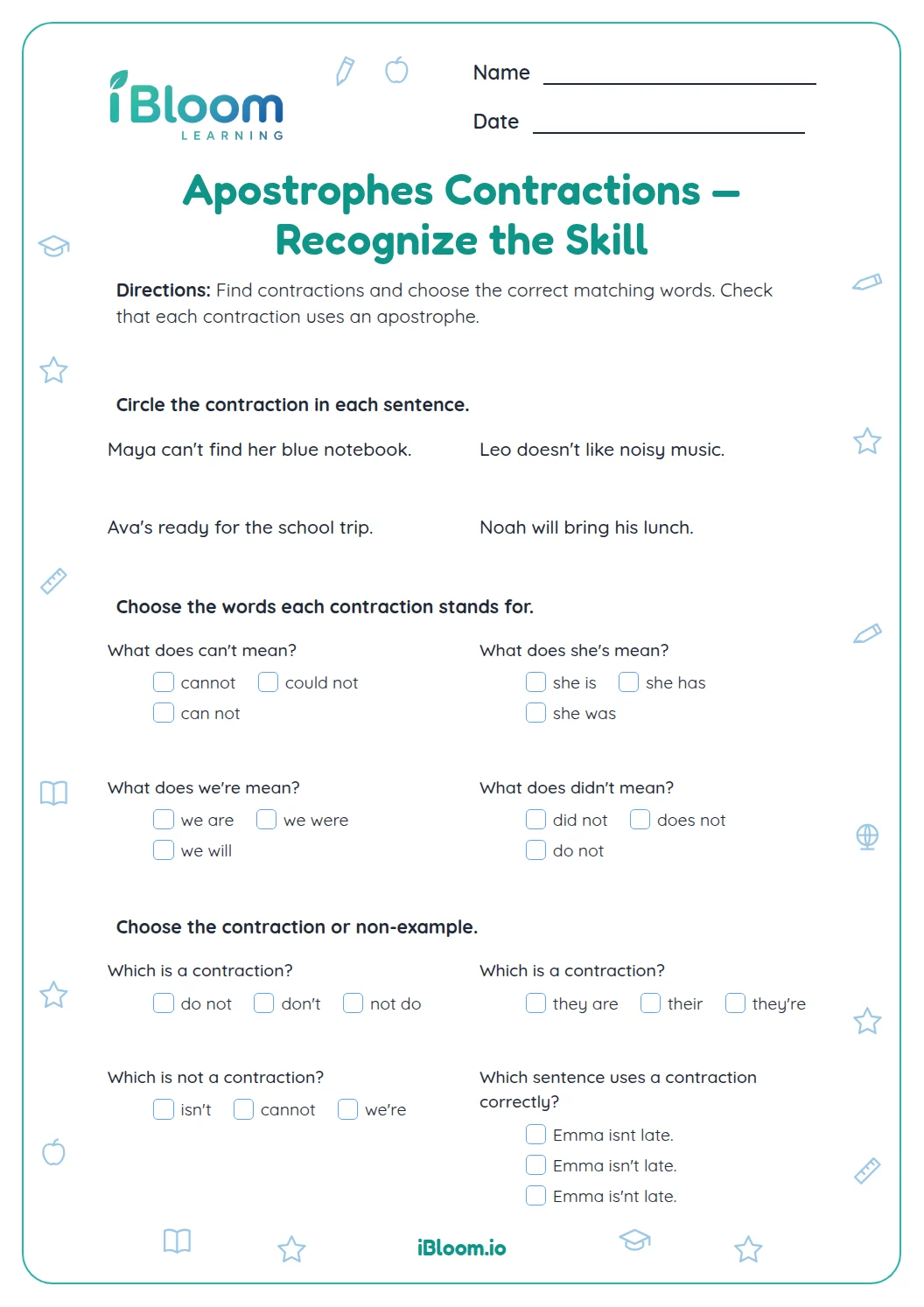
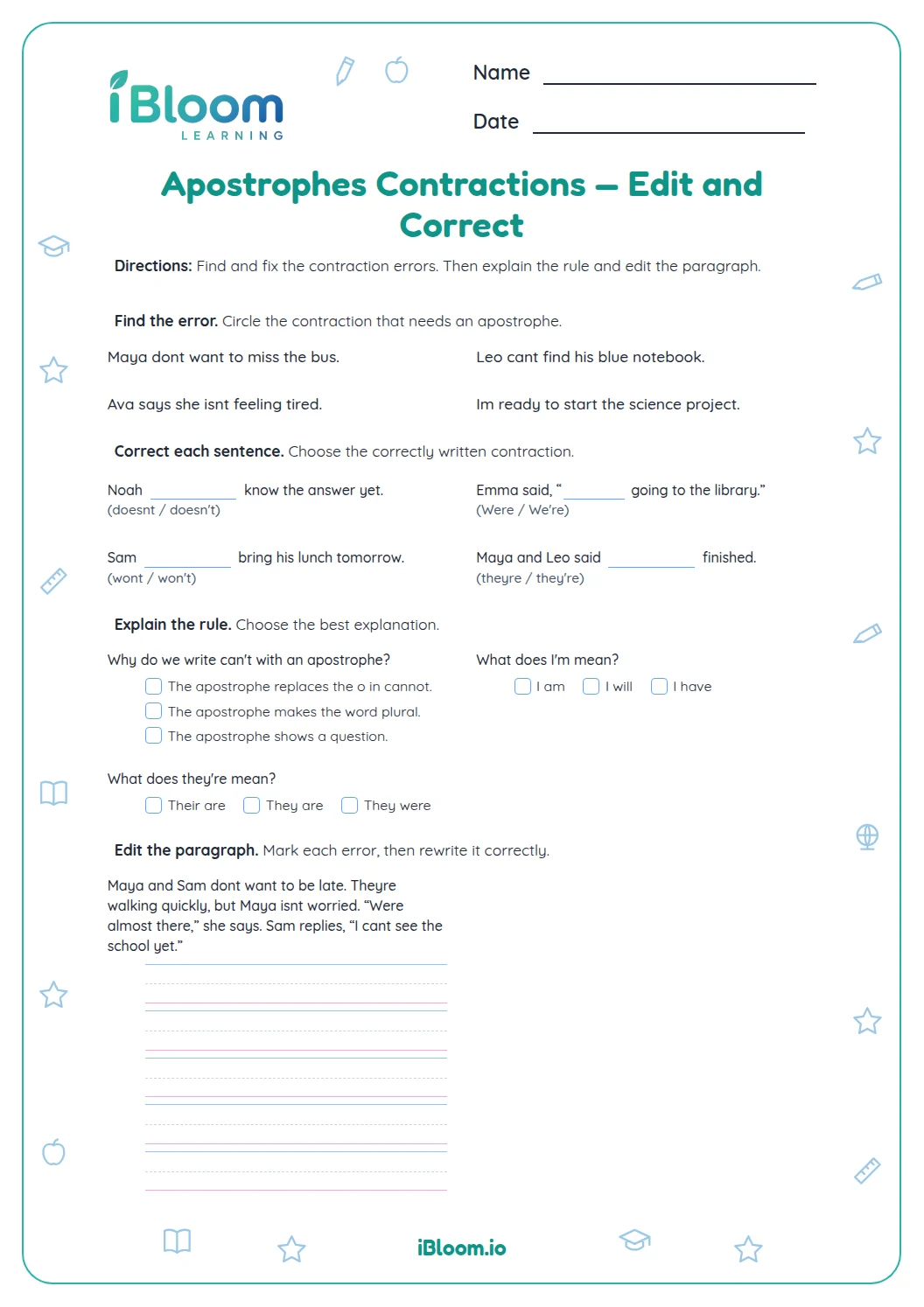
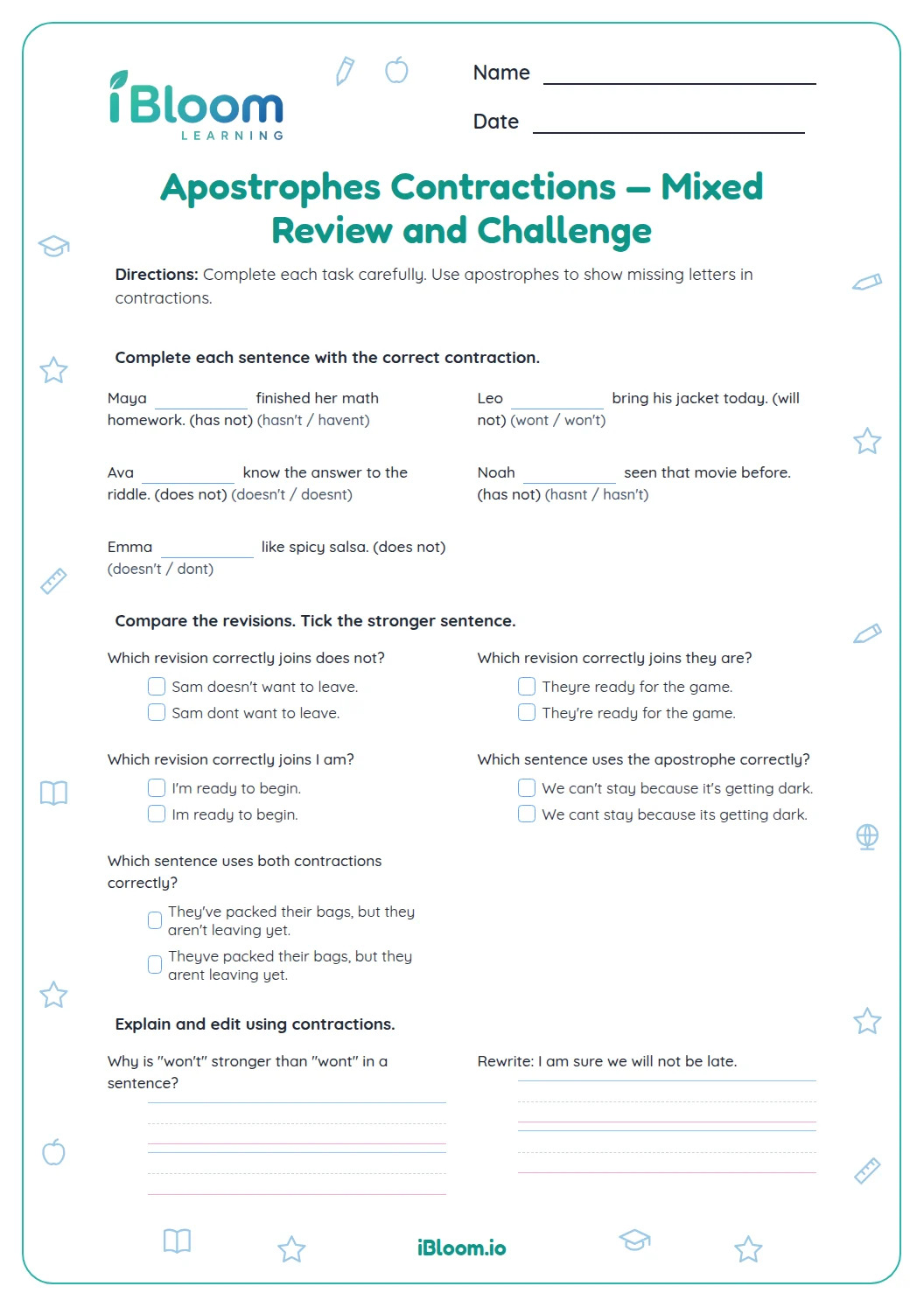
Form common contractions, expand them to their original words and punctuate them in sentences. This page includes 16 original questions in two parts, a printable worksheet and a separate answer key. It is written for US families and teachers practicing this skill.
Aligned to L.2.2.c
How does an apostrophe form a contraction?
A contraction joins two words and marks omitted letters with an apostrophe. The first questions connect word pairs such as do not with don’t.
For example, we will becomes we’ll.
How do contractions work in sentences?
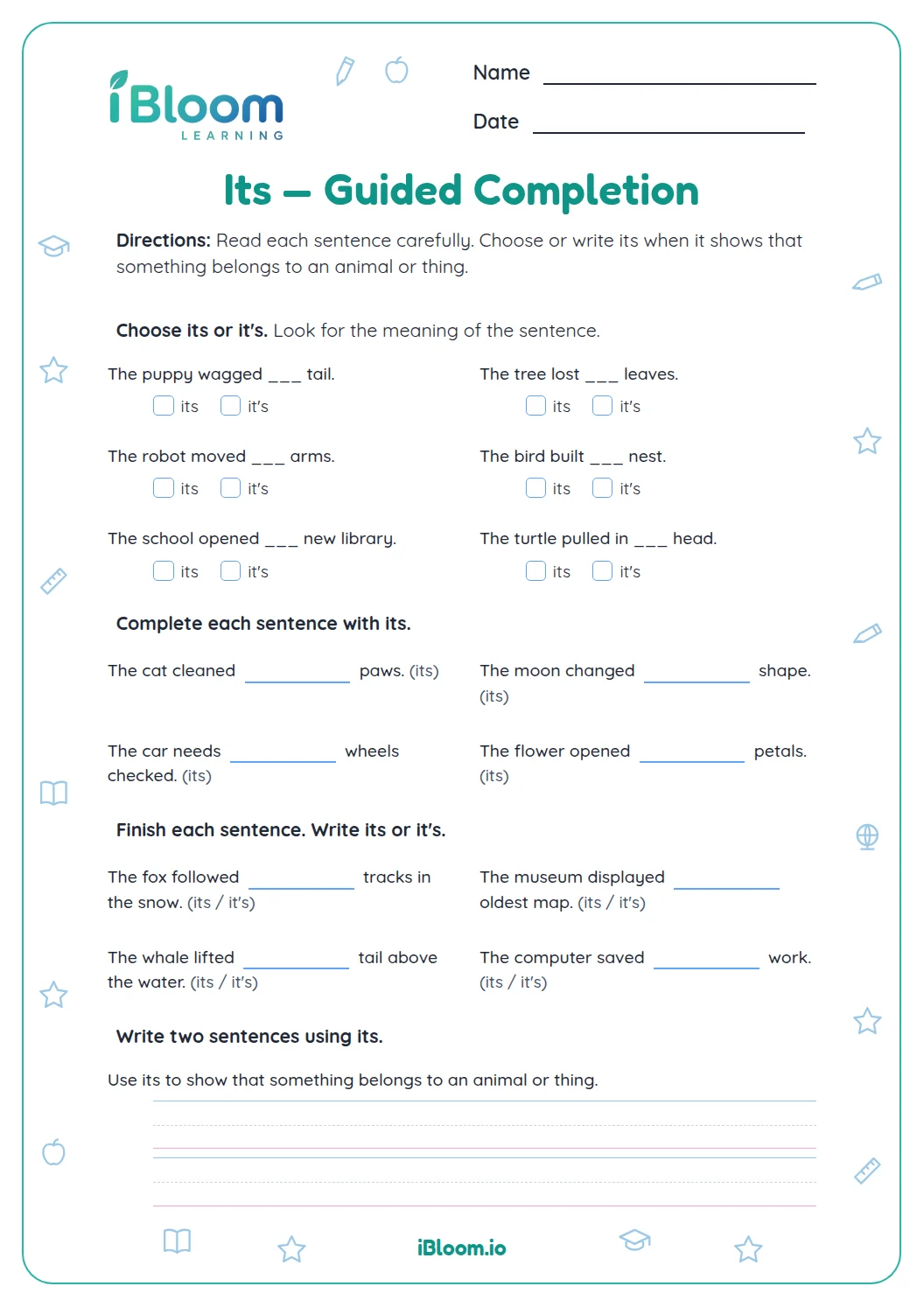
Sentence questions ask children to select or correct a contraction in context. In “The dog wagged its tail,” its shows possession and has no apostrophe; it’s means it is.
How to use this worksheet
- 1Read the two full words first.
- 2Say the contracted form and notice which letters are missing.
- 3Place the apostrophe in the contraction.
- 4For sentence edits, expand the contraction to confirm it fits.
Common mistakes and quick fixes
The mistake
Confusing “its” with “it’s”
The fix
Expand it’s to “it is”; use its to show that something belongs to it.
The mistake
Leaving the apostrophe out
The fix
Check the shortened form for the mark where letters are omitted.
The mistake
Choosing a contraction that does not match the subject
The fix
Read the full words in the sentence and check that the subject agrees.
Common Core alignment
This worksheet practices the listed Common Core skill through its printed questions.
Use apostrophes in contractions and frequently occurring possessives.
On this sheet: Children form, expand, and punctuate common contractions in sentence contexts.
Show the official wordingHide the official wording
Use an apostrophe to form contractions and frequently occurring possessives.
What to practice next
Make more practice
Further reading
Questions parents and teachers ask
What is a contraction?
A contraction combines two words into a shorter form. An apostrophe marks the letters left out, as in do not becoming don’t. Have the child point to the wording that supports the answer, explain the choice aloud, and compare it with the completed example on the key.
How is “its” different from “it’s”?
Its shows ownership, as in “The dog wagged its tail.” It’s means “it is.” The sentence “It’s raining” can be expanded to “It is raining.” Have the child point to the wording that supports the answer, explain the choice aloud, and compare it with the completed example on the key.
Can my child write a different sentence for the last question?
Yes. The last question is open-ended. Accept any complete sentence that uses a correctly formed contraction with an apostrophe. Have the child point to the wording that supports the answer, explain the choice aloud, and compare it with the completed example on the key.
How can children check a contraction?
Expand it to the two original words. If the expansion fits the sentence, the contraction is likely correct; then check that the apostrophe is in place. Have the child point to the wording that supports the answer, explain the choice aloud, and compare it with the completed example on the key.
Which contractions are practiced?
The worksheet includes forms such as don’t, they’re, we’ll, couldn’t, I’m, she’s, we’ve and you’d in word and sentence tasks. Have the child point to the wording that supports the answer, explain the choice aloud, and compare it with the completed example on the key.