

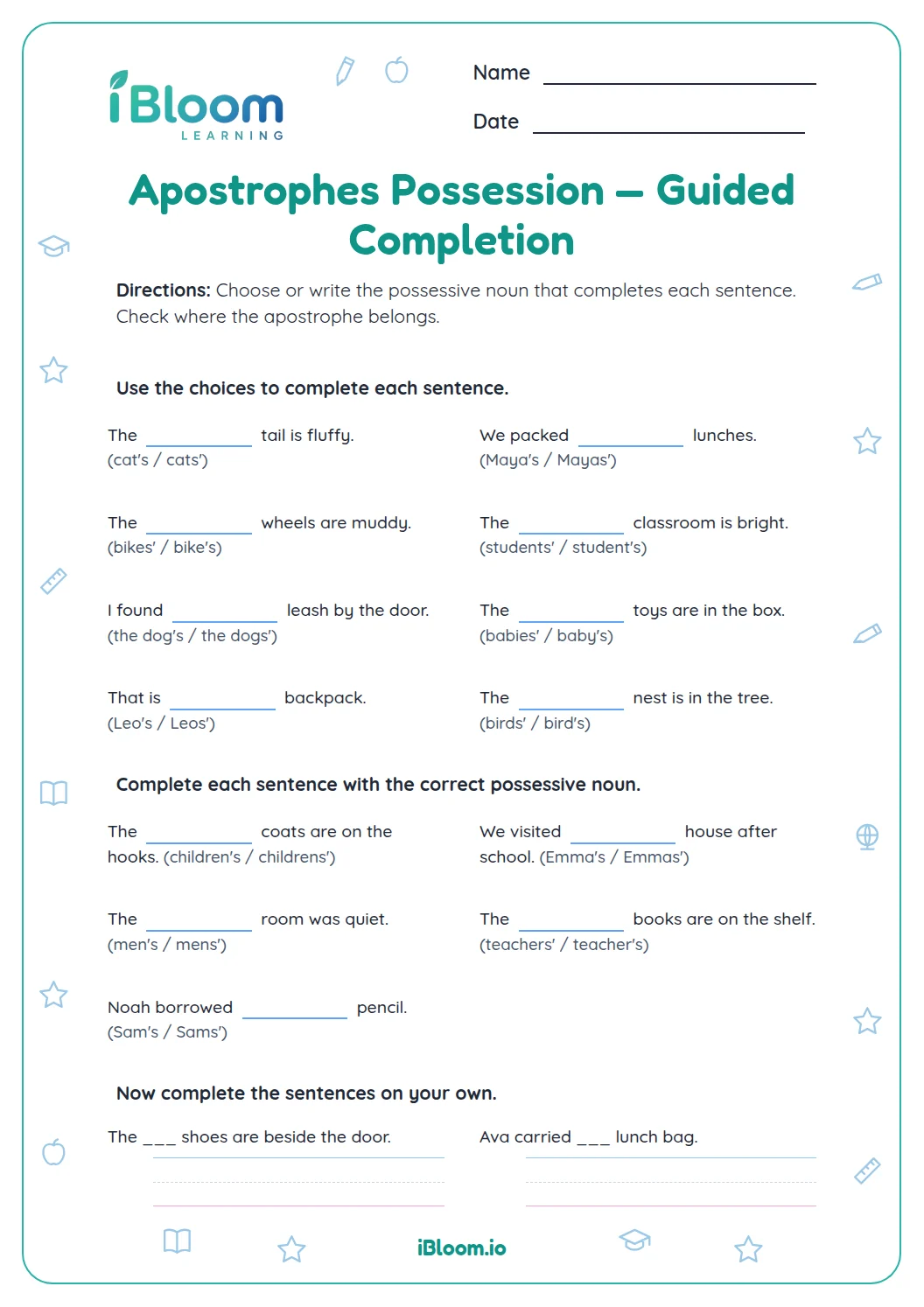
About this worksheet
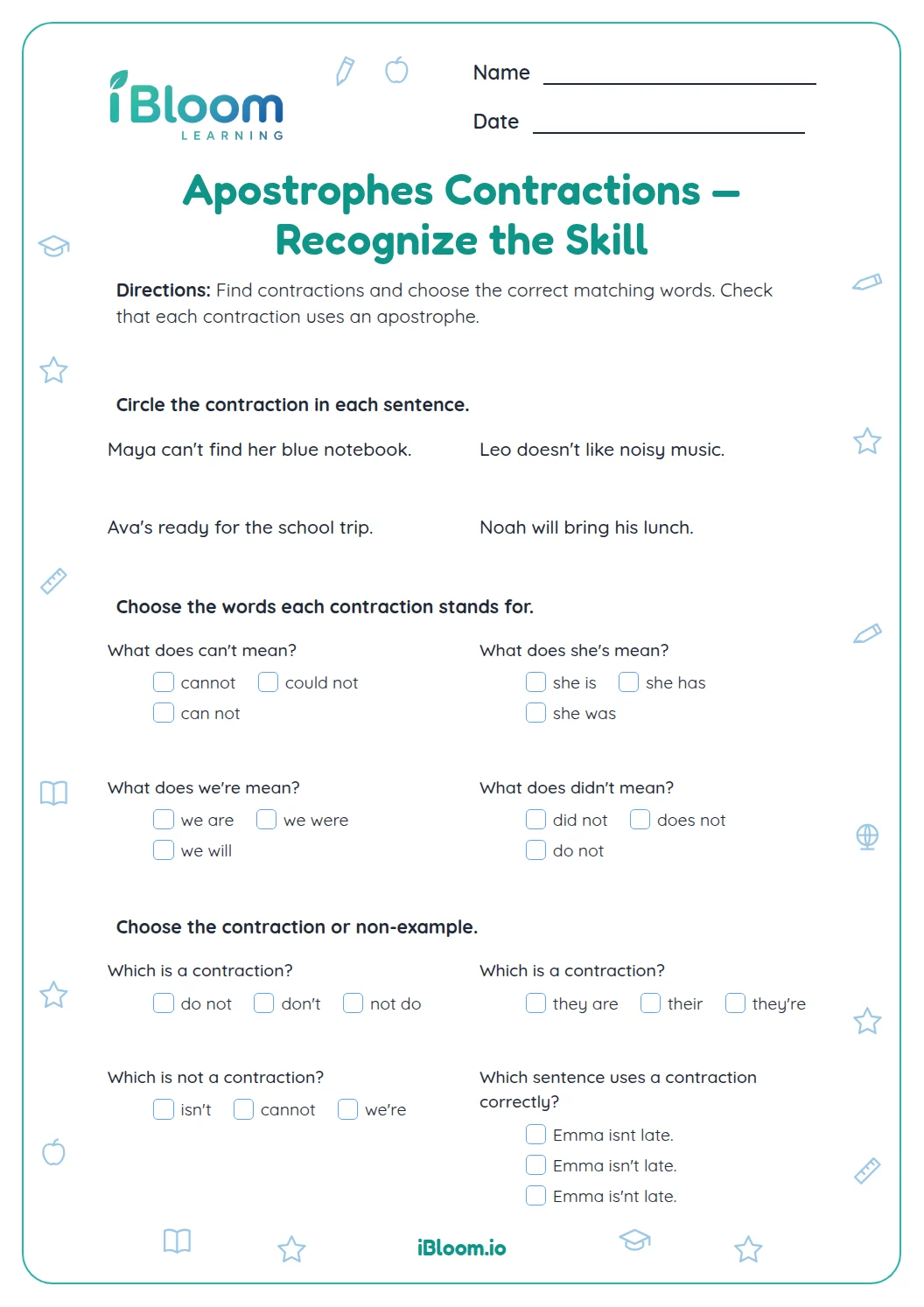
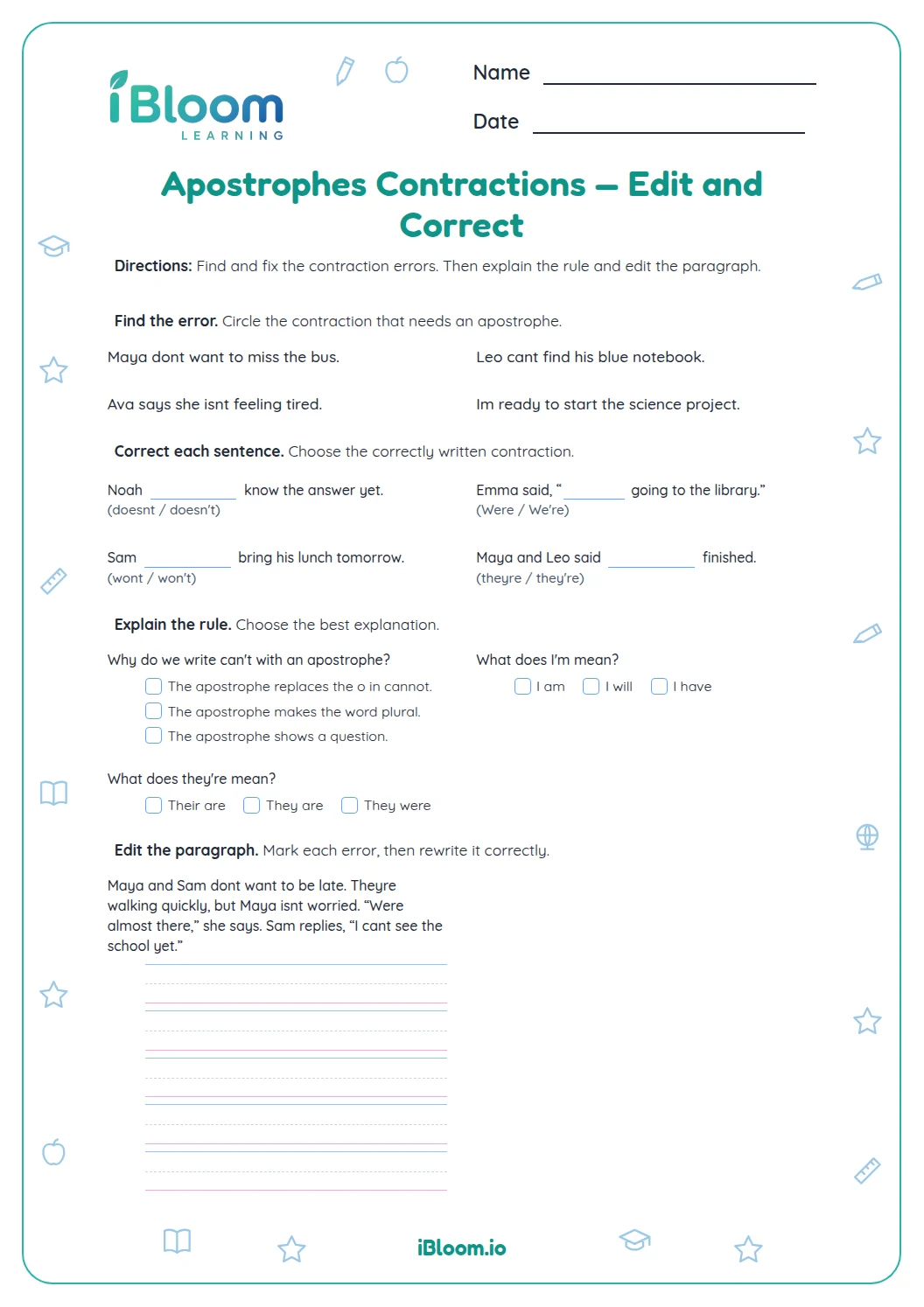
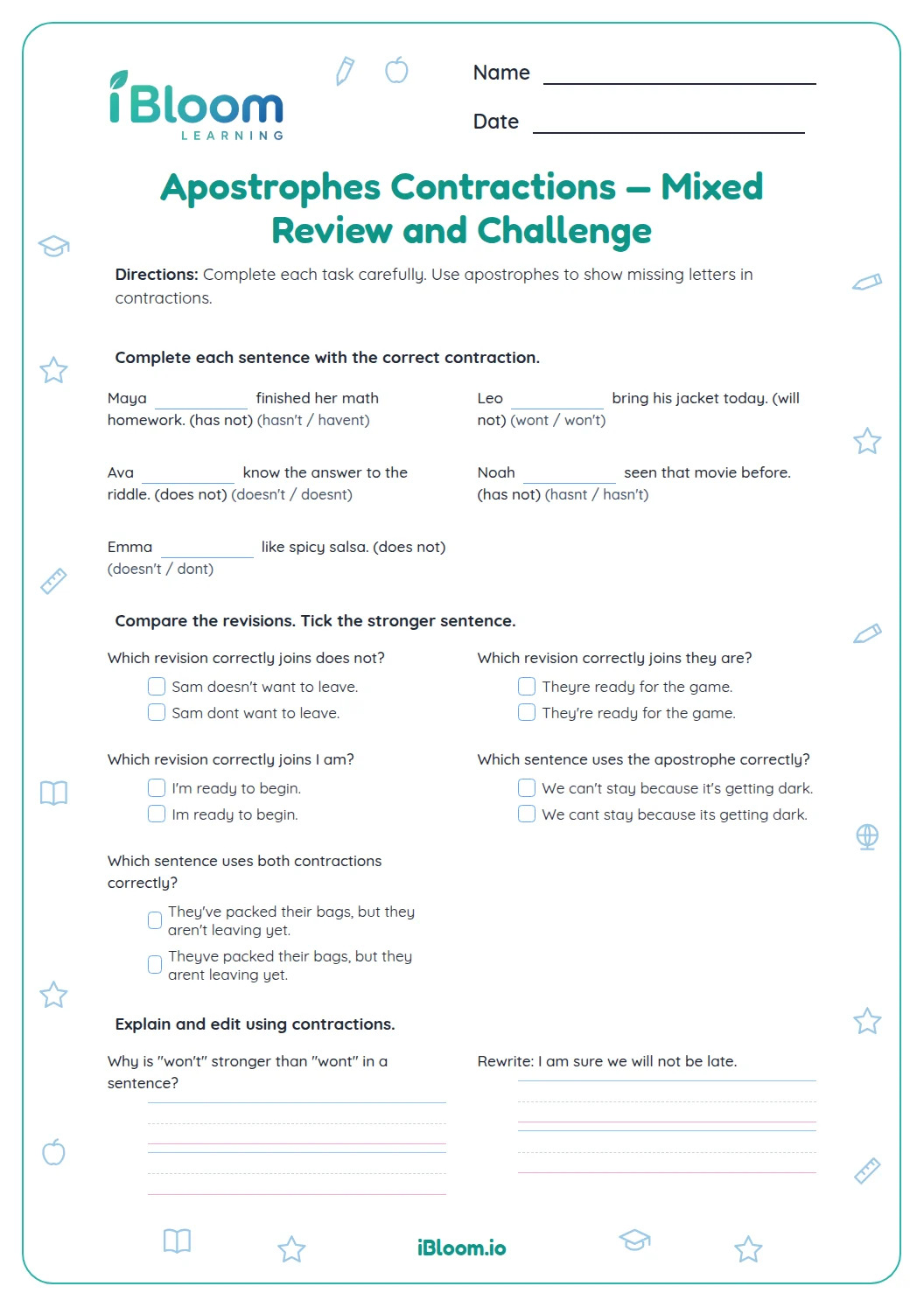
Students practice where the apostrophe belongs as letters are omitted in contractions. The guided sequence moves from forming and expanding contractions to choosing a form in context and editing sentences.
Aligned to L.4.2
How do contractions work?
A contraction combines two words and leaves out one or more letters. An apostrophe marks that omission: will not becomes won’t, and they have becomes they’ve.
Part A forms contractions, Part B expands and checks spelling, and Part C applies the forms in sentences and editing.
What will learners practice?
The worksheet includes common contractions with be, have, will, and not, with choices plus short written edits.
- Part A: A
- Part B: B
- Part C: C
How to use this worksheet
- 1Say the two original words aloud.
- 2Notice which letters disappear and put the apostrophe in their place.
- 3Read the completed sentence aloud to check that the contraction fits.
Common mistakes and quick fixes
The mistake
Leaving out the apostrophe in “you’re.”
The fix
Remember that you’re combines you are; the apostrophe marks omitted letters.
The mistake
Choosing a contraction that changes the meaning, such as she’d for she is.
The fix
Expand the contraction and check each word against the sentence.
Common Core alignment
This worksheet practices the following Common Core skill.
Use apostrophes in contractions.
On this sheet: Learners form, expand, spell, and punctuate common contractions in context.
Show the official wordingHide the official wording
Demonstrate command of the conventions of standard English capitalization, punctuation, and spelling when writing.
What to practice next
Make more practice
Questions parents and teachers ask
Why does a contraction need an apostrophe?
The apostrophe marks letters that have been left out when two words are joined. In don’t, for example, the apostrophe stands where letters from do not are omitted. Students should check both the spelling and the meaning by expanding the contraction back into its two words.
What is the difference between its and it’s?
It’s is a contraction for it is or it has, while its shows that something belongs to it. The apostrophe in it’s marks missing letters. Possessive its has no apostrophe. Read the surrounding sentence and expand it’s to check whether it means it is or it has.
How can I check a contraction in a sentence?
Say the two original words and substitute the contraction. The sentence should keep the same meaning and sound natural. For example, “We are going” can become “We’re going.” Check that the apostrophe is present and that the chosen contraction matches the subject and verb.
What does the answer key show?
The key lists the correct contractions, their expanded forms, and corrected sentences. Some writing prompts can have many correct answers, so the key gives a sample. A response is correct when it uses the requested contraction accurately and keeps the sentence meaning clear.
What words form “they’ve”?
“They’ve” is a contraction for “they have.” The apostrophe marks the letters omitted from have. In a sentence, read the expanded form back to check that it makes sense, as in “They’ve finished” becoming “They have finished.” This worksheet asks students to practice both the contraction and its expanded form.