




About this worksheet
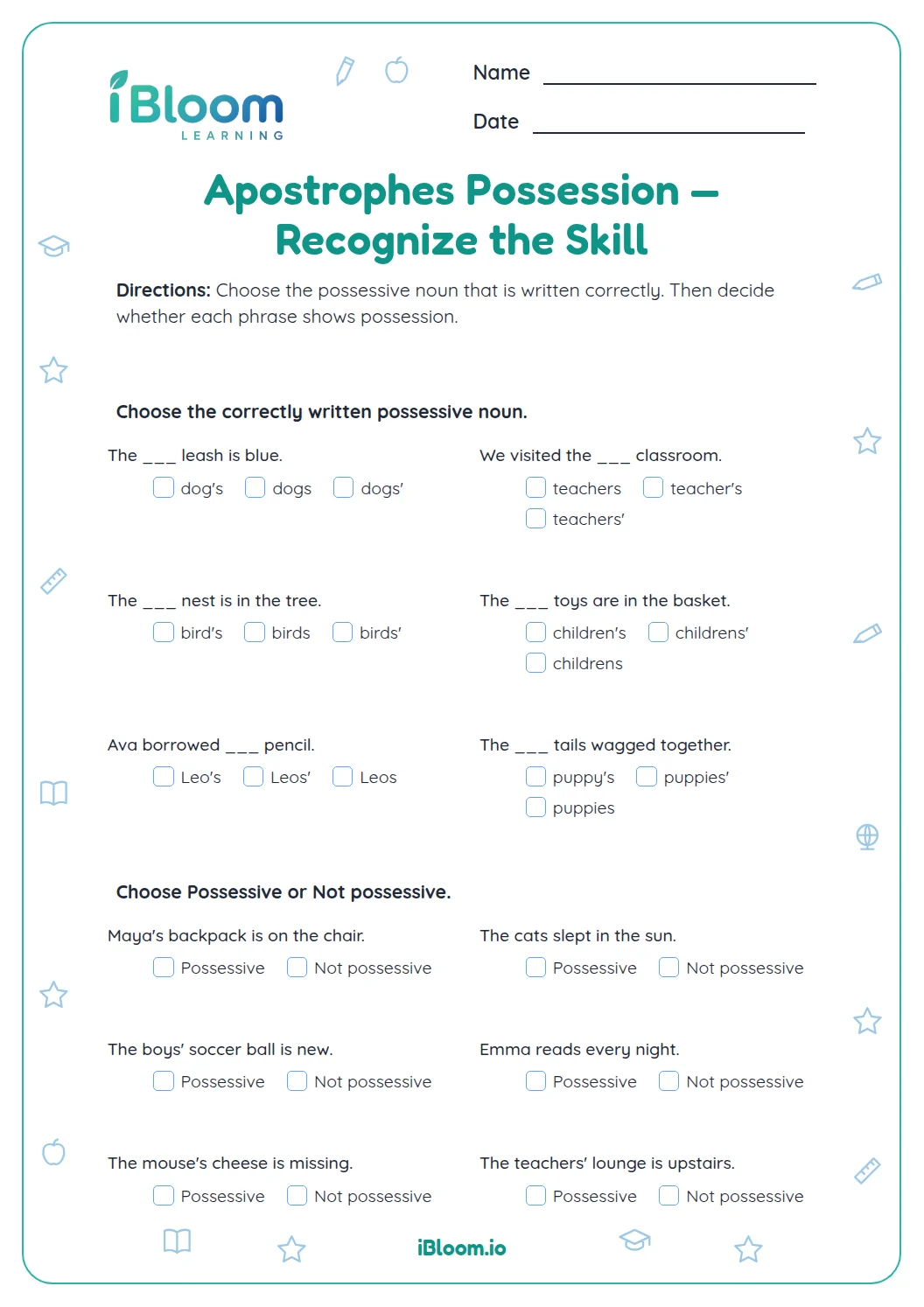
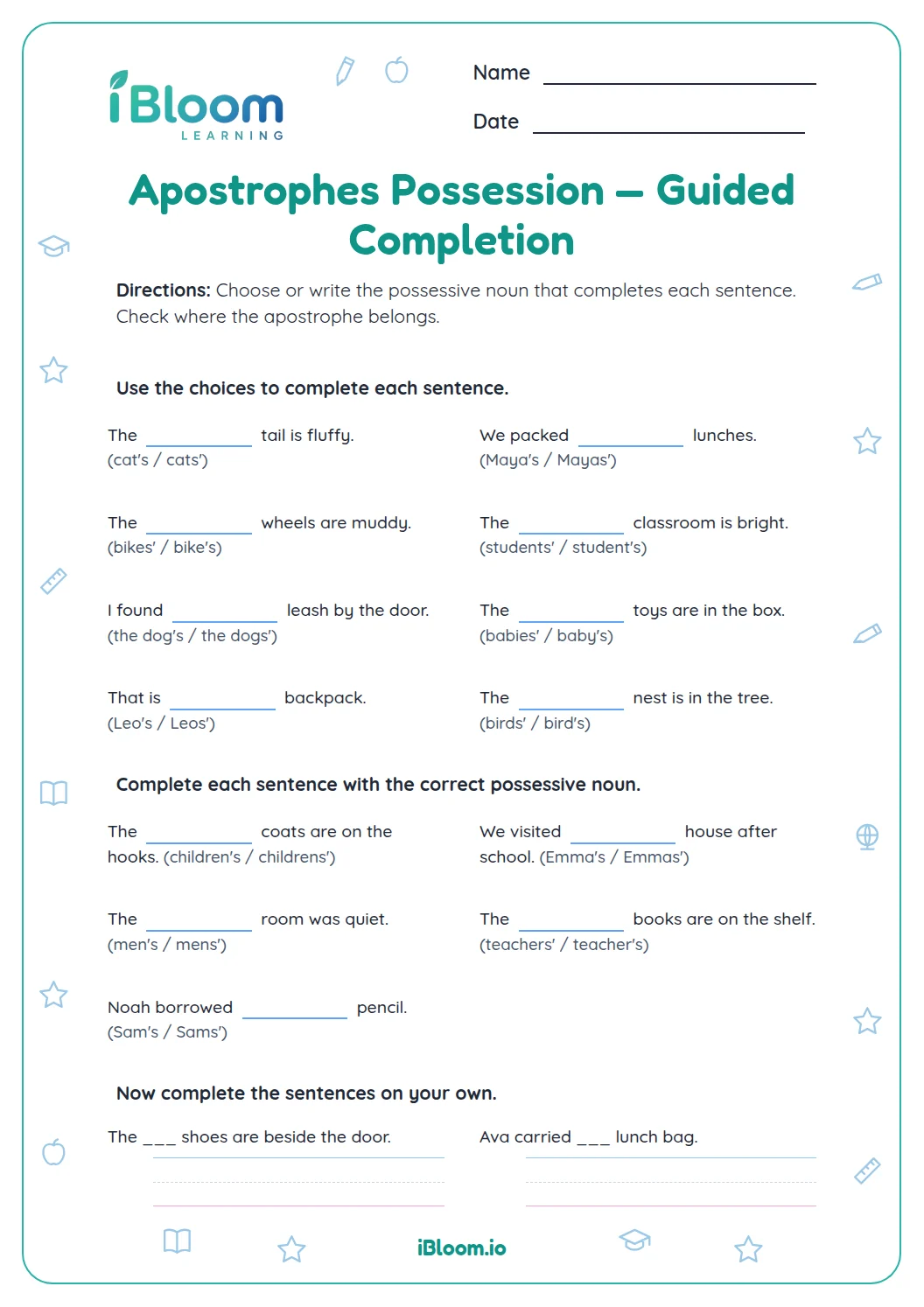
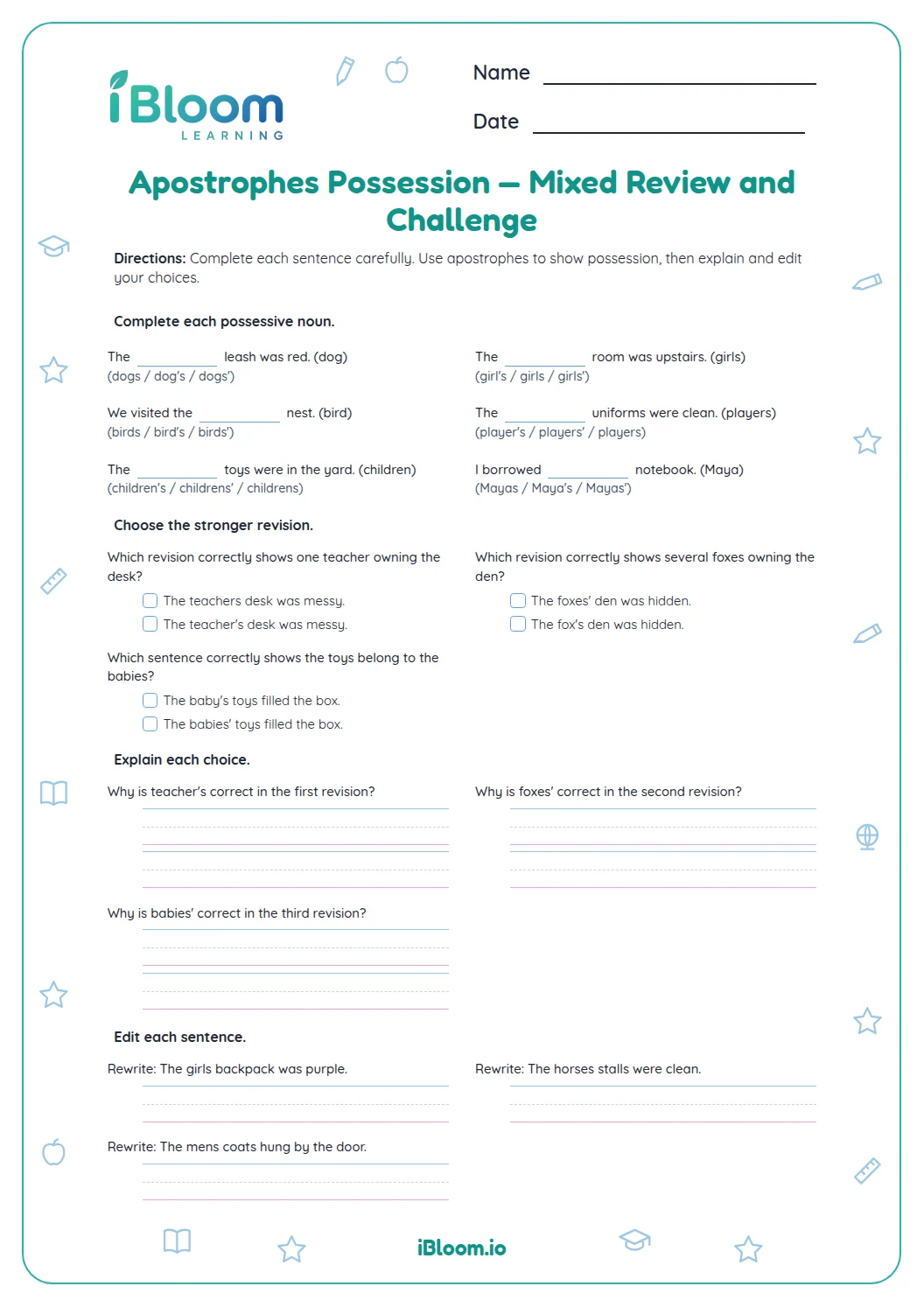
This Grade 4 punctuation worksheet gives 16 short editing and completion tasks about possessive apostrophes. Students work with singular owners, regular plurals ending in s, and irregular plurals, then check corrected phrases and sentences with a separate key.
What does this page help students practice?
The 16 tasks ask students to place apostrophes in singular possessives, regular plurals that end in s, and irregular plurals such as children and geese. They edit both phrases and complete sentences.
Work through the parts in order, then use the answer key to review the reasoning behind each response.
Where does the apostrophe go for a plural owner?
In “the girls backpacks,” girls already ends in s and names more than one owner. Add an apostrophe after the s: “the girls’ backpacks.” For an irregular plural such as children, add apostrophe s: “the children’s coats.”
- 1Edit the phrase: “the girls backpacks”
- 2Answer: the girls’ backpacks
How to use this worksheet
- 1Find the owner in each phrase or sentence.
- 2Decide whether the owner is singular, a regular plural ending in s, or an irregular plural.
- 3Place the apostrophe in the possessive form.
- 4Reread the complete phrase to check who owns the item.
- 5Check all sixteen corrections with the key.
Common mistakes and quick fixes
The mistake
Rushing and answering from one word or number alone.
The fix
Read the entire prompt and use all the clues it gives.
The mistake
Changing an answer without checking the evidence in the item.
The fix
Point to the clue, number relationship or grammar pattern that supports the choice.
The mistake
Copying a key response without understanding it.
The fix
Explain the answer in your own words before moving on.
What to practice next
Make more practice
Questions parents and teachers ask
How does an apostrophe show possession?
An apostrophe helps show that a person, animal or group owns something. For one owner, add apostrophe s, as in “the dog’s leash.” For a regular plural ending in s, place the apostrophe after the s, as in “the players’ jerseys.”
What is the difference between dog’s and dogs’?
Dog’s means one dog owns something. Dogs’ means more than one dog owns something. Say the owner phrase aloud and identify whether the noun names one owner or a plural group before placing the apostrophe. Ask the learner to point to the exact words in the prompt that support the response, then restate the idea in a complete sentence.
Does every plural possessive end with apostrophe s?
No. A regular plural that already ends in s usually takes an apostrophe after the s. An irregular plural that does not end in s, such as children, takes apostrophe s: children’s books. Ask the learner to point to the exact words in the prompt that support the response, then restate the idea in a complete sentence.
Why does class’s have two s letters?
The singular noun class ends in s, and the possessive form adds apostrophe s: class’s. The worksheet includes this pattern so students can distinguish a singular owner from a plural noun ending in s. Ask the learner to point to the exact words in the prompt that support the response, then restate the idea in a complete sentence.