






About this worksheet
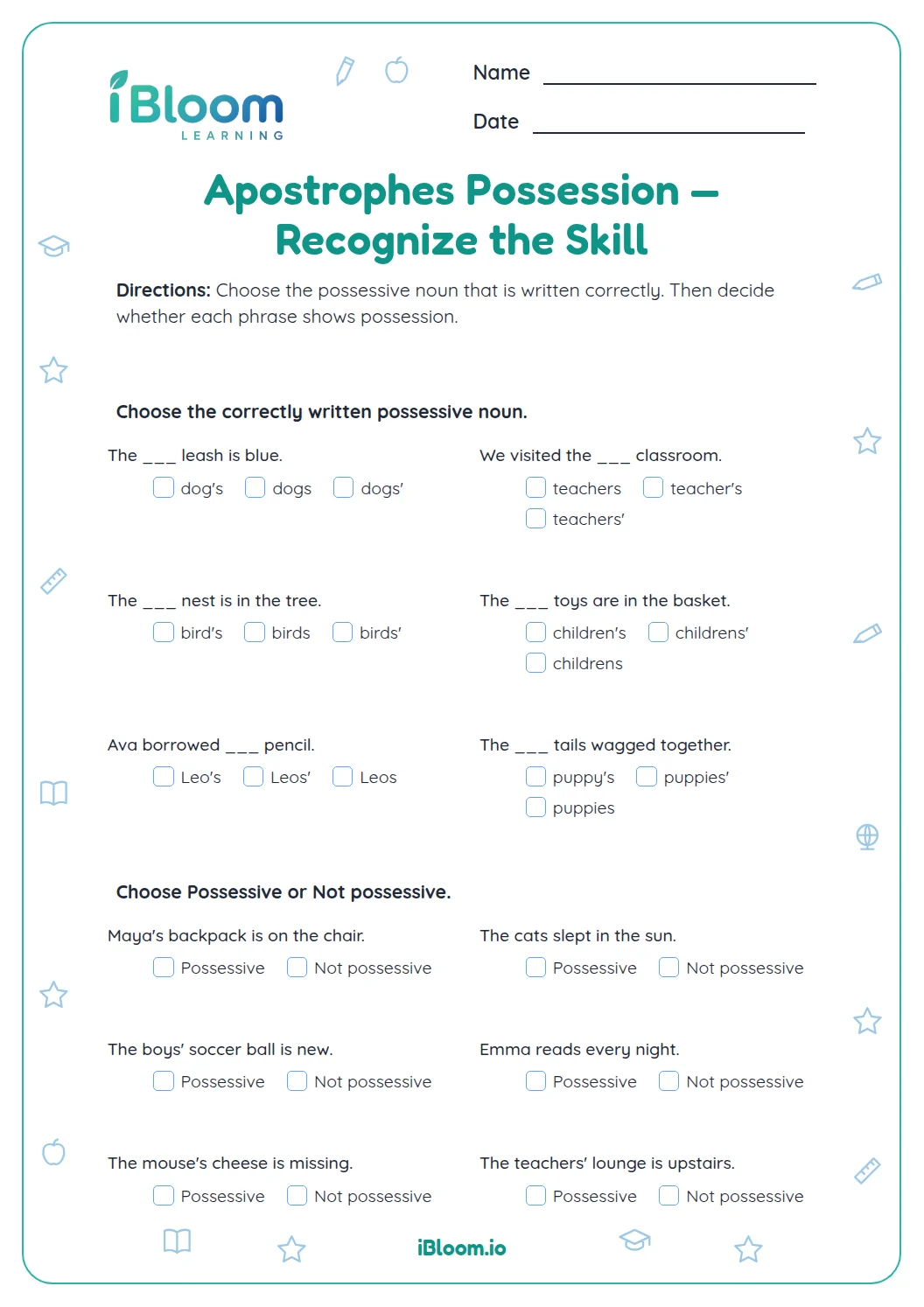
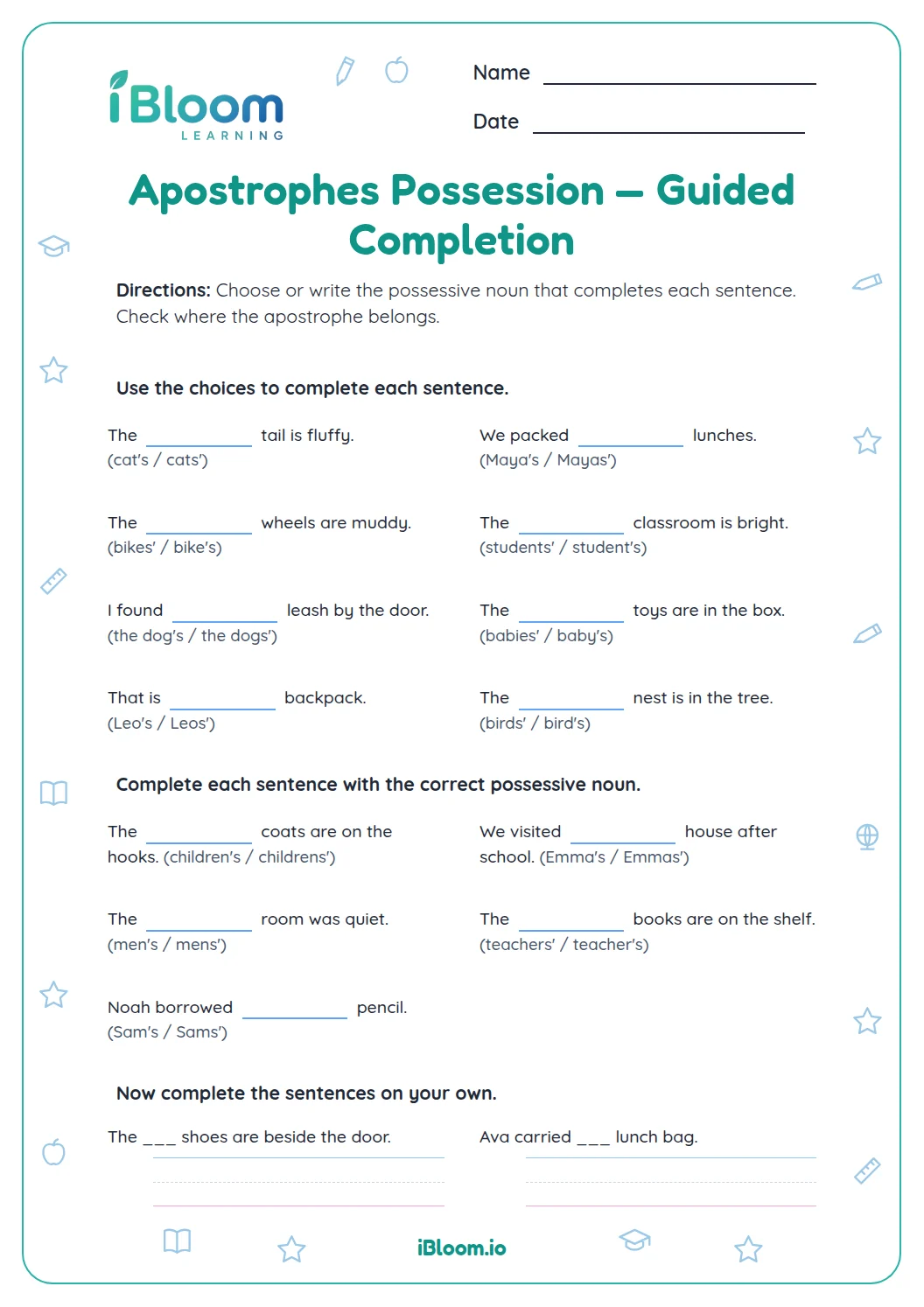
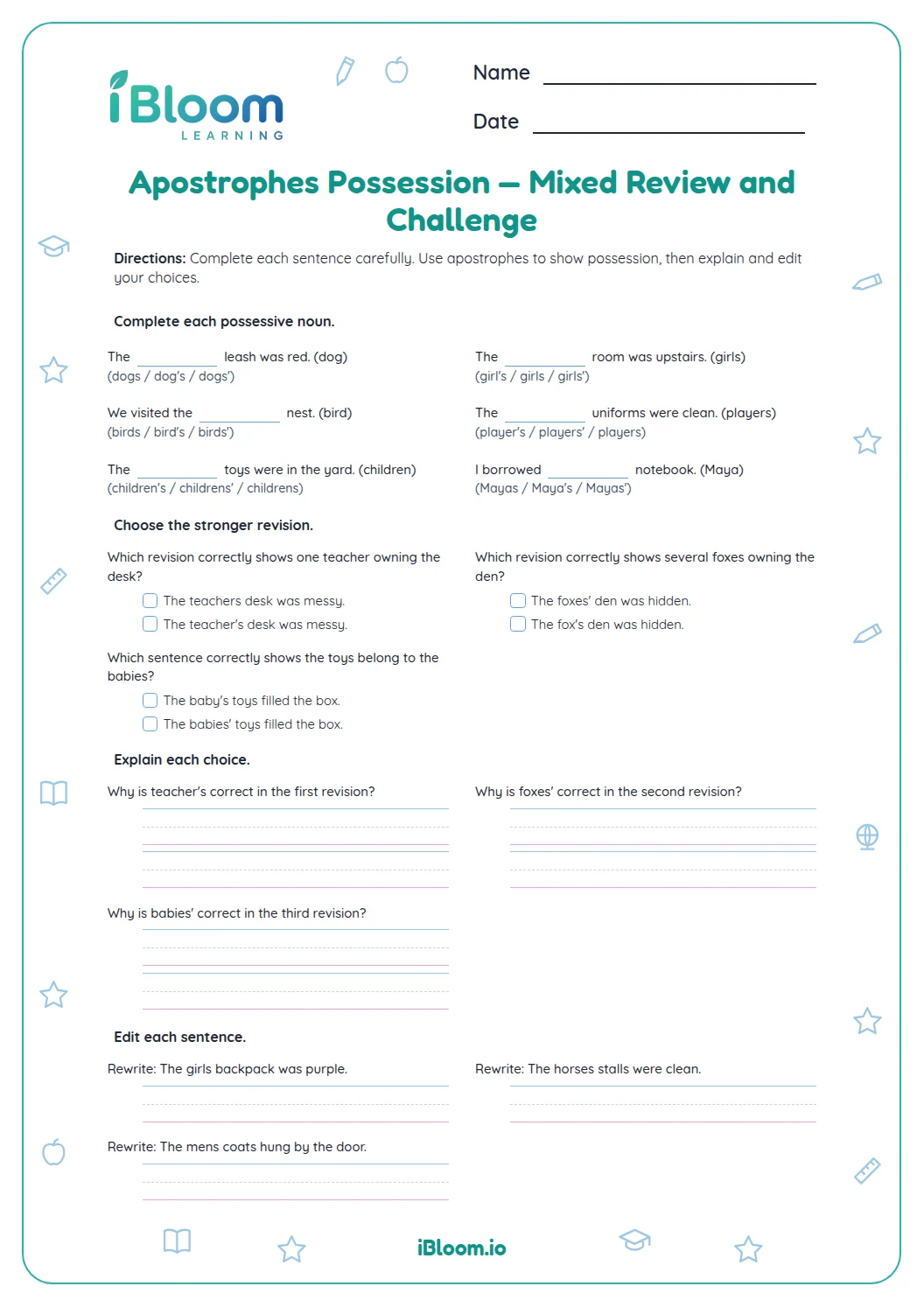
This Grade 4 sentence-practice worksheet gives students 18 blanks for possessive nouns. They form singular possessives, plural possessives ending in s, and possessives with irregular plural owners. The targeted punctuation practice connects to CCSS L.2.2.c and includes a separate answer key.
Aligned to L.2.2.c
Which possessives will students write?
The 18 sentences group owners by spelling pattern. Part A uses singular owners, Part B uses plural owners that already end in s, and Part C uses irregular plurals. Each blank asks for one possessive noun.
- 1The ___ uniforms are folded together. (players)
- 2players + apostrophe after the final s = players’
- 3The players’ uniforms are folded together.
Where does the apostrophe go for one owner?
For a singular owner, add apostrophe and s. Maya becomes Maya’s, and coach becomes coach’s. Read the whole sentence after filling the blank to check that the owner and the object make sense together.
- 1Question 1: ___ lunch box is on the hook. (Maya)
- 2Maya is the singular owner, so add apostrophe and s.
- 3Maya’s lunch box is on the hook.
What changes for owners that already end in s?
For a regular plural noun ending in s, add an apostrophe after the final s: players’ uniforms. For an irregular plural such as children, add apostrophe and s: children’s crayons. The ending of the owner tells you which pattern to use.
How to use this worksheet
- 1Read the words in parentheses to find the owner.
- 2Decide whether the owner is singular, regular plural ending in s, or irregular plural.
- 3Use apostrophe and s for a singular or irregular plural owner.
- 4Use an apostrophe after the s for a regular plural owner ending in s.
- 5Read the completed sentence aloud and check the meaning.
Common mistakes and quick fixes
The mistake
Writing players’s for a plural noun that already ends in s.
The fix
Keep the plural s and place only an apostrophe after it: players’.
The mistake
Writing childrens’ for the irregular plural children.
The fix
Children does not end in s, so add apostrophe and s: children’s.
The mistake
Leaving out the apostrophe in Maya’s.
The fix
Check the owner’s ending and add the apostrophe before the possessive s.
Common Core alignment
This sentence practice focuses on forming possessive nouns with an apostrophe.
Use an apostrophe to form frequently occurring possessives.
On this sheet: The sentence blanks ask students to form possessives with apostrophes, including singular and plural owners.
Show the official wordingHide the official wording
Use an apostrophe to form contractions and frequently occurring possessives.
What to practice next
Make more practice
Further reading
Questions parents and teachers ask
What is a possessive noun?
A possessive noun names who owns or has something. On this worksheet, the owner appears in parentheses and students add the apostrophe pattern that fits it. For example, Maya becomes Maya’s in “Maya’s lunch box”; the completed sentence identifies the lunch box as hers.
Where does the apostrophe go after a plural noun ending in s?
For a regular plural owner that already ends in s, place the apostrophe after the final s. Players becomes players’, and students becomes students’. Part B practices this pattern with plural owners in complete sentences, so the punctuation stays tied to meaning.
How do irregular plural possessives work?
An irregular plural such as children or women does not end in s. Add apostrophe and s to form children’s or women’s. Part C includes these forms so students can compare them with regular plurals that already end in s and notice the spelling difference.
How many sentences are included?
The worksheet has 18 sentence blanks across two worksheet pages, followed by a separate answer key. Six items focus on singular owners, six on regular plurals ending in s, and six on irregular plural owners. Each blank takes one possessive noun.
How many kinds of owners are practiced?
The worksheet practices three spelling patterns: singular owners such as Maya, regular plurals ending in s such as players, and irregular plurals such as children. Each sentence supplies the owner in parentheses, so students can focus on choosing the apostrophe pattern that matches it.