






About this worksheet
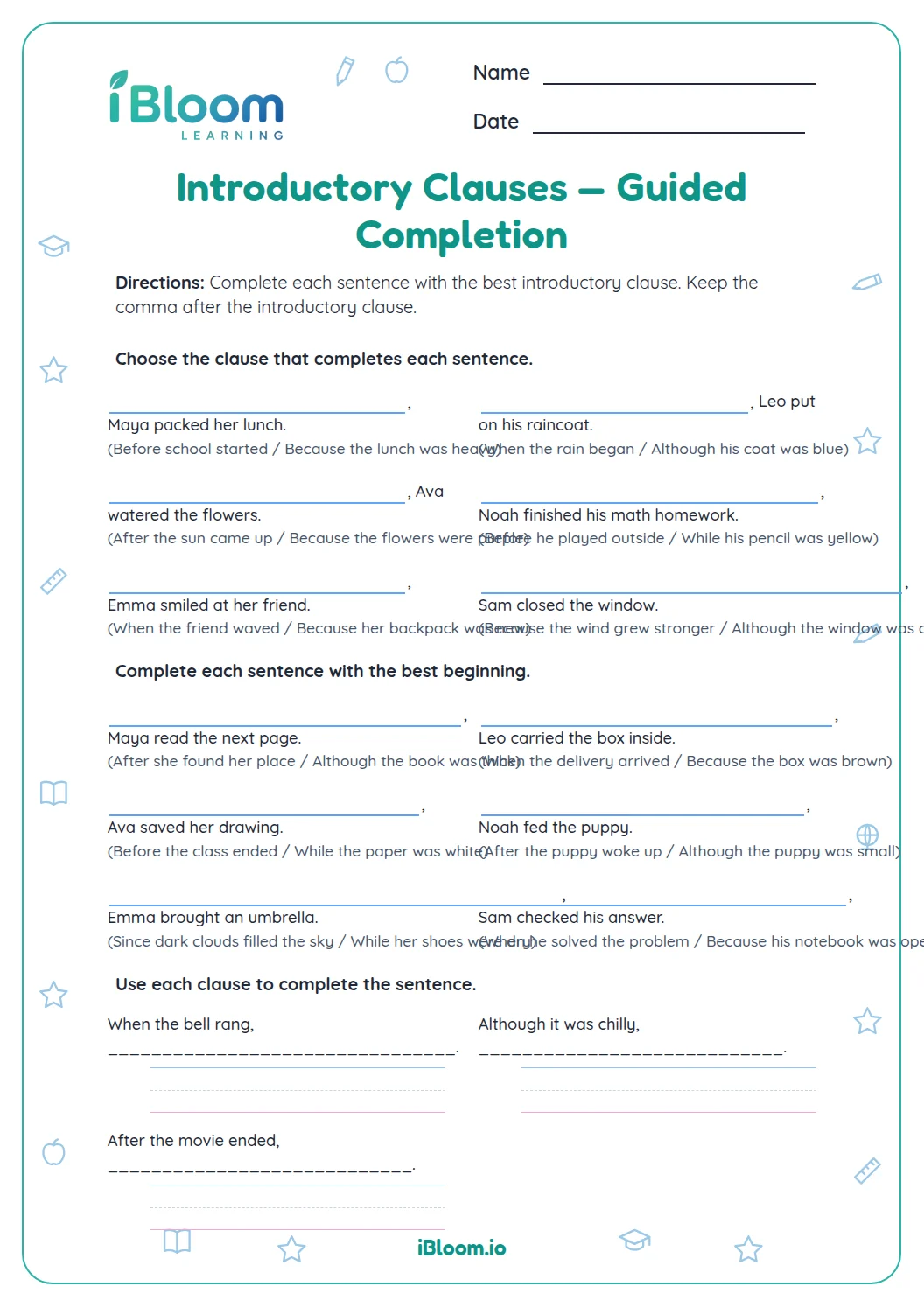
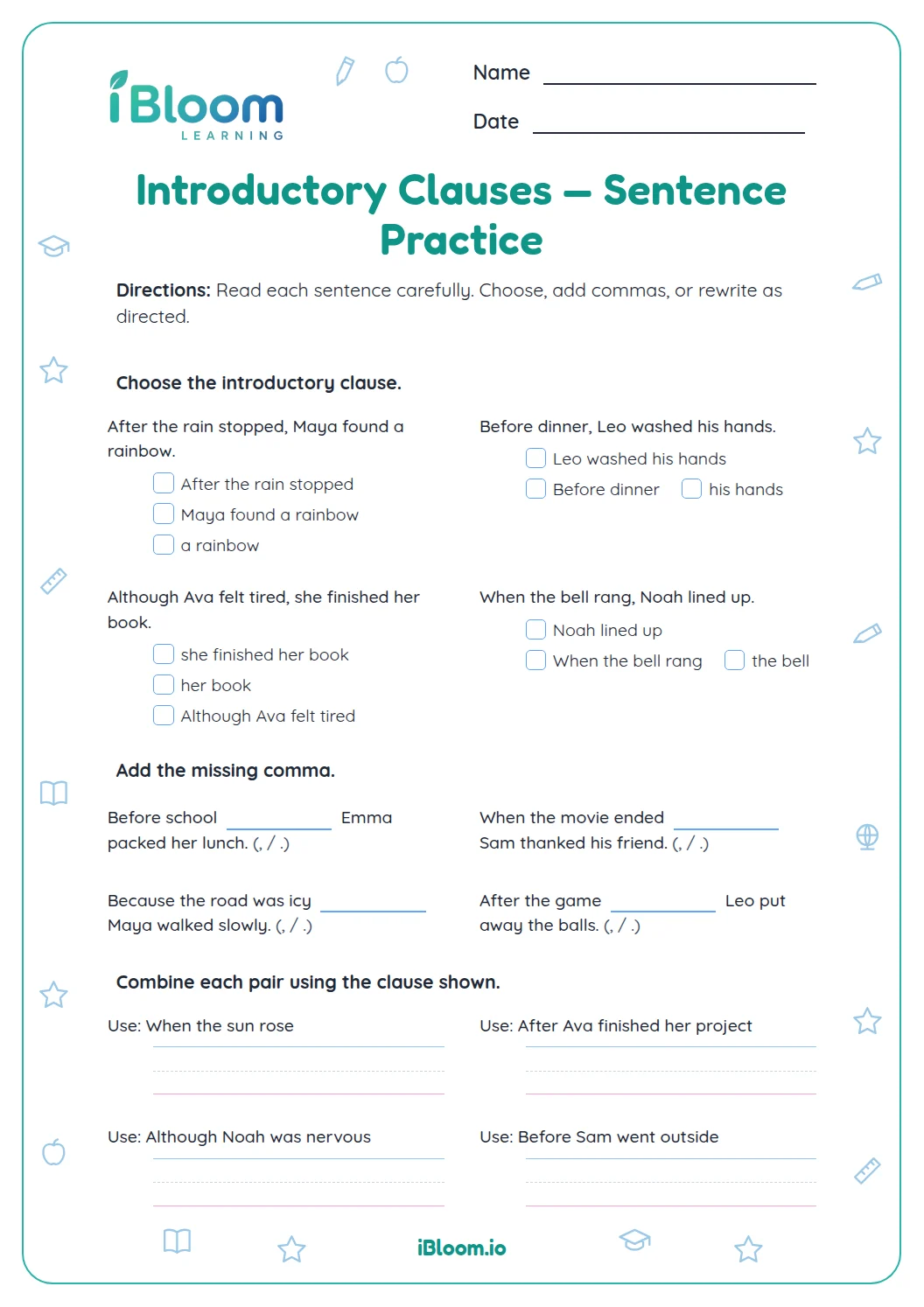
This Grade 4 worksheet focuses on introductory clauses and the comma that separates an opening clause from the main clause. Learners identify the opening in six sentences, add missing commas in four, then write four sentences using given openings or correcting punctuation. The answer key shows sample sentences for open-ended items.
What is an introductory clause?
It opens a sentence and sets up the main idea. Part A asks learners to select the opening clause in six complete sentences, such as “Before the sun rose, the hikers packed their bags.”
How does the worksheet practice comma placement?
Part B gives four sentences with the comma omitted. Learners rewrite each sentence and place a comma after the introductory clause and before the main clause.
How do learners apply the punctuation rule?
Part C has four sentence-writing prompts, including supplied opening clauses and sentences that need punctuation. The key gives sample responses; other complete, correctly punctuated sentences can also work.
- 1Before the show began the audience found their seats.
- 2Before the show began, the audience found their seats.
How to use this worksheet
- 1Read the entire sentence.
- 2In Part A, find the opening clause before the main clause.
- 3In Part B, mark where that opening ends and add the comma.
- 4In Part C, complete the thought after the given opening.
- 5Reread each sentence aloud and check its punctuation.
Common mistakes and fixes
The mistake
Putting the comma after the subject instead of after the opening clause.
The fix
Find the full introductory clause first, then put the comma at its end.
The mistake
Leaving an introductory dependent clause by itself.
The fix
Add a main clause so the sentence expresses a complete thought.
The mistake
Adding a comma but changing the sentence meaning.
The fix
Keep the original ideas and use punctuation to show where the main clause begins.
What to practice next
Questions parents and teachers ask
What is an introductory clause?
An introductory clause comes before the main clause and sets up the sentence. In “When the bell rang, students gathered their books,” the opening is “When the bell rang.” Part A asks learners to identify that opening before practicing punctuation.
Where should the comma go?
Place the comma after the introductory clause and before the main clause. For example, write “After the storm passed, we saw a rainbow.” Part B provides sentences without that comma, and learners rewrite them with the punctuation in the correct place.
How many items are on the worksheet?
There are 14 items in three parts: six clause-identification questions, four comma edits, and four writing or correction prompts. The answer key follows the three worksheet pages and includes sample responses for the open-ended sentences. Learners can use the three-part sequence to move from recognition to punctuation and then sentence creation.
Can a child write a different answer from the key?
Yes. The last part includes original sentences, so the key gives examples rather than the only possible wording. A response should contain a complete main clause and place a comma after the introductory clause. The prompt provides the opening; the learner supplies a sensible main idea that completes the sentence.
Is this a comma worksheet or a clause worksheet?
It practices both ideas together: identifying the introductory clause and using a comma to separate it from the main clause. The examples move from recognizing the opening to editing punctuation and writing sentences with supplied openings. Each part gives practice with one stage of the same editing skill, from recognition through writing.