






About this worksheet
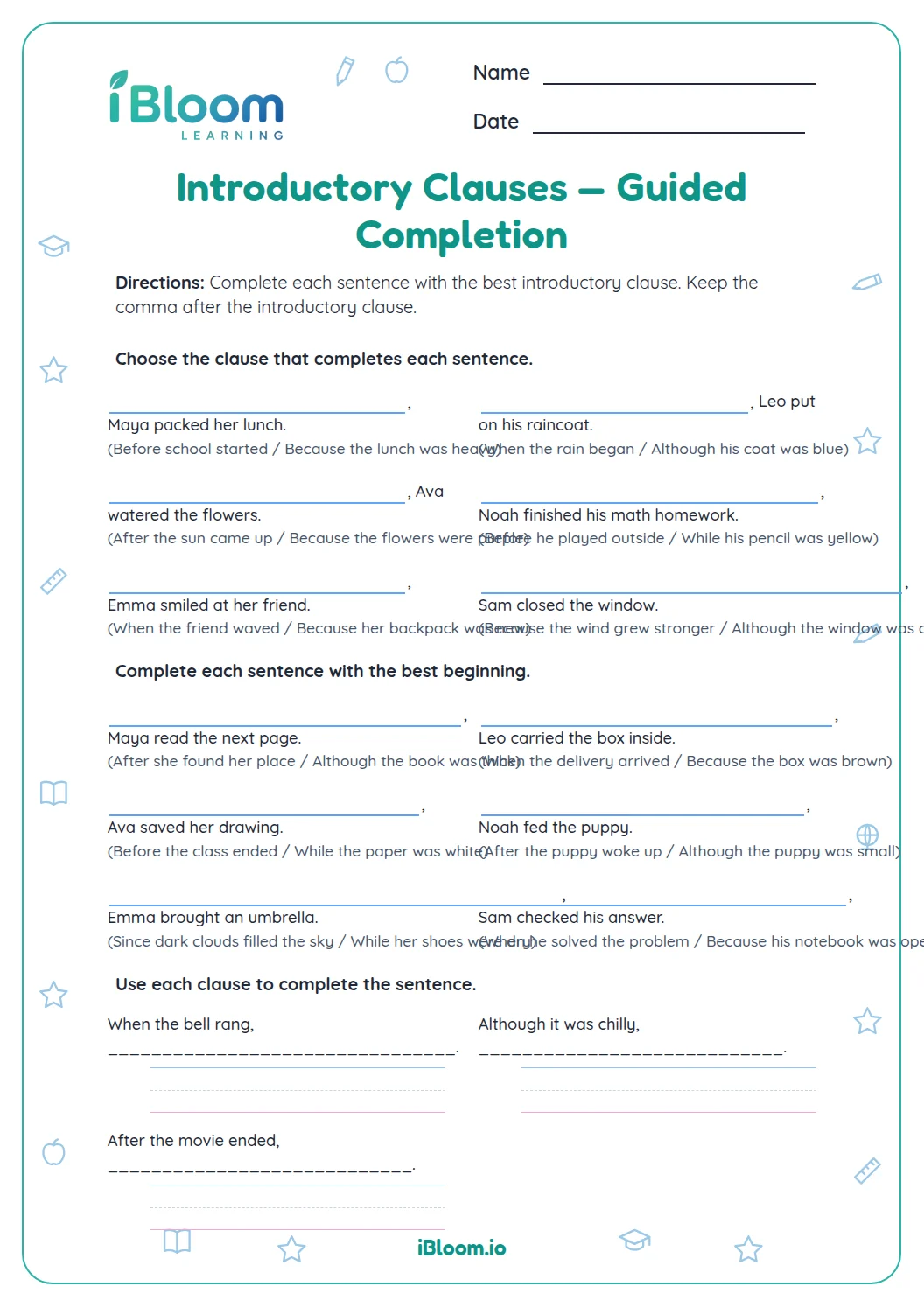
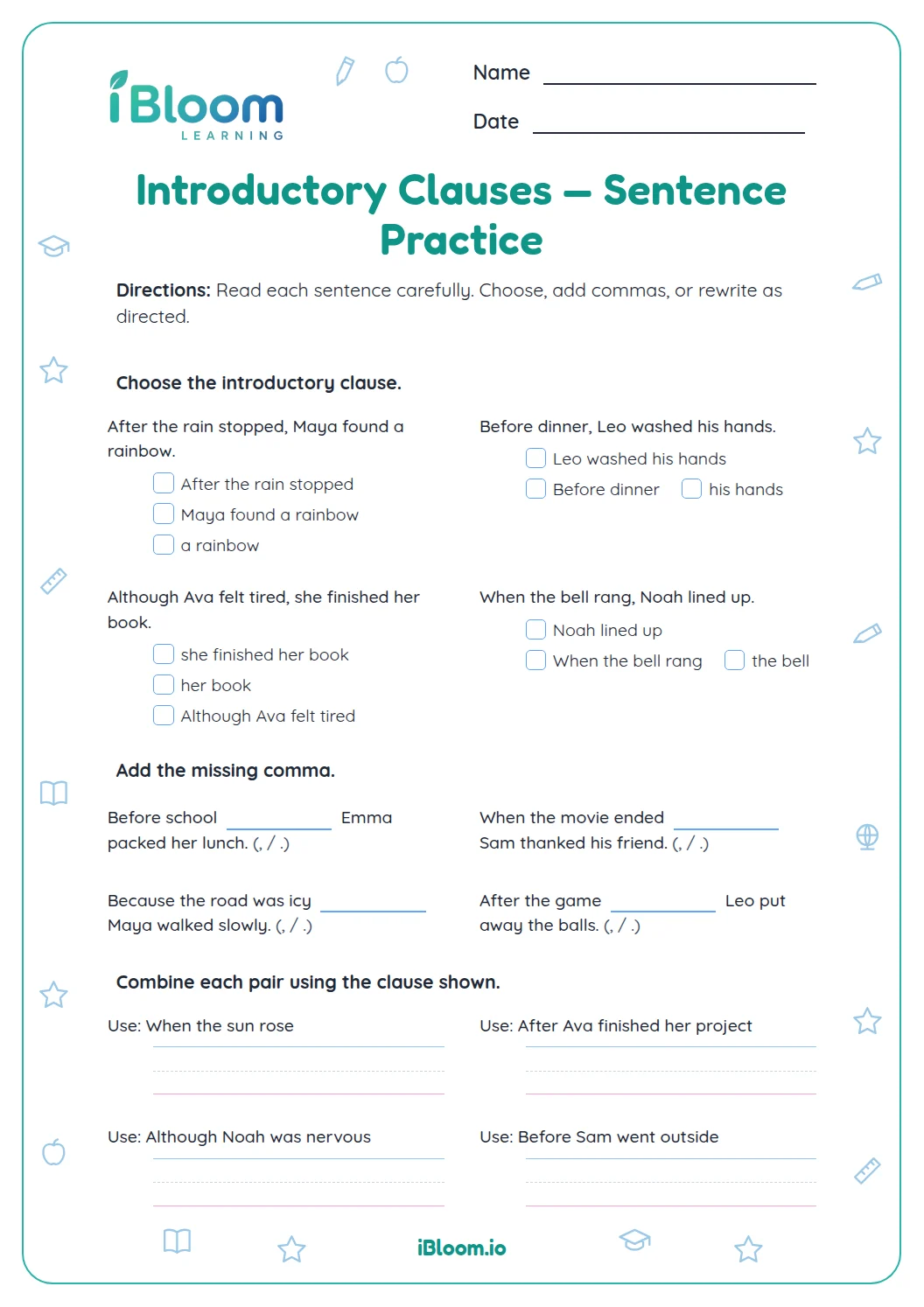
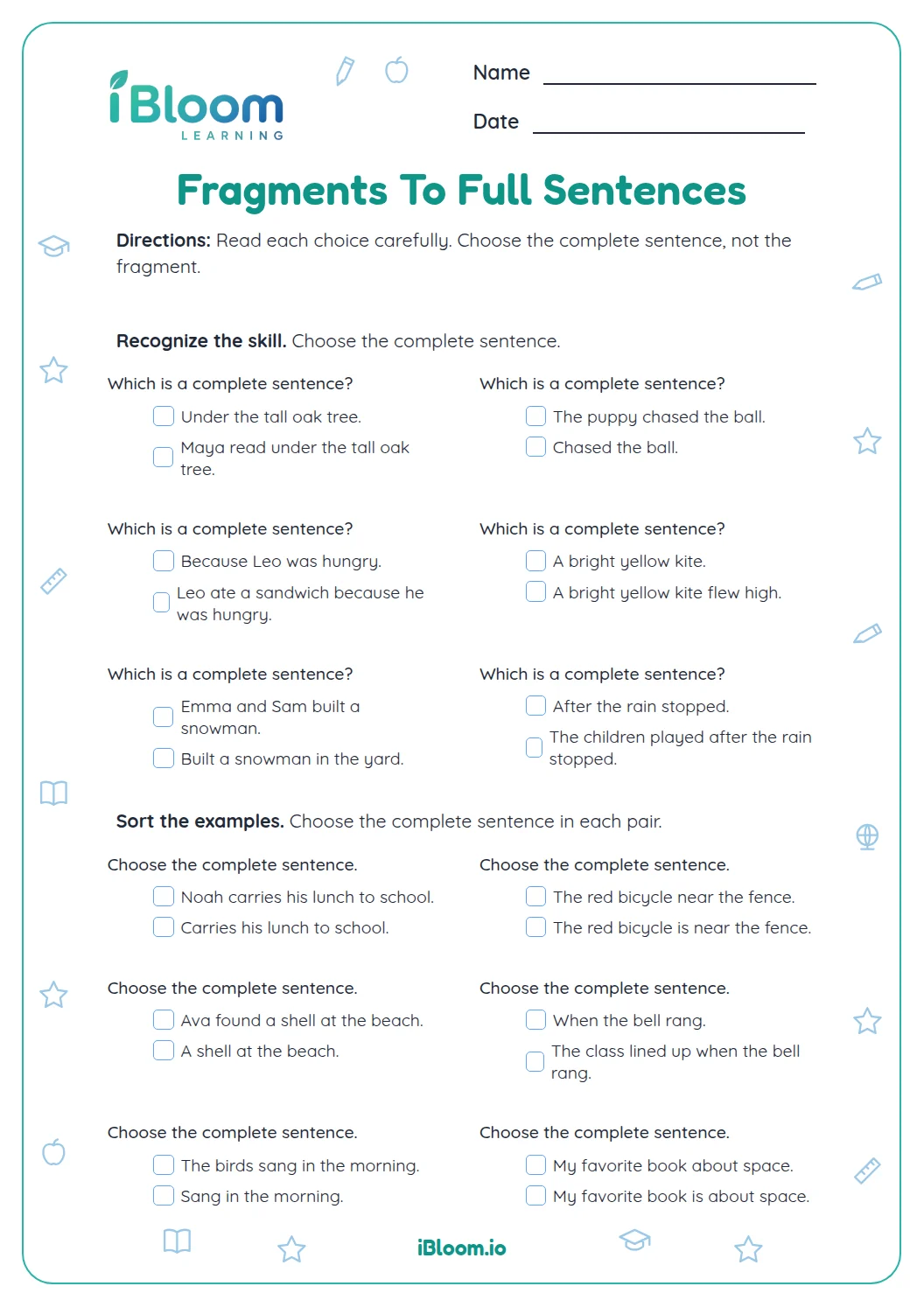
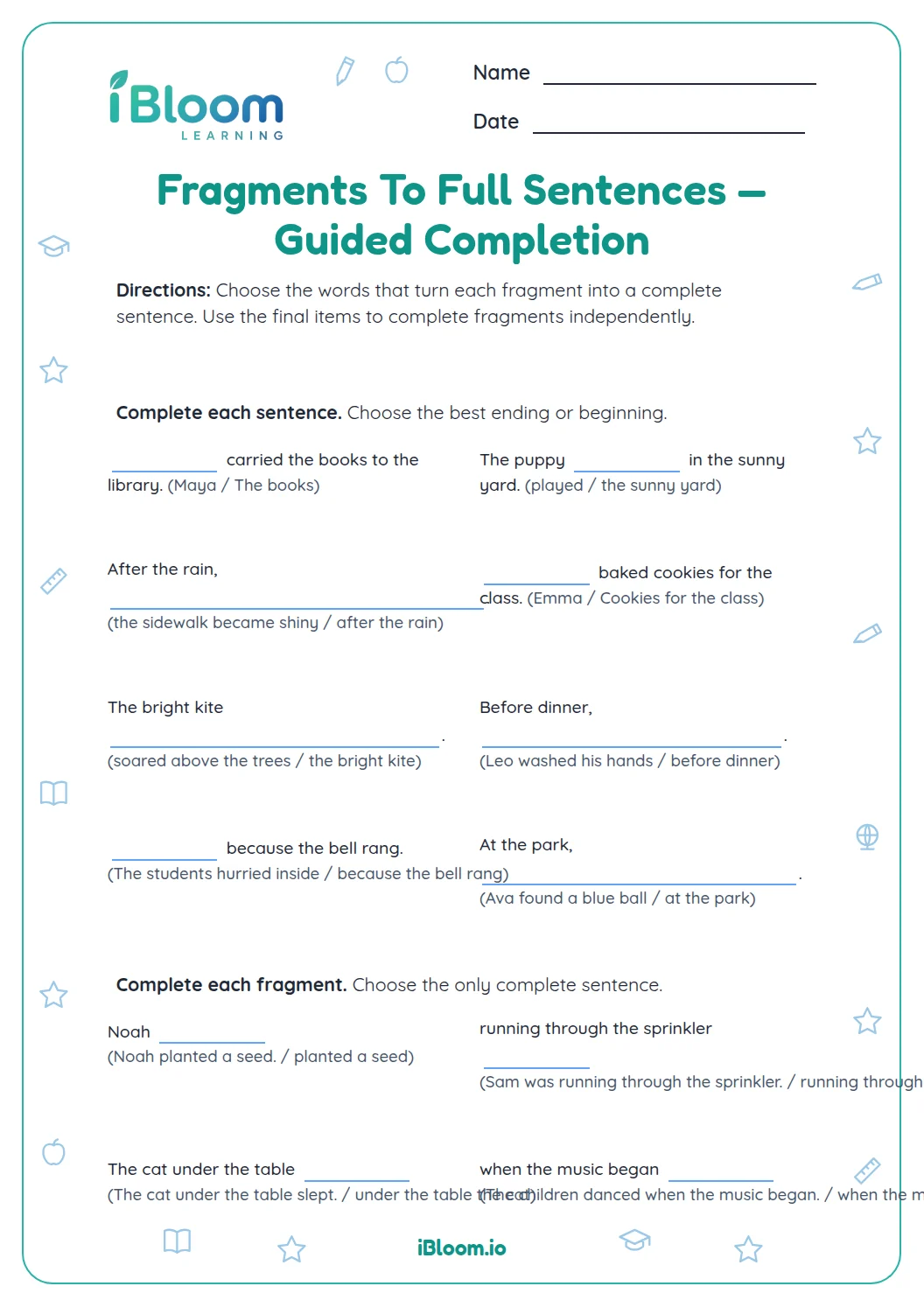
This free Grade 4 worksheet helps students turn introductory clauses into complete sentences. Part A gives four unfinished starters. Part B asks students to combine four pairs of ideas, and Part C asks for four original sentences with specified opening words. The 12 responses practice CCSS L.4.1f by joining dependent starters to main clauses that express complete thoughts. In Parts B and C, students also place a comma after each introductory clause. The separate answer key includes sample completions and combinations, so adults can check grammar and meaning while accepting different sensible responses.
Aligned to L.4.1f
Why is an introductory clause unfinished?
An introductory dependent clause has a subject and verb, but its opening word makes the reader wait for more. “When the bell rang” leaves a question: what happened then? A main clause answers it and can stand alone.
In Part A, students finish each printed starter by writing only the missing main clause. A comma is already supplied. The new ending needs its own subject and verb, not just a place or a time.
- 1Starter: When the bell rang
- 2Main clause: we packed our bags
- 3Complete sentence: When the bell rang, we packed our bags.
- 4Write only the ending: we packed our bags.
How do the joining words change the meaning?
Because introduces a reason, when introduces a time, if introduces a condition, and although introduces a contrast. Part B supplies two related ideas and names the word to use at the start. Students combine the ideas without losing either one.
For the rain and indoor-play pair, beginning with Because makes the cause clear: “Because it was raining, we played inside.” Read the new sentence aloud to check the relationship.
What should I check in an original sentence?
Part C asks for sentences beginning with Because, When, If, and Although. Each response should have a complete introductory clause, a comma, and a complete main clause. A sensible connection between the two parts matters as much as including the requested word.
Ask students to read just the words after the comma. If those words make a complete sentence, the main clause is present. Then reread the whole sentence to check that the opener supplies a reason, time, condition, or contrast.
How to use this worksheet
- 1Read “When the bell rang” aloud and notice that the thought is unfinished.
- 2Finish question 1 by writing a main clause after the starter’s printed comma.
- 3Complete Part A, checking for a subject and verb after each comma.
- 4Combine the paired ideas in Part B using the required opening word.
- 5Write Part C and read each main clause alone before checking the full sentence.
Mistakes to notice and fix
The mistake
Writing “Because I forgot my lunch.” as the complete answer.
The fix
Add what happened: “Because I forgot my lunch, I called home.”
The mistake
Finishing “When the bell rang” with only “after school.”
The fix
Add a main clause with a subject and verb, such as “we packed our bags.”
The mistake
Writing “Although I was tired, I went to sleep.” without a clear contrast.
The fix
Choose a main clause that contrasts with tiredness, such as “I finished the chapter.”
Common Core alignment
Turn introductory-clause fragments into complete sentences.
On this sheet: Students complete dependent-clause fragments and combine ideas into complete sentences.
Show the official wordingHide the official wording
Produce complete sentences, recognizing and correcting inappropriate fragments and run-ons.*
What to practice next
Make more practice
Further reading
Questions parents and teachers ask
What is an introductory clause on this worksheet?
It is a dependent clause at the start of a sentence, such as “When the bell rang.” It has a subject and verb but leaves the thought unfinished. Part A supplies a comma; students write a main clause. In Parts B and C, they write both clauses and the comma.
How is a clause different from a phrase?
A clause has a subject and a verb, while a phrase does not contain that complete pair. “When the bell rang” names a subject, bell, and an action, rang. The worksheet uses clause starters so students practice joining an unfinished clause to a complete main clause.
Must every response match the answer key?
No, the completion and original-writing tasks allow different sensible answers. Part A asks for only the missing main clause. The combinations keep both supplied ideas and the required opening word. Check for a complete main clause, a clear connection between ideas, and commas in Parts B and C.
Where does the comma go?
The comma goes after the full introductory clause and before the main clause. In “Because it was raining, we played inside,” it follows raining. Have students identify the complete reason first, then place the comma at the point where the sentence begins telling what happened.
What makes an although sentence work?
An although sentence connects ideas that contrast. For example, being tired might suggest stopping, but finishing a chapter shows a different outcome. Question 12 asks students to create that kind of contrast themselves. Check that both clauses are complete and that the second idea is meaningfully unexpected.