







About this worksheet
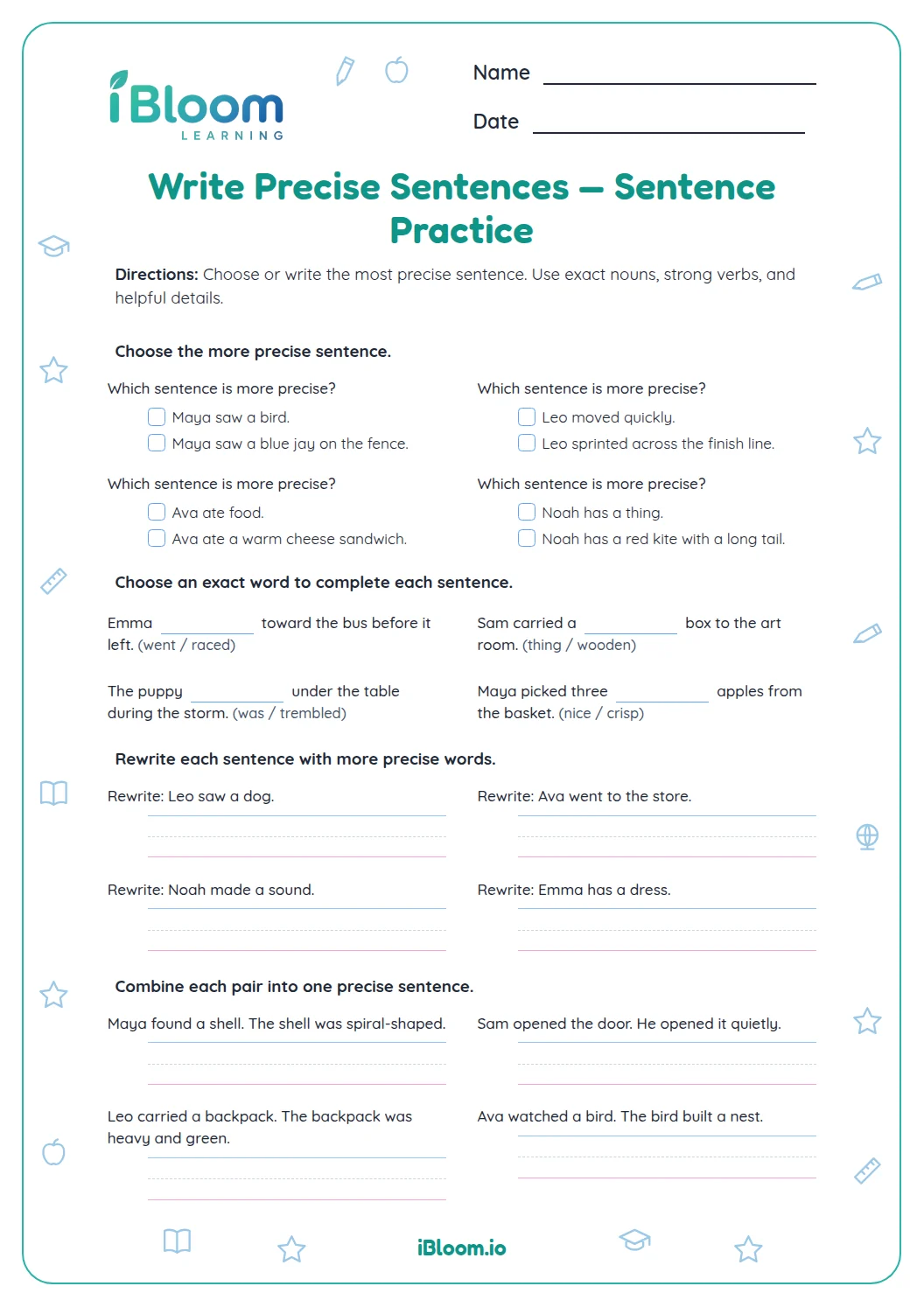
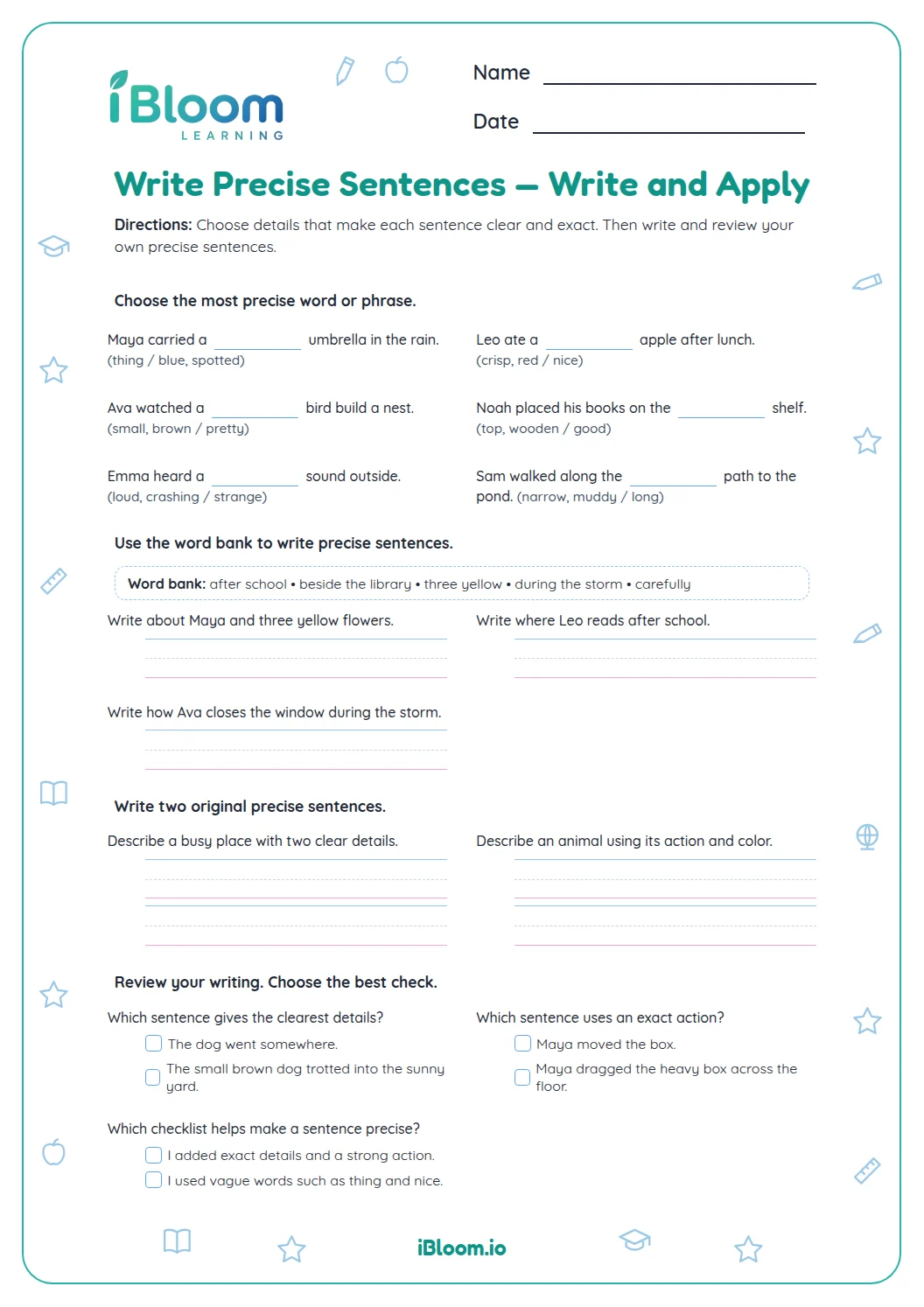
This free printable worksheet teaches Grade 4 writers to edit a sentence until every word does real work. In Part A, children circle the one vague word in four sentences, such as thing in "Maya put the thing on the table." In Part B, they choose the most exact word or phrase. In Part C, they rewrite three plain sentences with exact nouns, verbs and details of their own. It practices Common Core L.4.3.a, choosing words and phrases to convey ideas precisely, with W.4.3.d. A separate answer key shows the vague words and sample rewrites.
Aligned to L.4.3.a and W.4.3.d
What makes a sentence precise?
A precise sentence tells the reader exactly what, how or which one. "Noah saw a bird" is correct, but the reader has to guess. "Noah spotted a heron by the lake" shows what Noah saw and how he found it. Nothing in the first sentence is wrong; the words are just too general to paint a picture.
Editing for precision means asking of every word, "Could this word describe a hundred different things?" If so, a more exact word is waiting.
- 1Emma got a gift.
- 2Vague: got (bought it? won it? was handed it?) and gift (what kind?)
- 3Ask: how did she get it, and what was it?
- 4Sample rewrite: Emma unwrapped a red kite.
- 5Unwrapped shows how, and red kite shows what.
Which words are the usual suspects?
Some words are easy to reach for when writing fast: thing, stuff, nice, good, big, went, got, said, food. They are not wrong, but they carry little information. Part A uses four of them (thing, went, nice and food), each in a sentence where every other word is already exact.
Finding the weak word is half the skill. Once a child can circle it, choosing a stronger word is a matter of asking what the sentence is really about.
How do you fix a vague sentence?
Try three questions in order: What exactly was it? How exactly did it happen? What does it look, sound or feel like? A noun fix names the thing (heron, not bird), a verb fix shows the motion (crept, not went) and a detail fix adds a sense (creaked, not made noise).
In Part B children choose among those fixes. Each question also offers a choice that sounds fine but tells the reader no more, such as made noise or was loud in place of creaked.
What is on this worksheet?
Eleven questions on two pages, in three parts that move from noticing to choosing to writing. All the sentences are about everyday children, animals and objects, so the vocabulary stays at Grade 4 level.
- Part A, Find the vague word: circle thing, went, nice or food in four short sentences
- Part B, Pick the exact word: a stronger verb, a more exact sentence, a sound word and a clearer phrase
- Part C, Rewrite it: three plain sentences to rewrite with exact words, on writing lines
- Answer key with the vague words and sample rewrites on a separate page
How to use this worksheet at home or in class
- 1Warm up by saying two sentences out loud: "The dog went outside" and "The dog bolted outside." Ask which one lets you see the dog.
- 2Do question 1 together. Read the sentence aloud and ask which word could mean a hundred different things.
- 3Let your child finish Part A and Part B alone, saying each choice aloud before marking it.
- 4For Part C, have your child answer three questions before writing: What was it? How did it happen? What did it look like?
- 5Read the rewrites aloud and ask, "Could you picture it?" There is no single right sentence, so look for exact nouns and verbs.
- 6Check Parts A and B with the answer key, and compare Part C with the sample rewrites.
Common mistakes and quick fixes
The mistake
Swapping in a longer word that is no more exact, such as changing nice to pleasant.
The fix
Ask what the new word tells the reader. Pleasant still does not say what was good, so name the detail: "Ava made a card with gold stars."
The mistake
Piling on adjectives, like "a big, huge, giant dog."
The fix
Pick one exact word or a noun that carries the size. "A huge, shaggy collie" says more than three words that all mean big.
The mistake
Fixing only one vague word, as in “Emma got a red kite” for question 10, which still leaves the weak verb got.
The fix
Check every word, including the verb. Ask how Emma got it: did she unwrap it, win it or buy it? “Emma unwrapped a red kite” fixes both words.
Common Core alignment
Most US states use the Common Core Language and Writing standards or a close state version. This sheet practices the standards below.
Choose exact words and phrases to say what you mean.
On this sheet: Parts A and B ask children to spot vague words and choose the more exact word or phrase.
Show the official wordingHide the official wording
Choose words and phrases to convey ideas precisely.
Use concrete words and details so events are clear.
On this sheet: Part C asks children to rewrite plain sentences with concrete words and sensory details.
Show the official wordingHide the official wording
Use concrete words and phrases and sensory details to convey experiences and events precisely.
What to practice next
Make more practice
Further reading
Questions parents and teachers ask
What should my child know before this worksheet?
Your child should be able to write a complete sentence with a subject and a verb, and know common nouns and verbs. They do not need to know technical terms like "concrete" or "sensory." The sheet builds the habit of asking whether a word is exact before moving on.
Is there one right answer for the rewrites in Part C?
No. Part C questions have many good answers, and the key shows sample rewrites such as "Noah spotted a heron by the lake." Accept any sentence that replaces the vague words with exact nouns, verbs or details, and keeps the original meaning. Reading it aloud helps check.
What is the vague word in "Maya put the thing on the table"?
The vague word is thing. It could mean a book, a bowl, a bag or almost anything. A precise version names it: “Maya put the pitcher on the table.” Children can ask, “What exactly was it?” to find a better noun, and the same question fixes food in question 4.
Why does Part B include answers that look good but are not exact?
Some wrong choices are longer or sound fancier without saying more. "Made noise" is not more exact than "was loud," while "creaked" tells the reader what sound the gate made. Children learn that a precise word carries more information, not just more letters.
How can I help a child who keeps writing nice and good?
Ask, "What made it nice?" and have your child answer in a few words. Then swap those words in. "Ava made a nice card" becomes "Ava made a card with gold stars." Keep a short list of replacement words on the wall for the next piece of writing.
Is there an answer key for this worksheet?
Yes. Separate answer key pages show the vague word in each Part A sentence, the correct choice in Part B and a sample rewrite for each Part C sentence. Print the worksheet pages for your child and keep the key for checking, or use the key to talk through each choice together.