


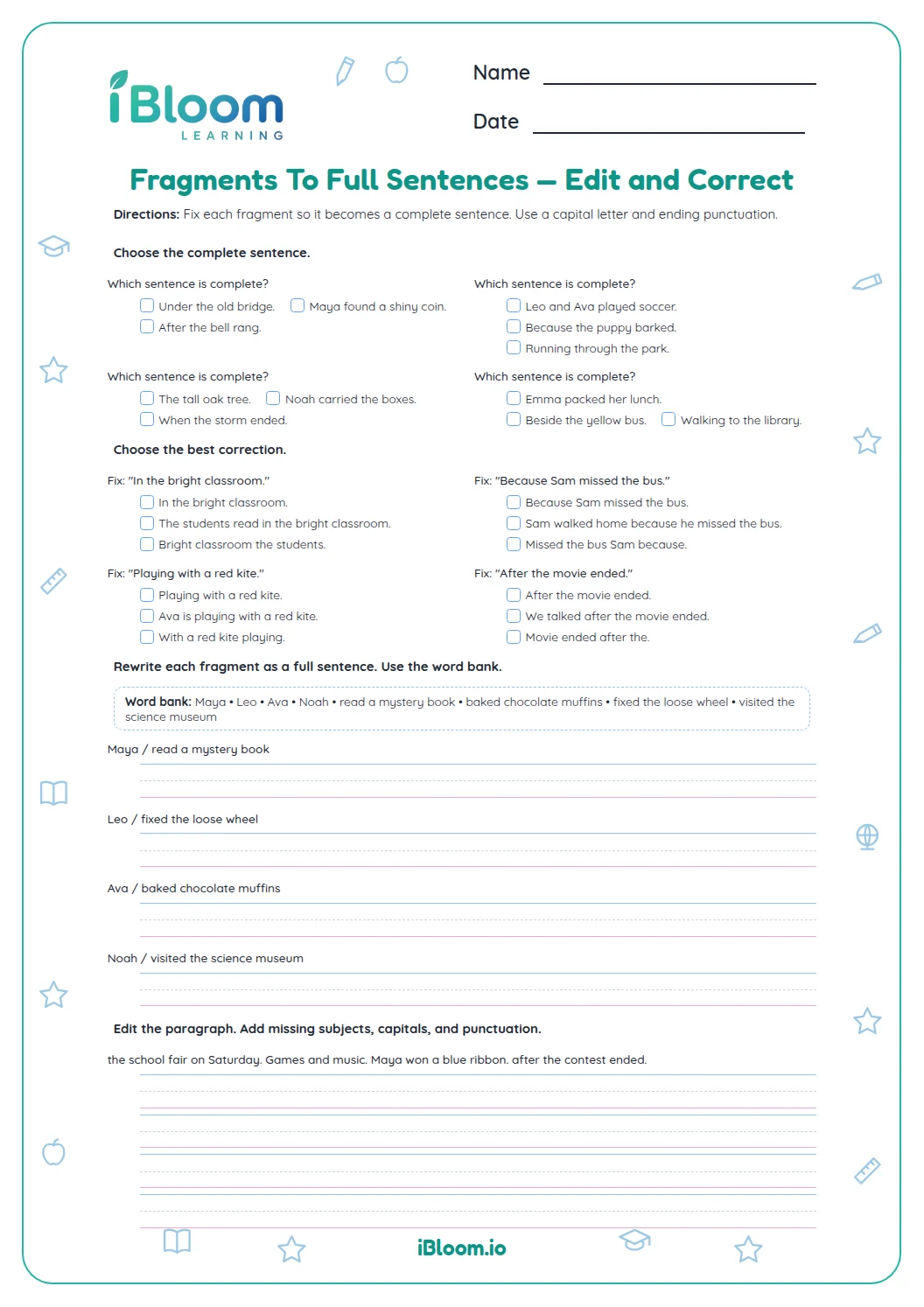


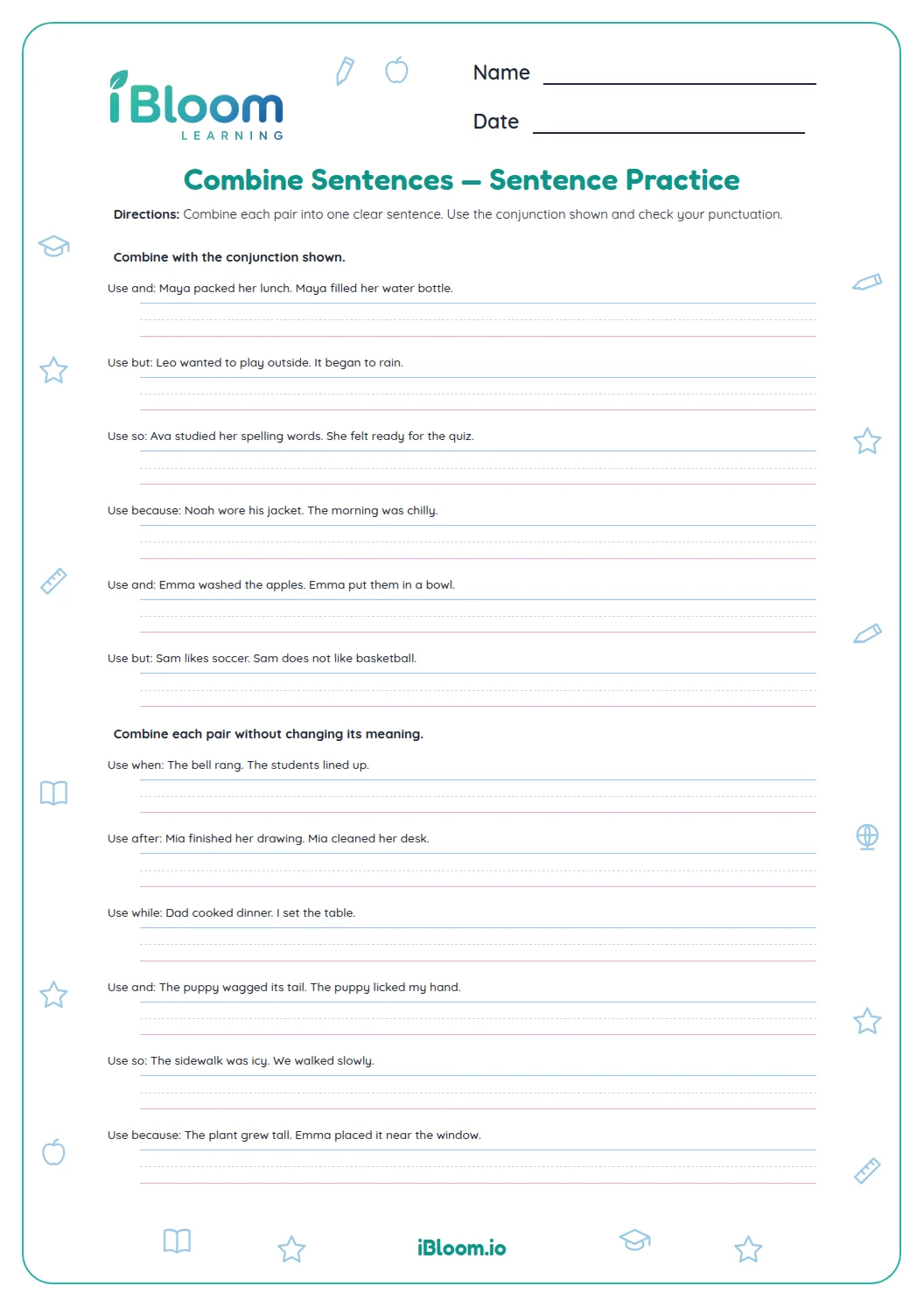


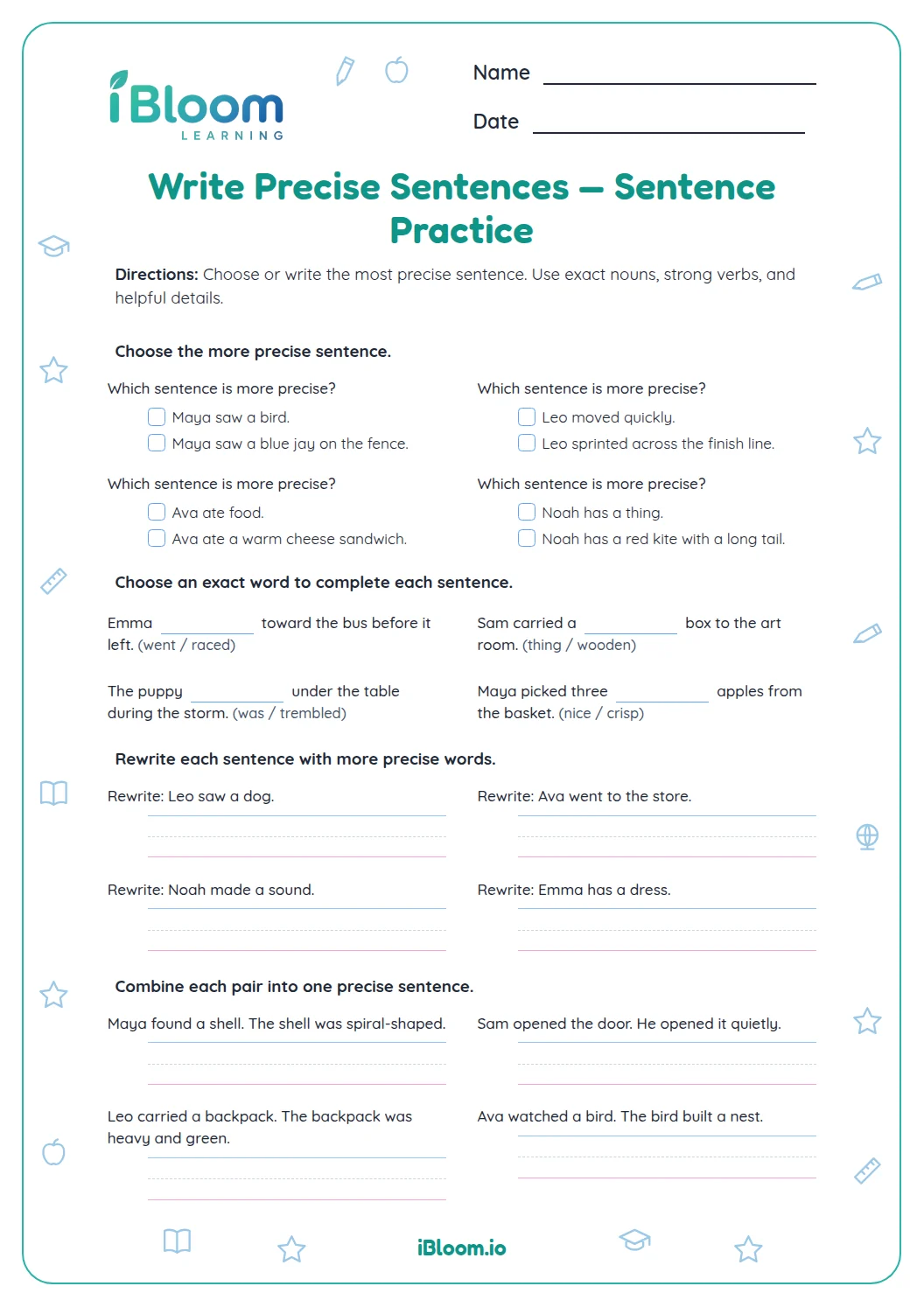
About this worksheet
This free Grade 4 worksheet helps children edit vague sentences so a reader can picture what happened. Part A asks them to identify four vague words. Part B has four sentence-completion items that add supplied details. Part C asks why one edit helps. Part D includes an independent sentence revision and a short paragraph edit. Three final choices give extra practice selecting precise details. The 14 tasks practice precise word choice under Common Core L.4.3.a and guided revision under W.4.5. The answer key identifies the vague words and gives sample responses.
Aligned to L.4.3.a and W.4.5
Which words need a clearer detail?
The four opening sentences use thing, nice, there, and something. Each leaves a gap for the reader: what object, what kind of lunch, which place, or what sound? Children circle just the word that needs replacing.
Part B returns to four of those situations with supplied details to complete. Part C asks why yellow kite is clearer than thing. Children practice making a precise choice and explaining what the reader learns from it.
- 1Original: Maya saw a thing beside the sidewalk.
- 2Detail to use: yellow kite
- 3Revision: Maya saw a yellow kite beside the sidewalk.
How do children keep an added detail relevant?
A useful detail answers a question raised by the original sentence. In “Ava went there after practice,” a place name tells the reader where Ava went. Adding the color of her shoes would leave the missing destination unresolved.
In Part B, use each supplied detail to complete a clearer sentence while keeping the original event. For the explanation, name the information that yellow kite adds: the object and its color. Part D lets children invent plausible details while meeting each prompt’s requirements.
How should the final paragraph be edited?
The last task begins “Sam found a thing. It was nice. He took it there.” Children identify the object, describe it, and name a destination. The three sentences should refer to the same object throughout.
A short answer is enough: Sam might find a silver key, describe it as shiny, and take it to the office. Check capitals and ending punctuation after the details are clear.
How to work through this sheet
- 1Read the first sentence and ask what thing could mean.
- 2Circle one vague word in each Part A sentence.
- 3Complete the four Part B sentences with their supplied details, then explain why yellow kite helps.
- 4For Part D, name the missing information before inventing a detail.
- 5Read the final paragraph aloud to check that all three sentences describe the same object.
- 6Compare with the sample key and discuss one detail that made the writing clearer.
Mistakes to discuss
The mistake
Adding adjectives while leaving thing as the main noun.
The fix
Name the object first: kite, key, or another specific noun.
The mistake
Replacing there with another vague place word such as somewhere.
The fix
Name a destination, such as the library or the school office.
The mistake
Changing the object halfway through the final paragraph.
The fix
Check what it refers to in each sentence; keep the same object from finding it to taking it somewhere.
Common Core alignment
Choose specific nouns and phrases to make sentence meanings clear.
On this sheet: Children replace vague words with precise details and explain meaning through clearer wording.
Show the official wordingHide the official wording
Choose words and phrases to convey ideas precisely.*
Strengthen sentences and a short paragraph through guided revision and editing.
On this sheet: Supplied details guide revisions before children edit independently and discuss them with an adult.
Show the official wordingHide the official wording
With guidance and support from peers and adults, develop and strengthen writing as needed by planning, revising, and editing. (Editing for conventions should demonstrate command of Language standards 1-3 up to and including grade 4 here.)
What to practice next
Make more practice
Further reading
Questions parents and teachers ask
What counts as a useful detail on this editing worksheet?
A useful detail makes the original meaning clearer. Yellow kite names the object Maya saw, and library names Ava’s destination. Ask what the reader still needs to know before adding words. A longer sentence is useful when its extra information answers that question and fits the original event.
Do children need to fix spelling errors in these sentences?
The main editing task is to improve vague wording by adding precise details. Children rewrite sentences and should use capitals and ending punctuation in their own responses. During checking, first discuss whether the meaning is clearer, then help the child correct any spelling or punctuation slips in the revision.
Must the detail completions match the sample key exactly?
Use the supplied detail in each sentence and keep the original event. The answer key shows one complete version, such as “Leo had warm tomato soup for lunch at school.” Check that the given food, location, and useful detail remain clear in the completed sentence.
How much should children write for the final task?
Children should rewrite the three short sentences as a connected paragraph. They need to name what Sam found, add a clear description, and say where he took it. Three concise sentences are enough. Check that the same object is described throughout and that each sentence adds useful information.
How can I help without choosing every detail for my child?
Ask a focused question such as “What sound did Noah hear?” or “Where did Ava go?” Let the child choose a plausible answer and try it in the sentence. In the guided part, point to the supplied detail; in the independent part, discuss whether their chosen detail fits.