






About this worksheet
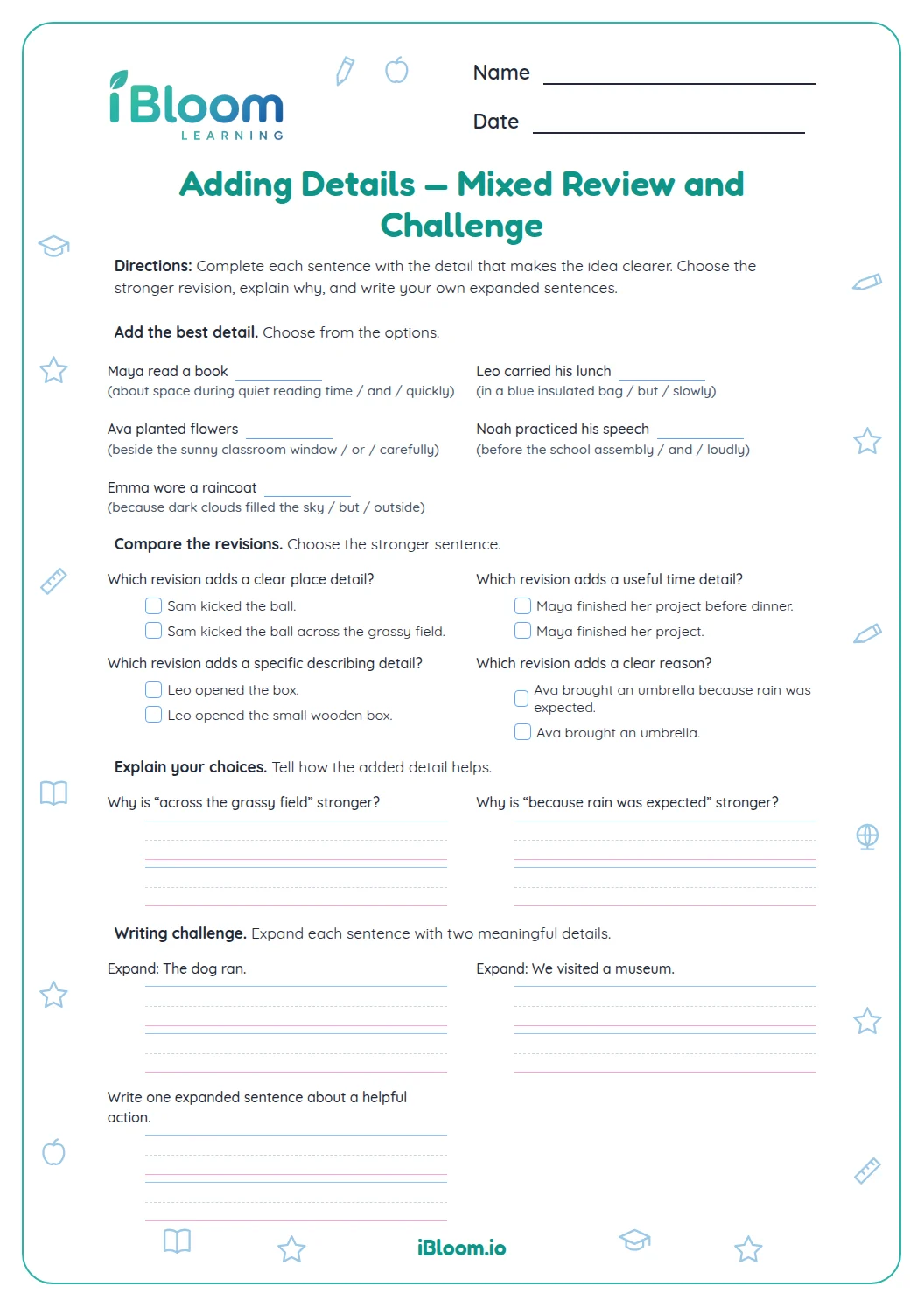
This Grade 4 worksheet gives students guided practice adding relevant details to sentences. They first choose a phrase that answers where, when, how, or what kind, then complete sentence stems and revise simple sentences in their own words. The progression supports sentence revision and editing in CCSS W.4.5. There are 15 questions across three parts, with a separate answer key and sample responses for open-ended writing.
Aligned to W.4.5
How do details make a sentence clearer?
A detail answers a useful question: where, when, how, or what kind. Part A asks children to choose the detail that fits a clue. In Part B, each blank needs a phrase that completes the thought.
- 1Question 1 asks where the puppy slept. “Under the kitchen table” answers where.
How can a writer add a detail independently?
Part C gives a sentence and asks students to fill a blank with a detail for where, when, how, or what kind. The sentence stays intact, so children can focus on making it more specific.
How can an adult give useful feedback?
Ask what new information the added phrase gives the reader. A detail should fit the sentence and answer the prompt, rather than simply adding extra words.
How to use this worksheet
- 1Read the clue word in each item: where, when, how, or what kind.
- 2Complete Part A by choosing the phrase that matches the clue.
- 3For Part B, read the entire sentence after adding your phrase.
- 4Write complete sentences for Part C; use the prompt to choose a detail.
- 5Compare open responses with the samples and discuss other clear answers.
Mistakes to watch for
The mistake
Adding an interesting phrase that does not answer the prompt.
The fix
Match the detail to the clue word before writing it.
The mistake
Writing only a phrase when the prompt asks for a sentence.
The fix
Copy the original idea and add the phrase to make one complete sentence.
The mistake
Adding so many details that the sentence becomes hard to follow.
The fix
Keep the detail focused on the event or person already named.
Common Core alignment
This practice connects sentence revision with Grade 4 writing expectations.
Revise and edit sentences by adding details that make meaning clearer.
On this sheet: Students revise simple sentences by adding precise details and writing complete expanded sentences.
Show the official wordingHide the official wording
With guidance and support from peers and adults, develop and strengthen writing as needed by planning, revising, and editing. (Editing for conventions should demonstrate command of Language standards 1–3 up to and including grade 4 here.)
What to practice next
Make more practice
Further reading
Questions parents and teachers ask
What kinds of details does the page practice?
The questions focus on where, when, how, and what kind. Early items ask children to select a phrase that answers a clue; later items ask them to complete or revise sentences with their own fitting details. Ask which clue word the phrase answers before accepting a different but sensible response.
Do answers need to match the sample exactly?
No. The answer key gives one fitting example for each blank. Accept another phrase when it answers the clue, completes the sentence naturally, and keeps the original meaning clear. For question 14, both details should fit the squirrel sentence and follow the requested order.
How many questions are on the worksheet?
There are 14 questions in three parts: four detail choices, five sentence completions, and five guided blanks. The answer key lists a suitable detail phrase for each response, so children can compare their work and discuss other clear choices. They move from guided phrases to full sentences.
How can I help if my child is stuck?
Read the prompt aloud and ask which question word it contains: where, when, how, or what kind. Then invite the child to add a phrase that answers that clue and read the whole sentence back. A specific phrase helps the reader picture the event without changing its meaning.
What should I look for in a completed sentence?
Look for a complete sentence and a detail that fits the original idea and the clue. A longer sentence is not automatically better; the added words should answer the prompt and help the reader picture or understand the event. The requested clue should be easy to find in the response.
What can come next?
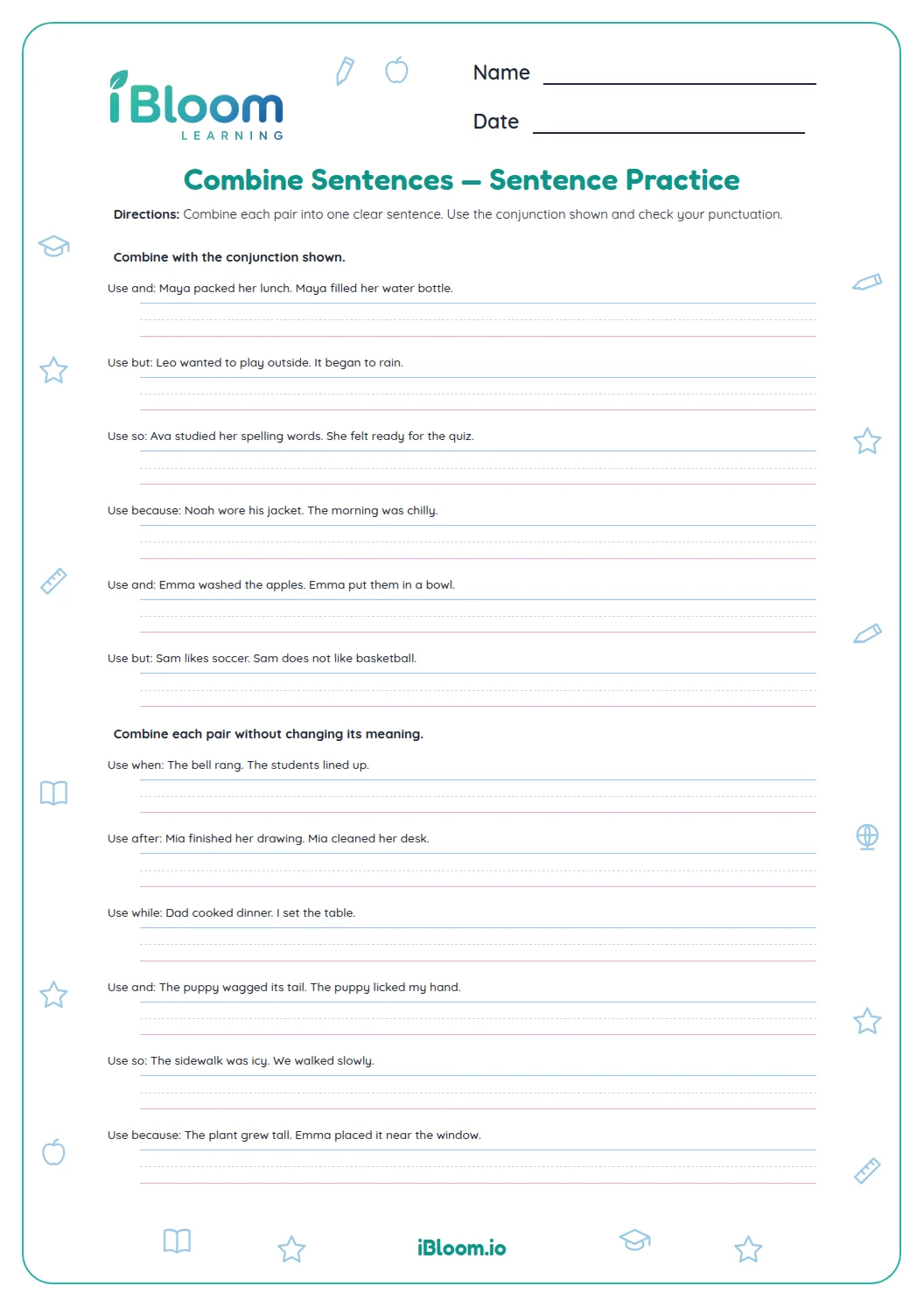
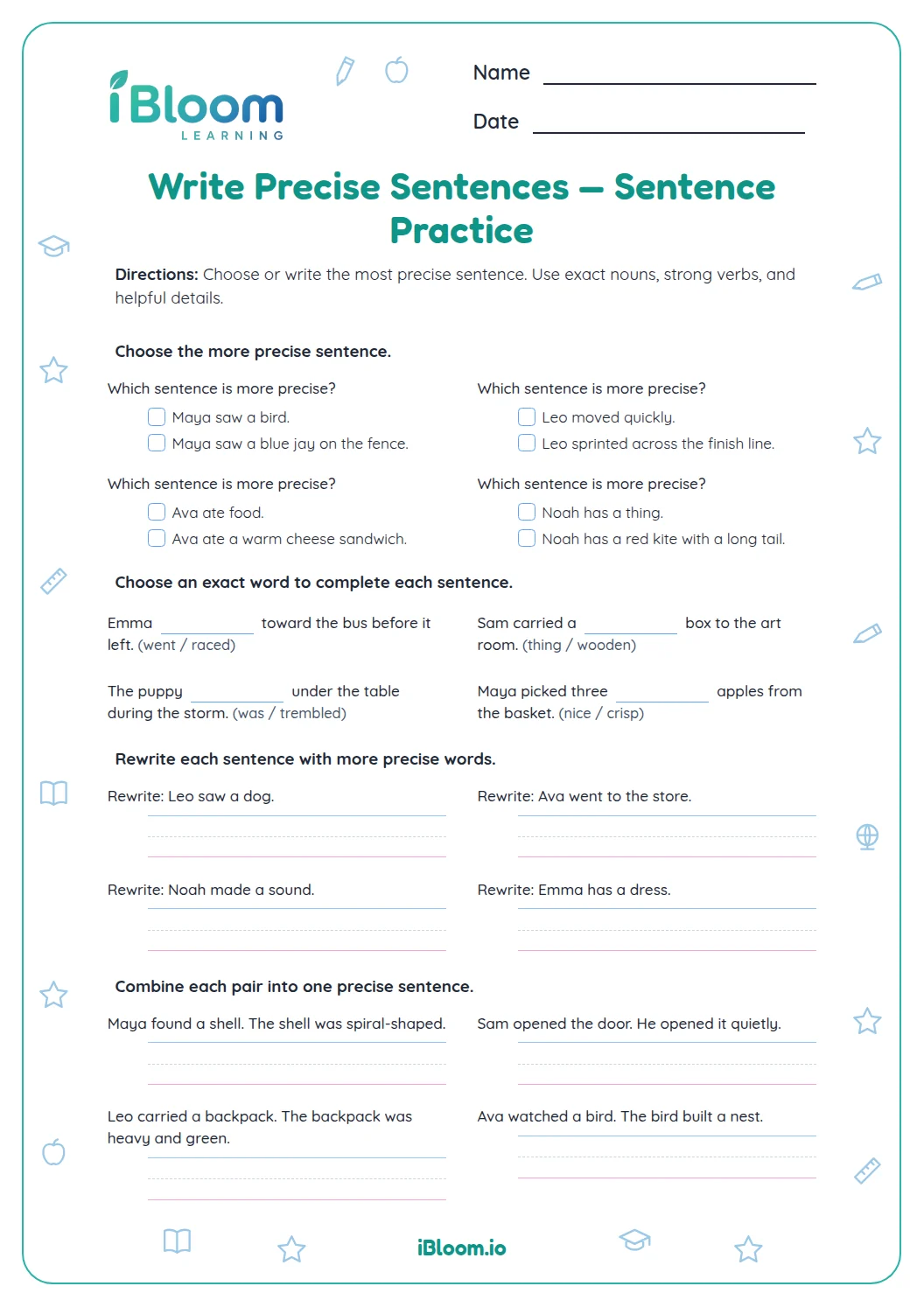
Combine Sentences is a useful next step for joining related ideas, while Write Precise Sentences extends the work of choosing exact words and details. Both links are in the related practice list. Several original sentences can work when they meet the prompt and remain complete.