







About this worksheet
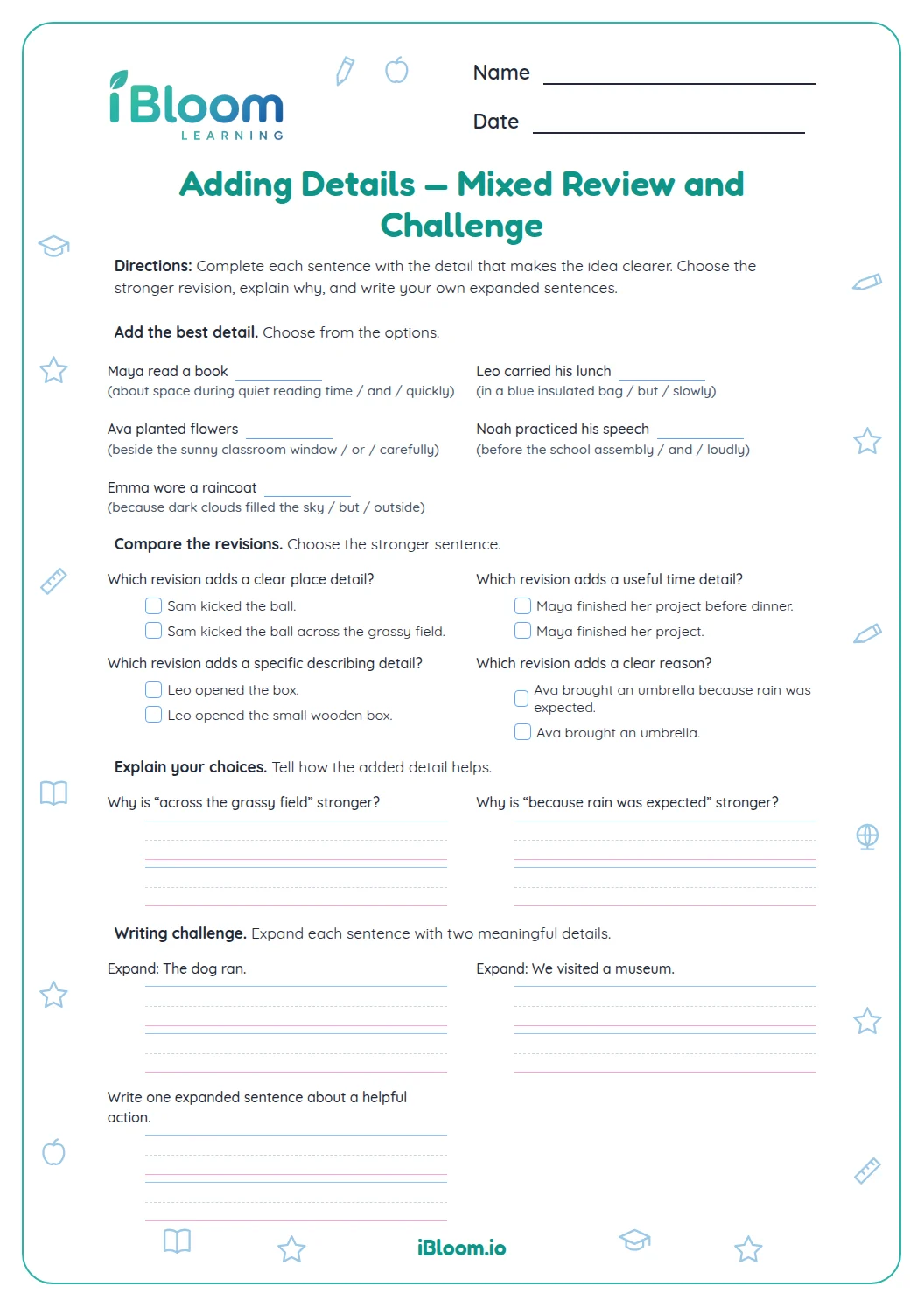
Students practice adding relevant details that answer questions such as when, where, how, why, who, and what kind. Selection and completion lead into revision and original sentence writing.
Aligned to L.4.1 and W.4.5
Choose details that fit
A strong detail answers a useful question about the sentence. “After lunch” tells when; “beside the stove” tells where. A detail should make sense with the action and the rest of the sentence.
Build a fuller sentence
Parts A and B let students identify and supply a fitting detail. Part C asks them to combine details or write their own complete sentence. Encourage children to reread each result to check that the added information is clear and relevant.
How to use this worksheet
- 1Read each prompt carefully.
- 2Show a step when the question asks you to explain or solve.
- 3Use the answer key to check your work.
Common mistakes and quick fixes
The mistake
Rushing past a prompt detail or symbol can lead to a mismatched response.
The fix
Reread the complete question and check that the response answers exactly what it asks.
The mistake
A computation or sentence may look finished before it has been checked.
The fix
Use the answer key to verify each result and revise any response that needs it.
Common Core alignment
This worksheet practices the standards listed below through focused grade-level work.
Students build complete sentences with relevant details.
On this sheet: Students build complete sentences with relevant details.
Show the official wordingHide the official wording
Demonstrate command of the conventions of standard English grammar and usage when writing or speaking.
Students revise and add details to sentences.
On this sheet: Students revise and add details to sentences.
Show the official wordingHide the official wording
With guidance and support from peers and adults, develop and strengthen writing as needed by planning, revising, and editing.
What to practice next
Make more practice
Further reading
Questions parents and teachers ask
What counts as a sentence detail?
A detail gives useful information about an action or idea. It may tell when or where something happened, how it happened, why it happened, who was involved, or what kind of thing is described. The detail should fit the sentence and preserve its meaning.
How should students choose an answer?
Read the clue in the question first. A prompt asking where needs a place; one asking when needs a time. In the multiple-choice items, select the phrase that answers that clue and makes sense with the sentence. For open prompts, write a relevant detail in a complete sentence.
Can more than one written answer be correct?
Yes. Open-ended sentence tasks can have many accurate responses. The answer key provides a sample, while another clear detail is acceptable if it follows the direction and creates a complete sentence. Encourage students to reread their revised sentence to make sure the detail fits.
What does the worksheet progress toward?
Students begin by choosing a fitting detail, then complete sentences with their own details, and finally revise or write fuller sentences. This progression supports careful sentence building and rereading for clarity. Learners practice both identifying a useful phrase and creating one themselves.
How many questions ask students to revise a sentence?
Four questions ask students to revise a sentence by adding named details. For example, one prompt asks for a where detail and a when detail. The answer key gives a sample, and another clear sentence that adds both details while keeping the original meaning is also acceptable.