







About this worksheet
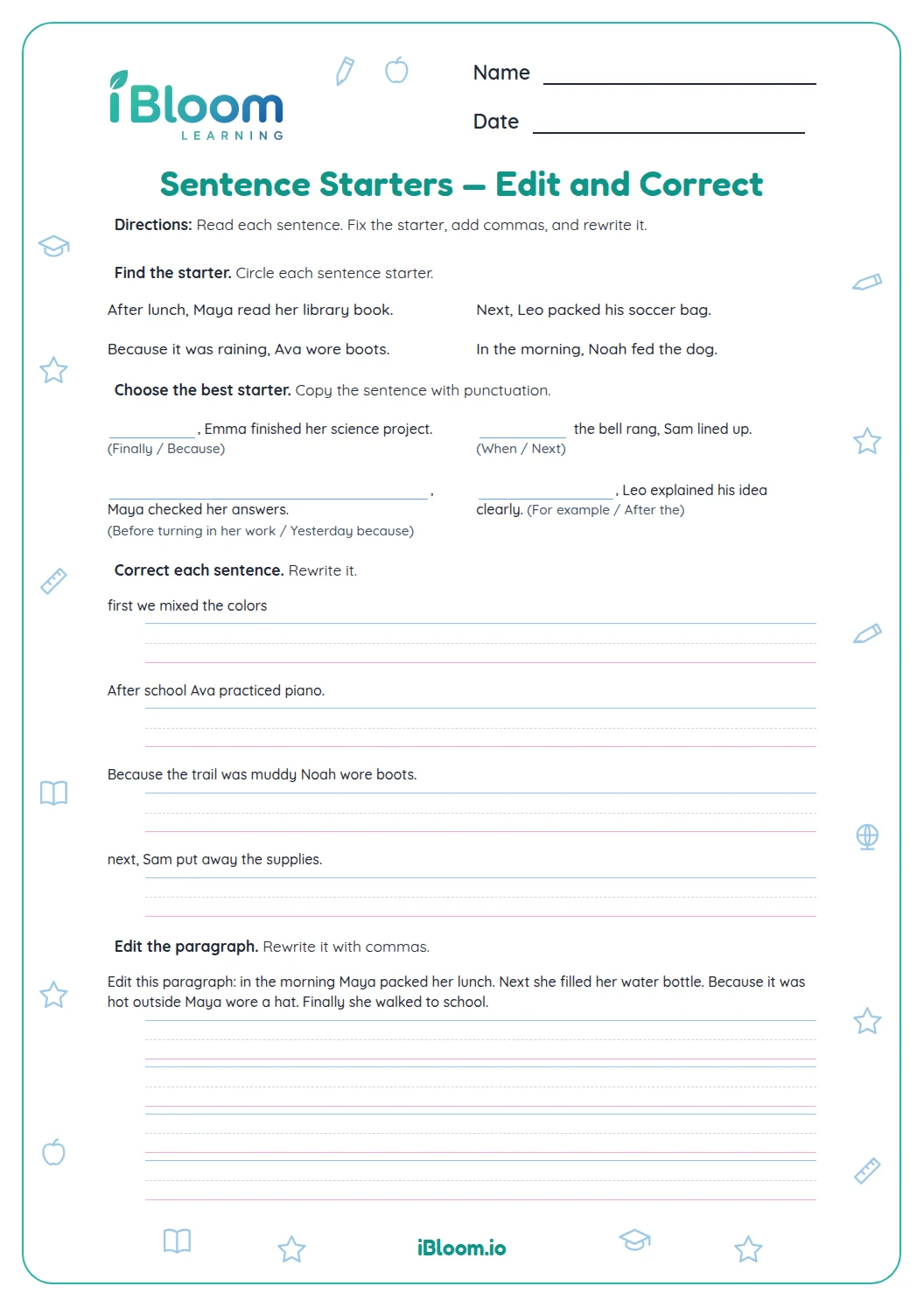
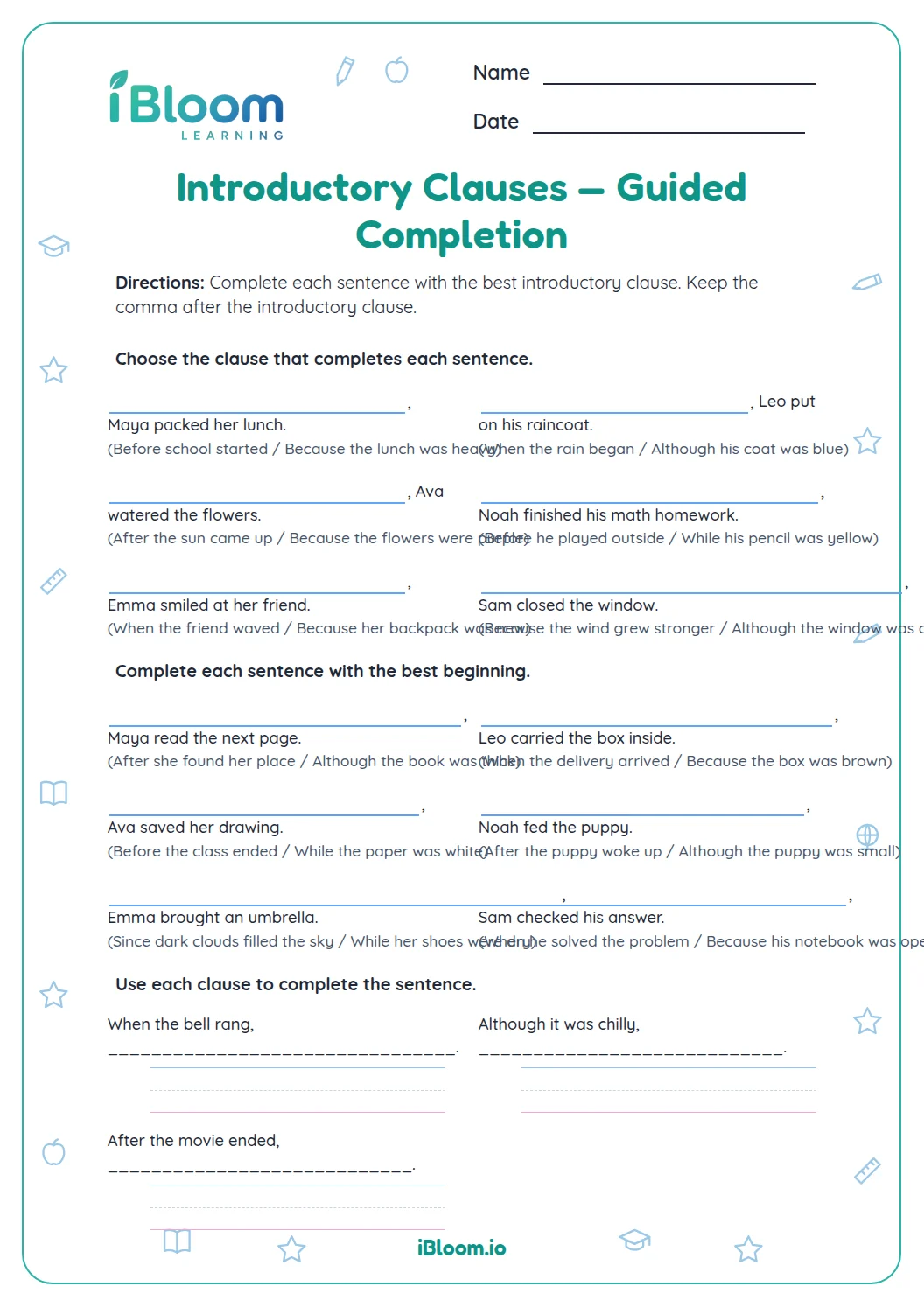
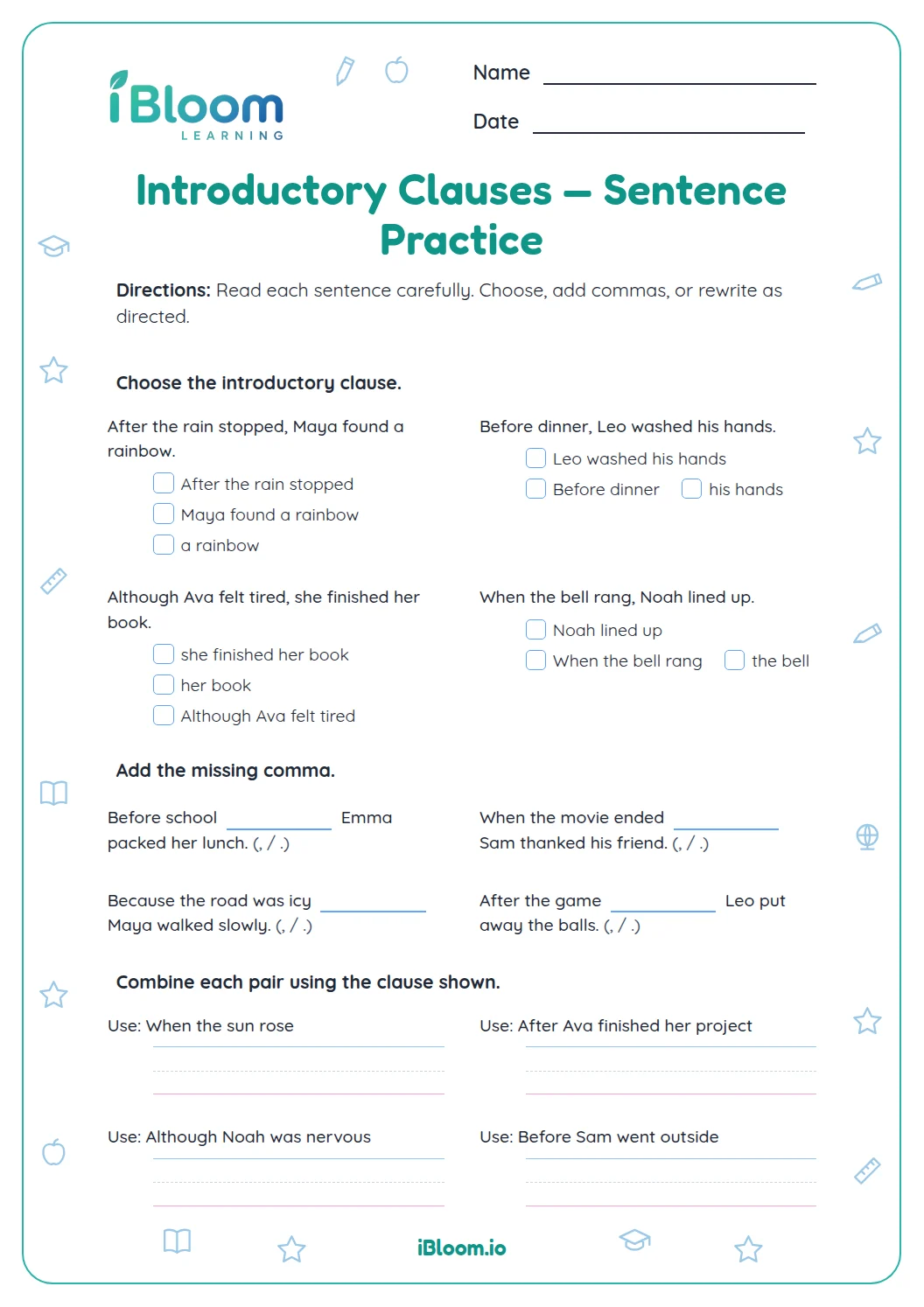
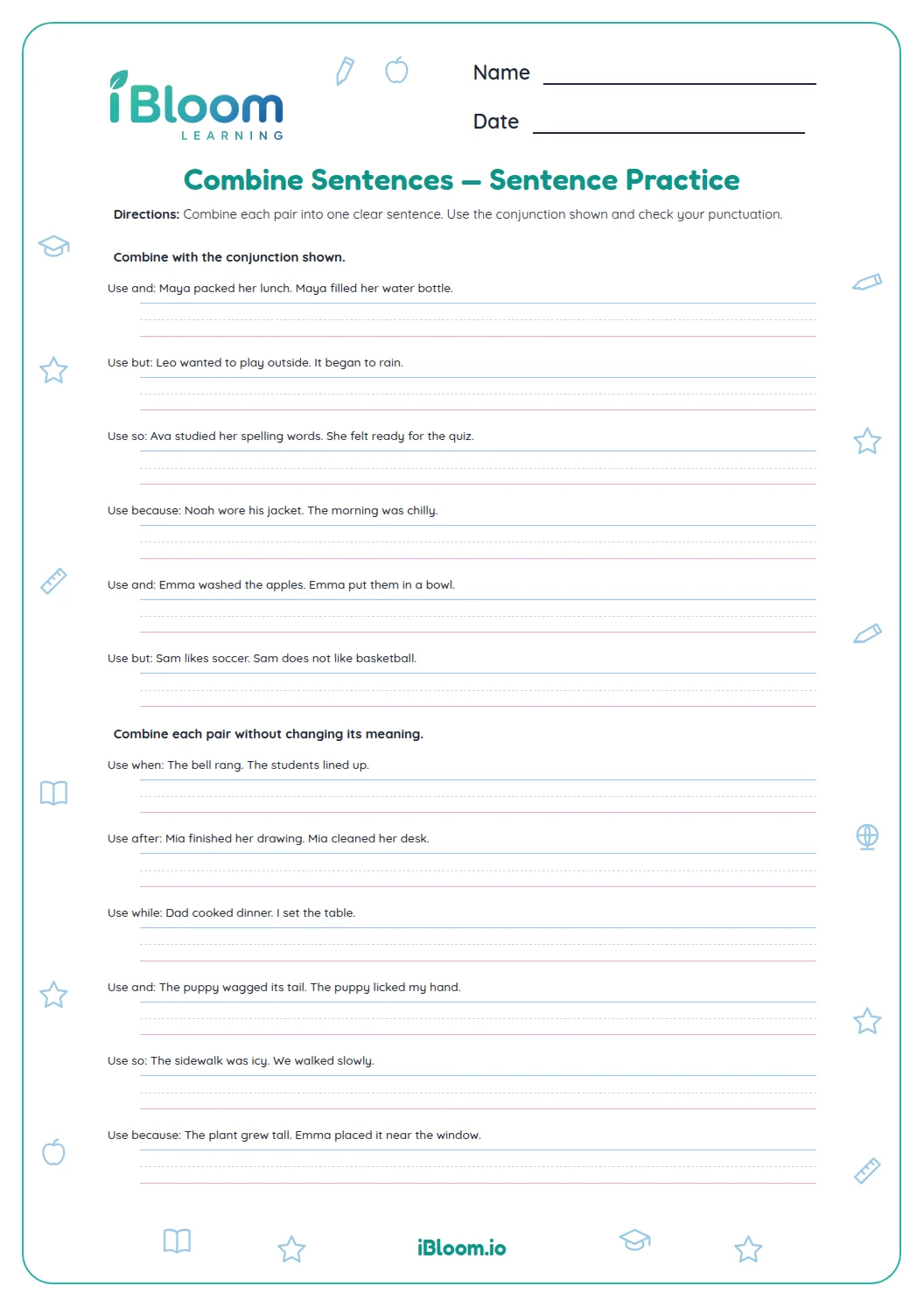
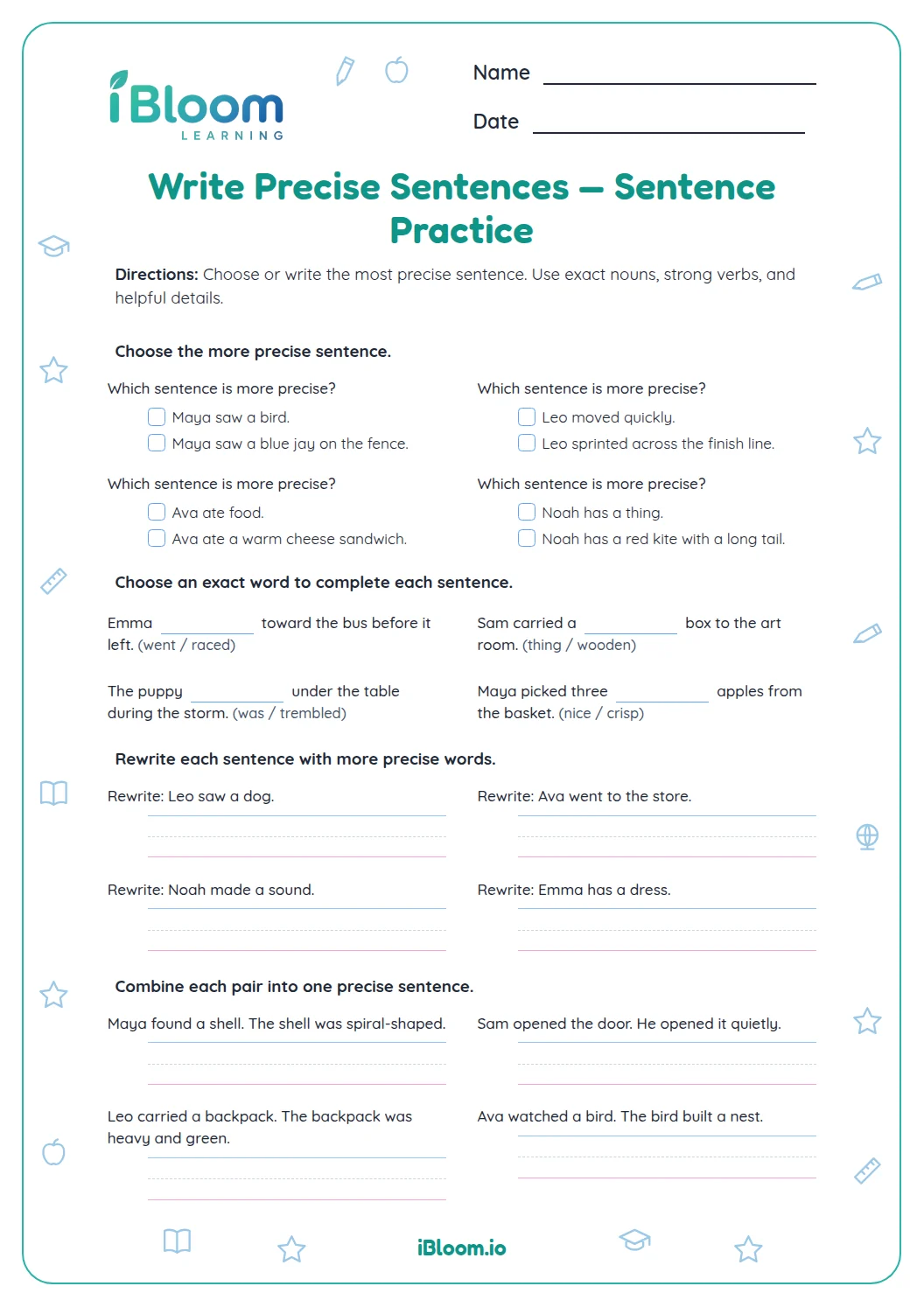
This Grade 4 sentence-practice worksheet asks students to finish sentence starters with complete thoughts. Five opening clauses lead into matching main clauses; seven multiple-choice items check how a phrase fits a sentence; the final section asks students to combine two ideas and write one original sentence. The practice focuses on complete sentences, including dependent clauses that need a main clause, and supports CCSS L.4.1.f.
Aligned to L.4.1.f
Why does a sentence starter need a full thought?
Some sentence starters are dependent clauses. They establish a time, reason, or contrast but cannot stand alone. A complete main clause finishes the idea. In question 1, “Before the rain began” needs a clause that tells what happened before the rain.
- 1Before the rain began, the class covered seedlings.
- 2The second part completes the idea and makes a full sentence.
How can students choose an ending that fits?
The final part asks students to combine two given ideas with an opening phrase, then write one original sentence that begins with a specified starter.
How to use this worksheet
- 1Read the opening phrase and notice whether it can stand alone.
- 2Choose or write an ending that completes the thought.
- 3Read the full sentence aloud to check its meaning.
- 4Use a comma after an introductory dependent clause.
- 5For the last two items, begin with the exact phrase in the prompt.
Common mistakes and quick fixes
The mistake
Leaving a dependent clause by itself.
The fix
Add a main clause that tells a complete thought.
The mistake
Choosing an ending that does not match the opening.
The fix
Read the whole sentence together and check the connection word.
The mistake
Forgetting the comma after an opening clause.
The fix
Place a comma after the introductory clause before the main clause.
Common Core alignment
This worksheet gives focused practice with the named skill at the listed grade level.
Produce complete sentences, recognizing and correcting inappropriate fragments and run-ons.
On this sheet: Students complete sentence openings with main clauses and write two original complete sentences.
Show the official wordingHide the official wording
Produce complete sentences, recognizing and correcting inappropriate fragments and run-ons.
What to practice next
Make more practice
Further reading
Questions parents and teachers ask
What kinds of sentence starters are on this page?
The openings use time, cause, and contrast phrases, including “Before,” “Although,” “When,” “Because,” “After,” and “As soon as.” Students choose from two possible endings for twelve sentence starters, combine two ideas with a starter, and write one original example.
What is a dependent clause?
A dependent clause has a subject and verb but does not express a complete thought by itself. For example, “Although the trail was muddy” leaves the reader waiting to learn what happened. Add a main clause to complete the sentence.
Do original answers have to match the key exactly?
No. The final section asks students to combine two given ideas into a sentence beginning with “Although” and write one original sentence beginning with “As soon as.” The key provides samples. Another answer works when it uses the required opening and expresses a complete thought.
Why does an introductory clause need a comma?
A comma separates an introductory clause from the main clause so readers can see where the opening ends. In “Before the rain began, the class covered seedlings,” the comma follows the opening phrase and comes before the complete main thought.
How can a student check an answer?
Read the entire sentence, including its opening, and ask whether it makes sense and expresses a complete thought. Check that the ending fits the transition phrase and that a comma follows an introductory dependent clause. The key includes sample completions for comparison.