

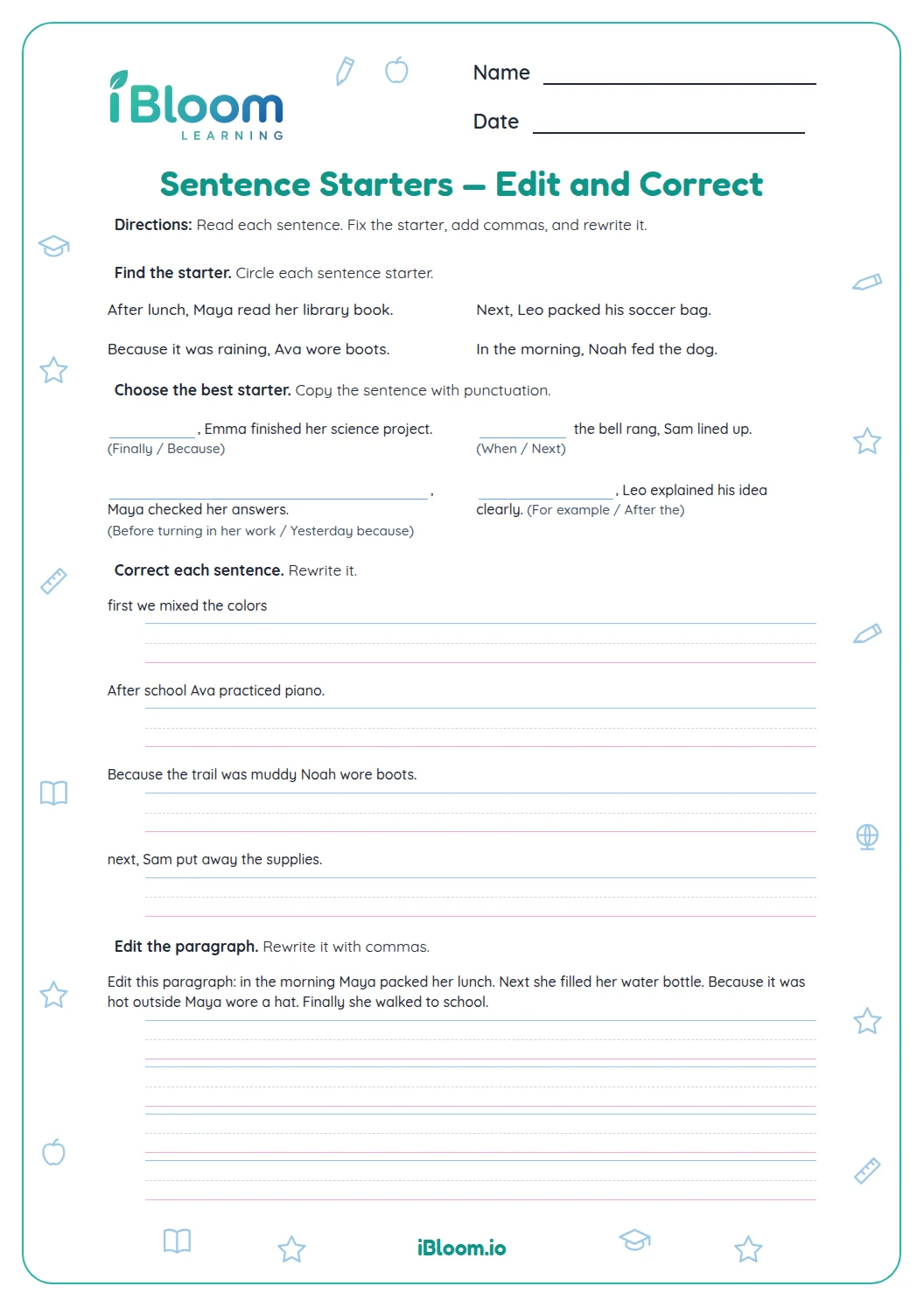


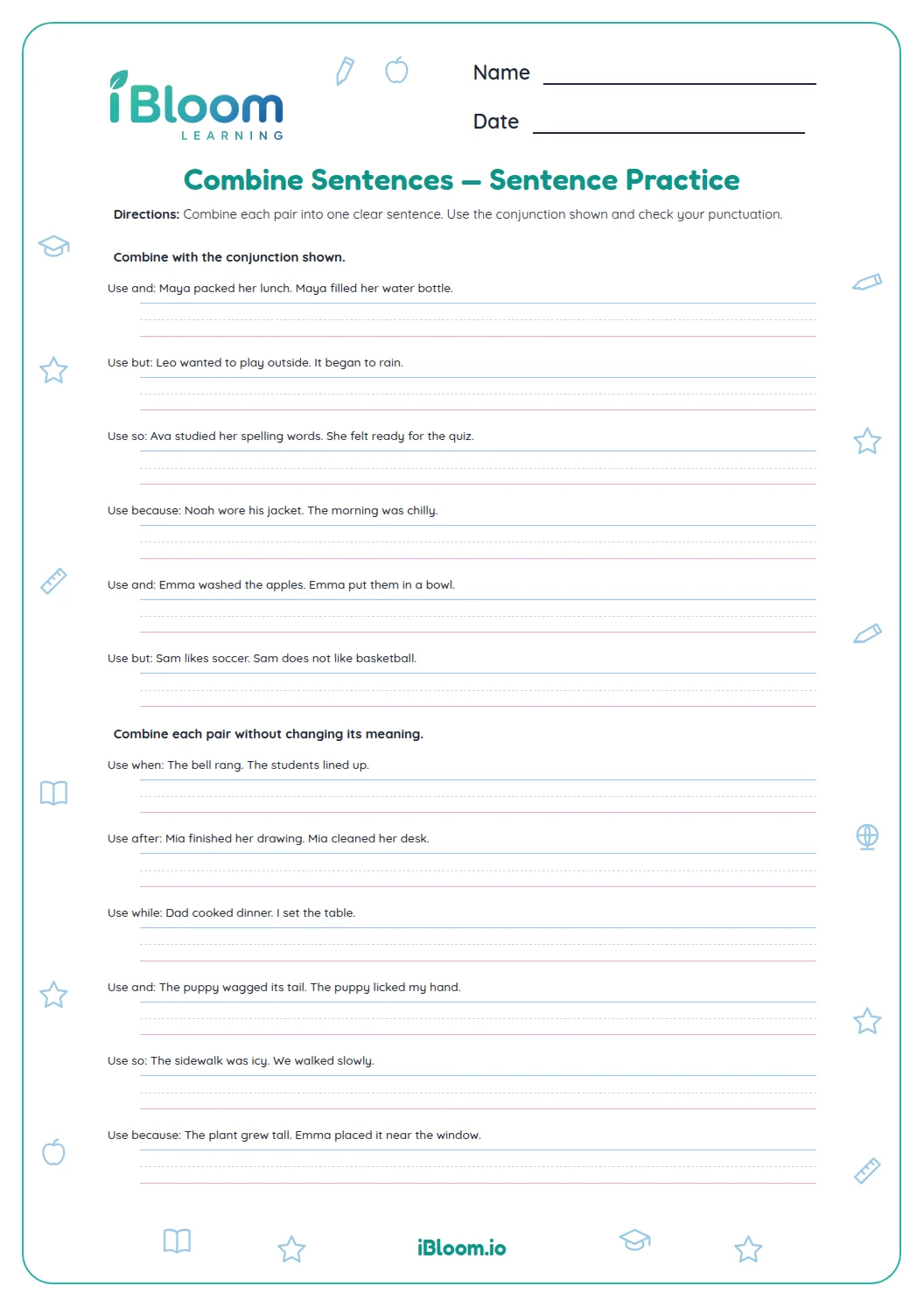


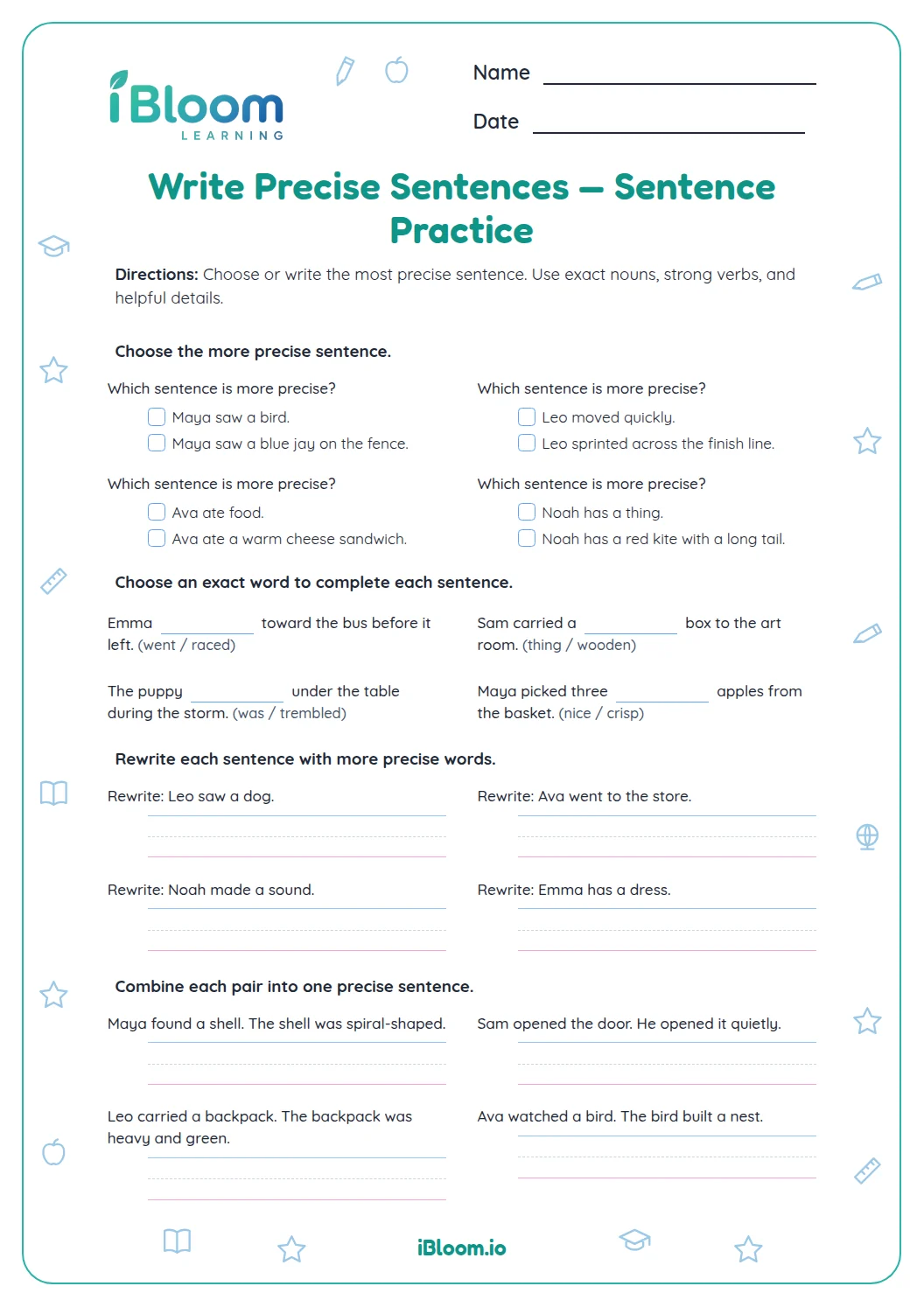
About this worksheet
This Grade 4 worksheet moves from recognizing a complete ending to writing one. Students first choose endings that make eight sentence starters complete; then they finish eight new starters in their own words. The work supports Common Core L.4.1.f by asking students to produce complete sentences. The answer key includes one model ending for each open response, while other clear, complete answers can also work.
Aligned to L.4.1.f
What kinds of sentence starters appear?
Part A asks students to select an ending that completes a starter as a full sentence. Part B has six open starters for students to complete in their own words.
The starters use time, cause, condition, and contrast words. The answer key offers one possible completion for each open prompt.
- 1Although the rain had stopped, ___ → the sidewalk still glistened.
- 2The ending has a subject and verb and completes the contrast.
How can students tell whether an ending is complete?
Read the starter and ending together. Look for a subject and a verb in the ending, then check that it finishes the thought rather than leaving a dependent clause or phrase by itself.
A useful check is to cover the starter and read the ending alone. If it can stand as a sentence and fits the starter, it is likely a strong choice.
How can students make their own endings clear?
For Part B, complete the idea in your own words. Use a subject and a verb, make the meaning fit the opening, and reread the full sentence for sense.
The key is a model, not a required script. Accept other complete endings that fit the starter.
How to use this worksheet
- 1Read each starter and notice its connecting word.
- 2In Part A, check that the selected ending makes a full thought.
- 3In Part B, write an ending with a subject and a verb.
- 4Reread the whole sentence for grammar and meaning.
- 5Compare with the key, accepting other sensible complete endings.
Common mistakes and fixes
The mistake
Ending a starter with a phrase such as “after lunch.”
The fix
Add who did what so the ending completes the thought.
The mistake
Choosing an ending that does not fit a word such as although or because.
The fix
Read the whole sentence and check the relationship between its ideas.
The mistake
Writing an ending that repeats the starter without adding a thought.
The fix
Finish the idea with a clear action, event, or result.
Curriculum alignment
This page gives children focused practice with the named skill.
Write complete sentences and recognize fragments and run-ons.
On this sheet: Children select complete clause endings and write their own complete sentences.
Show the official wordingHide the official wording
Produce complete sentences, recognizing and correcting inappropriate fragments and run-ons.
What to practice next
Further reading
Questions parents and teachers ask
What is a sentence starter?
A sentence starter gives the beginning of a thought and invites the writer to complete it. Words such as although, before, or since signal how the rest of the sentence should connect. This worksheet asks students to choose or write an ending that completes the thought.
How many items are on this page?
There are 14 items in two parts. Part A has eight multiple-choice items where students select a complete ending. Part B has six open sentence starters where students write their own endings. The answer key gives the Part A choices and sample responses for Part B.
Can a child give a different answer from the key?
Yes. Part B is open-ended, so a different ending is correct if it completes the thought as a grammatical sentence and makes sense with the starter. The answer key models one possible response for each item rather than limiting children to those exact words.
Why do some starters begin with although or because?
Words such as although, because, before, and whenever connect ideas or show a relationship in time or cause. They also create a beginning that needs a complete main clause to finish the thought. Students can read the whole sentence aloud to check the connection.
What should I check in a written ending?
Check that the ending has a subject and a verb and completes the meaning begun by the starter. Then read the full sentence aloud. For example, “Although the path was muddy, we walked carefully to the gate” gives a complete contrast and a complete thought.
How can students extend the practice?
The pages on adding details and combining sentences build on this practice. Students can expand a clear sentence with precise information or join related ideas smoothly, then reread their work to check that every sentence expresses a complete thought.