









About this worksheet
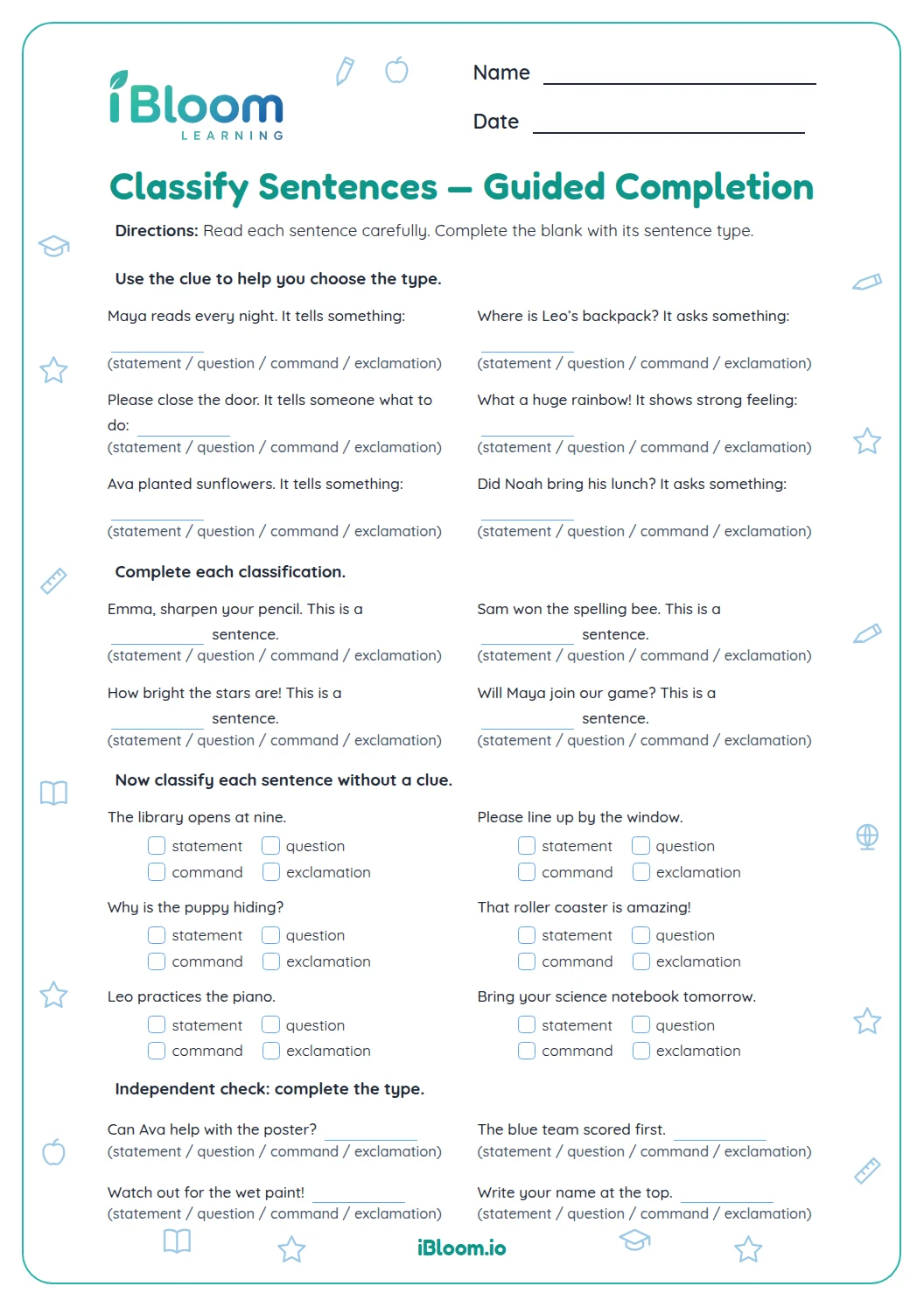
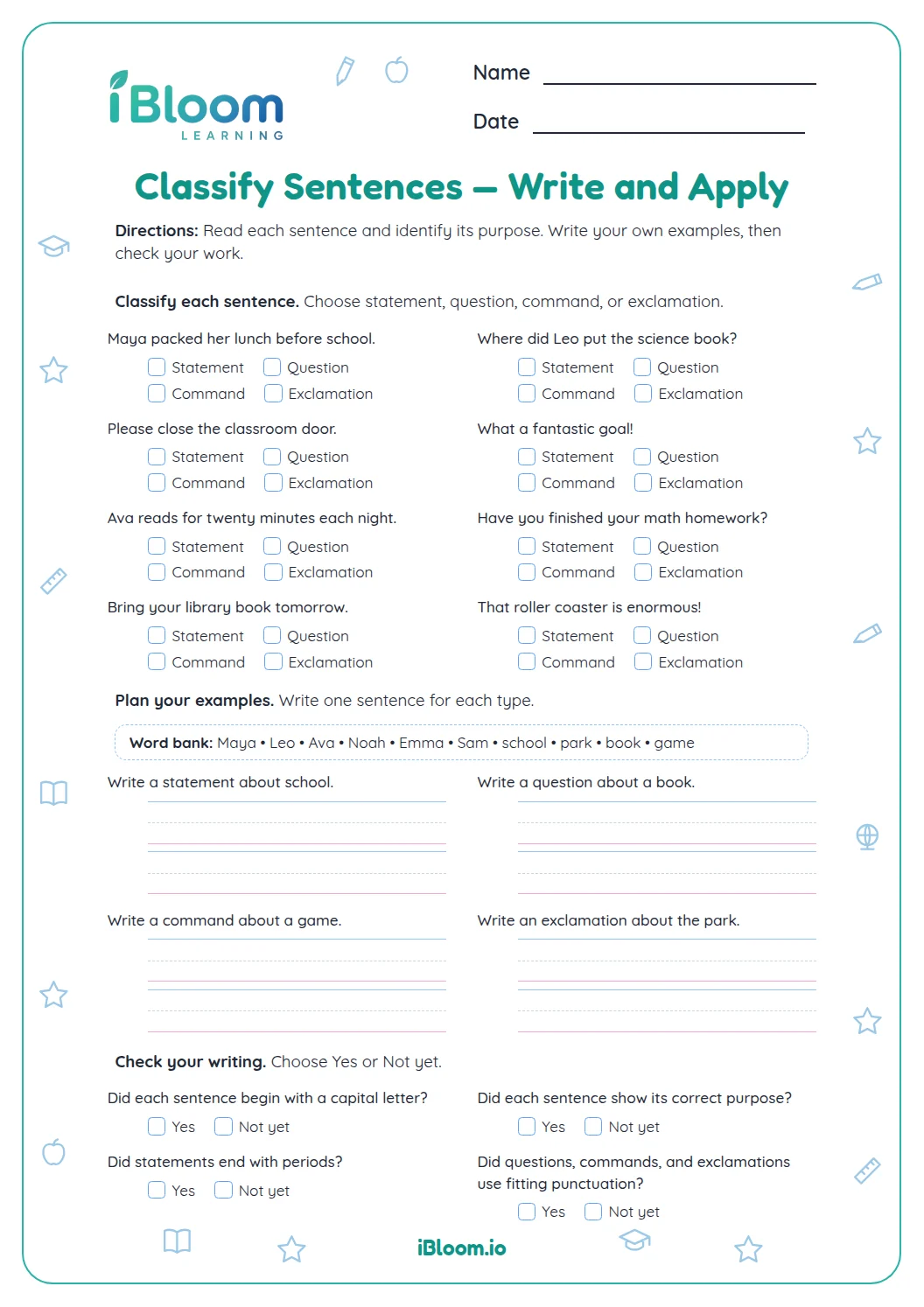
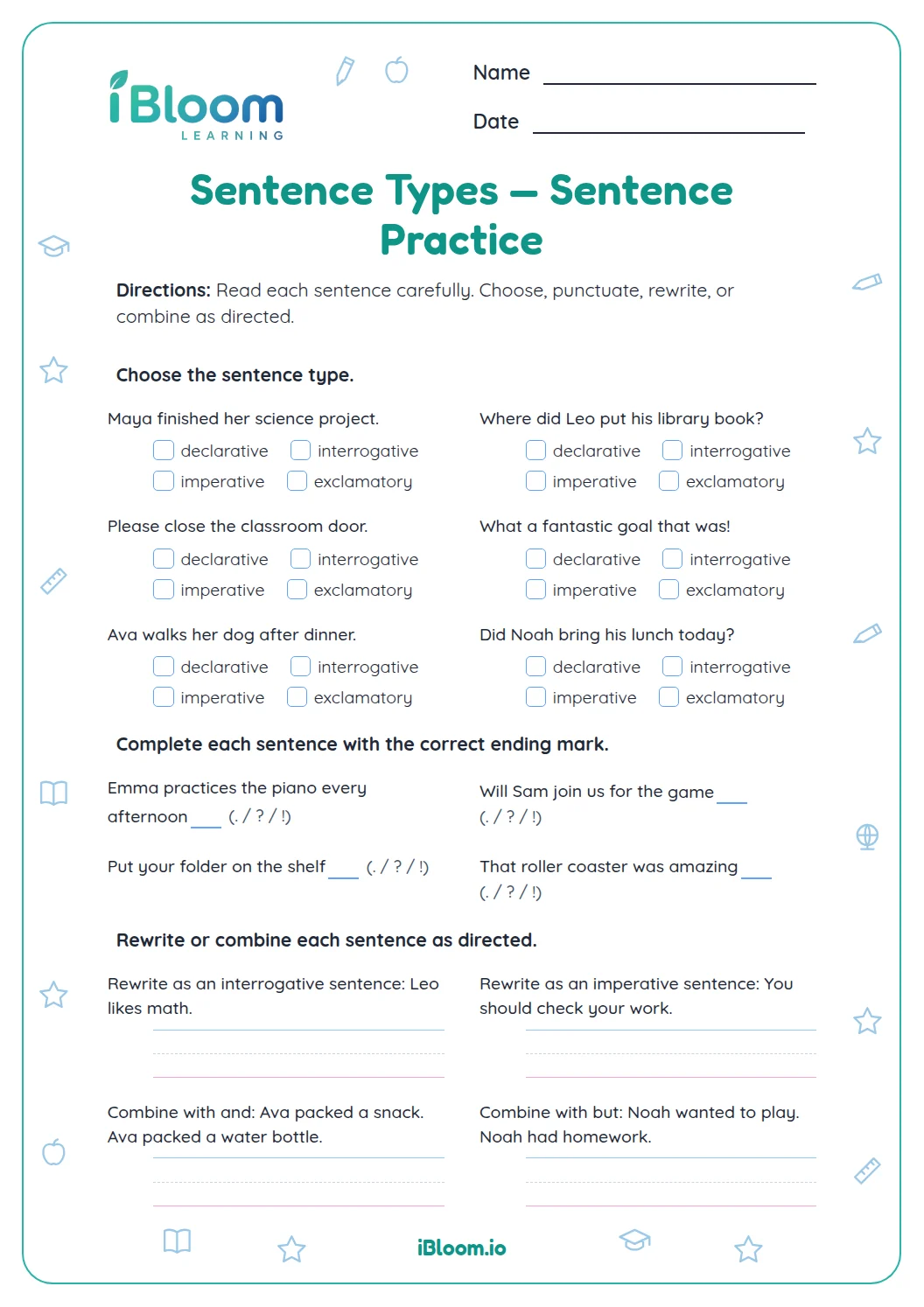
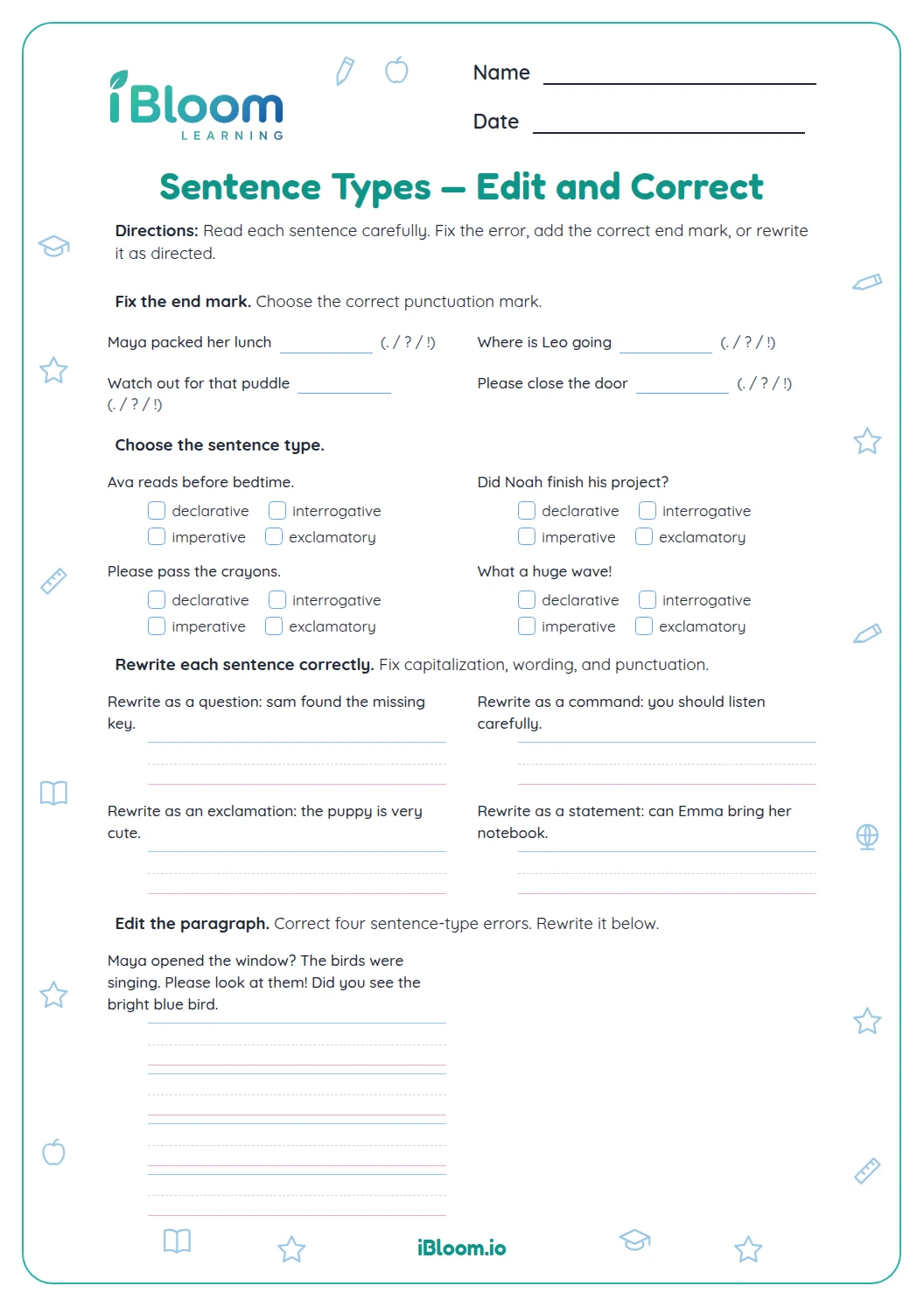
This Grade 4 grammar worksheet helps students classify sentences by purpose. Across a connected classroom-garden setting, students distinguish declarative statements, interrogative questions, imperative commands, and exclamatory sentences. Punctuation supports the decision, while the words and purpose provide the evidence. The page includes 16 multiple-choice items and a separate answer key.
How do you identify a declarative sentence?
A declarative sentence tells an idea or gives information. It usually ends with a period. The first item, “The class planted bean seeds in small pots,” reports what happened, so it is declarative.
Do not classify by sentence length; classify by what the sentence does.
- 1The class planted bean seeds in small pots.
- 2It tells what the class did.
- 3It ends with a period.
- 4Type: declarative
What makes a sentence interrogative?
An interrogative sentence asks a question and usually ends with a question mark. Question 2 asks where to put the pot, so it is interrogative.
Some questions begin with can, did, where, or which. The opening word can help, but the purpose is what matters.
How can you recognize an imperative sentence?
An imperative sentence gives a command, direction, or request. Its subject is often the understood word you. “Please label your pot” is a request directed to the reader.
Imperatives can end with periods or exclamation points, so punctuation alone may not settle the type. Check whether the sentence tells someone to do something.
When is a sentence exclamatory?
An exclamatory sentence expresses strong feeling or emphasis and ends with an exclamation point. “What a tall stem the bean has grown!” shows excitement.
A sentence with an exclamation point is often exclamatory, but commands can use one too. Use both meaning and punctuation to decide.
How to use this worksheet
- 1Read each sentence once for its meaning before looking at the punctuation.
- 2Ask whether it tells, asks, directs, or strongly exclaims.
- 3Use the final punctuation as a clue, especially for questions and exclamations.
- 4For commands, imagine the understood subject you.
- 5Review choices that were close by rereading the sentence purpose.
Common mistakes and quick fixes
The mistake
Calling every sentence with an exclamation point exclamatory.
The fix
Check the purpose: “Stop!” is a command even though it uses an exclamation point.
The mistake
Choosing interrogative just because a sentence begins with can or where.
The fix
Check whether it truly asks for information and ends as a question.
The mistake
Missing the hidden you in a command.
The fix
Restate it as “You should label the pot” to hear the direction.
What to practice next
Make more practice
Questions parents and teachers ask
What are the four sentence types on this page?
The page uses declarative, interrogative, imperative, and exclamatory. They respectively tell, ask, direct, and express strong feeling. Each item asks students to select the type that best describes the sentence’s purpose, using meaning and punctuation clues. The answer key supports a second check after students finish the worksheet.
Does an exclamation point always mean a sentence is exclamatory?
No. A command can end with an exclamation point, as in “Stop!” That sentence directs someone to act, so its purpose is imperative. Students should use meaning along with punctuation when classifying each example on this page. The answer key supports a second check after students finish the worksheet.
How can I spot an imperative sentence?
Look for a command, direction, or request. The subject you is often understood rather than written: “Please label your pot” means “You, please label your pot.” Imperatives can end with a period or exclamation point. The answer key supports a second check after students finish the worksheet.
How can I tell a question from a statement?
An interrogative sentence asks for information and usually ends with a question mark. A declarative sentence tells something and usually ends with a period. Read the sentence aloud and listen for whether it asks or simply reports information. The answer key supports a second check after students finish the worksheet.
Is there an answer key?
Yes. The separate answer key gives the sentence type for all sixteen items. Students can check the key after completing the page and explain one choice by naming what the sentence does: tell, ask, command, or exclaim. The answer key supports a second check after students finish the worksheet.