







About this worksheet
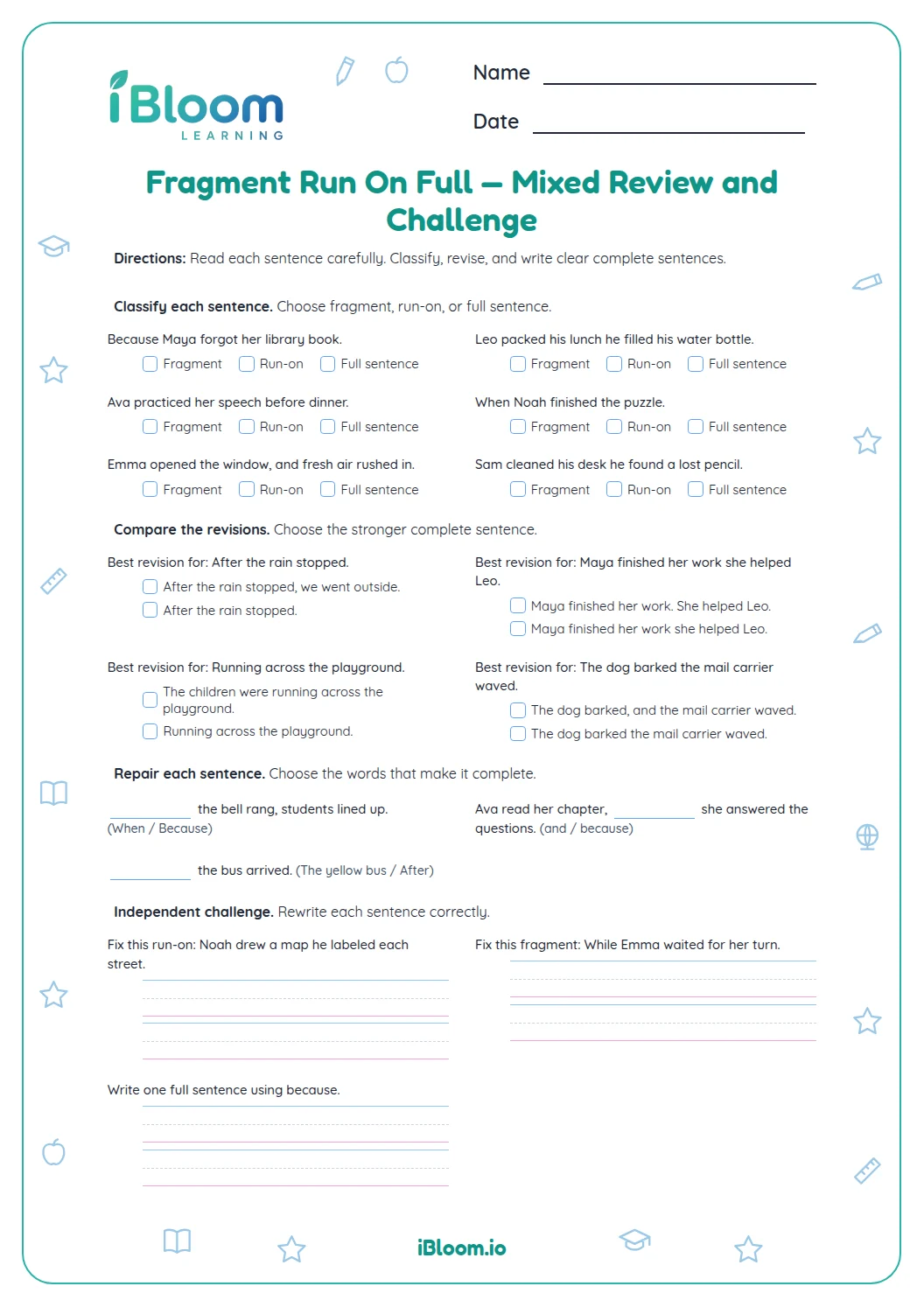
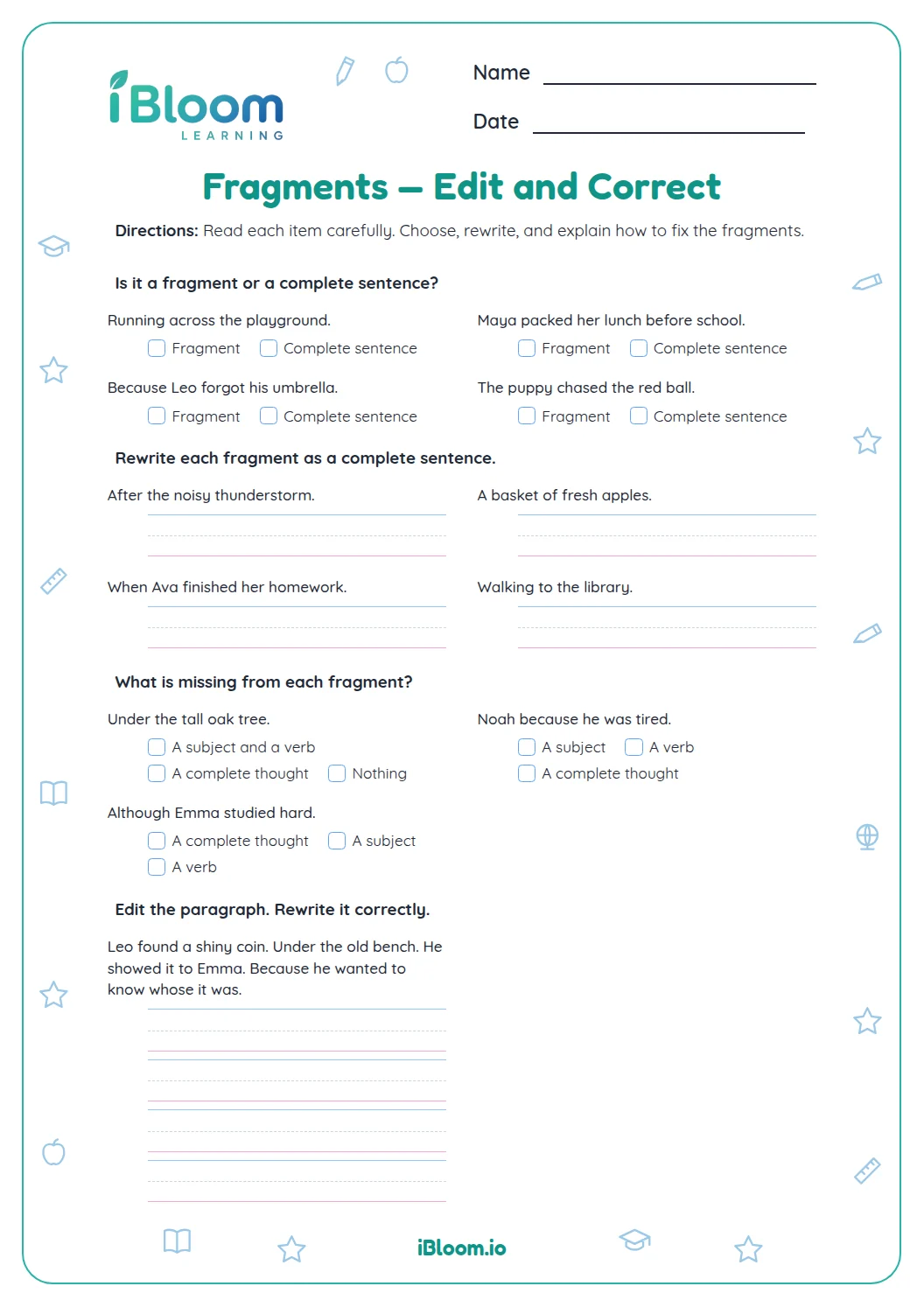
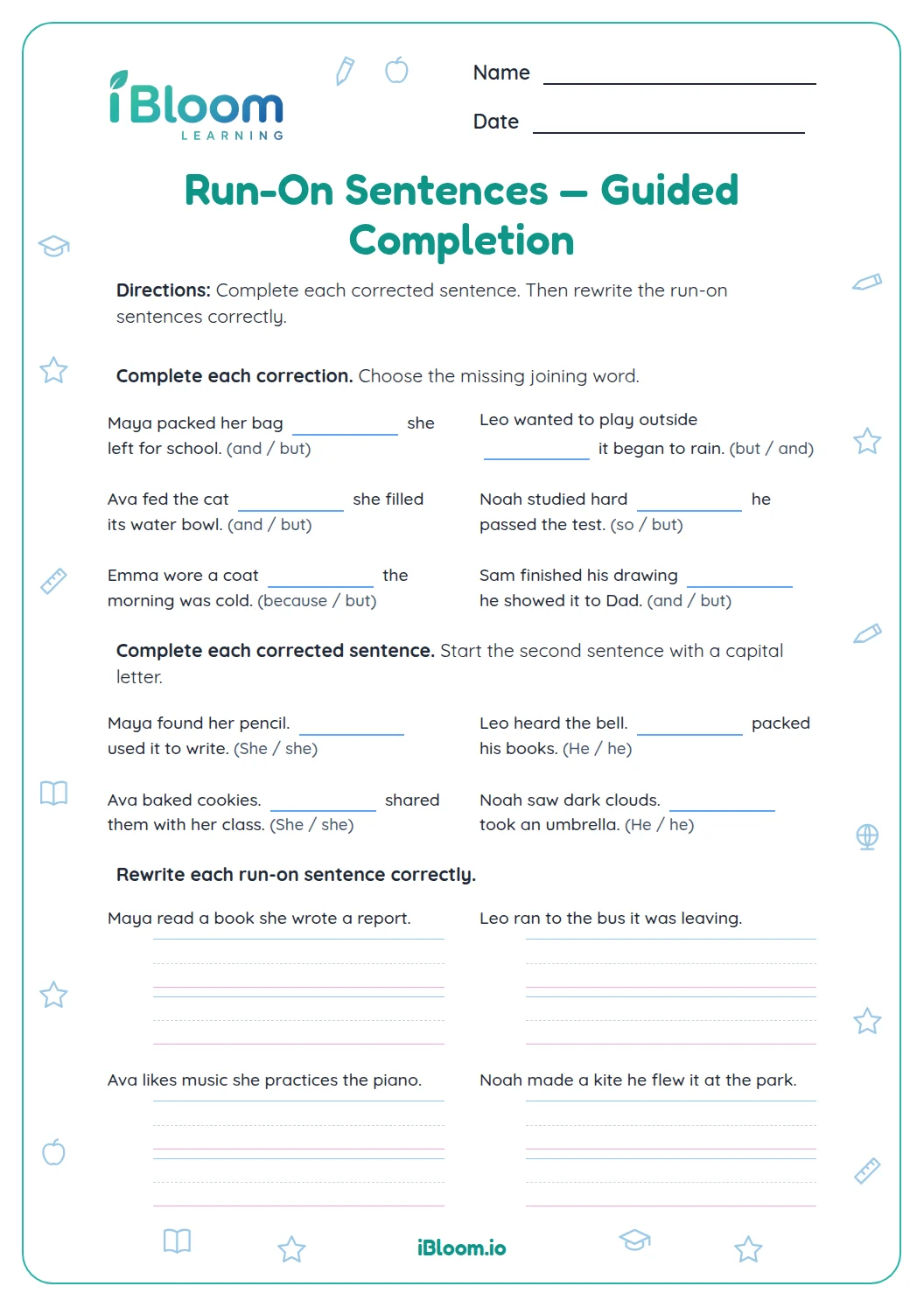
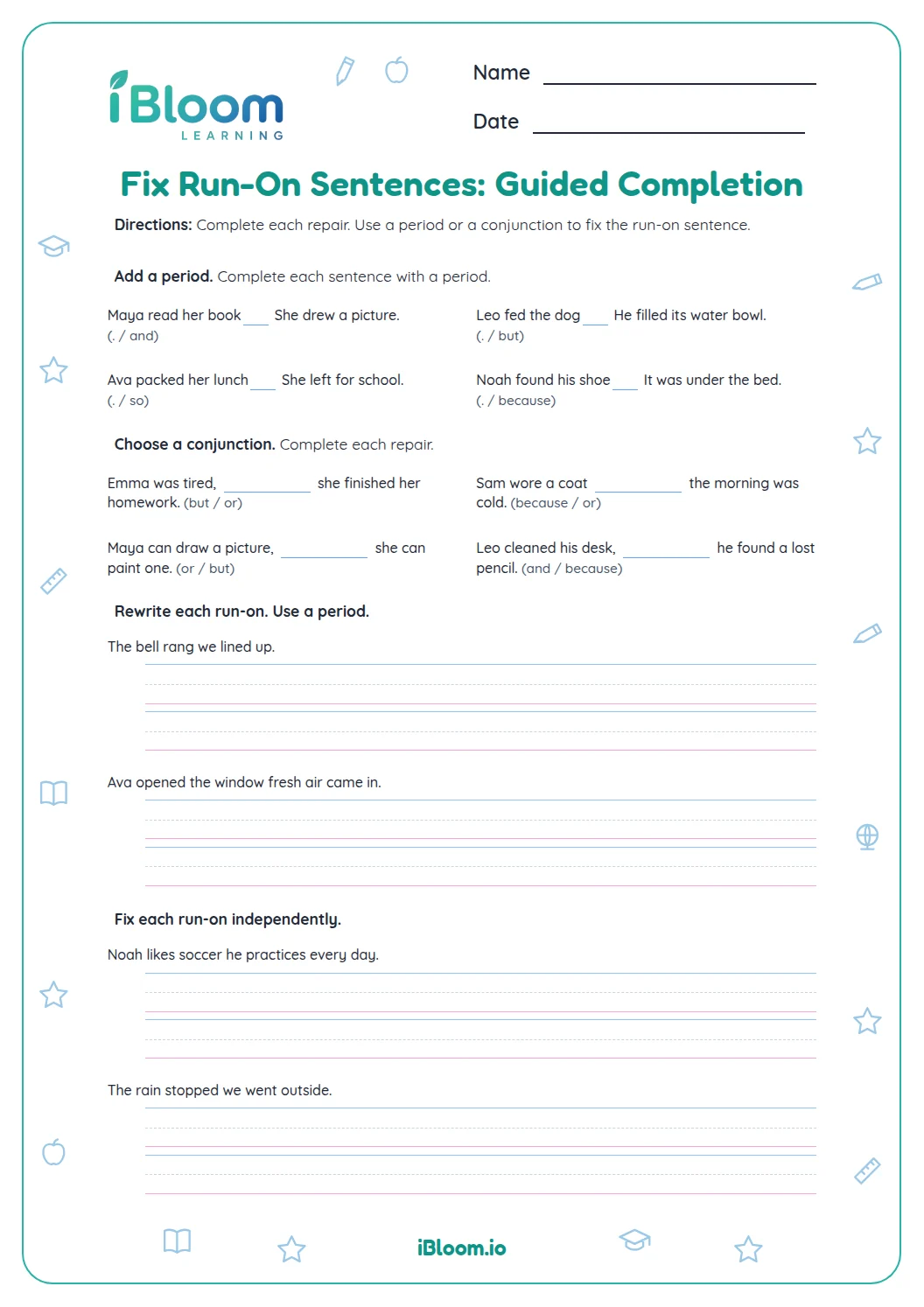
This Grade 4 printable practices the skill named in its title: recognizing fragments, run-ons, and complete sentences, then making sentences complete or correcting run-ons. Eight classification items lead into eight revision and sentence-writing prompts. The three worksheet pages and matching three-page answer key give learners room to identify the issue and write a repair.
Aligned to L.4.1f
What does this worksheet ask learners to identify?
Part A has eight examples to classify as a fragment, run-on, or full sentence. For instance, “After the heavy rain” is a fragment because it does not finish the thought.
How do learners repair the sentences?
Part B has eight writing prompts: complete fragments, punctuate run-ons, and write or combine complete sentences. A valid repair may differ from the sample key if it fixes the stated problem and reads as a complete sentence.
How can a run-on be corrected?
Separate complete thoughts with punctuation or connect them with a comma and a coordinating conjunction.
- 1Ava drew a map she gave it to Ben.
- 2Ava drew a map, and she gave it to Ben.
How to use this worksheet
- 1In Part A, decide whether each line is complete, incomplete, or improperly joined.
- 2In Part B, identify whether the prompt names a fragment or run-on.
- 3Write a repair that keeps the intended meaning.
- 4Reread the result for a complete thought and correct punctuation.
- 5Compare with the key; another correct repair can also work.
Common mistakes and fixes
The mistake
Calling every short group of words a fragment.
The fix
Ask whether it expresses a complete thought; length alone does not decide.
The mistake
Calling a dependent clause a full sentence.
The fix
Look for an unfinished idea after words such as because, when, or after.
The mistake
Fixing a run-on with only a comma.
The fix
Use a period, or a comma plus a joining word such as and.
Common Core alignment
This page practices sentence construction and revision.
Recognize and correct fragments and run-ons in sentences.
On this sheet: Part A identifies fragments and run-ons; Part B asks learners to recognize and correct both.
Show the official wordingHide the official wording
Produce complete sentences, recognizing and correcting inappropriate fragments and run-ons.
What to practice next
Questions parents and teachers ask
What is a fragment?
A fragment is a group of words that does not express a complete thought as written. On Part A, “After the heavy rain” is incomplete because the reader still needs to know what happened. Part B asks learners to add a main idea and make such an opening into a full sentence.
What is a run-on sentence?
A run-on joins two complete thoughts without the punctuation or conjunction needed to separate them. “Ava drew a map she gave it to Ben” can be revised as “Ava drew a map, and she gave it to Ben.” Part A asks learners to recognize this pattern.
How many questions and pages are included?
There are 16 questions in two parts: eight sentence classifications and eight revision or original-sentence prompts. The worksheet uses three pages, followed by a matching three-page answer key. The writing prompts have room for learners to write a repair or their own complete sentence.
Does the key allow different sentence repairs?
Yes. Several Part B prompts allow more than one correct sentence. The key gives sample wording; another response is also correct when it expresses a complete thought and fixes the fragment or run-on named in the prompt. The teacher or parent can check that the new version remains complete and correctly punctuated.
Which standard does this page practice?
The worksheet practices CCSS L.4.1f by asking learners to recognize and correct inappropriate fragments and run-ons. Part A builds recognition, and Part B applies correction through sentence revision and writing. This is the Grade 4 language standard for producing complete sentences and correcting these two errors.