







About this worksheet
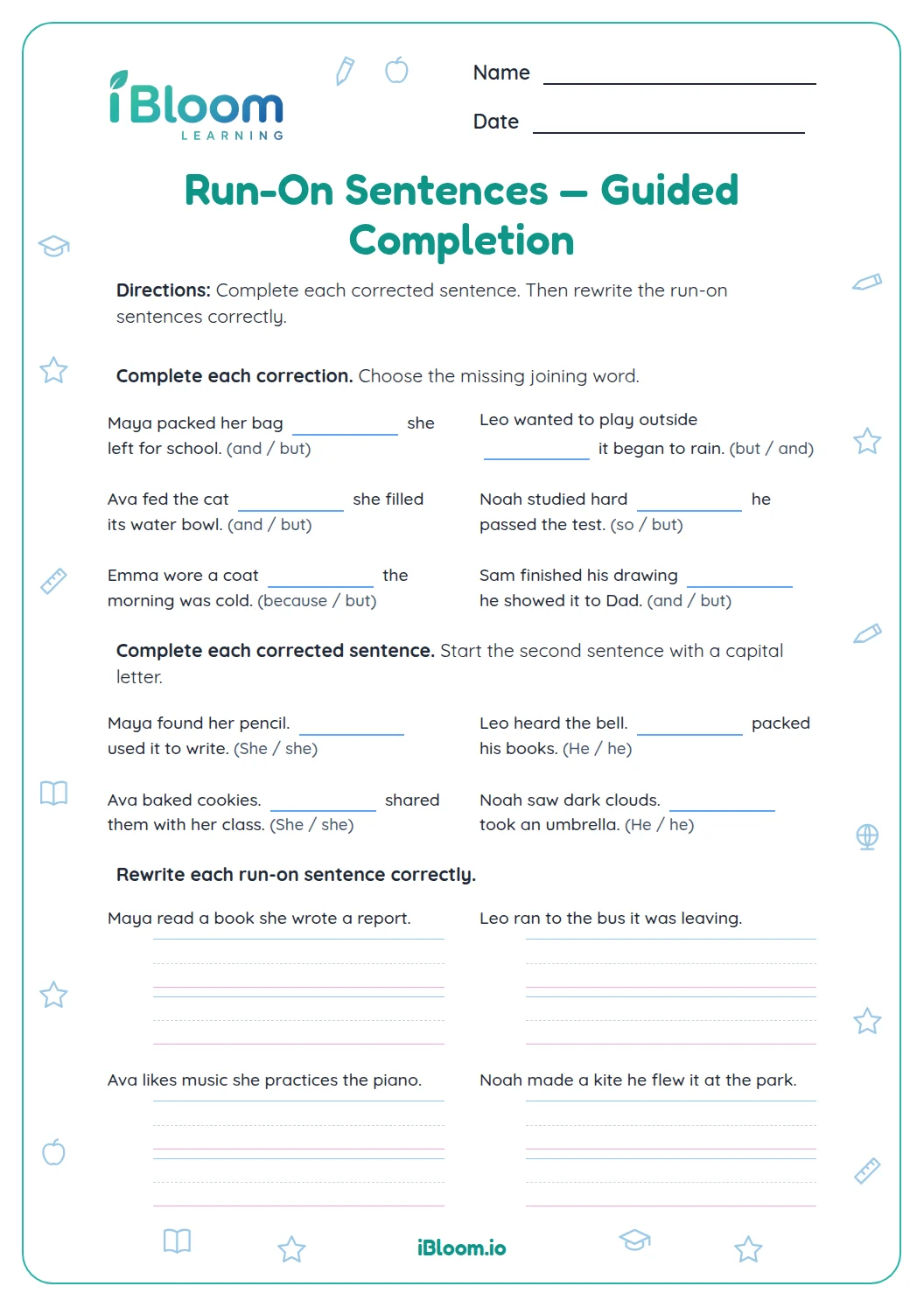
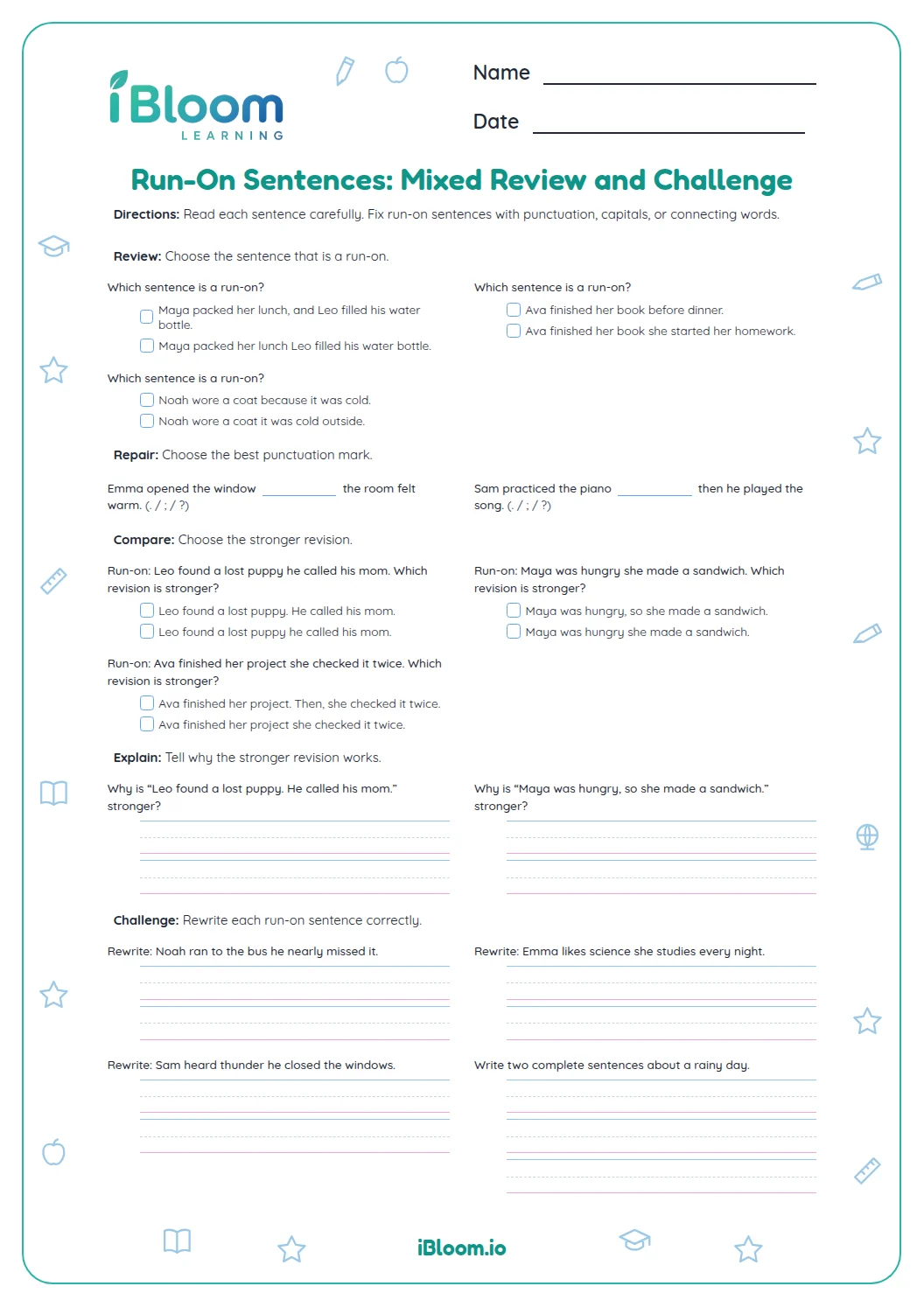
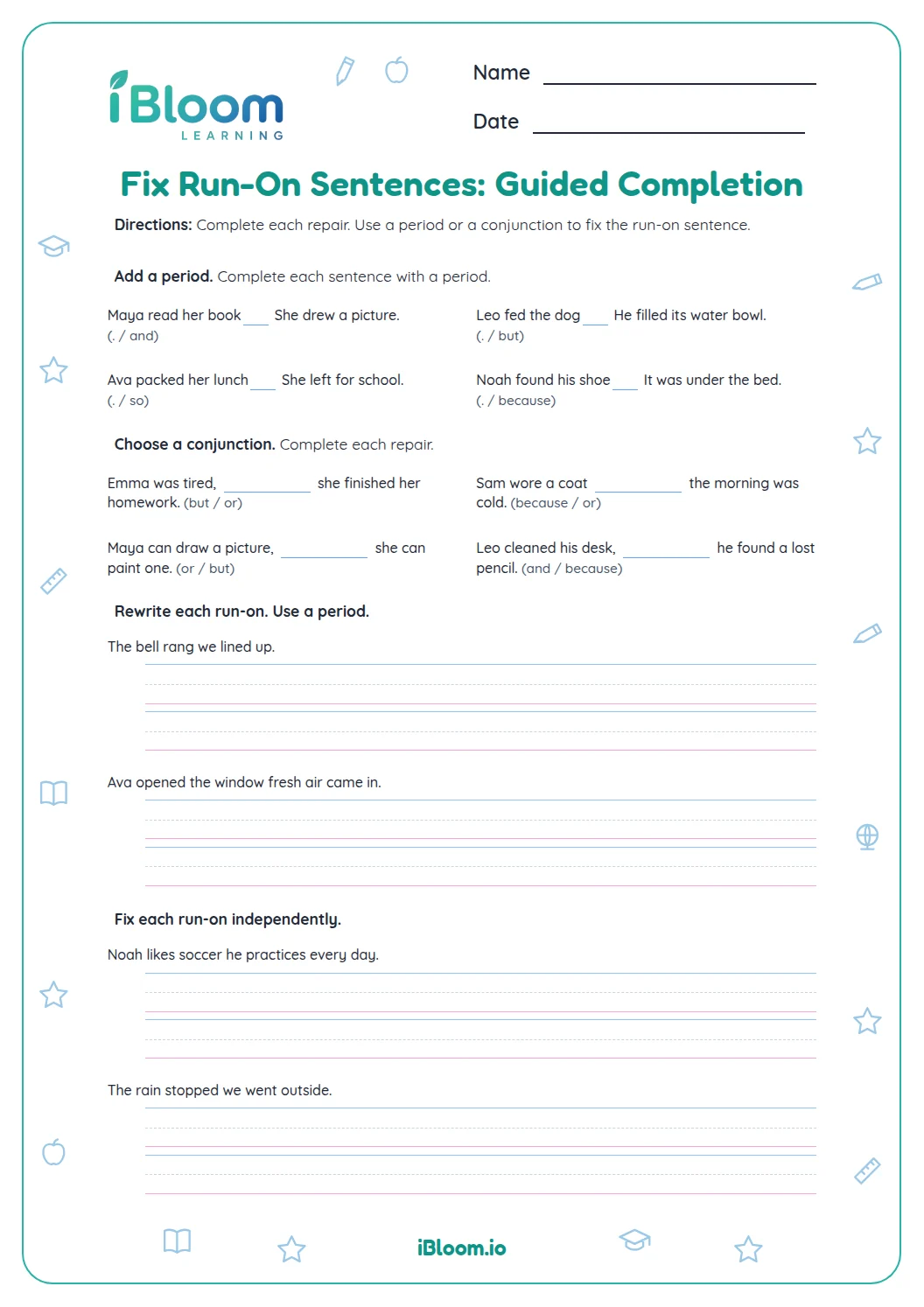
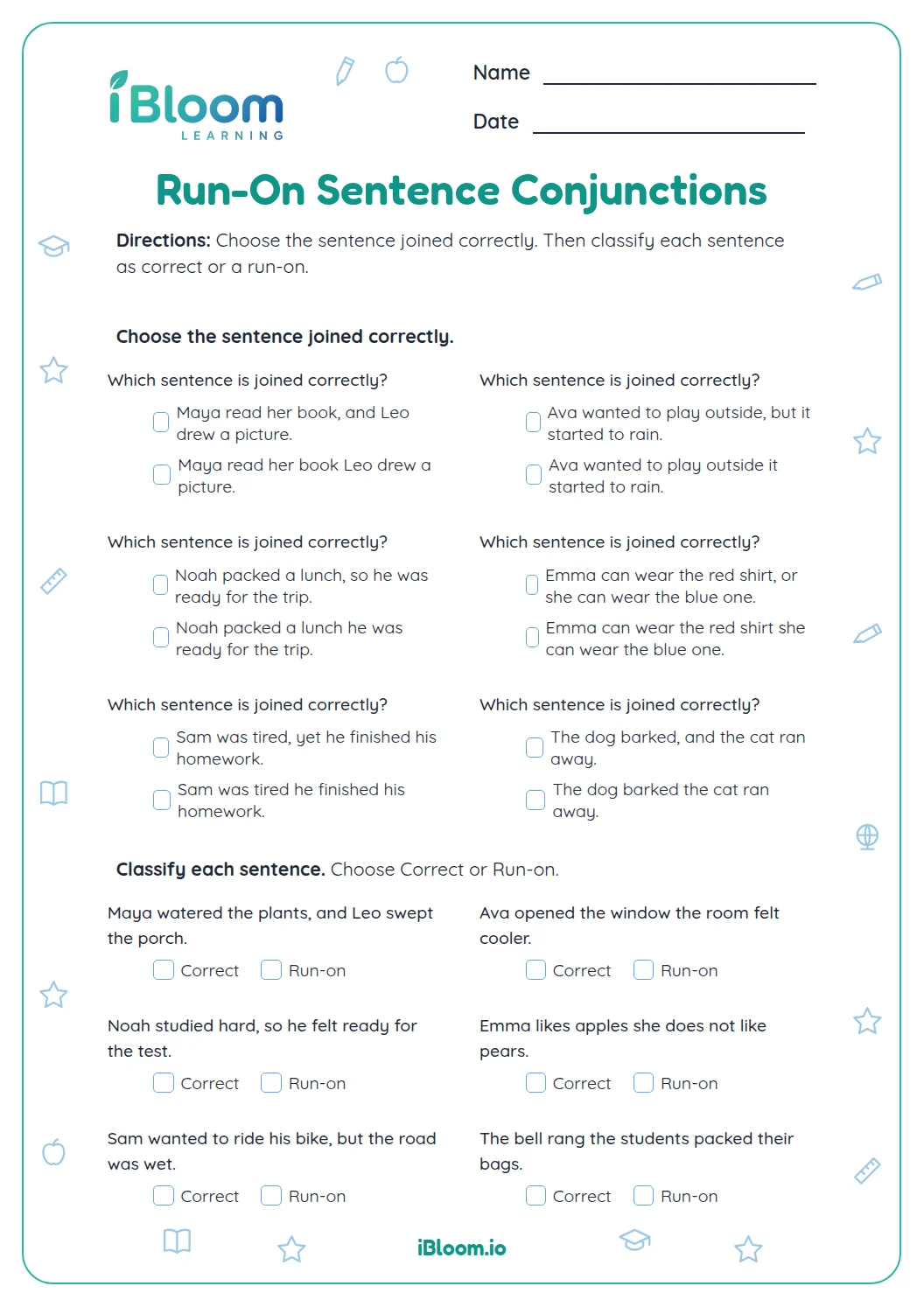
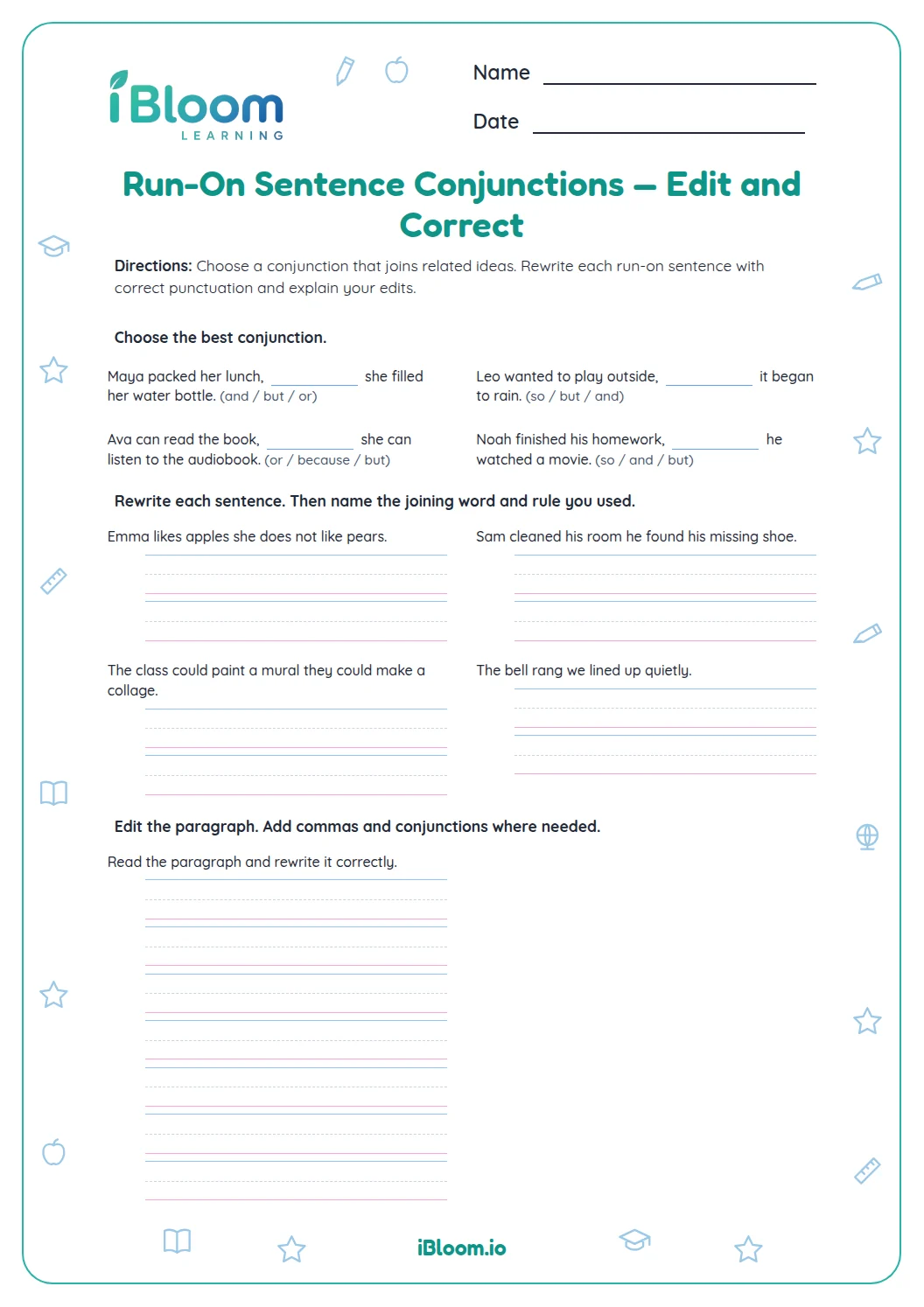
This Grade 4 grammar worksheet has 14 questions on recognizing and repairing run-on sentences. It practices CCSS L.4.1f by asking students to identify run-ons and choose a correction that produces a complete sentence. Part A contrasts run-ons with correctly joined sentences; Part B uses periods or commas with conjunctions to separate complete thoughts. The answer key accompanies the printable.
Aligned to L.4.1f
What makes a sentence a run-on?
A run-on joins two complete thoughts without the punctuation or joining word needed to separate them. “Maya fed the cat she filled its water bowl” has two complete thoughts pushed together. A period or a comma and a coordinating conjunction can make the relationship clear.
A long sentence is not automatically a run-on. It can be complete when its ideas are joined with appropriate punctuation and a word such as and, but, or so.
- 1Maya fed the cat she filled its water bowl.
- 2Thought 1: Maya fed the cat.
- 3Thought 2: She filled its water bowl.
- 4No punctuation joins them, so it is a run-on.
How can you repair a run-on?
Separate the thoughts with a period, or join them with a comma and a coordinating conjunction such as and, but, or so. Choose the punctuation that makes the relationship clear.
- Questions 1–7: identify complete sentences and run-ons
- Questions 8–14: choose complete sentences or clear repairs
How can you tell if both sides are complete thoughts?
Read each side aloud and ask whether it has a subject and a verb and can stand as a sentence. If both can stand alone but run together, look for a needed joining mark.
How to use this worksheet
- 1Read the full line once for meaning.
- 2Find the subject and verb in each possible thought.
- 3Ask whether each thought can stand alone as a sentence.
- 4If two complete thoughts run together, choose a period or a comma with a joining word.
- 5Reread the corrected sentence to make sure it sounds clear.
Common mistakes and quick fixes
The mistake
Calling every long sentence a run-on
The fix
Check for two complete thoughts and the punctuation joining them.
The mistake
Using a comma alone between two complete thoughts
The fix
Use a period or add a coordinating conjunction after the comma.
The mistake
Joining ideas that are not complete thoughts
The fix
Check for a subject and verb before labeling each part a complete thought.
Common Core alignment
This practice connects the named skill to a grade-level Common Core expectation.
Recognize and correct fragments and run-ons to produce complete sentences.
On this sheet: Students identify run-ons among complete sentences and choose corrected versions.
Show the official wordingHide the official wording
Produce complete sentences, recognizing and correcting inappropriate fragments and run-ons.*
What to practice next
Make more practice
Further reading
Questions parents and teachers ask
Is every long sentence a run-on?
No. A sentence can be long and still be complete when its ideas are joined with appropriate punctuation and connecting words. Look for two complete thoughts pushed together without a clear join. Part A contrasts run-ons with sentences that use a conjunction or dependent clause correctly.
What are two ways to repair a run-on?
Separate the complete thoughts with a period, or join them with a comma and a coordinating conjunction such as and, but, or so. For example, “The sun set. We lit the lanterns” works, as does “The sun set, and we lit the lanterns.”
What does Part A ask students to do?
Part A has seven sentences to classify as complete or run-on. Students check whether two complete thoughts meet without the punctuation or conjunction needed to join them. The answer key identifies each sentence, including “Maya fed the cat she filled its water bowl.”
What does Part B practice?
Part B has seven multiple-choice repair items. Students choose a period or a comma with a conjunction to separate two complete thoughts, such as “The team practiced, so they felt ready.” The answer key shows the selected correction for each sentence.
Why is a comma alone not enough between two thoughts?
A comma by itself cannot properly join two complete sentences in standard usage. Use a period, or add a coordinating conjunction after the comma. The worksheet’s repair choices give students examples of both options and the answer key identifies a clear repair for each run-on.