




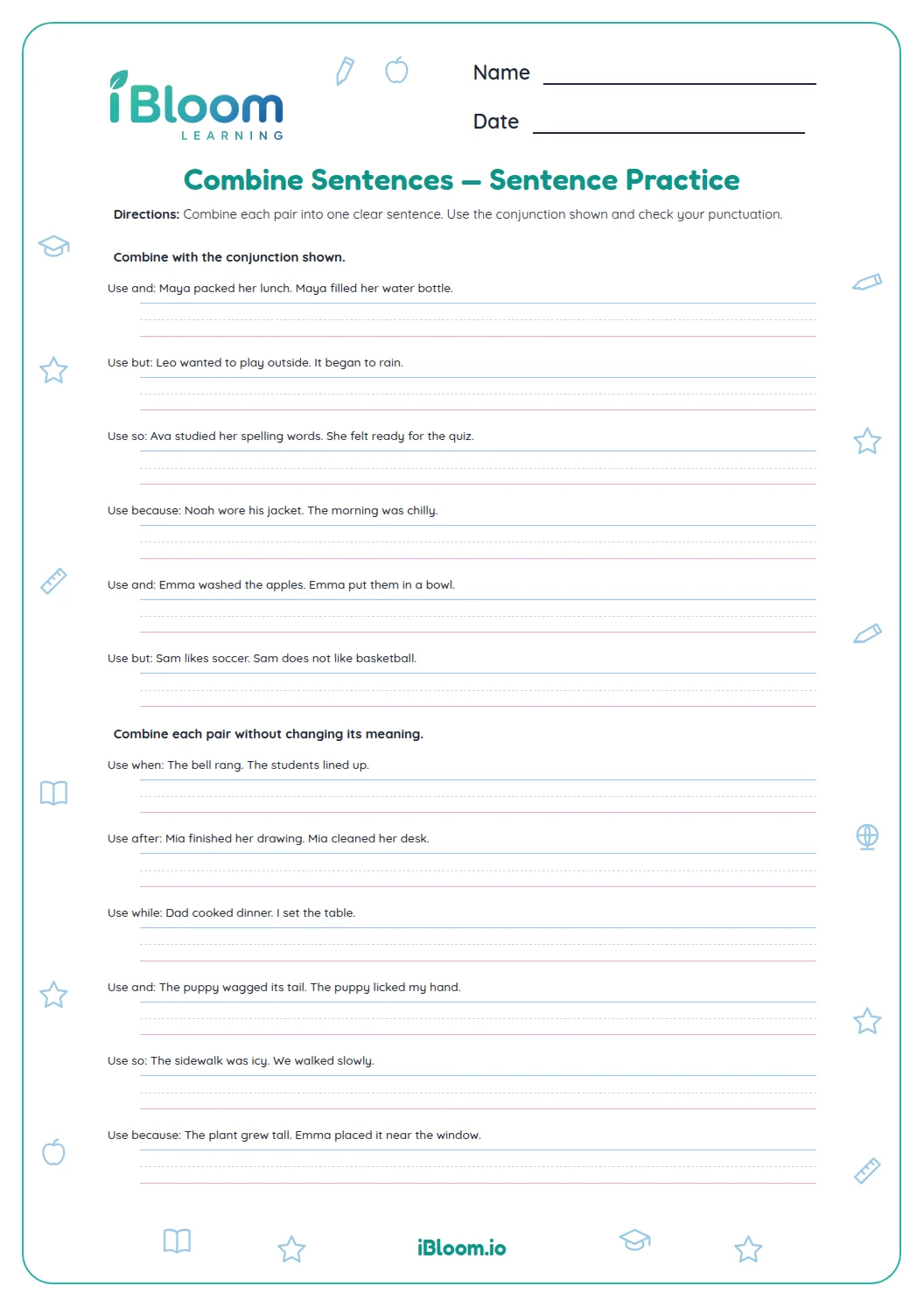

About this worksheet
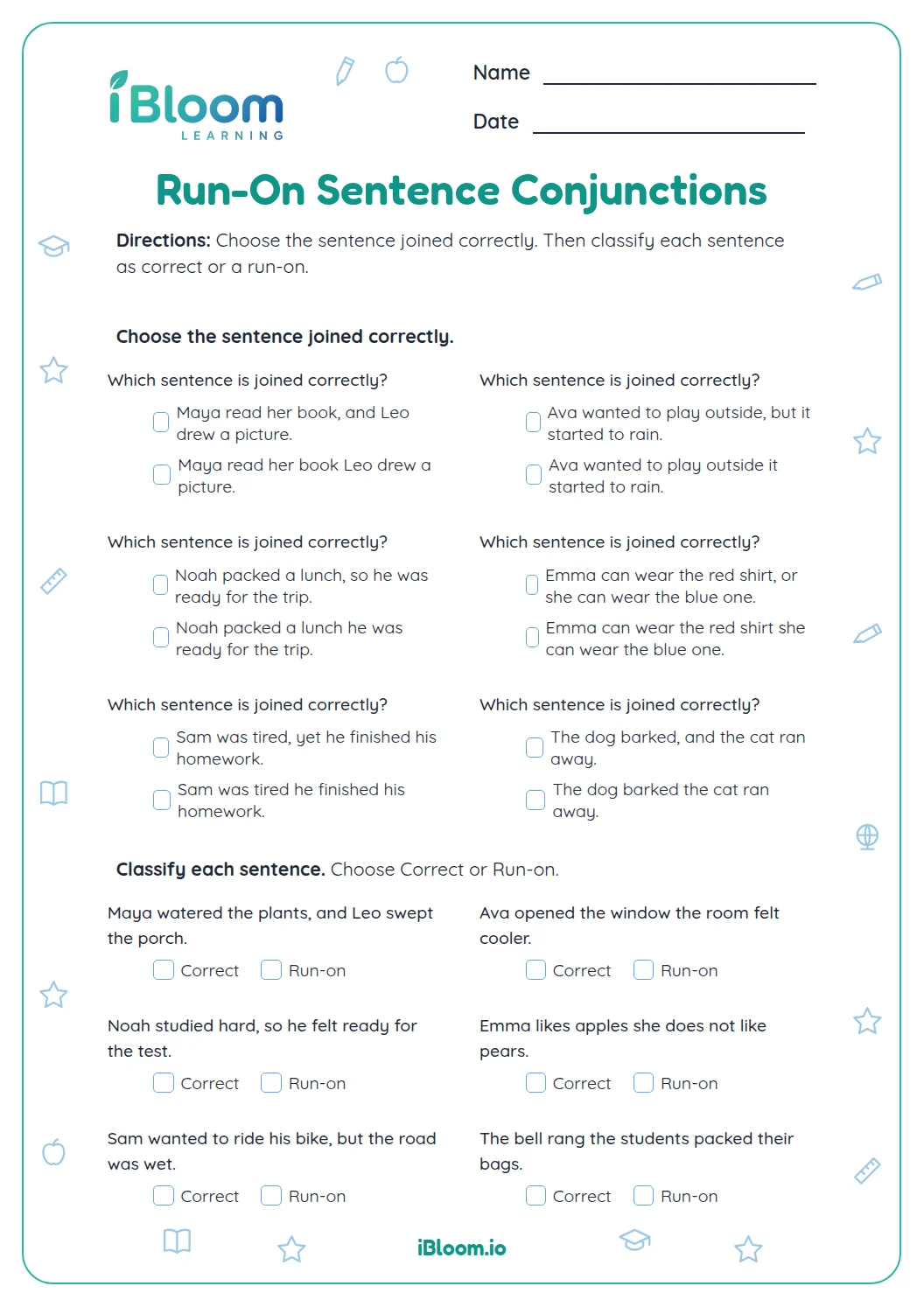
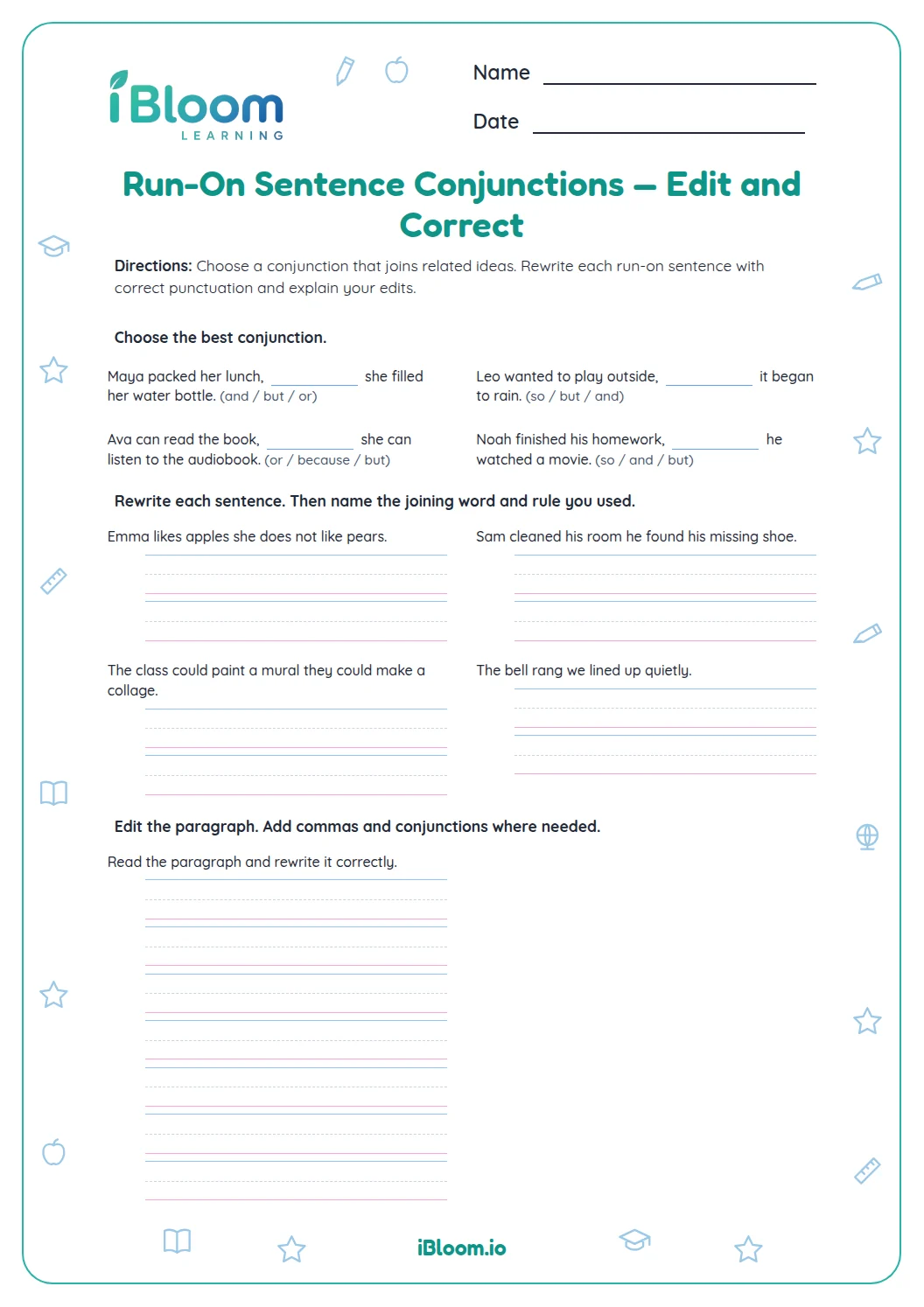
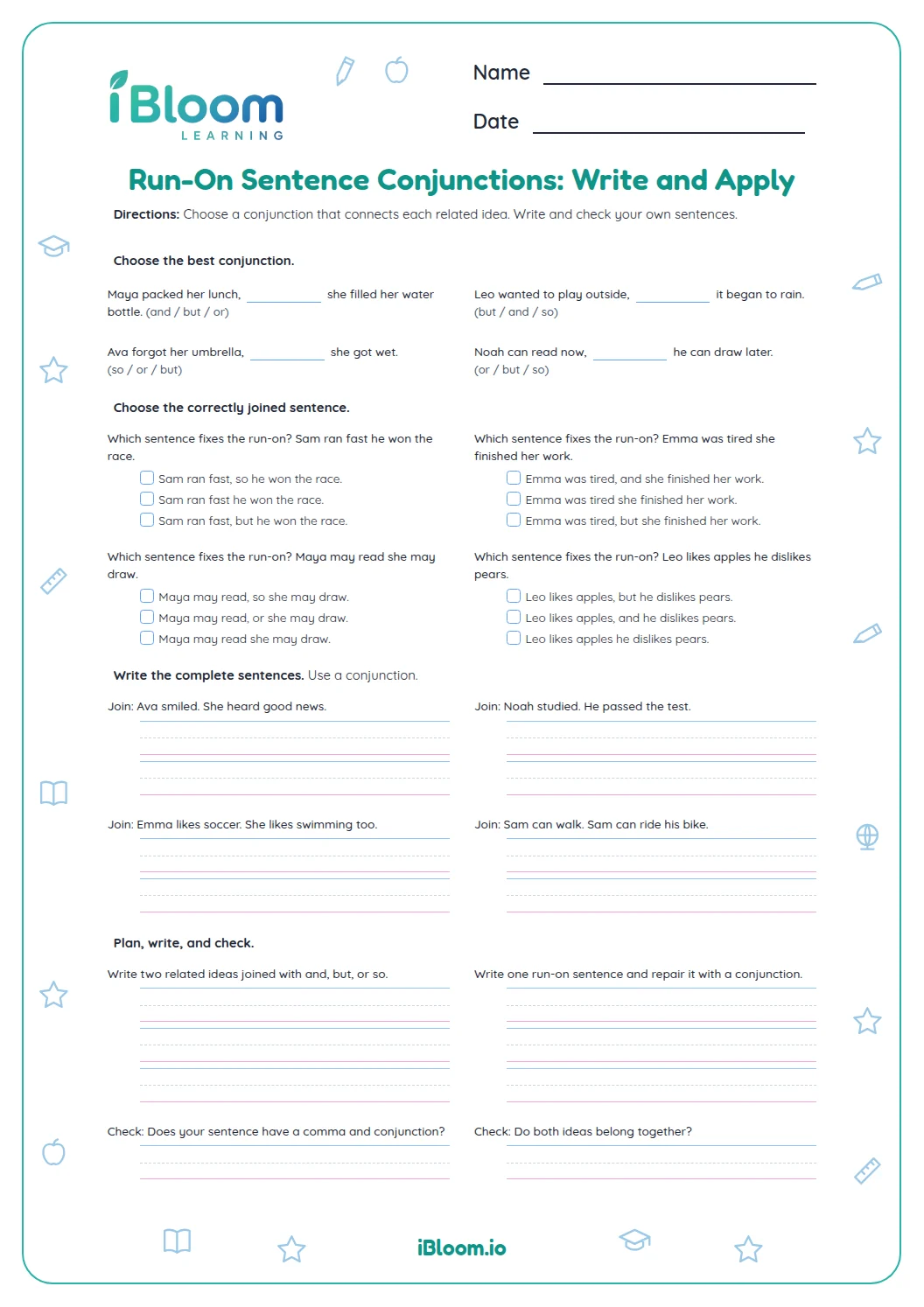
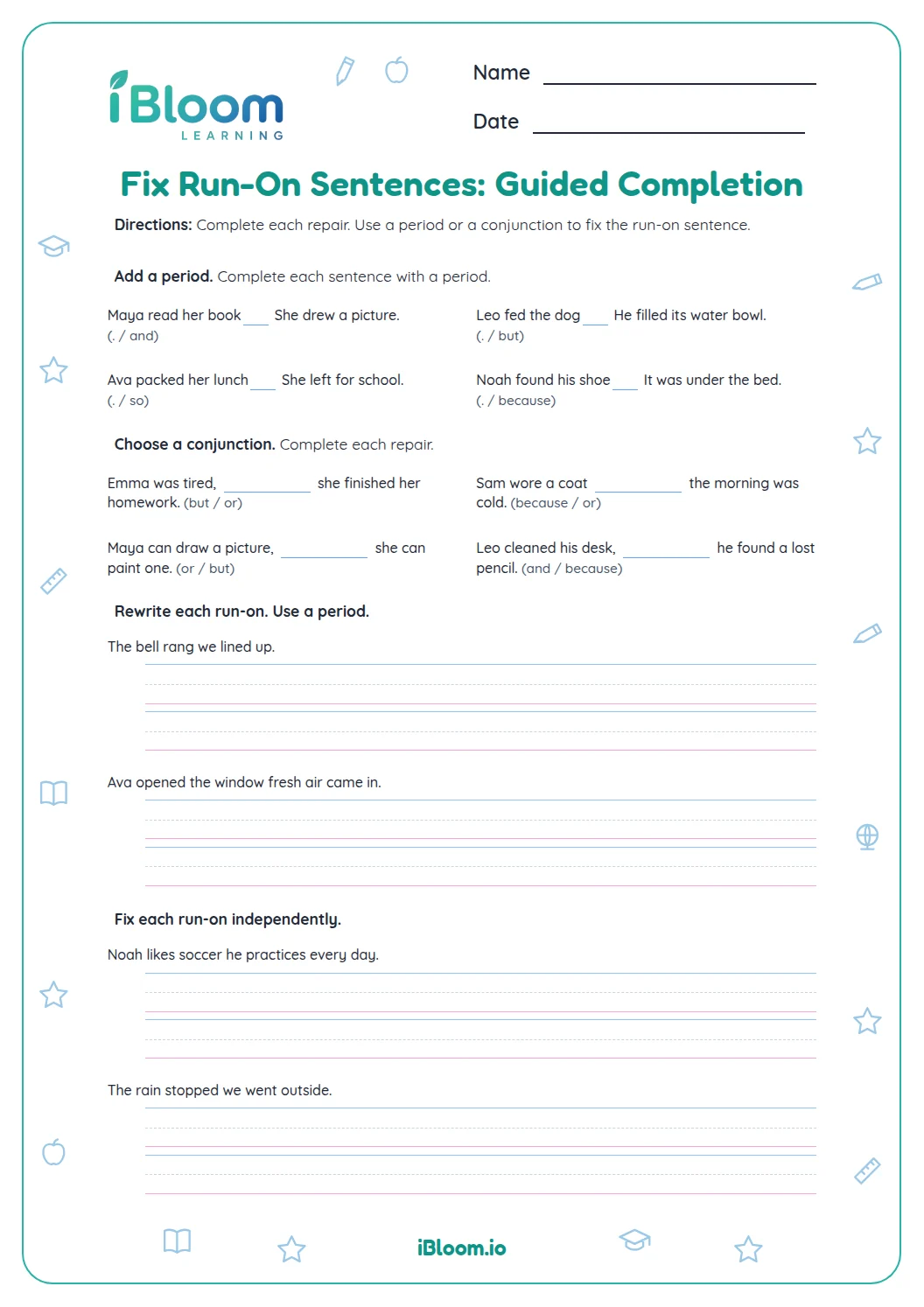
This free printable gives Grade 4 writers twelve sentence questions about joining complete thoughts. Part A asks whether each join is correct or a run-on. Part B uses meaning clues to choose “and,” “but,” “so” or “or.” Part C asks students to repair four run-ons using a specified conjunction and a comma. It practices Common Core L.4.1f and L.4.2c: correcting run-ons and punctuating compound sentences. A separate answer key includes the correct choices and full corrected sentences, making it possible to check both the connection between ideas and the punctuation.
Aligned to L.4.1f and L.4.2c
What makes these sentences run-ons?
A run-on joins complete thoughts without a correct boundary. Question 1 runs “I packed my bag” straight into “I left for school.” Question 3 uses only a comma between two complete thoughts, which is a comma splice.
Part A includes two correctly joined sentences as well. Students must check the boundary between ideas rather than assume that every sentence with two actions is wrong.
How do students choose a conjunction?
Part B names the intended connection. And adds an idea, but shows a contrast, so introduces a result, and or offers a choice. Reading the connection cue makes each choice specific.
In Part C, the conjunction is supplied so students can concentrate on repairing the boundary. They copy both thoughts, place a comma before the conjunction, and keep one period at the end.
- 1Question 10: I called Ben, he did not answer.
- 2Complete thoughts: I called Ben. / He did not answer.
- 3The required conjunction but shows a contrast.
- 4Corrected: I called Ben, but he did not answer.
What should I look for in the rewritten sentences?
Check that both original thoughts remain and that the required conjunction has a comma immediately before it. The second thought begins with a lowercase word unless that word is a name or I.
Have students read the corrected sentence aloud, then identify the subject and verb on each side of the join. That check helps explain why a compound sentence uses this punctuation.
How to use this worksheet
- 1Read each Part A sentence and find its complete thoughts.
- 2Decide whether the boundary joins them correctly.
- 3In Part B, use the named connection to choose the conjunction.
- 4Rewrite every Part C item with the given conjunction and a comma.
- 5Compare the rewrites with the key, checking capitals and final periods too.
Mistakes to catch and how to fix them
The mistake
Calling a sentence a run-on just because it is long.
The fix
Locate the complete thoughts and inspect their join; length does not decide correctness.
The mistake
Fixing “The dog barked the cat hid” with only a comma.
The fix
Add a coordinating conjunction after the comma, or use two complete sentences when directions allow.
The mistake
Writing “I called Ben but, he did not answer.”
The fix
Move the comma before but: “I called Ben, but he did not answer.”
Common Core alignment
Recognize run-ons and rewrite them as complete, correctly joined sentences.
On this sheet: Parts A and C identify and repair fused sentences and comma splices.
Show the official wordingHide the official wording
Produce complete sentences, recognizing and correcting inappropriate fragments and run-ons.*
Put a comma before the conjunction joining two complete thoughts.
On this sheet: Part C requires a comma and coordinating conjunction in each compound sentence.
Show the official wordingHide the official wording
Use a comma before a coordinating conjunction in a compound sentence.
What to practice next
Make more practice
Further reading
Questions parents and teachers ask
Which conjunctions are practiced?
The sheet practices and, but, so and or. Part B gives a connection cue for each choice: add an idea, show a contrast, show a result or give a choice. Part C then names the conjunction students must use to repair each run-on sentence.
Is a comma alone enough to fix a run-on?
A comma alone cannot join the two complete thoughts in these items. “The dog barked, the cat hid” is still a run-on called a comma splice. In Part C, students repair each boundary with a comma followed by the coordinating conjunction named in the prompt.
Can my child split a run-on into two sentences?
Splitting a run-on into two complete sentences is a valid editing method. This sheet’s Part C specifically asks for one sentence using the named conjunction, so students should practice that repair here. As a follow-up, they can say how the same ideas would sound as two sentences.
Does every sentence with and need a comma?
No, the comma rule practiced here concerns a conjunction joining two complete thoughts. Both sides can stand as sentences: “Ava fed the cat” and “she filled its water bowl.” Have your child identify those complete thoughts before placing the comma before and in question 9.
What does the answer key include?
The key identifies the four sentence judgments and four conjunction choices, then provides all four corrected sentences. Check the rewrites for the supplied conjunction, a comma before it, both original thoughts and a final period. This makes the punctuation check as clear as the word choice.