






About this worksheet
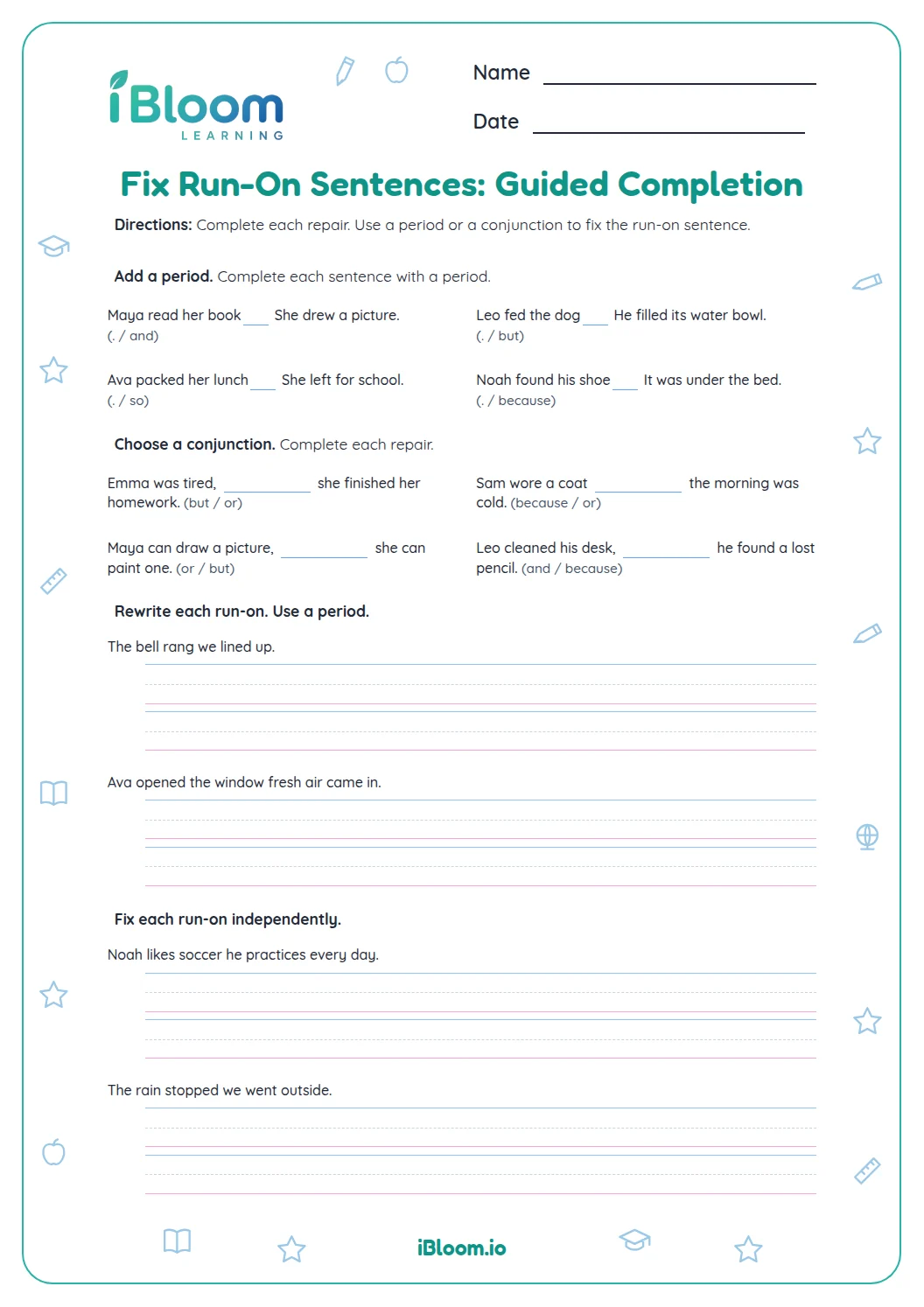
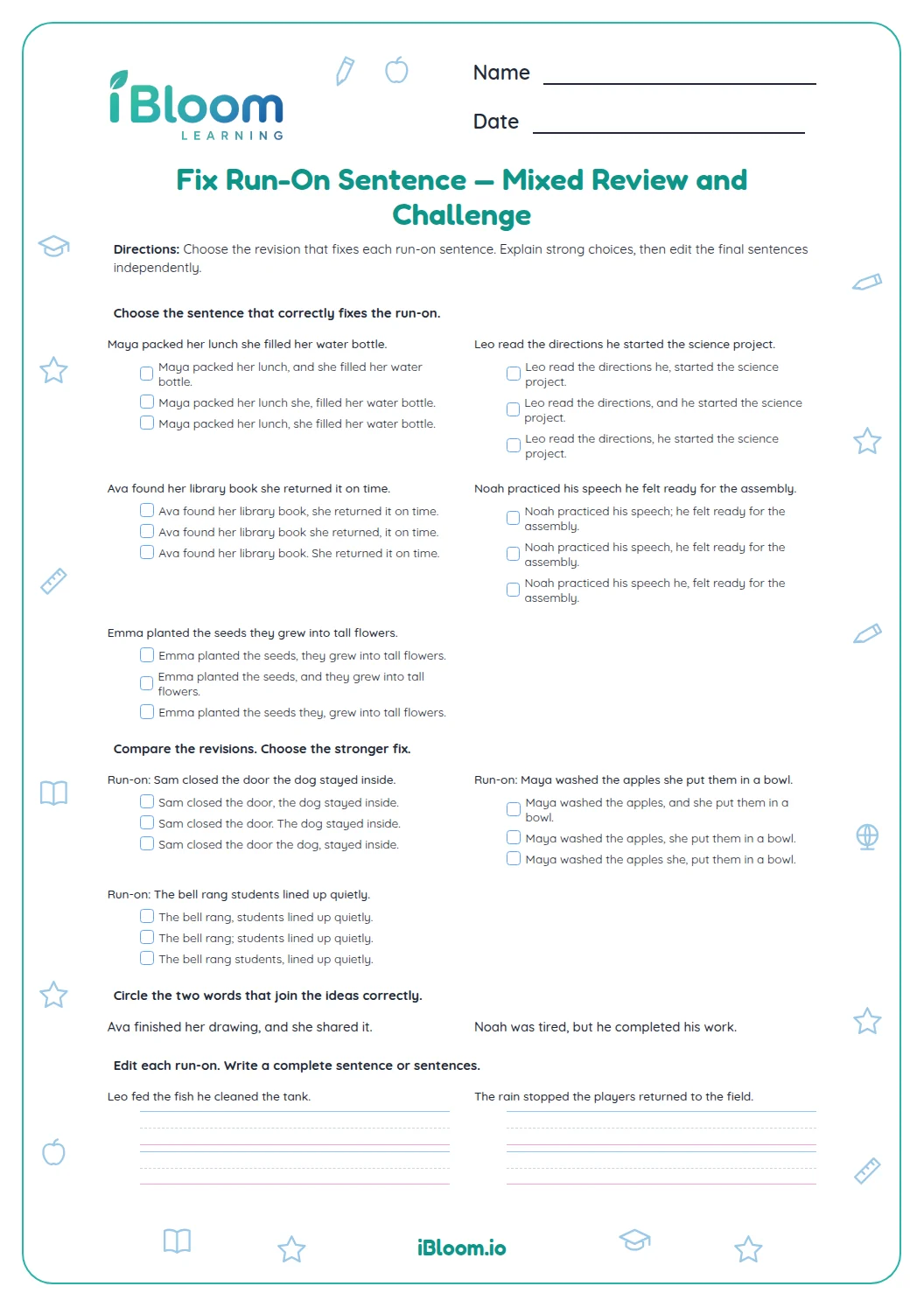
This Grade 4 sentence-practice worksheet helps students repair run-on sentences while keeping the original meaning clear. Part A asks students to choose a complete repair; Part B gives them space to rewrite run-ons using end punctuation or an appropriate joining word. The answer key includes one clear model for each item.
Aligned to L.4.1.f
What makes a run-on sentence?
A run-on joins two complete thoughts without the punctuation or connecting word needed to show their relationship. Each thought can stand as a sentence, so the repair must separate or correctly join them.
- 1Question 1 can be repaired as two sentences: “Maya packed her lunch. She filled her water bottle.” Both thoughts are complete.
- 2Question 6 uses “so” to show a result: opening the window made the room feel cooler.
How can punctuation fix a run-on?
A period can end the first complete thought and begin a new sentence with a capital letter. A semicolon can also join closely related complete thoughts when used correctly.
When does a joining word help?
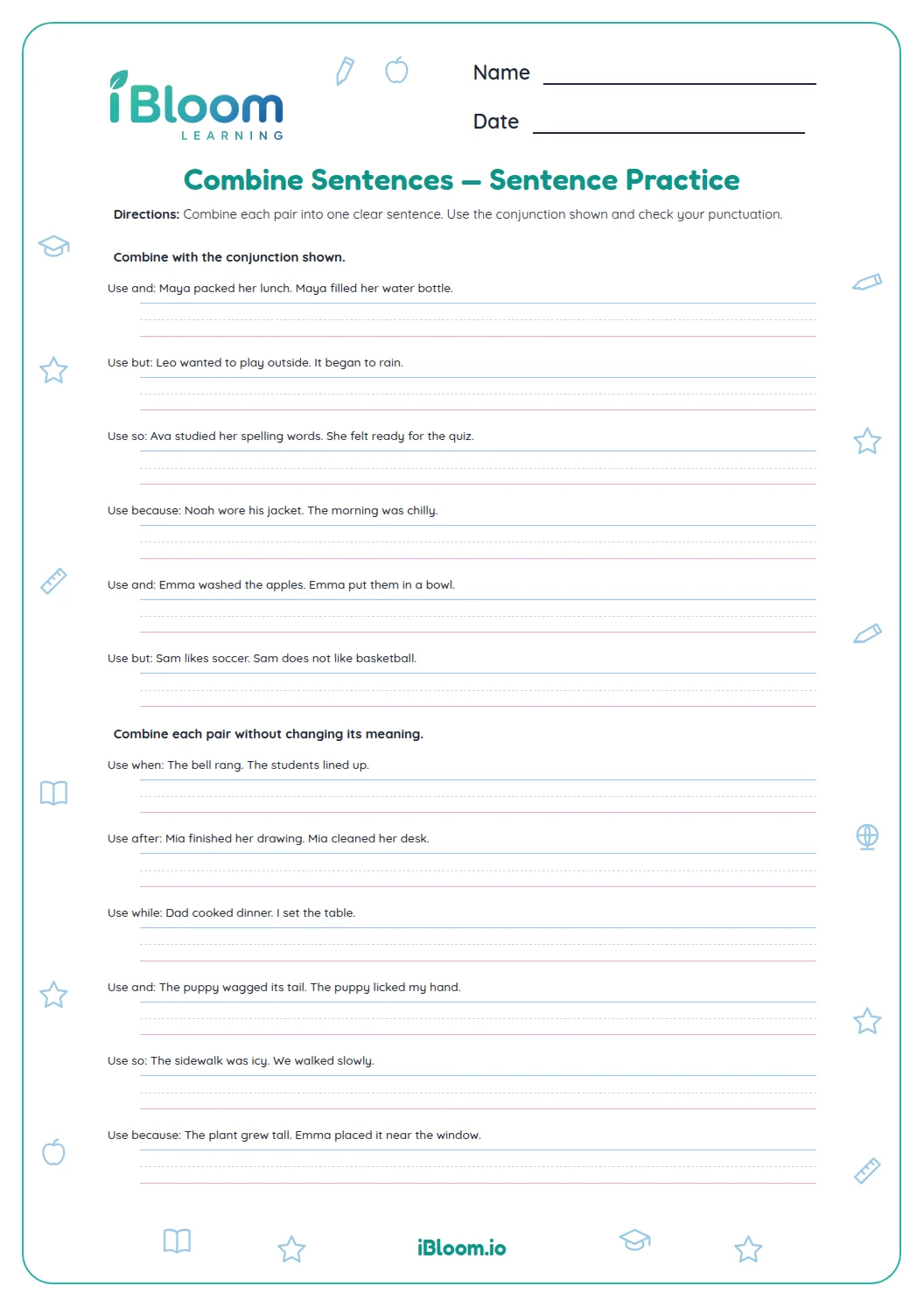
A conjunction such as and, but or so can connect thoughts and show how they relate. Choose a word that fits the meaning, then check the punctuation around it.
How to work through this page
- 1Find the two complete thoughts.
- 2Choose a period, semicolon or joining word that fits their relationship.
- 3Capitalize the first word after a period.
- 4Read the repaired sentence aloud to check meaning and punctuation.
Common mistakes and quick fixes
The mistake
Joining two complete thoughts with only a comma
The fix
Use a period, semicolon, or comma with a conjunction.
The mistake
Forgetting the capital after a period
The fix
Capitalize the first word of the new sentence.
The mistake
Choosing a connector that changes the meaning
The fix
Select a joining word that shows the original relationship.
Common Core alignment
This worksheet gives students focused practice with the named skill.
Produce complete sentences, recognizing and correcting inappropriate fragments and run-ons.
On this sheet: Students recognize and correct run-on sentences with punctuation or joining words.
Show the official wordingHide the official wording
Produce complete sentences, recognizing and correcting inappropriate fragments and run-ons.
What to practice next
Make more practice
Further reading
Questions parents and teachers ask
What is a run-on sentence?
A run-on joins complete thoughts without correct punctuation or a joining word. The worksheet asks students to separate or connect those thoughts correctly. For example, “Maya packed her lunch. She filled her water bottle.” separates the two complete thoughts and gives each its own ending punctuation.
Can I fix every run-on with a period?
A period works when it creates two clear sentences. Capitalize the first word of the second sentence; a semicolon or a conjunction may also fit. For example, “The puppy barked. The mail carrier stepped back.” makes two complete sentences. Check that each begins with a capital and ends with punctuation.
Why is a comma by itself not enough?
A comma alone does not correctly join two complete sentences. Use a period, semicolon, or comma with a coordinating conjunction such as and or so. For example, use “The rain stopped, and we went outside.” The comma and conjunction connect two complete thoughts correctly.
Can there be more than one correct repair?
Yes. A run-on can have several correct repairs if the punctuation and meaning are clear. The key gives one model; another sound repair can also work. For example, “The clouds gathered, so the game moved indoors” shows cause and result. A period between the thoughts would also preserve the meaning.
How can a joining word change meaning?
Joining words signal how ideas relate: “so” can show a result, “but” a contrast, and “and” an addition. Choose the connector that preserves the intended meaning. For example, “so” fits when one event causes another. “But” would signal contrast, so reread the original thoughts before choosing a connector.