






About this worksheet
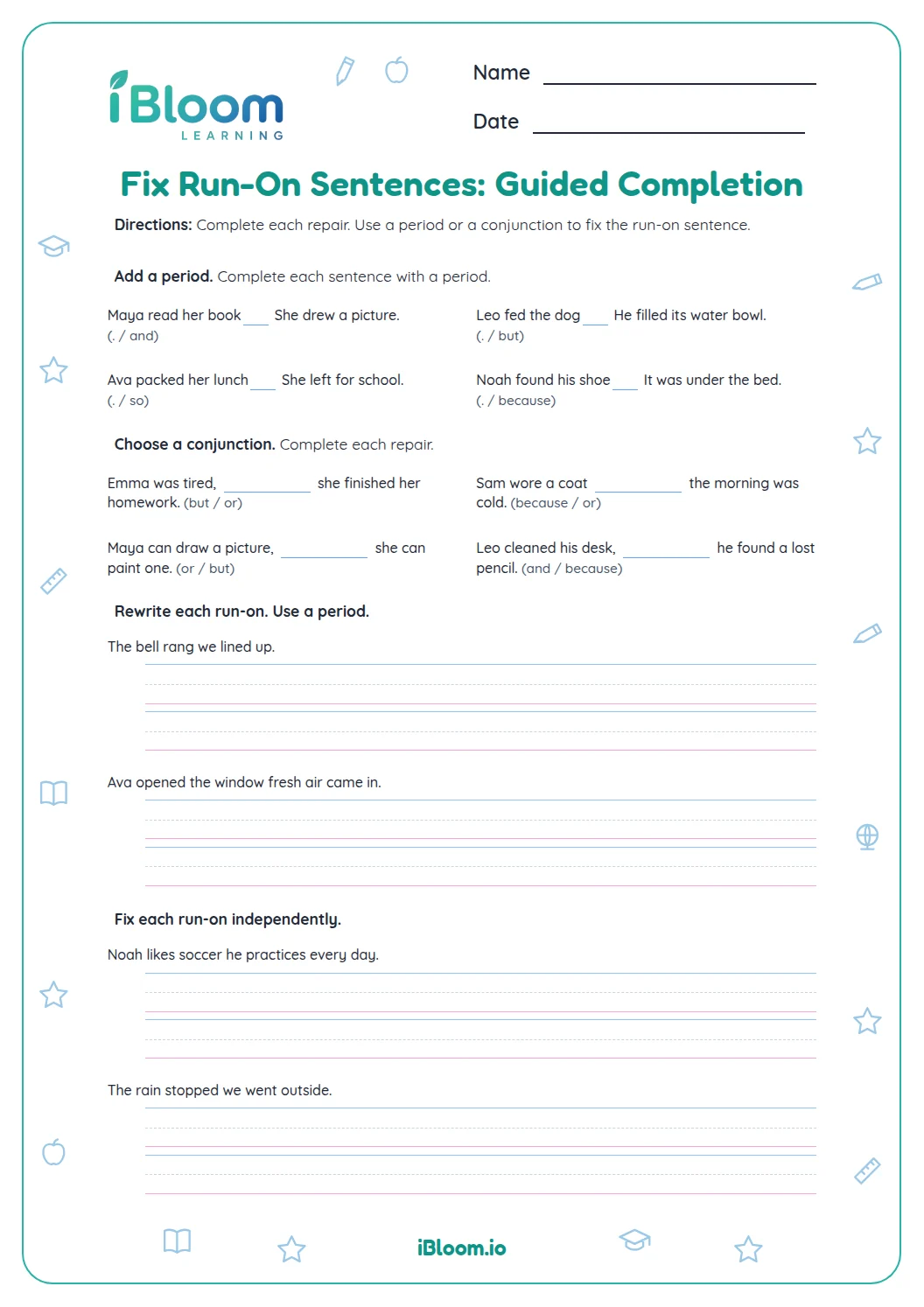
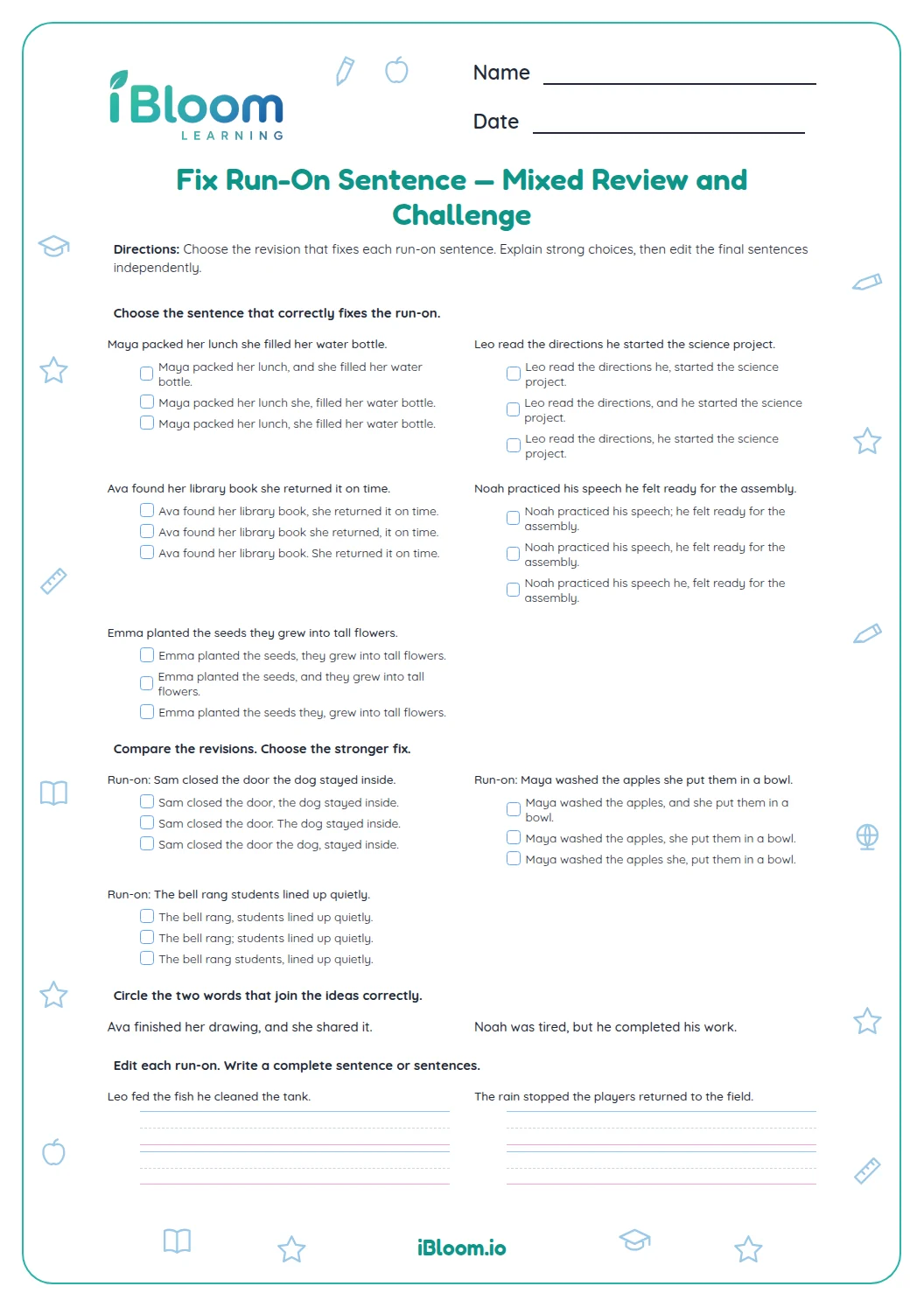
This free Grade 4 worksheet builds skill in fixing run-on sentences. Students first choose a sound correction for eight examples, then apply the strategy in six writing prompts using conjunctions, commas, periods, and capitals. It aligns with Common Core L.4.1.f, producing complete sentences and recognizing/fixing inappropriate fragments and run-ons. The key includes correct choices and sample written responses; other revisions that clearly separate or join complete thoughts are also valid.
Aligned to L.4.1.f
What makes a run-on sentence?
A run-on places two complete thoughts together without the punctuation or joining word readers need. “Rain stopped, we left” has two complete thoughts connected only by a comma.
A comma plus a conjunction can join the thoughts: “The rain stopped, so we went outside.” A period can also separate them into two sentences.
- 1Run-on: The rain stopped, we went outside.
- 2Correction: The rain stopped, so we went outside.
When should you use a conjunction?
Use and for an added idea, but for a contrast, or for a choice, and so when one event leads to another. Place a comma before the conjunction when it joins two complete thoughts.
How can you revise your own run-on?
Find the subject and verb in each thought. Then choose a period and capital letter, or use a comma and a conjunction that shows how the ideas connect.
How to use this worksheet
- 1Read the sentence aloud and listen for two complete thoughts.
- 2Mark the subject and verb in each thought.
- 3Choose a period or a comma plus a fitting conjunction.
- 4Read the revision again to check the meaning and punctuation.
- 5Use the same steps on your own writing prompts.
Common mistakes and quick fixes
The mistake
Putting only a comma between two complete thoughts.
The fix
Use a period or add a conjunction after the comma.
The mistake
Choosing a conjunction that changes the relationship.
The fix
Use so for a result, but for contrast, and for an added idea.
The mistake
Joining a fragment as though it were a complete thought.
The fix
Check that both sides have a subject and a verb.
Curriculum alignment
This worksheet connects focused practice to the listed Common Core skill.
Produce complete sentences and recognize and correct inappropriate run-ons.
On this sheet: Students identify run-ons, choose corrections, and write revised sentences.
Show the official wordingHide the official wording
Produce complete sentences, recognizing and correcting inappropriate fragments and run-ons.
What to practice next
Make more practice
Further reading
Questions parents and teachers ask
What is a run-on sentence?
A run-on joins two complete thoughts without correct punctuation or a joining word. “Rain stopped, we left” needs a repair. A student can make two sentences or join the thoughts with a comma and a conjunction, as the worksheet practices.
How many ways can a student repair a run-on?
The page practices separating complete thoughts with a period or joining them with a conjunction such as and, but, or so. Some responses may vary. A correct repair keeps the original meaning and uses capitalization and punctuation appropriately.
Can an answer differ from the sample key?
Yes. The key shows one suitable correction for each prompt. Accept a different repair when it clearly separates or correctly joins the complete thoughts and preserves their meaning. For example, a period can work where the sample uses “so.”
What should students check after revising?
Check that each sentence begins with a capital letter and ends with punctuation. Then look at the two original thoughts: they should be separated by a period or joined with suitable punctuation and a conjunction. Read the revision aloud to catch a missing pause.
Why does the worksheet ask students to write?
The page practices separating complete thoughts with a period or joining them with a conjunction such as and, but, or so. Some responses may vary. A correct repair keeps the original meaning, uses capitalization and punctuation appropriately, and makes both complete thoughts easy to read.