






About this worksheet
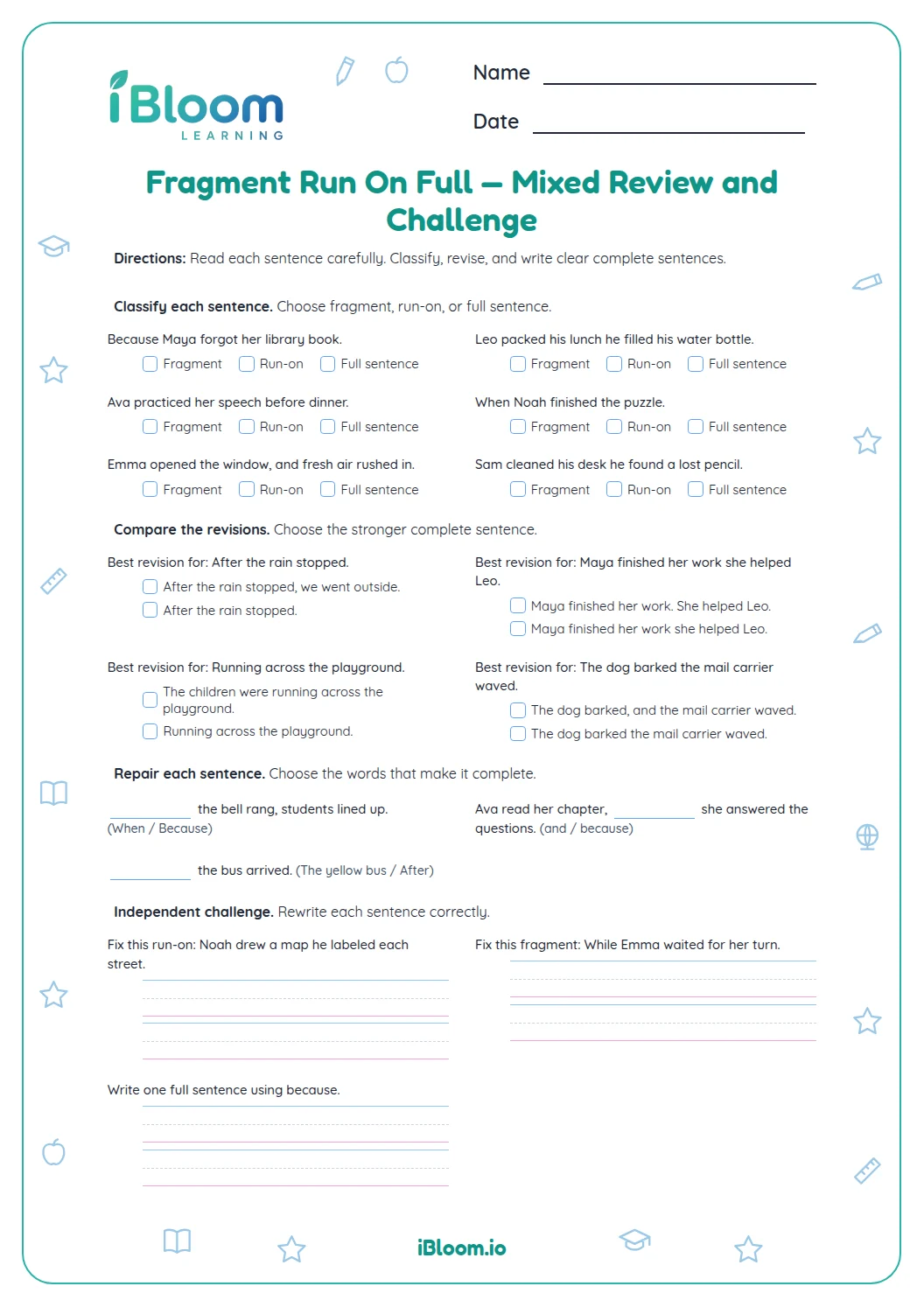
This editing page helps Grade 4 learners check whether each group of words expresses a complete thought. It progresses from recognition to repairing fragments and run-ons with a subject, verb, period, comma, or conjunction, then ends with a short paragraph edit.
Aligned to CCSS.ELA-LITERACY.L.4.1.F and CCSS.ELA-LITERACY.L.4.2
How this worksheet builds the skill
This editing page helps Grade 4 learners check whether each group of words expresses a complete thought. It progresses from recognition to repairing fragments and run-ons with a subject, verb, period, comma, or conjunction, then ends with a short paragraph edit.
A fragment is missing a complete thought. A run-on joins complete thoughts without correct punctuation or a joining word.
- 1A fragment is missing a complete thought. A run-on joins complete thoughts without correct punctuation or a joining word.
What children practice
Identify fragments and run-ons, repair sentence boundaries, and edit a short paragraph into complete sentences.
- 15 questions in three parts
- A separate answer key
- Practice that moves from recognition to independent use
A simple way to use the page
- 1Read the direction for each part before beginning.
- 2Ask the learner to explain one answer aloud.
- 3Use the answer key to check the work and revisit one missed item.
Common slips to watch for
The mistake
A dependent clause may be punctuated as a full sentence.
The fix
Add a main clause to complete the thought.
The mistake
Two complete thoughts may be joined with only a comma.
The fix
Use a period, semicolon, or comma with a conjunction.
The mistake
A run-on may be fixed with punctuation that changes the idea.
The fix
Choose a conjunction that shows how the two ideas relate.
Curriculum alignment
This worksheet practices the following Common Core skill.
Produce complete sentences, recognizing and correcting inappropriate fragments and run-ons.
On this sheet: The questions ask learners to practice grade 4 sentence editing at the level described by this standard.
Show the official wordingHide the official wording
Produce complete sentences, recognizing and correcting inappropriate fragments and run-ons.
Demonstrate command of capitalization, punctuation, and spelling.
On this sheet: Editing tasks practice punctuation and capitalization in complete sentences.
Show the official wordingHide the official wording
Demonstrate command of the conventions of standard English capitalization, punctuation, and spelling when writing.
What to practice next
Make more practice
Questions parents and teachers ask
How can a student spot a sentence fragment?
Check whether the words express a complete thought. A dependent beginning such as “Because the rain stopped” leaves the reader waiting for the main idea. Add a subject and predicate that complete the thought, then check punctuation. The worksheet provides space to try the skill before checking the key.
How can a run-on sentence be corrected?
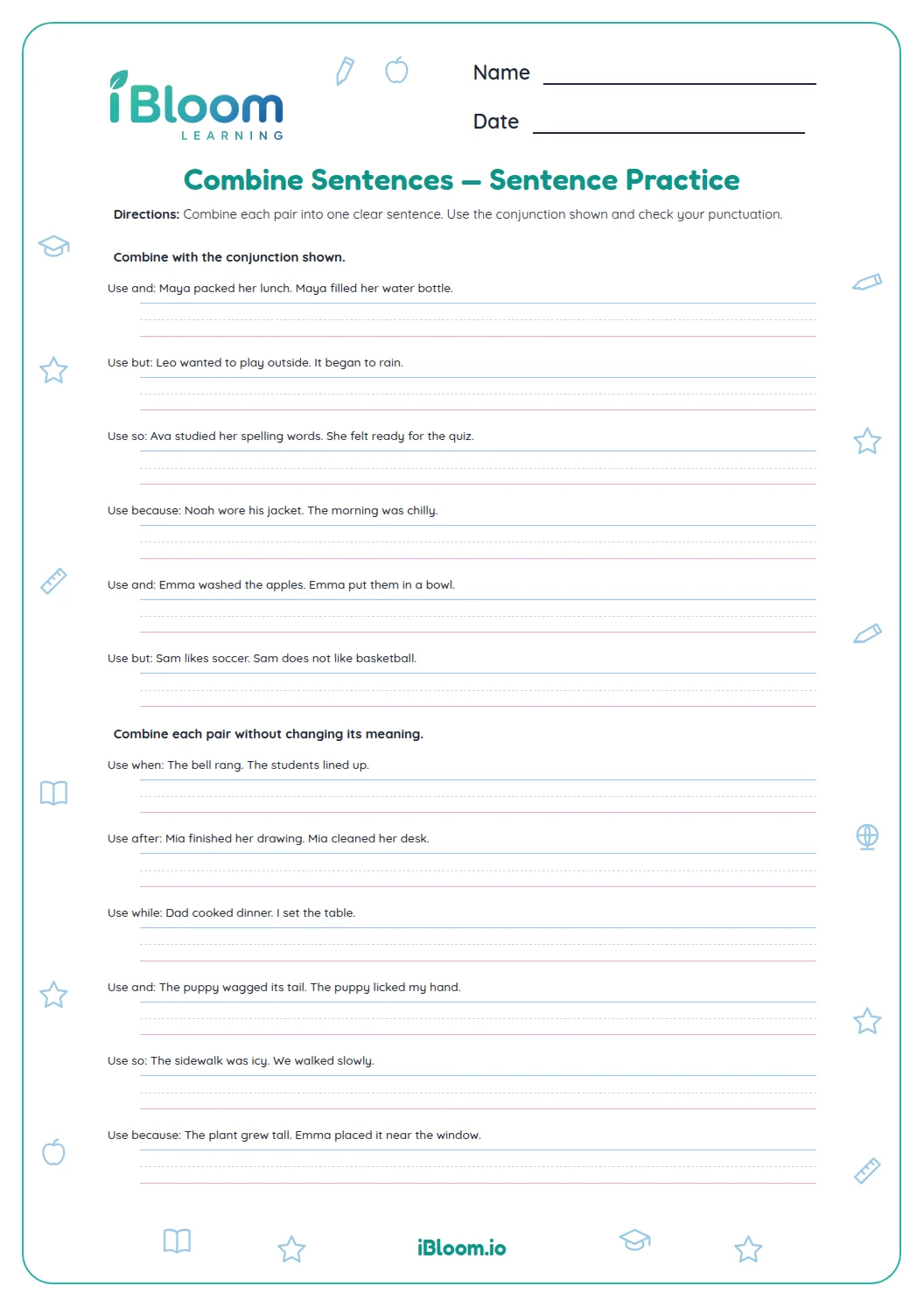
Separate the complete thoughts with a period or semicolon, or join them with a comma and a fitting conjunction such as and, but, or so. Read the edited sentence aloud to check that the relationship between ideas is clear. The worksheet provides space to try the skill before checking the key.
Can a fragment begin with because or while?
Yes, but the dependent clause needs a main clause to complete its meaning. “Because the rain stopped” is incomplete by itself. “Because the rain stopped, we went outside” expresses a complete thought. The worksheet provides space to try the skill before checking the key.
What does this worksheet mean by a complete sentence?
For this practice, a complete sentence expresses a whole thought with a subject and a predicate and uses an appropriate beginning capital and ending mark. Some short commands have an understood subject, but the exercises use clear examples with stated subjects.