







About this worksheet
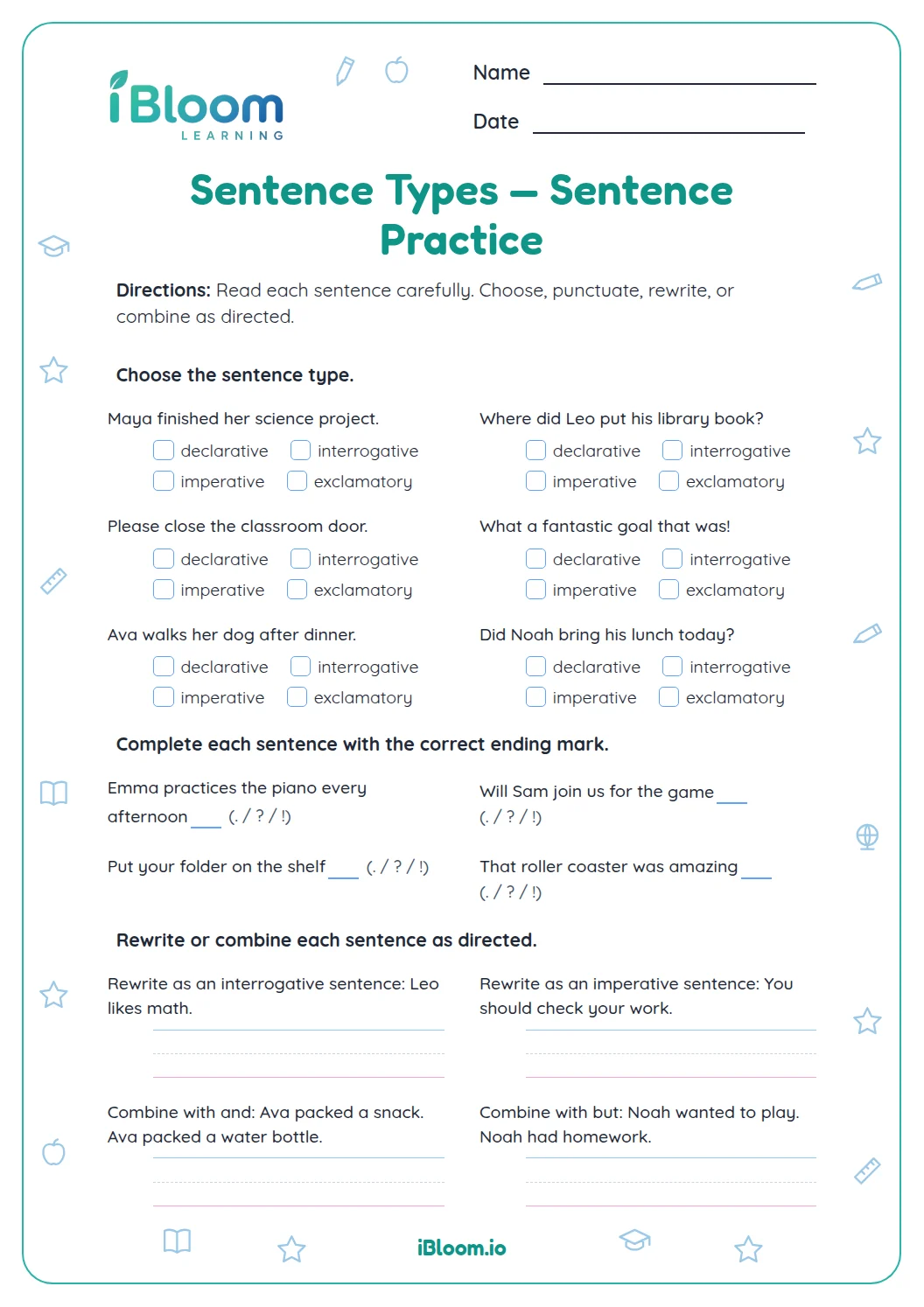
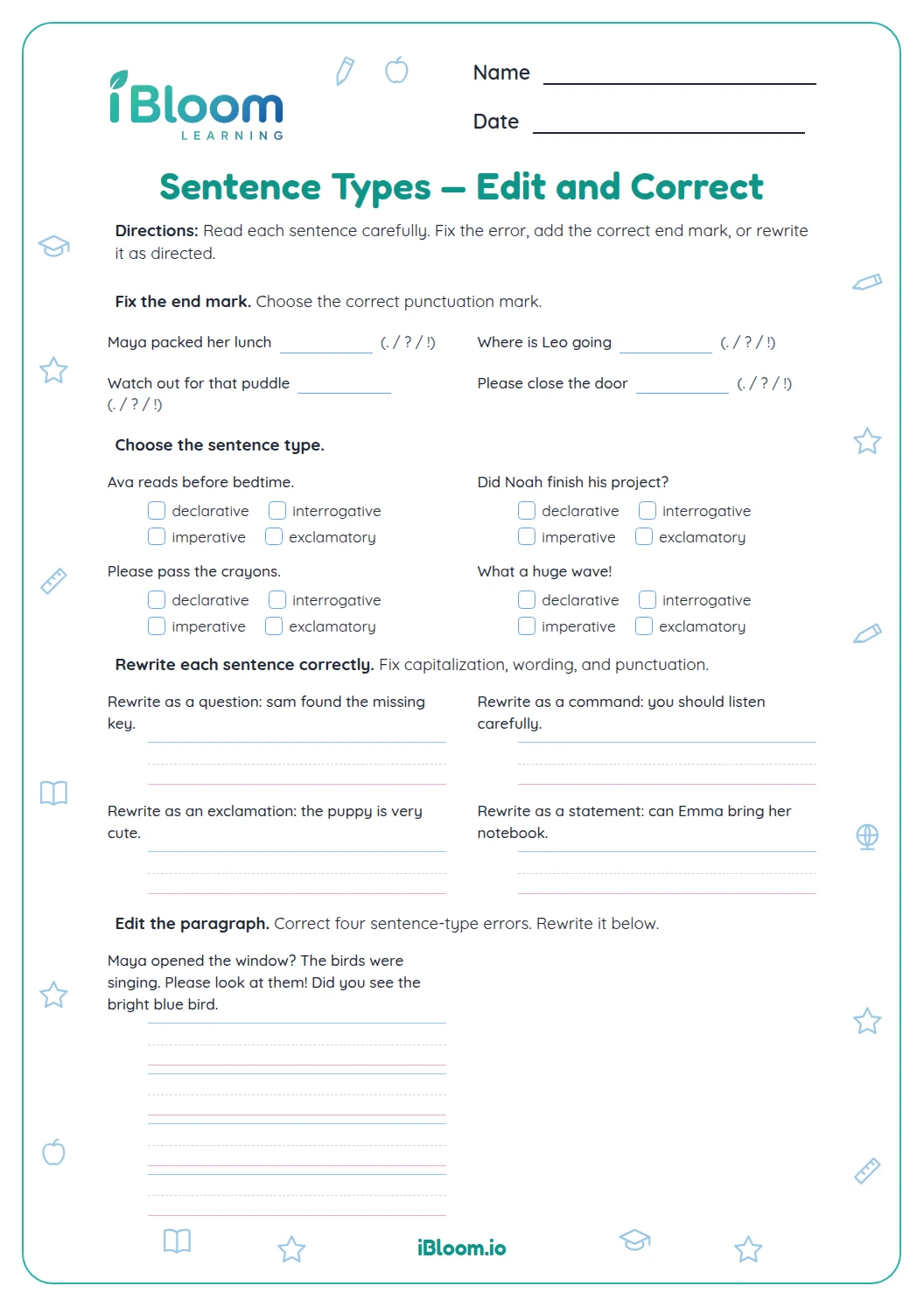
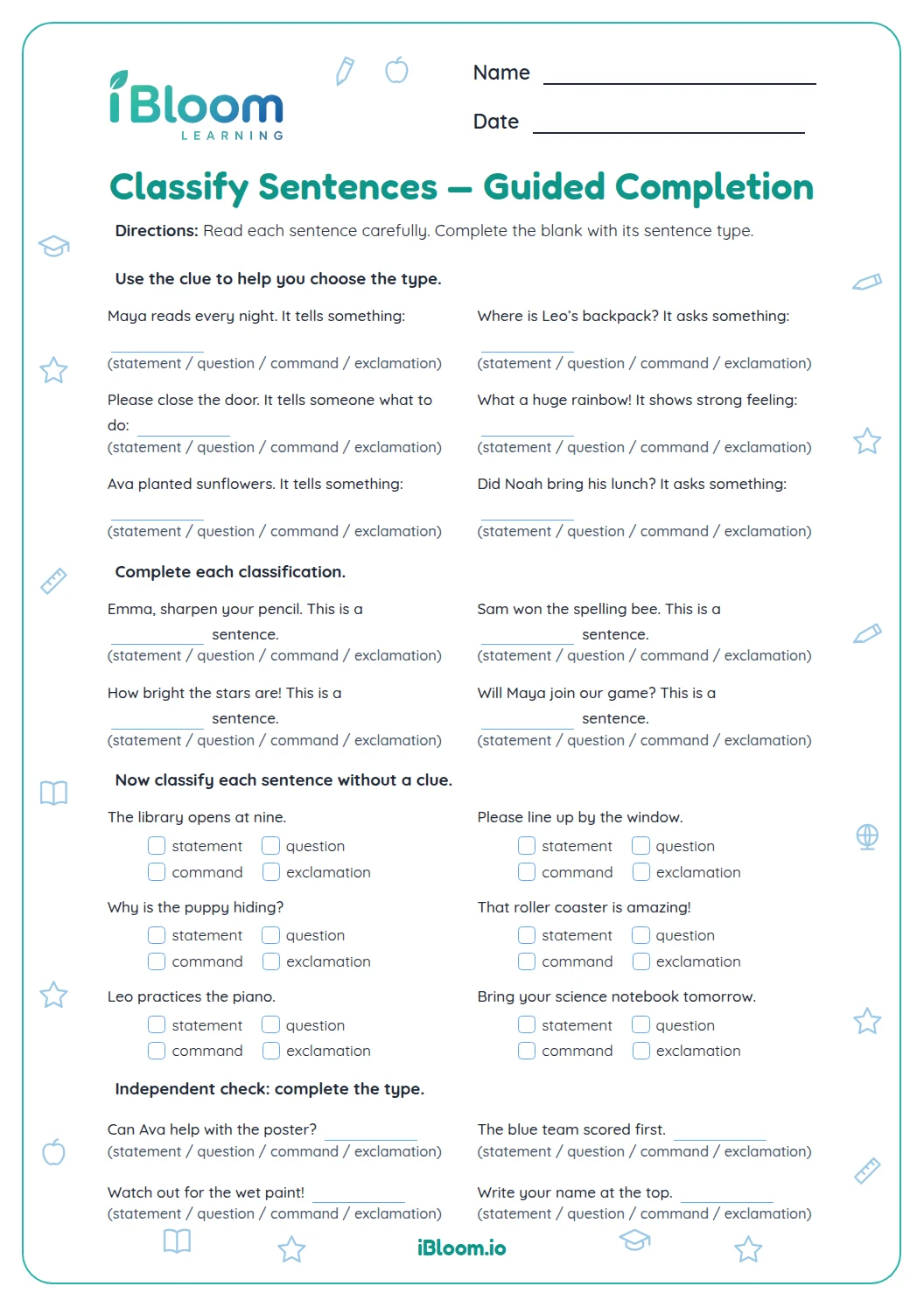
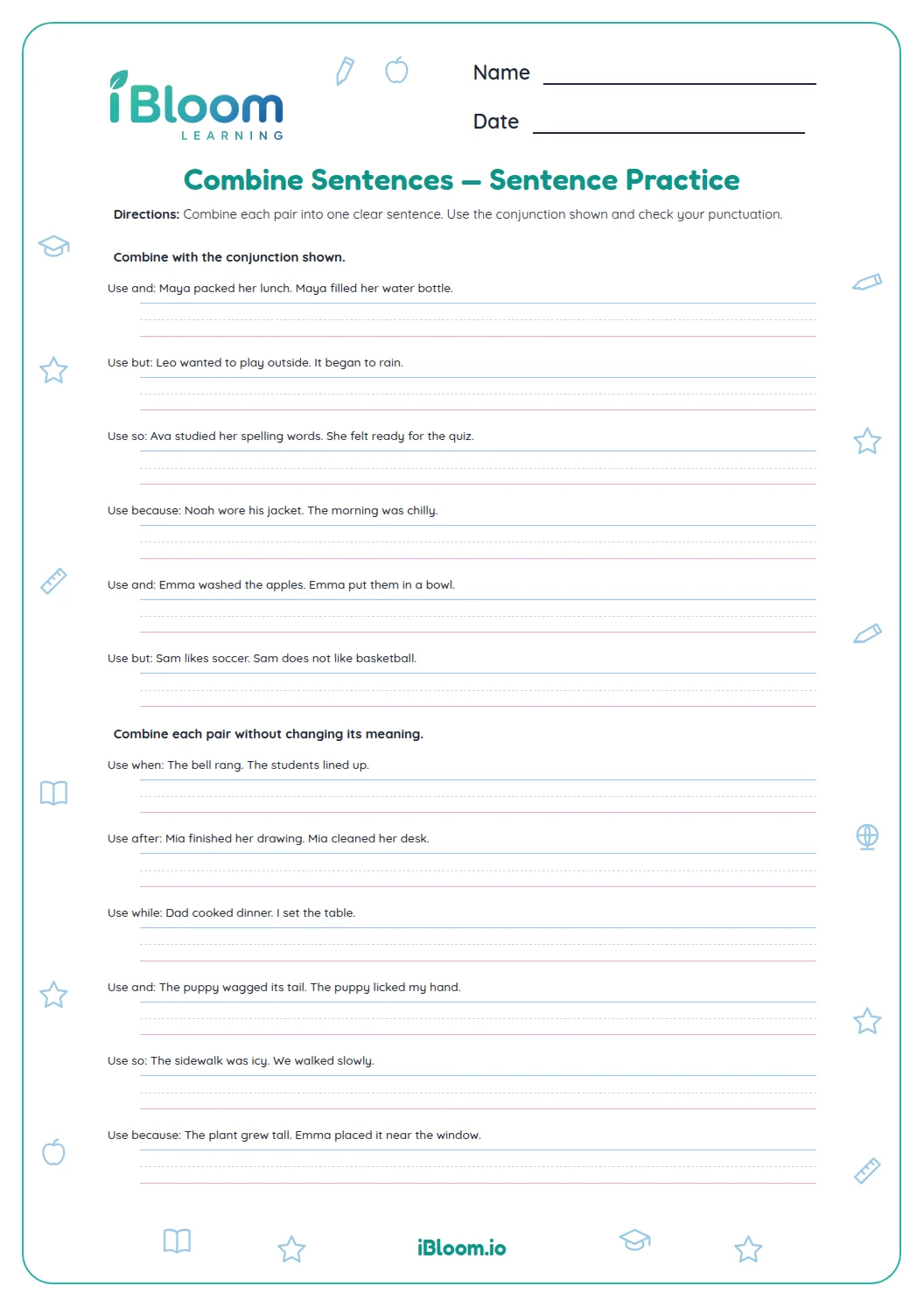
This Grade 4 printable practices four sentence purposes: statements, questions, commands, and exclamations. Students classify examples, choose matching end punctuation, complete a fragment, repair a run-on, and write their own examples. The 16 questions move from recognition to editing, with a separate answer key that includes sample responses.
How do the four sentence types differ?
Sentence type depends on what the sentence does. A statement tells, a question asks, a command directs, and an exclamation expresses a strong feeling. A sentence’s first word is not always enough to identify it; read the whole thought and its punctuation.
- 1Question 2 asks “Where did the robin go?” so it is a question.
How does punctuation support meaning?
Periods commonly finish statements and calm commands. A question mark signals a direct question, and an exclamation point shows strong feeling. In the worksheet, “What a huge sunflower!” expresses excitement, while “Please carry the small pot.” gives a calm direction.
- 1Question 10 ends “What a huge sunflower” with an exclamation point.
How can a fragment become complete?
A complete sentence expresses a finished thought. “After the rain stopped” is a dependent time phrase, so add a subject and action: “We went outside after the rain stopped.” Part C moves from recognition to this kind of repair.
- 1Question 13 adds “We went outside” to complete the thought.
How to use this worksheet
- 1Read the whole sentence and decide its purpose.
- 2Ask whether it tells, asks, directs, or expresses strong feeling.
- 3Check the ending mark against the purpose and tone.
- 4For a fragment, add who or what and what happened.
- 5For a run-on, separate complete thoughts with punctuation.
Common mistakes and quick fixes
The mistake
Choosing a type from the first word alone.
The fix
Read the entire sentence and ask what it communicates.
The mistake
Using a period after every sentence.
The fix
Match the mark to purpose: direct questions need question marks.
The mistake
Leaving a time phrase as a complete sentence.
The fix
Add a subject and action after phrases such as “After the rain stopped.”
What to practice next
Make more practice
Questions parents and teachers ask
What are the four sentence types?
A statement tells something, a question asks for information, a command gives a direction or request, and an exclamation expresses strong feeling. Students classify examples in Part A, then apply the categories while completing punctuation and writing tasks.
How can I tell a command from a statement?
A command directs someone to do something, as in “Please close the gate.” Its subject you is usually understood. A statement reports information, as in “The gate is open.” Read for the sentence’s purpose, rather than relying only on its first word.
Which punctuation mark ends a question?
A direct question that asks for information ends with a question mark. The worksheet contrasts questions with periods for statements and calm commands, plus exclamation points for strong feeling. Reading the full sentence helps students connect its purpose to the correct ending.
Can a command end in an exclamation point?
Yes. A command can end with an exclamation point when it expresses urgency or strong feeling. A calm request can end with a period. Students use context and tone to decide which punctuation fits, rather than treating every command as if it had the same ending.
How many questions are included?
There are 16 items in three parts: six sentence-purpose classifications, six punctuation completions, and four complete-thought or writing prompts. The final part includes a fragment, a run-on, and prompts to create a question and a command. A separate two-page answer key provides examples.