




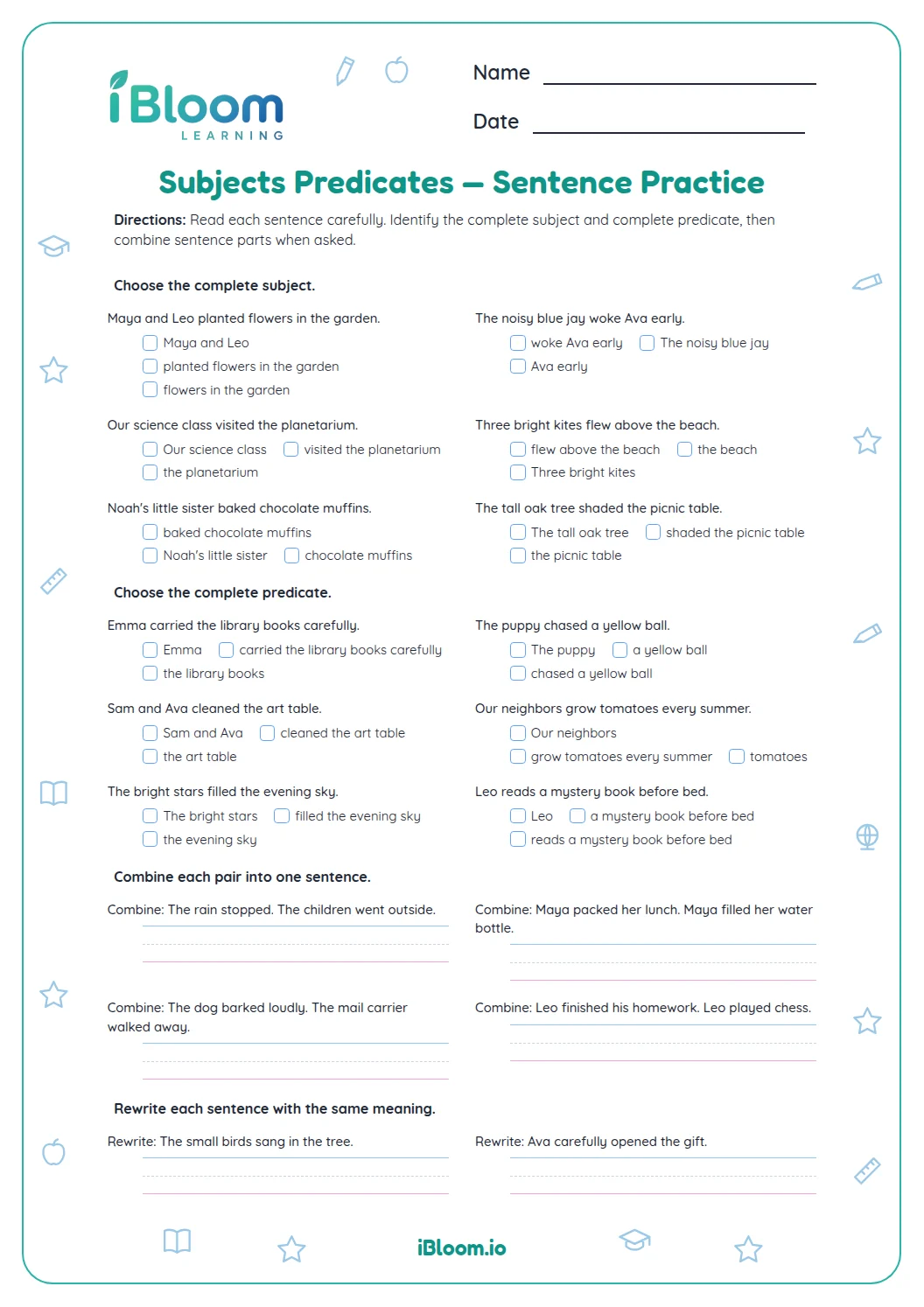
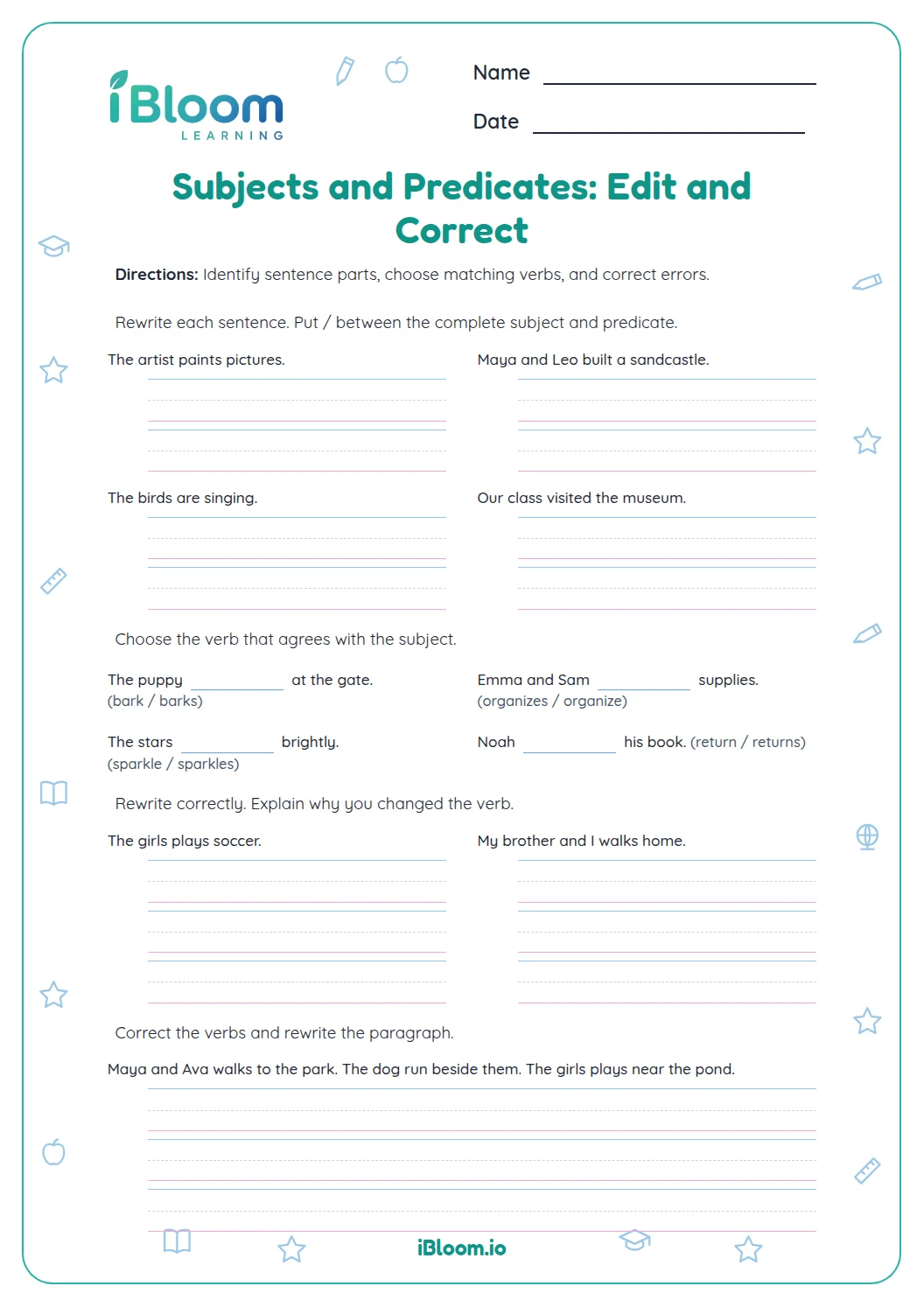
About this worksheet
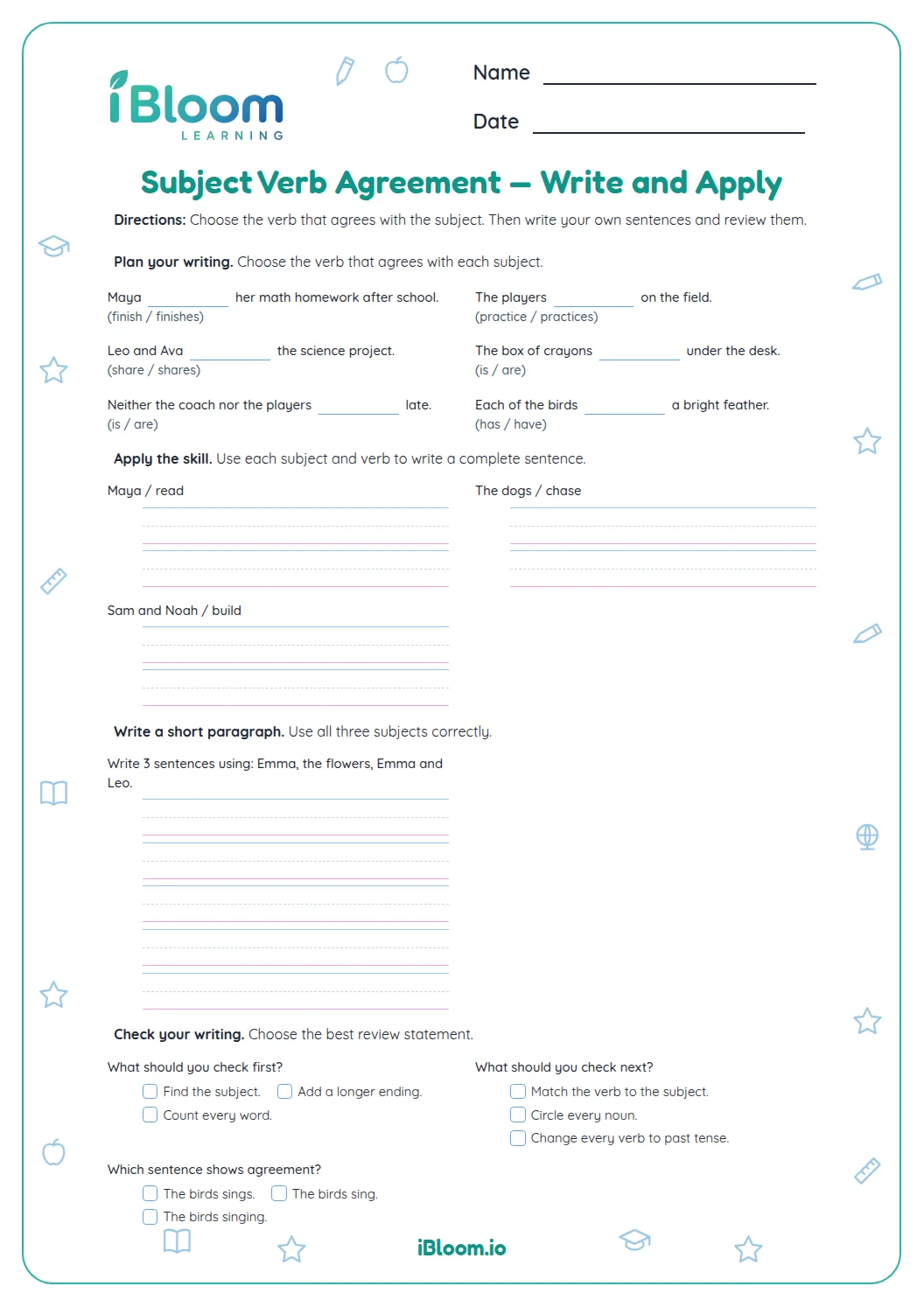
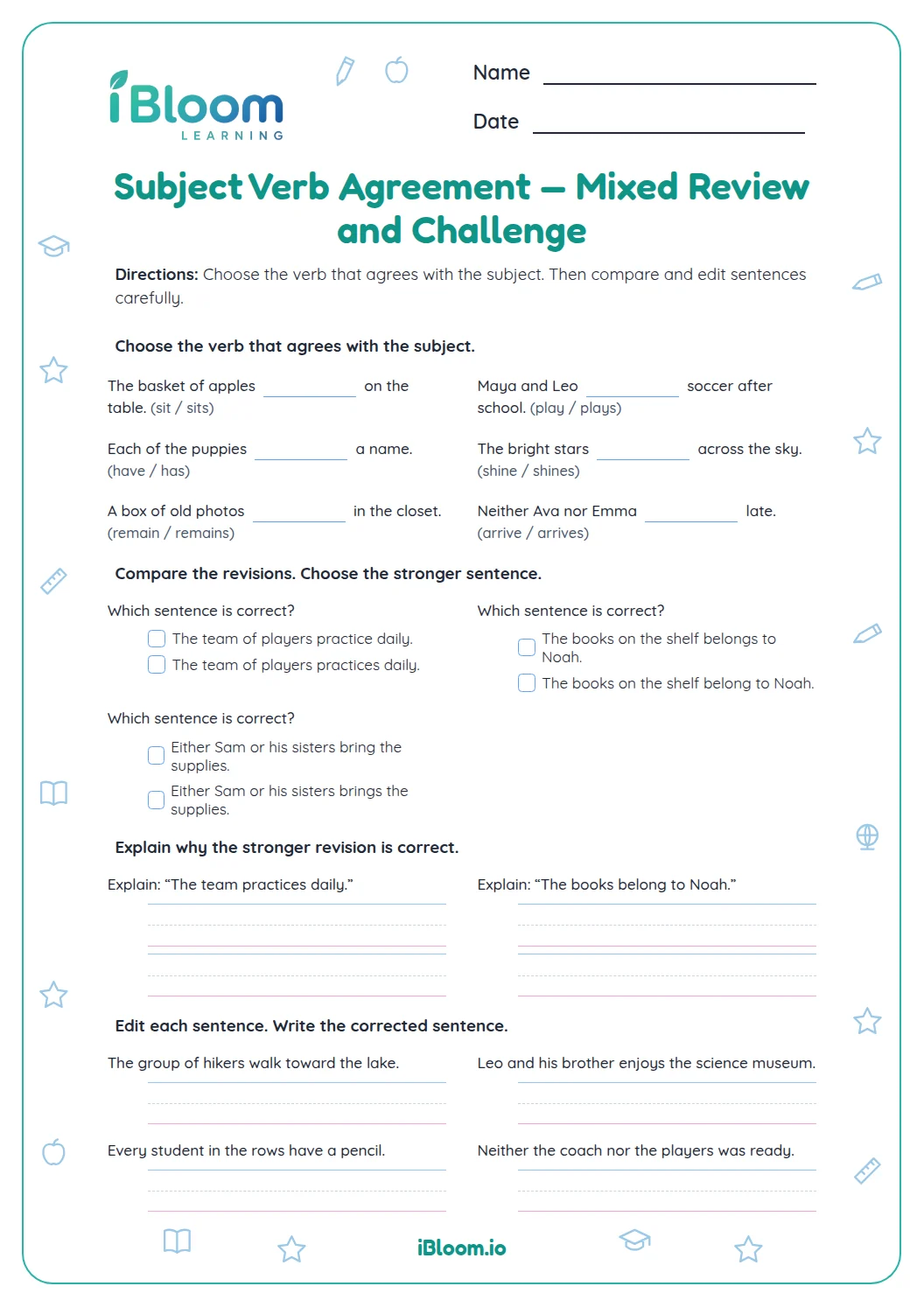
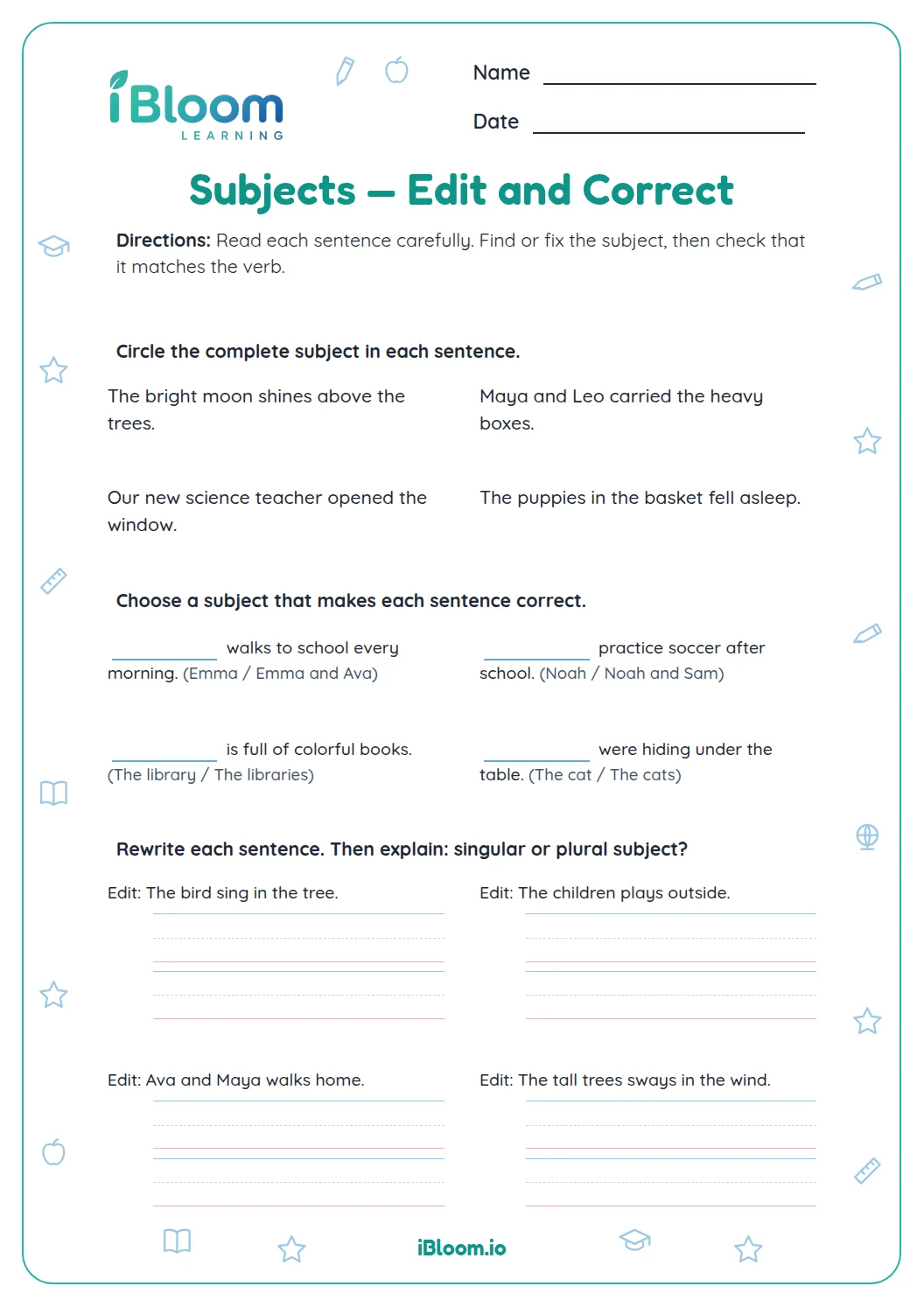
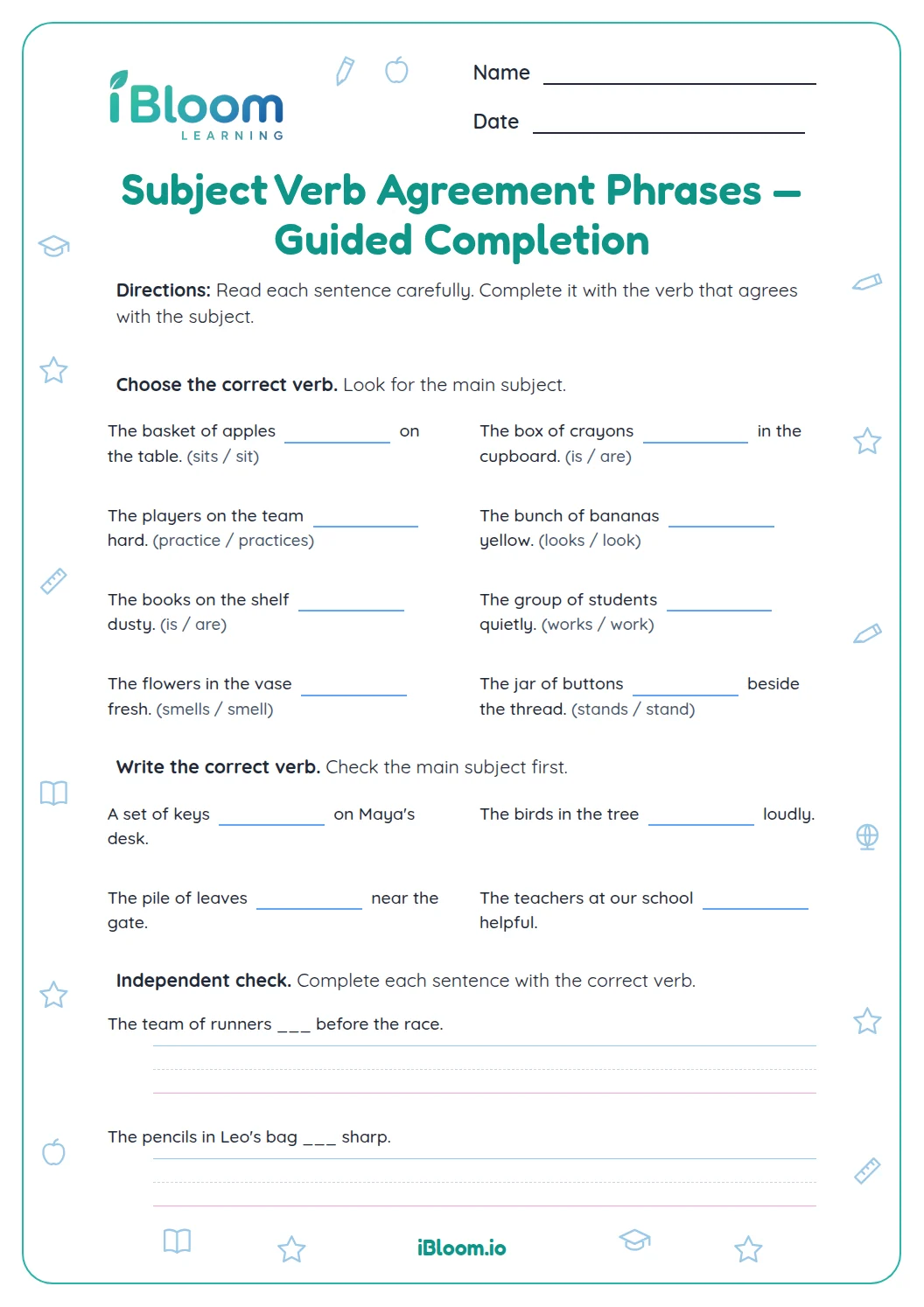
This free Grade 4 grammar worksheet helps students edit subject-verb agreement in complete sentences. They choose a matching verb, supply a verb in a sentence with a nearby phrase, and rewrite sentences with agreement errors. A separate answer key provides the expected verbs and corrected sentences. The practice aligns with CCSS L.3.1f, which calls for subject-verb agreement.
Aligned to L.3.1f
How do you find the subject that controls the verb?
The subject tells who or what the sentence is about. A phrase between the subject and verb can contain another noun, but that noun does not automatically control the verb. In “The basket of apples is on the table,” basket is the subject; apples is inside a phrase.
Which verb form agrees with a singular or plural subject?
A singular subject usually takes a singular present-tense verb such as waits or explains. A plural subject usually takes the base form, such as wait or explain. Subjects joined by and are plural.
- 1Sentence: The basket of apples ___ on the table.
- 2Subject: basket
- 3The phrase of apples adds detail but does not change the subject.
- 4Answer: is
How can editing improve an entire sentence?
Read the sentence with the corrected verb and listen for a smooth match. Check that the sentence still makes sense, then copy the whole sentence so the correction is clear. The final part asks for a complete rewrite rather than only naming the verb.
How to use this worksheet
- 1Read the whole sentence.
- 2Ask who or what is doing or being something.
- 3Ignore nouns inside a phrase when finding the subject.
- 4Decide whether the subject is singular, plural, or joined with and.
- 5For a fill-in, follow the verb clue in the prompt and write the matching form.
- 6Reread the complete sentence to check it.
Common mistakes and quick fixes
The mistake
Matching the verb to the closest noun.
The fix
Find the main subject before choosing the verb.
The mistake
Adding -s to every present-tense verb.
The fix
Singular subjects often take -s; plural subjects usually use the base form.
The mistake
Changing the subject while correcting the sentence.
The fix
Keep the original meaning and edit only the verb form needed.
Common Core alignment
Keep subjects and verbs in agreement.
On this sheet: Students choose, supply, and correct verbs that agree with their subjects.
Show the official wordingHide the official wording
Ensure subject-verb and pronoun-antecedent agreement.*
What to practice next
Make more practice
Further reading
Questions parents and teachers ask
What is subject-verb agreement?
Subject-verb agreement means the verb form matches its subject. A singular subject such as puppy pairs with waits, while a plural subject such as puppies pairs with wait. The subject controls the verb even when another noun appears nearby in a phrase.
How many items are in the worksheet?
There are 14 questions in three parts: six verb-choice items, five constrained verb fill-ins, and three sentences to edit and rewrite. The answer key gives the expected verbs or corrected sentences for every item so students can compare their work.
Why are phrases included between subjects and verbs?
A phrase can add detail and place another noun near the verb. In “The basket of apples is,” basket remains the subject. Students practice looking past the phrase to find the noun that controls the verb form in the sentence.
Can a corrected sentence use a different word?
The final part is designed to correct agreement while preserving the sentence meaning. A student should change the verb form, then copy the full sentence on the response line. The key shows one correct version for each item to compare.
What is the fastest way to check an answer?
Underline the subject, cover any phrase between it and the verb, and read the sentence aloud. Then check whether a singular or plural subject matches the verb form. The sentence should sound clear and keep its original meaning after correction.