



About this worksheet
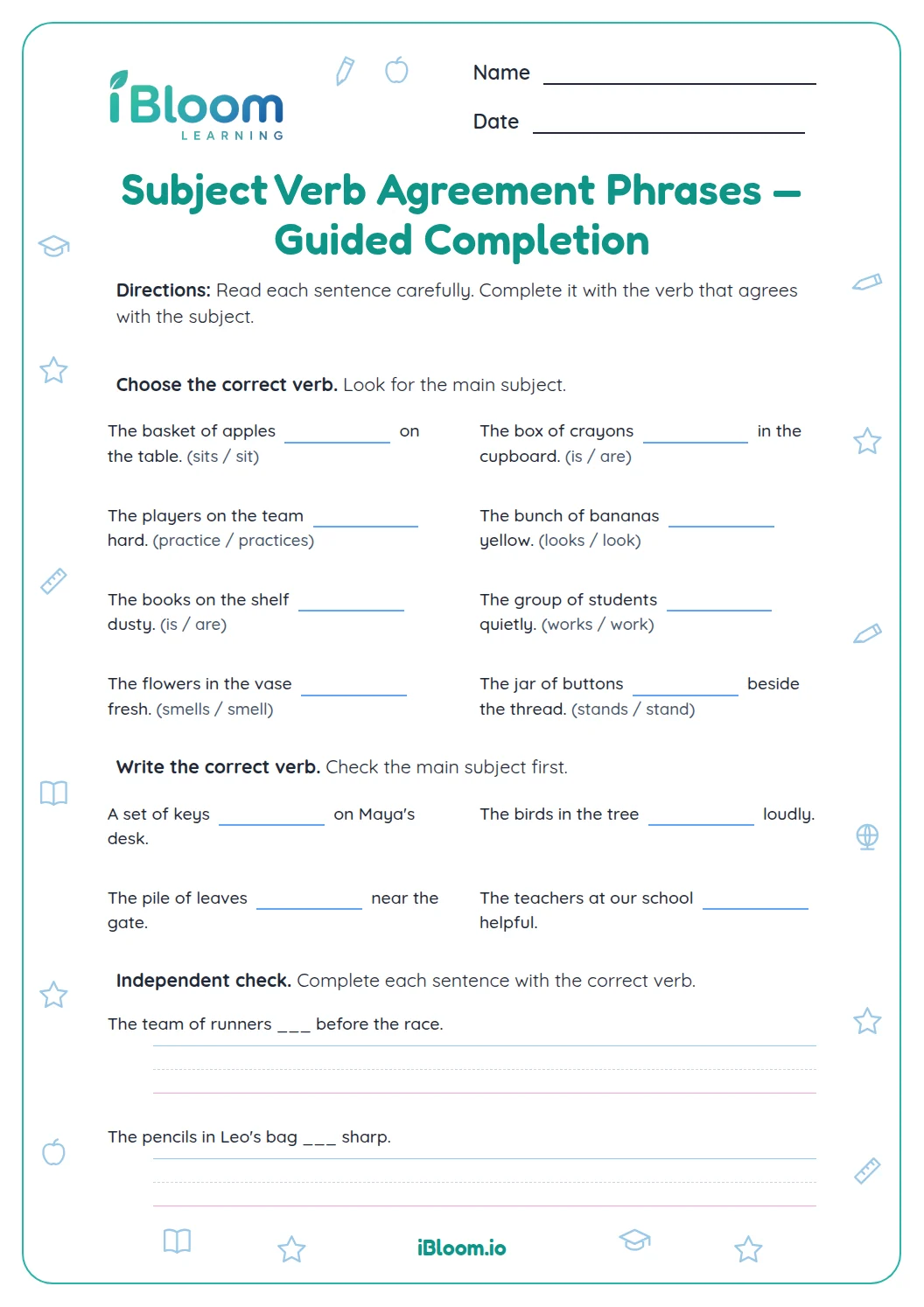
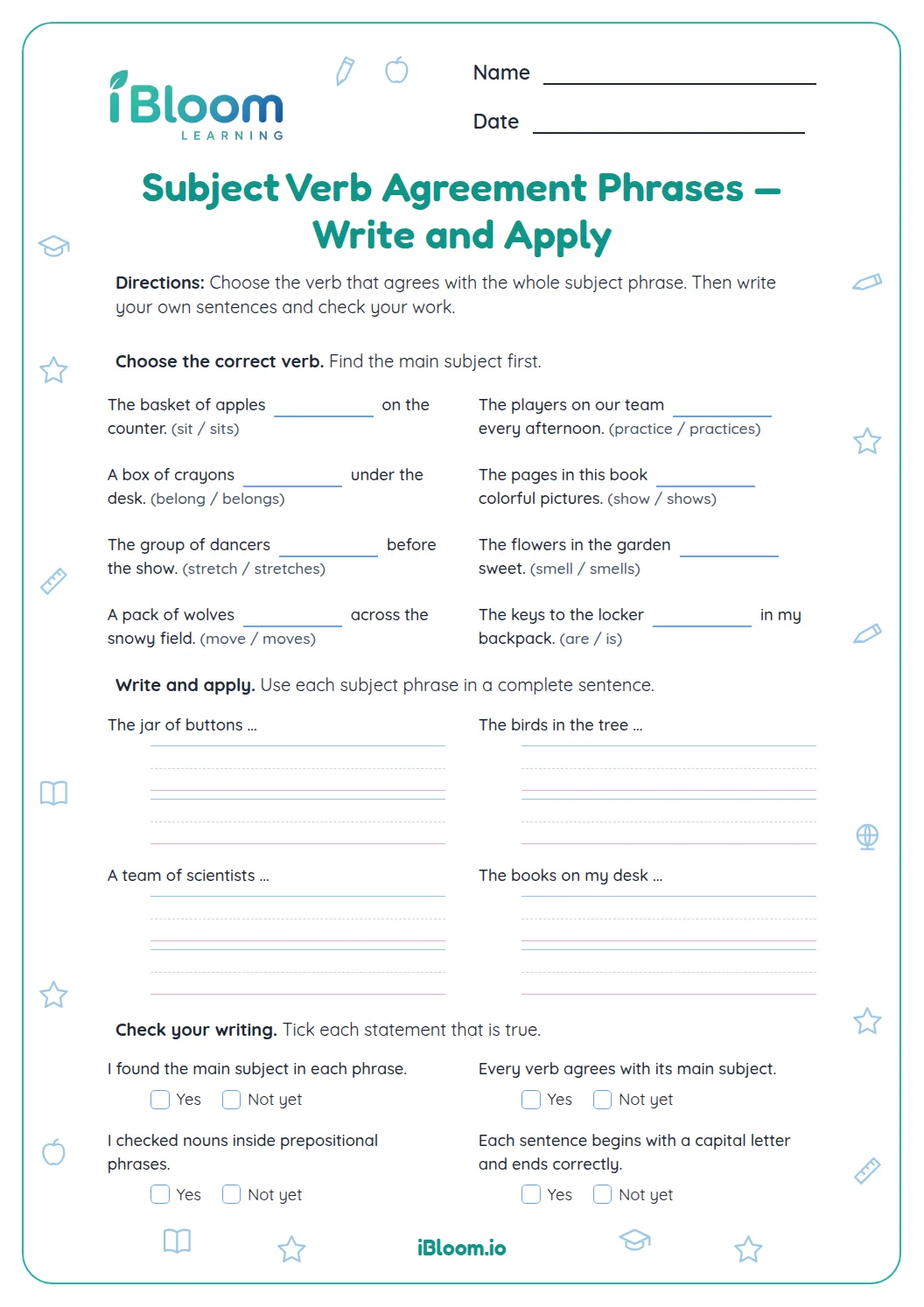
This free Grade 4 grammar worksheet asks students to recognize subject-verb agreement when a phrase separates the subject noun from the verb. Four questions identify the subject noun, six select an agreeing verb, and six judge completed sentences. The intervening phrases include “of apples,” “near the gate,” and “with blue covers,” making students look beyond the closest noun. These sixteen questions practice Common Core L.3.1f by keeping subject and verb in agreement. The separate answer key shows every correct choice.
Aligned to L.3.1f
How do students find the noun that controls the verb?
Ask who or what the sentence is about, then identify the main noun in that subject. In “The basket of apples sits on the table,” the sentence tells what the basket does. “Of apples” adds information about the basket.
The complete subject is “The basket of apples,” but question 1 asks for the subject noun: basket. This distinction keeps the task precise when a subject contains several words.
- 1Sentence: The basket of apples sits on the table.
- 2Subject noun: basket
- 3Intervening phrase: of apples
- 4Agreement: one basket sits
Why can the closest noun lead to a wrong verb?
A phrase can put a plural noun beside a verb even when the subject is singular. In question 5, “of buttons” describes one jar. The sentence needs sits because jar is the subject noun.
The reverse also appears. In question 6, team is singular, but players is the plural subject noun. The correct choice is are. Temporarily setting aside the phrase helps students test the subject and verb together.
How do the three parts build recognition?
Part A isolates the subject noun in four completed sentences. Part B then asks students to choose between two verb forms in six new sentences. The subjects alternate between singular and plural so students have to inspect each one.
Part C mixes three correct sentences with three errors. The last two items have compound subjects joined by and. Maya and Leo together take play, and Mia and Ben together take swim. For the other errors, say “The bag of marbles feels heavy” and “The bikes by the shed have rust.”
How to use this worksheet
- 1Read question 1 and identify basket as the subject noun.
- 2Bracket the phrase of apples and read “The basket sits.”
- 3Complete Part A, then use the same phrase check in Part B.
- 4For each Part B choice, say the subject and selected verb together.
- 5Judge Part C and orally repair the three incorrect sentences.
Mistakes to notice and fix
The mistake
Choosing the verb to match the noun closest to it.
The fix
In “The jar of buttons,” set aside of buttons and test “The jar sits.”
The mistake
Treating every noun ending in s as a subject.
The fix
Ask what the sentence tells about; apples names what is in the basket.
The mistake
Assuming singular subjects always take is.
The fix
Check the actual verb pair: teacher takes rings, key takes is, and puppy takes likes.
Common Core alignment
Match verbs to their subjects even when a phrase separates them.
On this sheet: Students identify subject nouns and select agreeing verbs across intervening phrases.
Show the official wordingHide the official wording
Ensure subject-verb and pronoun-antecedent agreement.*
What to practice next
Make more practice
Further reading
Questions parents and teachers ask
What is an intervening phrase?
It is a group of words placed between the subject noun and its verb. On this sheet, phrases such as “of apples” and “near the gate” add details. Students briefly set those words aside to hear the subject and verb together, then read the complete sentence again.
Why is basket the answer instead of apples in question 1?
Basket is the subject noun because the sentence tells where the basket sits. Apples belongs to the phrase “of apples,” which describes its contents. Reading “The basket sits on the table” makes the agreement clear, and adding the phrase back does not change the verb.
Does Part A ask for the complete subject?
Part A asks for the subject noun that controls the verb. For the first sentence, the complete subject is “The basket of apples,” but the answer choice is basket. Ask your child to explain which noun names the thing the sentence is mainly telling about.
How can I check the incorrect sentences in Part C?
Say each subject and verb without the intervening phrase. “The bag feel” needs feels, “The bikes has” needs have, and “Maya and Leo plays” needs play. The other three sentences agree. The key marks the labels; saying the corrected sentences aloud adds a final check.
Which standard does this Grade 4 worksheet practice?
It practices Common Core L.3.1f, which calls for subject-verb and pronoun-antecedent agreement. This sheet’s sixteen questions focus on subject-verb agreement across phrases. Students identify the controlling noun, select its matching verb, and decide whether completed sentences keep the two in agreement, using both singular and plural subjects.