







About this worksheet
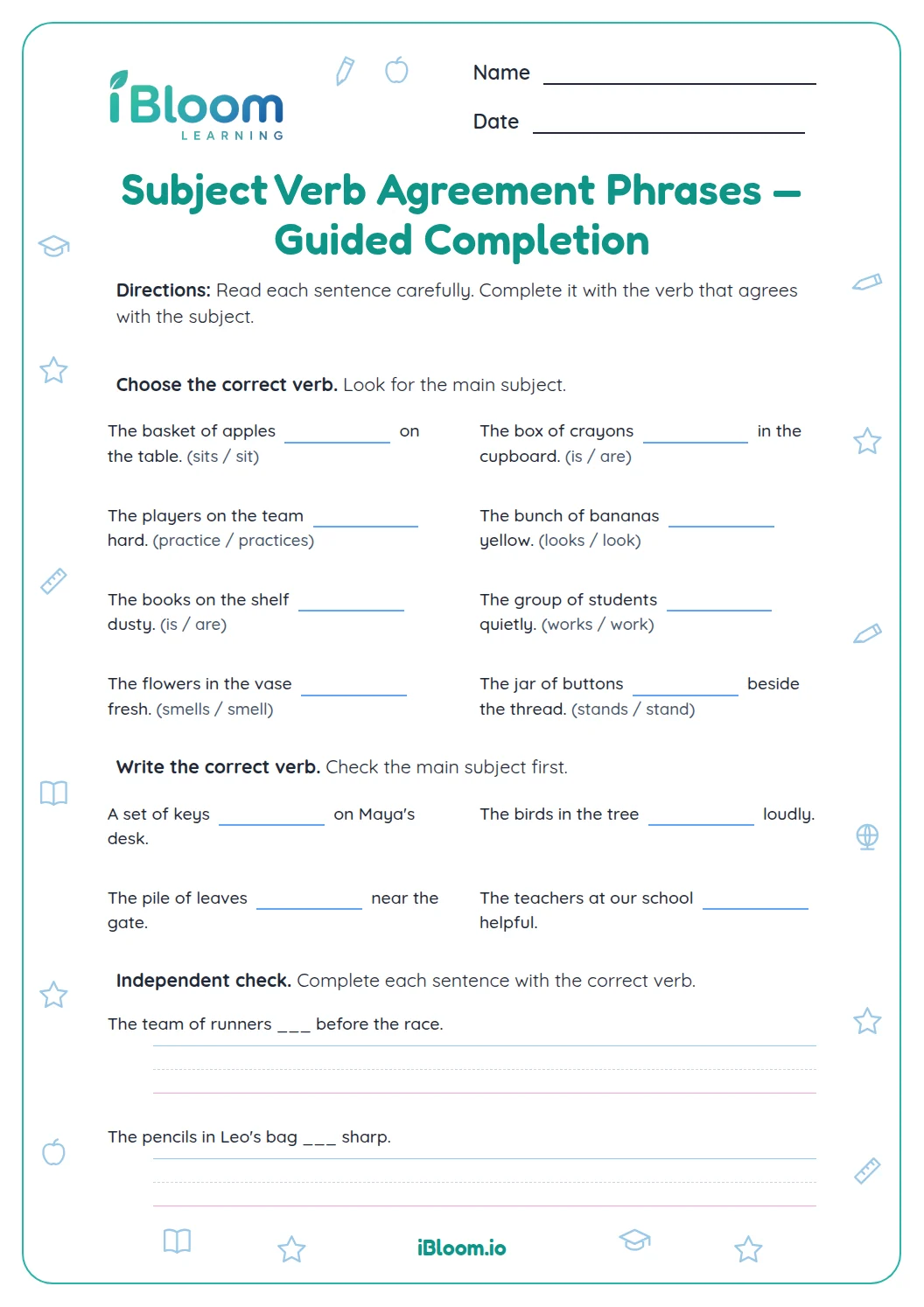
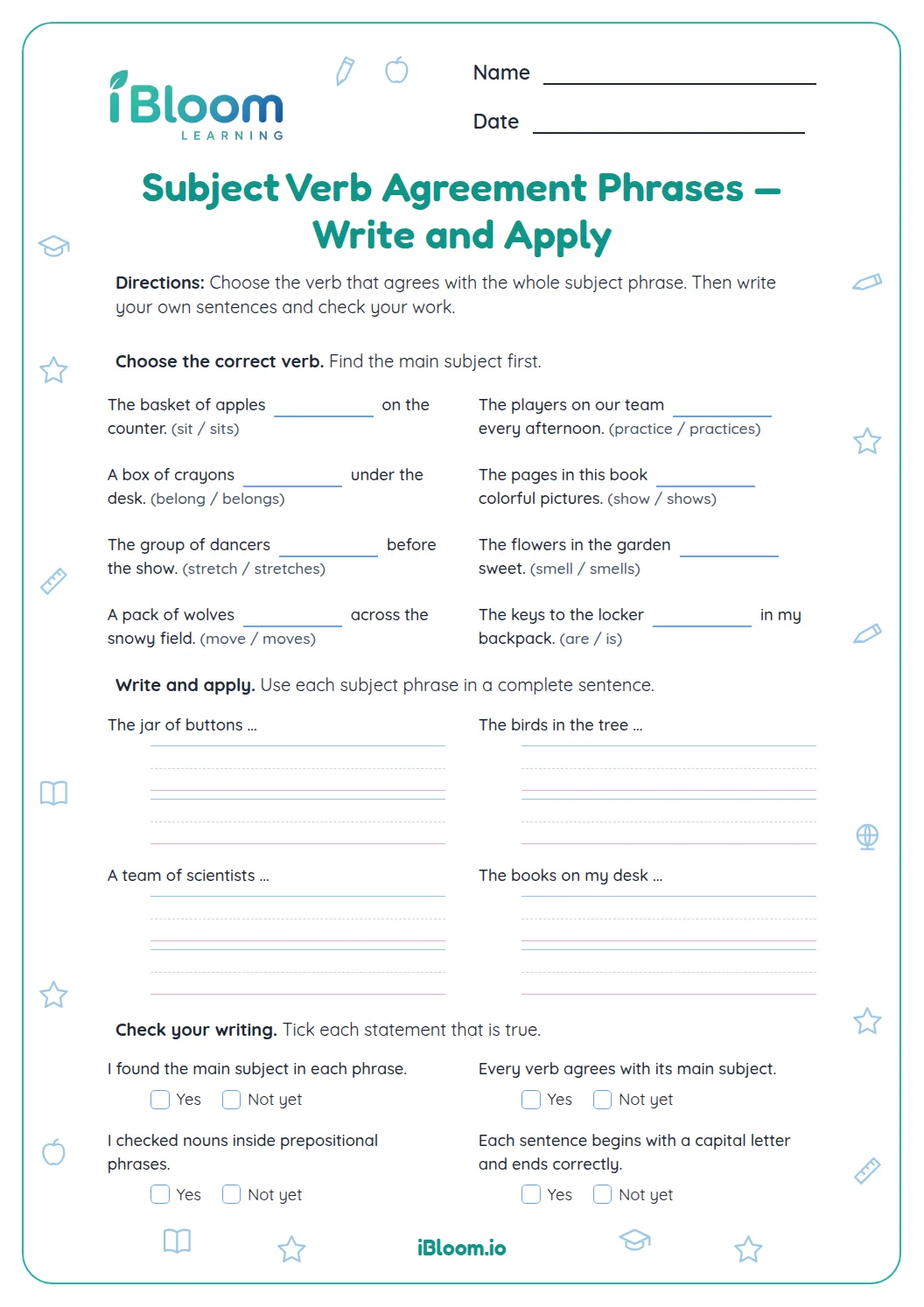
This Grade 4 grammar worksheet focuses on subject-verb agreement when extra phrases sit between the subject and verb. Children choose and write matching verbs, edit sentences, and apply the pattern in additional sentences. The 16 questions move from recognition to application and include a separate answer key with sample sentences. The work practices standard English grammar and usage under CCSS L.4.1.
Aligned to L.4.1
How do I find the subject?
Ask who or what is doing or being something. In “The basket of apples sits on the table,” basket is the subject. The phrase “of apples” adds information but does not change the subject from singular to plural.
- 1Subject: basket
- 2Phrase: of apples
- 3Singular subject → sits
Which words should I check in a phrase?
Phrases beginning with words such as of, near, along with, and on can sit between a subject and verb. Temporarily set the phrase aside and match the verb to the subject. “The players near the gate are ready” uses plural players.
How does editing build agreement skills?
The sheet has three parts: choose a matching verb, complete sentences, and apply agreement in sentences with intervening phrases.
How to use this worksheet
- 1Read each whole sentence once.
- 2Identify the subject before choosing a verb.
- 3Mentally set aside the phrase between subject and verb.
- 4Check whether the subject is singular or plural.
- 5Use the answer key to check the verbs and discuss any sentence that was difficult.
Mistakes to watch for
The mistake
Matching the verb to the nearest noun.
The fix
Find the subject outside the phrase. In “basket of apples,” basket is singular, so use sits.
The mistake
Treating “along with” as part of a compound subject.
The fix
“The captain, along with two helpers” still has the singular subject captain.
The mistake
Using a plural verb after each.
The fix
Each is singular in “Each of the campers,” so write packs.
Common Core alignment
This worksheet practices the following Common Core skills.
Use standard English grammar to match verbs with their subjects.
On this sheet: Children apply standard grammar in sentence choices, edits, and original writing.
Show the official wordingHide the official wording
Demonstrate command of the conventions of standard English grammar and usage when writing or speaking.
What to practice next
Make more practice
Further reading
Questions parents and teachers ask
What is subject-verb agreement?
Subject-verb agreement means the verb matches its subject in number. A singular subject takes a singular verb, and a plural subject takes a plural verb. In “The basket of apples sits,” basket is singular, so the verb is sits.
What does an interrupting phrase do?
An interrupting phrase adds detail between the subject and verb. It does not usually become part of the subject. In “The captain, along with two helpers, raises the flags,” captain remains the subject, so raises is singular. The sentence context makes it possible to check the subject and verb together.
Why is the nearest noun sometimes misleading?
The noun closest to the verb may be inside a phrase rather than the subject. In “A box of old maps waits,” maps is plural, but the subject is box. Find the subject first, then choose the verb that agrees with it.
How many items are on the worksheet?
There are 14 questions in three parts. Children choose a verb, complete sentences, and apply agreement in sentences with phrases between the subject and verb. The answer key lists the matching verb for each item, so families can review the subject together.
How do the phrases affect the verb?
A phrase between the subject and verb adds detail, but the subject still controls the verb. In “A box of old maps waits,” box is singular, so waits agrees even though maps is plural. Naming the subject first helps children ignore that nearby plural noun.