




About this worksheet
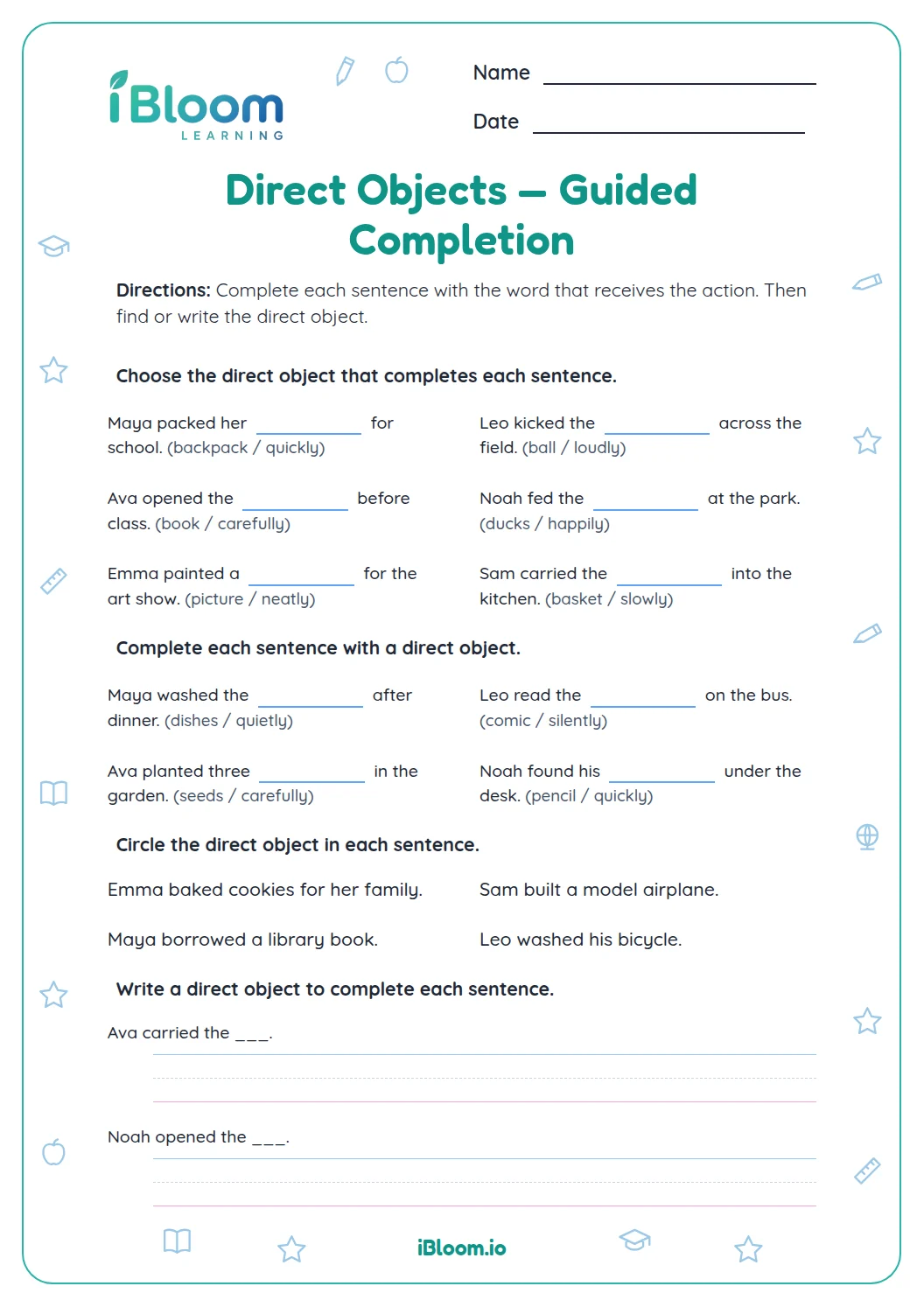
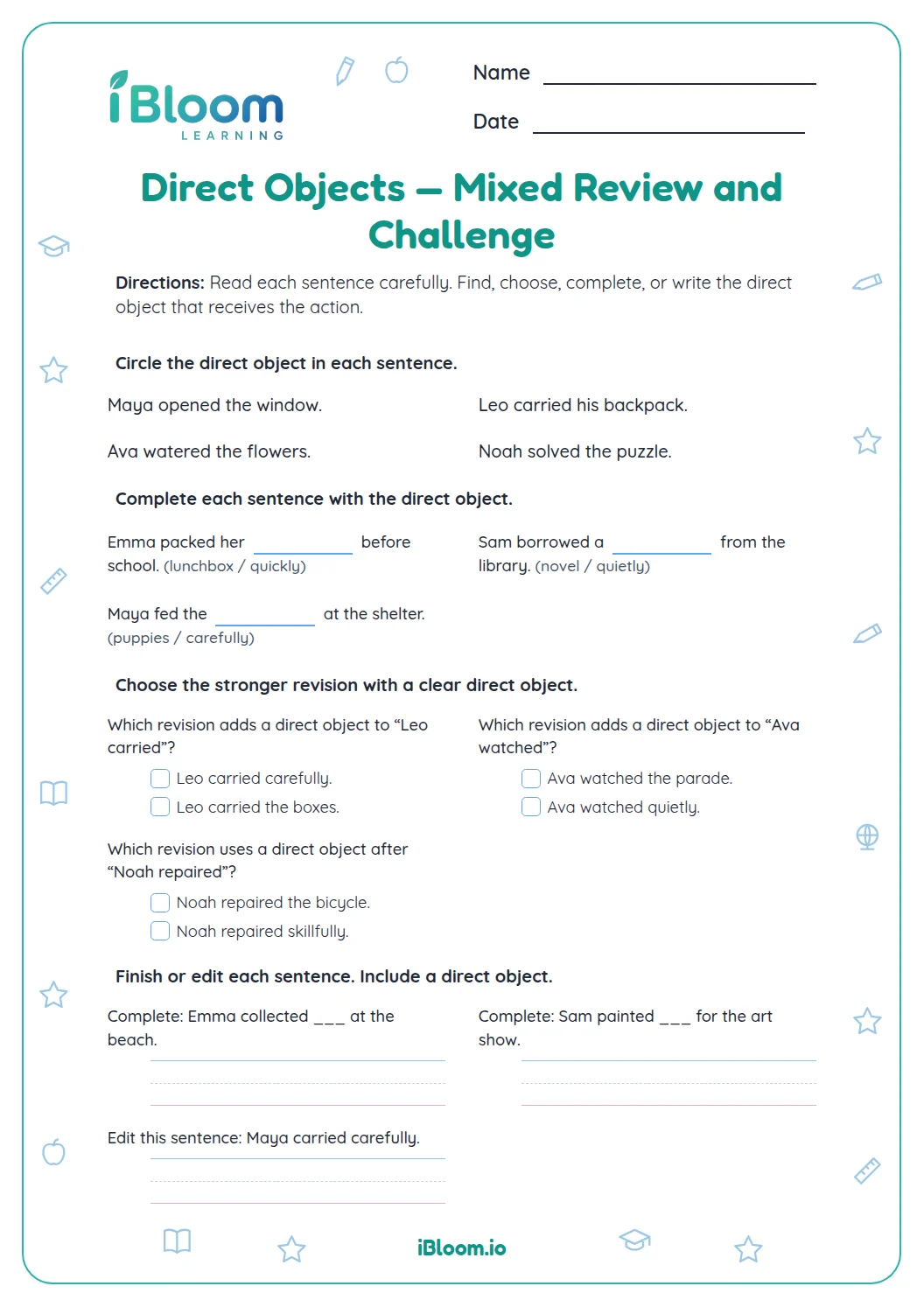
This Grade 4 printable practices recognizing direct objects in two ways. Students write the direct object in eight complete sentences, then classify six sentences as having or not having a direct object. The first task includes familiar nouns and longer noun phrases such as “the heavy gate.” The classification task includes both action verbs with objects and verbs such as laughed and arrived without direct objects. A separate answer key gives the phrases and choices.
Aligned to L.4.1
What does a direct object do?
A direct object is a noun or pronoun that receives a verb’s action. Find the verb and ask what? or whom? after it. In “Maya carried a basket,” carried what? A basket.
- 1Maya carried a basket.
- 2carried what? a basket
- 3Direct object: a basket
Which sentences have a direct object?
Some verbs have no direct object. “The baker mixed batter” answers mixed what? batter. “Maya laughed” has no answer to laughed what? Part B asks students to classify sentences using this check.
- 1Maya laughed.
- 2Laughed what? No answer.
- 3It does not have a direct object.
How can you check an answer?
Ask what or whom after the action verb. Write the complete noun phrase that answers the question: “the heavy gate” is the object in “Nora opened the heavy gate.” If nothing answers the question, the sentence has no direct object.
How to use this worksheet
- 1Read the sentence from beginning to end.
- 2Find the action verb.
- 3Ask what or whom receives that action.
- 4Choose the complete noun or pronoun phrase that answers the question.
- 5Check that you selected the receiver, not the person doing the action.
Common mistakes and quick fixes
The mistake
Choosing the subject because it is a noun.
The fix
Ask who performs the verb; that is the subject, not the object.
The mistake
Choosing the action word itself.
The fix
Ask what or whom after the verb; the answer is the direct object.
The mistake
Choosing only part of a longer object phrase.
The fix
Include the words that belong with the noun, such as the roses or a library book.
Common Core alignment
Recognize and use direct objects as part of standard English grammar.
On this sheet: Students identify direct objects in complete sentences and distinguish them from subjects and verbs.
Show the official wordingHide the official wording
Demonstrate command of the conventions of standard English grammar and usage when writing or speaking.
What to practice next
Make more practice
Further reading
Questions parents and teachers ask
What is a direct object?
A direct object is a noun or pronoun that receives a verb’s action. In “The dog chased the ball,” the ball receives the action. The first eight questions ask students to find that receiver in complete sentences. Then six more questions ask whether each sentence has an object.
What question helps find a direct object?
Find the verb and ask what? or whom? “The baker mixed batter”: mixed what? Batter is the direct object. If the verb has no answer, as in “Maya laughed,” the sentence has no direct object. Use this check for the six classification questions.
How is a direct object different from a subject?
The subject performs the action; the direct object receives it. In “Maya carried a basket,” Maya carries and the basket is carried. The last six questions ask whether each sentence has an object, so students compare both kinds of verbs.
Why are some answers longer than one word?
A direct object can include a noun with describing words. “The heavy gate” and “a library book” are complete noun phrases that receive the action. Write the whole phrase when the sentence includes those details, including the article and any describing words.
How many questions are included?
There are 14 items in two parts: eight blanks asking for the direct object and six choices about whether a sentence has one. The answer key lists the object phrases and the yes-or-no classifications. It also includes sentences with intransitive verbs, such as laughed.
Is there an answer key?
Yes. The separate answer key lists the direct object for each sentence. Use the question “what or whom receives the verb’s action?” to explain why the selected phrase is an object, not the subject or verb. The key shows concise answers for all 14 examples.