




About this worksheet
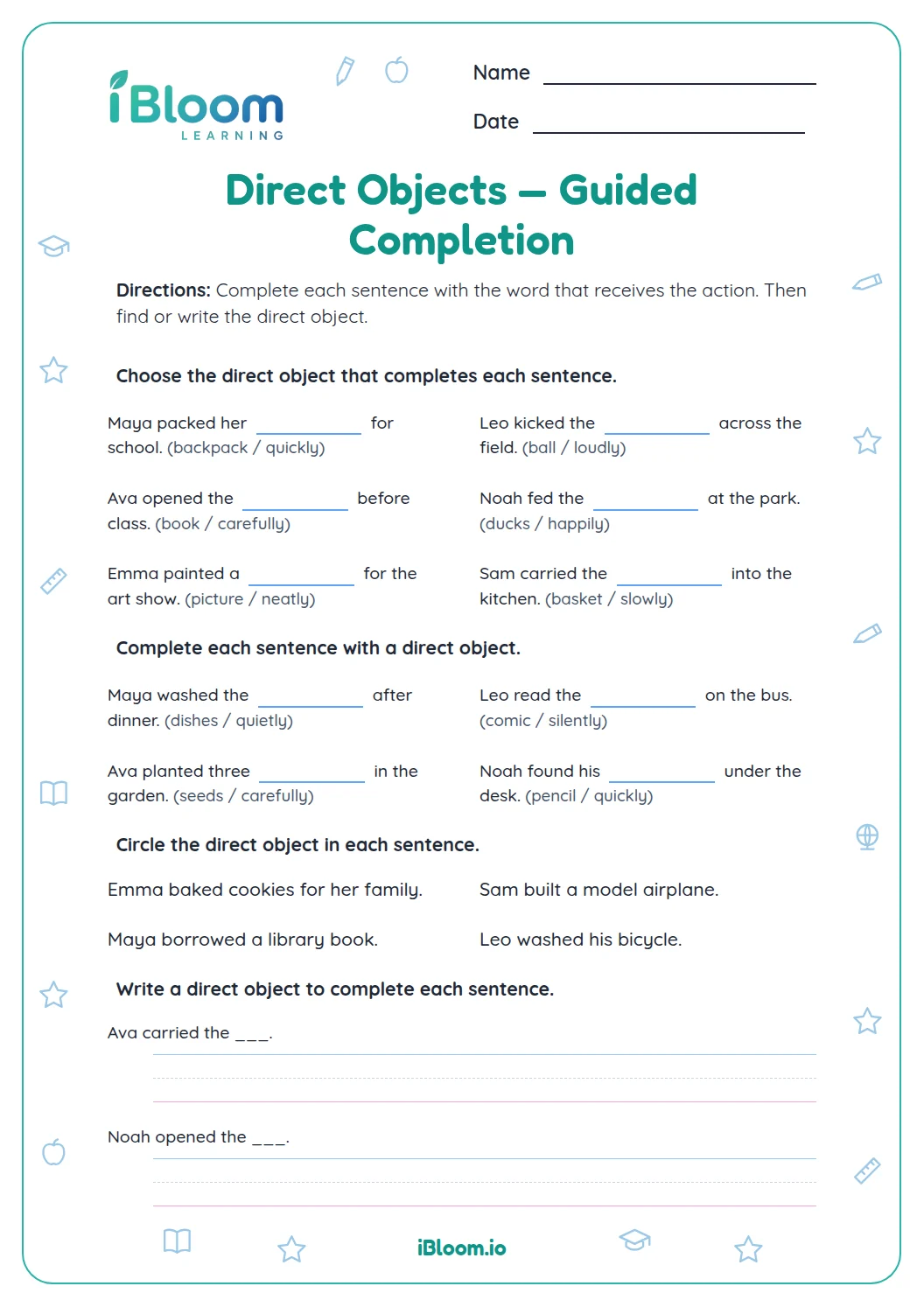
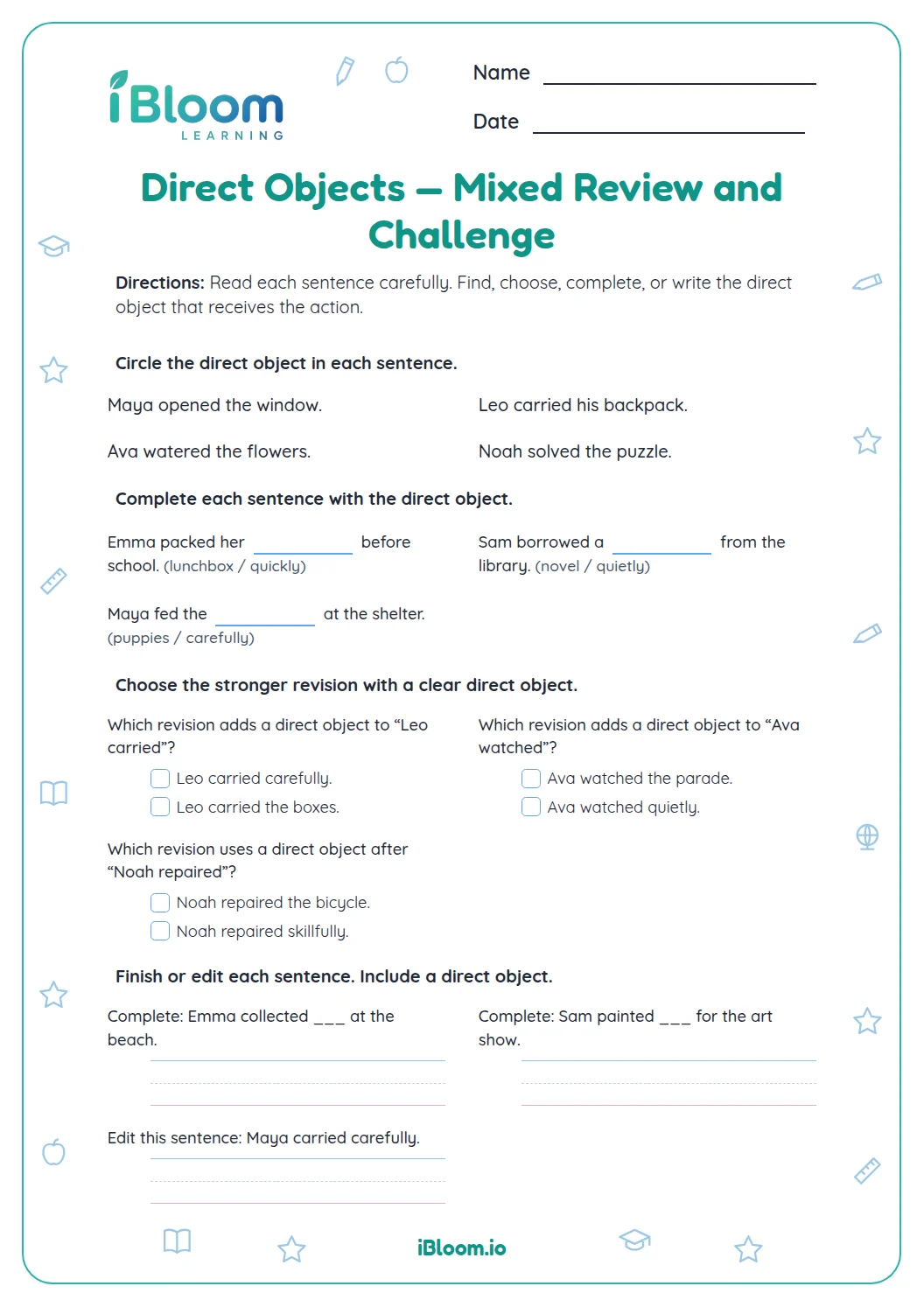
This Grade 4 worksheet helps students identify and use direct objects. Students answer what or whom after the verb, choose objects in sentences with extra details, and write five original sentences. It practices grammar conventions in writing aligned to CCSS L.4.1. The answer key includes target objects and sample responses.
Aligned to L.4.1
How can a direct object be found?
Find the action verb, then ask what or whom after it. In question 1, Maya packed what? Her lunch receives the action, so her lunch is the direct object.
- 1Maya packed her lunch.
- 2Packed what?
- 3her lunch
How is the direct object different from the subject?
The direct object answers what or whom after the action verb. In question 7, Nora gave her friend a note. Gave what? A note. “Her friend” answers to whom, so it is an indirect object, not the direct object.
How can students use direct objects in writing?
Choose an action verb, then name what or whom receives the action. Write a complete sentence and underline that noun or noun phrase.
How to use this worksheet
- 1Find the action verb.
- 2Ask what or whom after the verb.
- 3Check that the answer receives the action.
- 4Read every choice before selecting.
- 5Write a complete sentence and underline its direct object.
Common mistakes and quick fixes
The mistake
Naming the subject as the object.
The fix
Ask separately who acts and what receives the action.
The mistake
Choosing a where or when phrase.
The fix
A direct object answers what or whom.
The mistake
Writing a fragment.
The fix
Include a subject and a verb, then add a direct object.
Common Core alignment
This worksheet practices the Common Core skill named below.
Students identify and use direct objects while writing complete sentences.
On this sheet: The sheet asks students to identify direct objects, choose them in sentences, and write sentences with direct objects.
Show the official wordingHide the official wording
Demonstrate command of the conventions of standard English grammar and usage when writing or speaking.
What to practice next
Make more practice
Further reading
Questions parents and teachers ask
What is a direct object?
A direct object is a noun or noun phrase that receives the action of a verb. Ask what or whom after the verb to find it. In “Maya packed her lunch,” ask “packed what?” The answer, “her lunch,” is the direct object.
How is a direct object different from the subject?
The subject does the action, while the direct object receives it. In “The puppy chased the ball,” the puppy is the subject and the ball is the direct object. Asking “chased what?” helps identify the receiver of the action.
What should students write in the last five questions?
Write a complete sentence with the verb named in the prompt and a direct object that answers what or whom after that verb. For example, “Ben carried the basket” uses carried and makes “the basket” the direct object. Other correct sentences may use different subjects and objects.
Can a sentence have more than one noun after the verb?
Yes. A sentence can name a person who receives something and the thing given. In “Nora gave her friend a note,” “her friend” tells to whom and “a note” tells what. The worksheet asks students to identify the direct object, which answers what.
Does the answer key give one required sentence?
The key gives a sample for each writing prompt, but students can write other complete sentences. Check that each response uses the requested verb and includes a noun or noun phrase that receives its action. The first two sections have specific direct-object answers.