


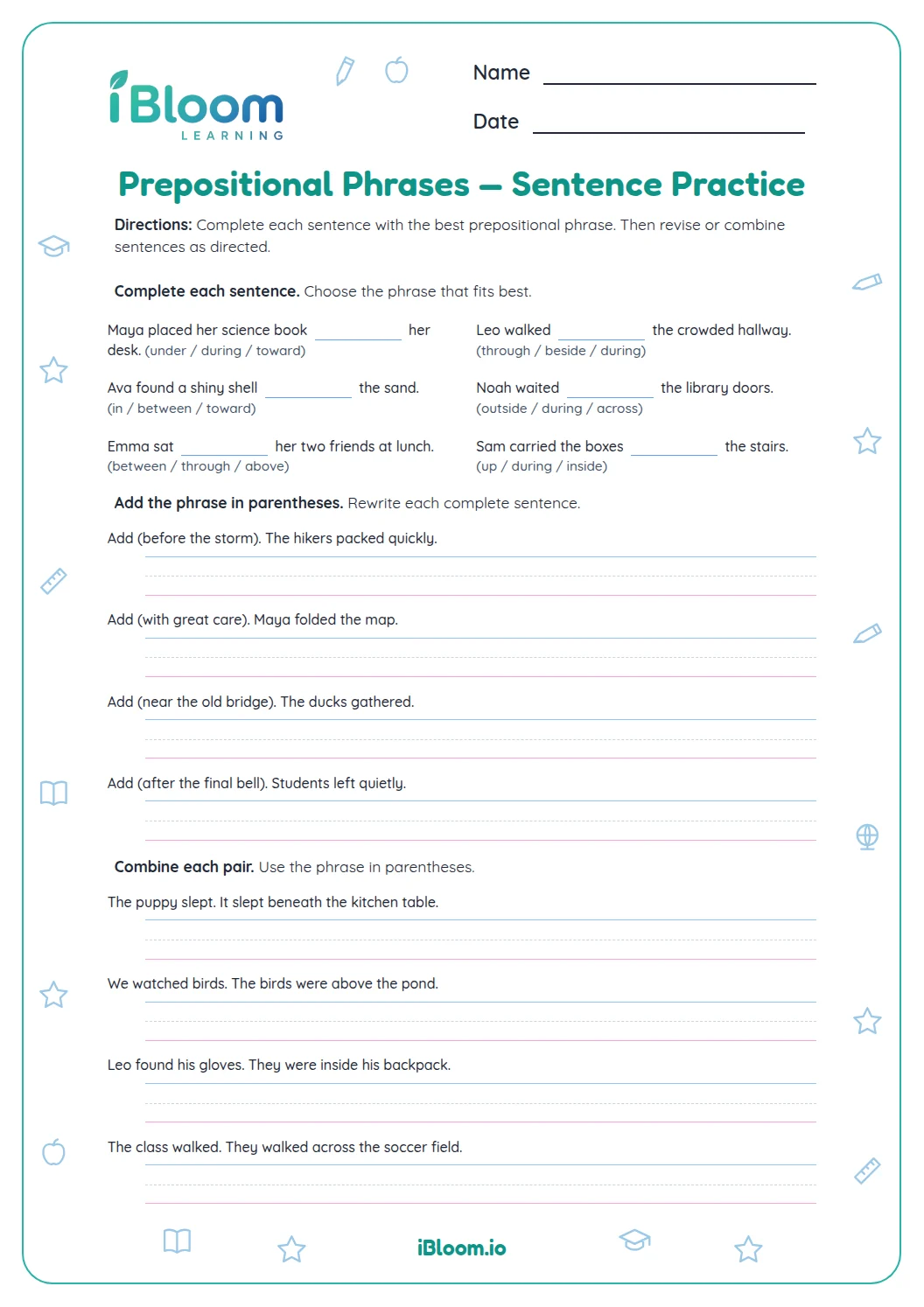



About this worksheet
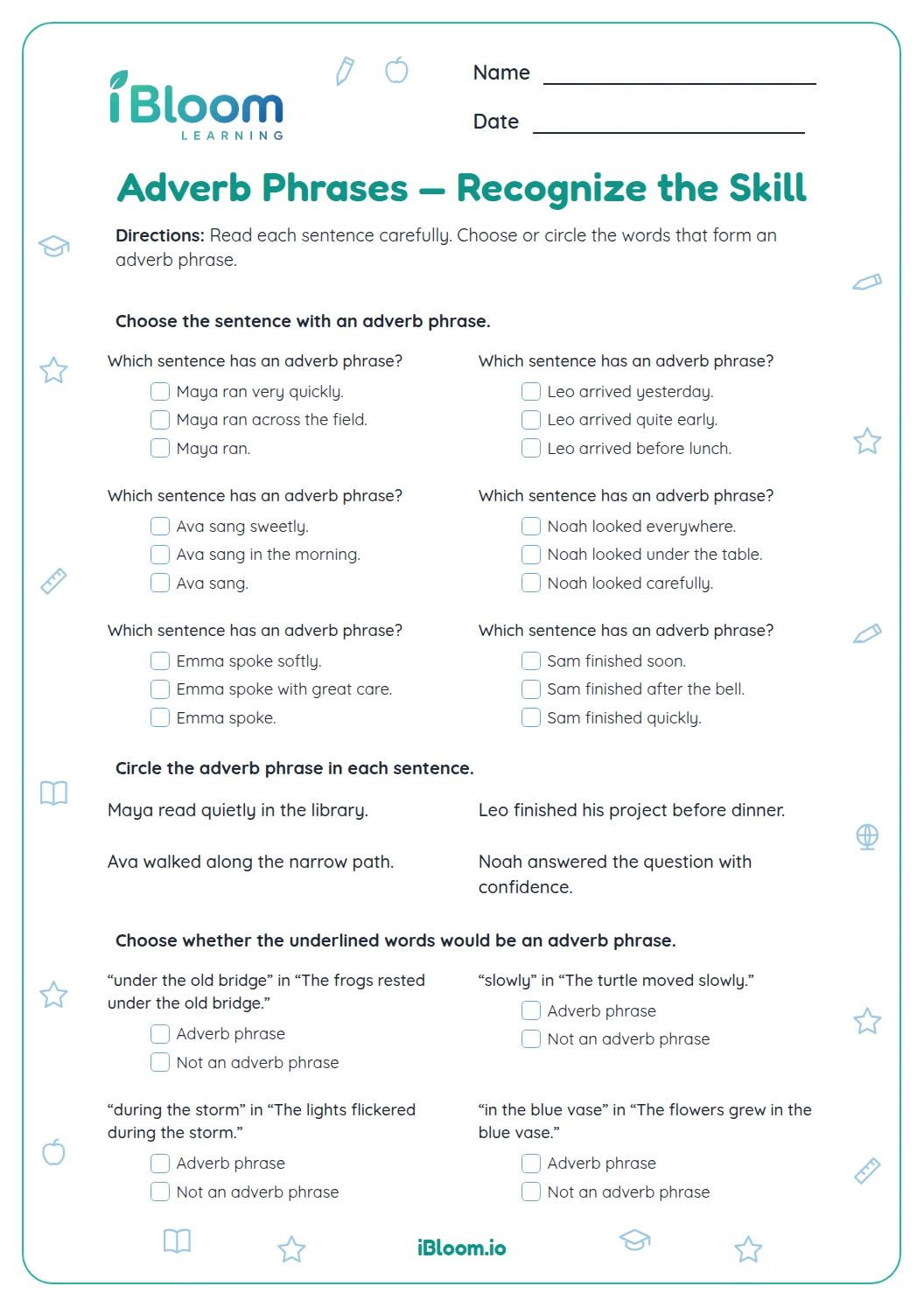
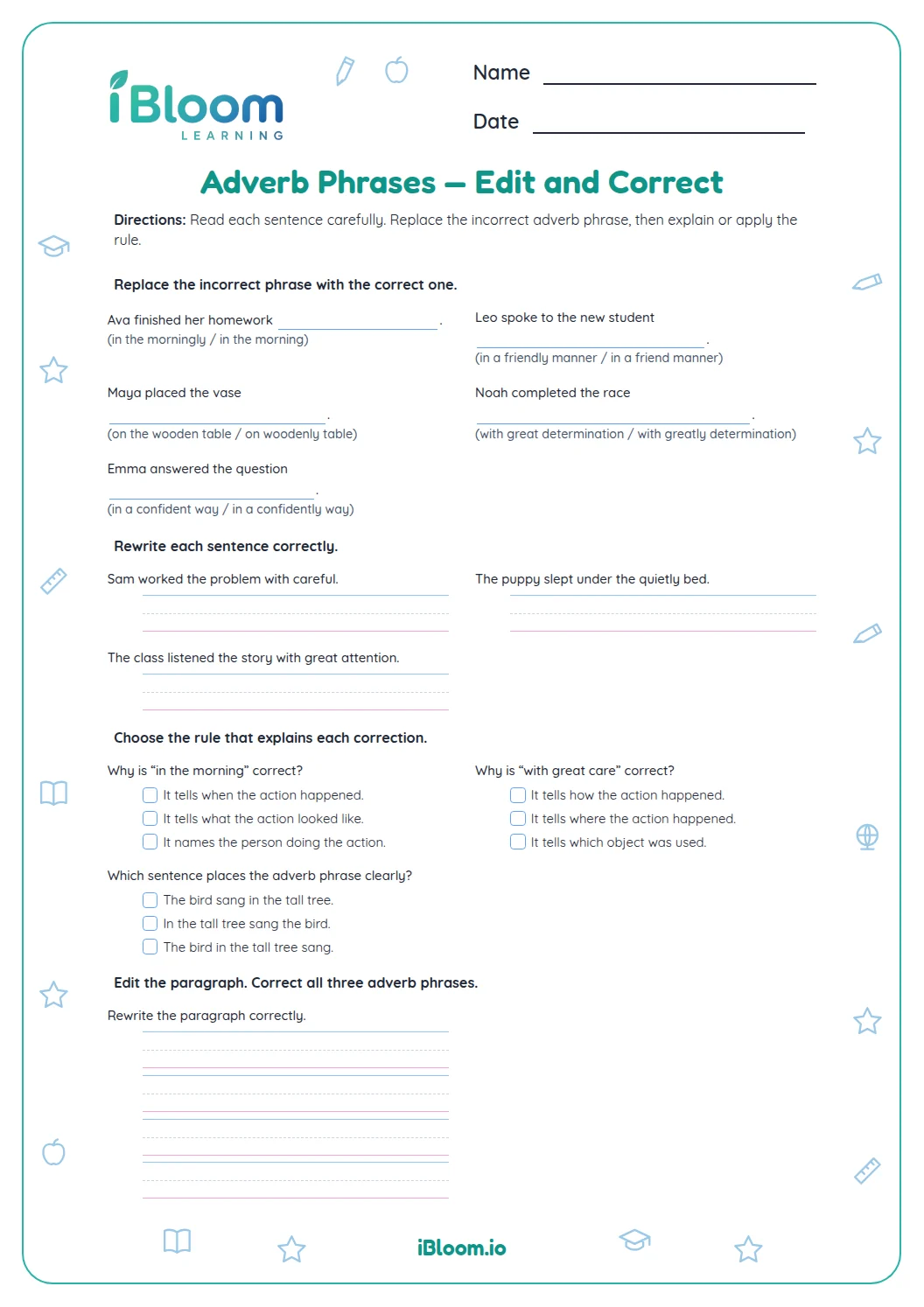
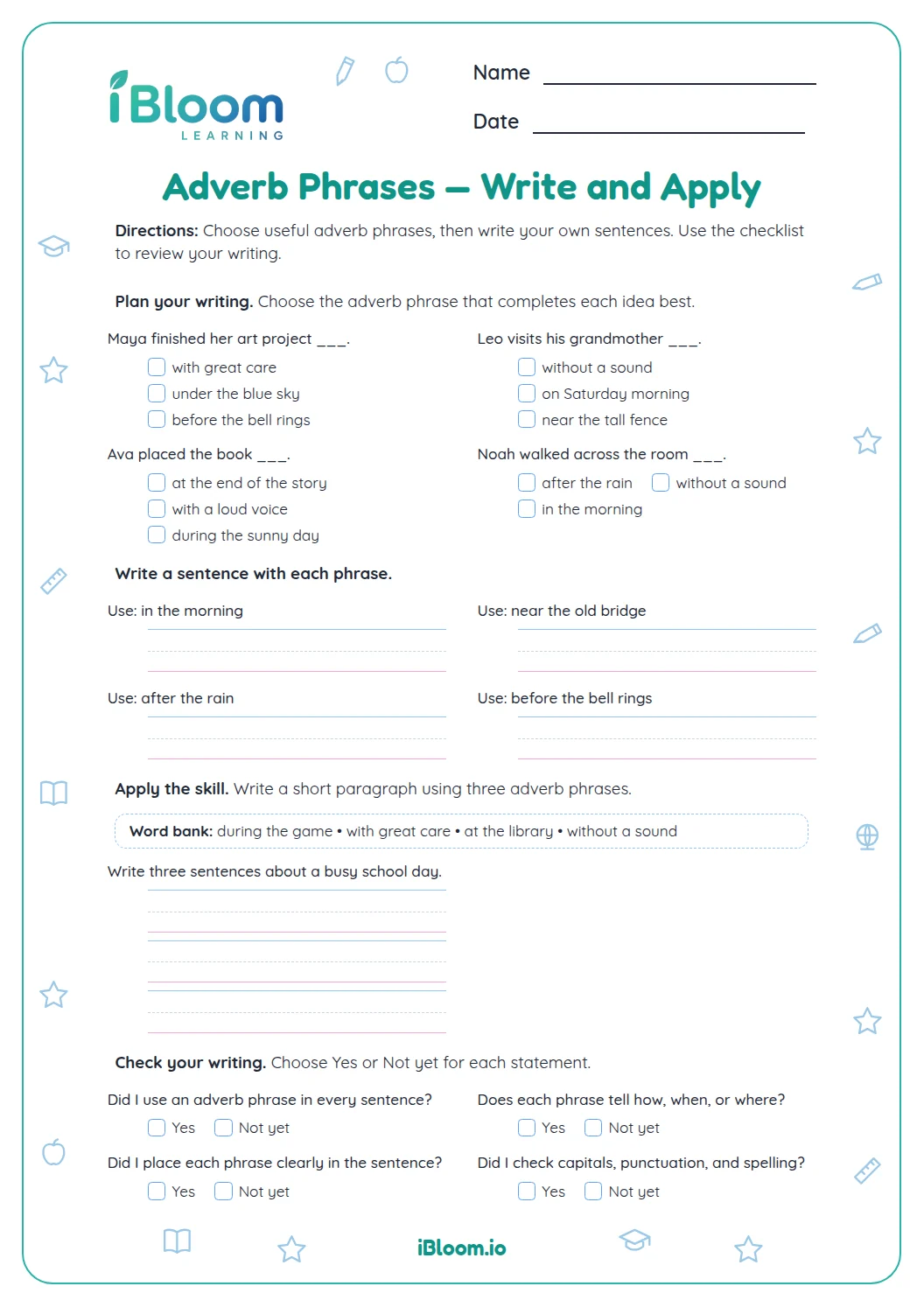
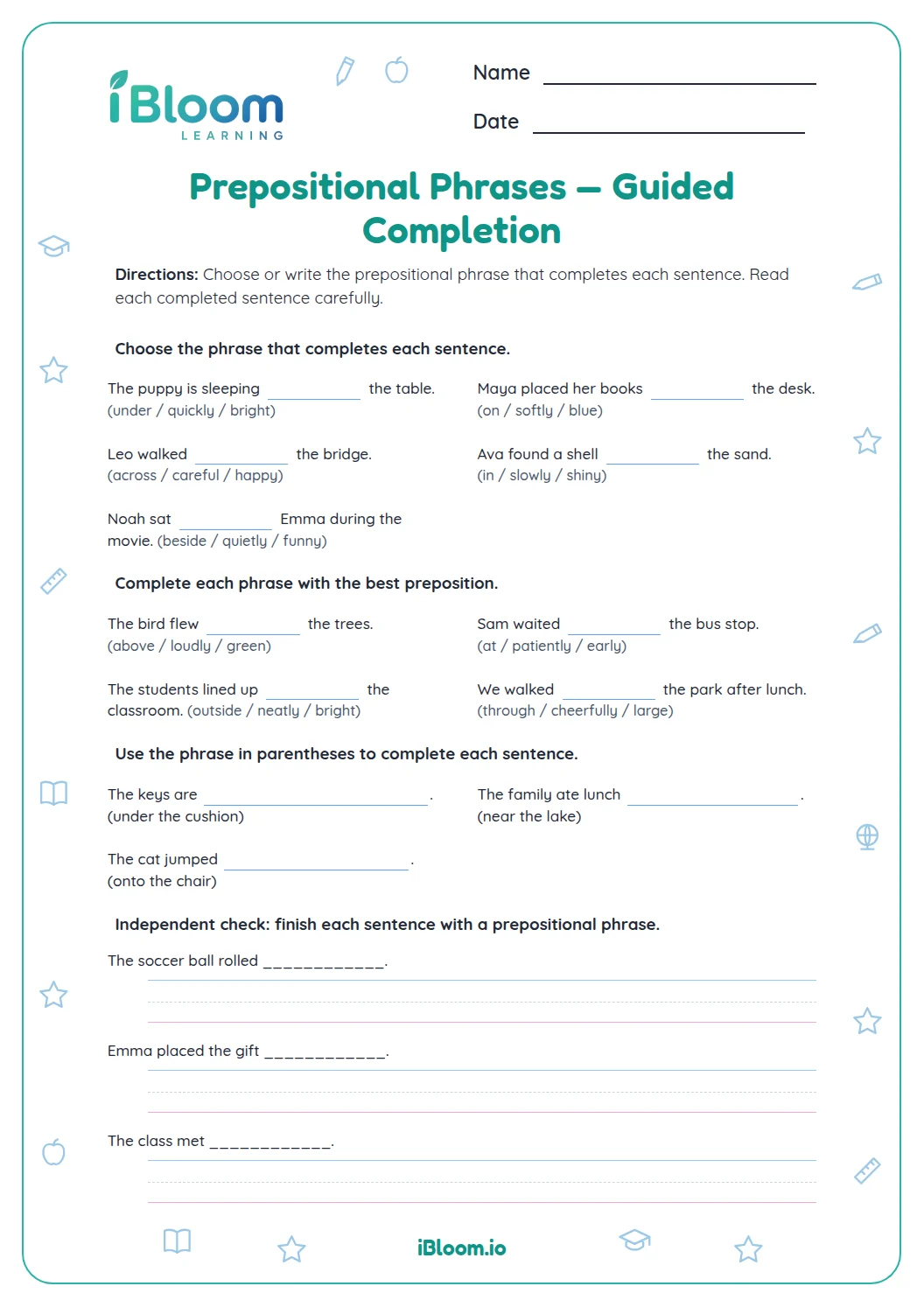
This printable gives students 18 questions to practice adverb phrases at Grade 5. The answer key follows the same order and accepts the listed responses.
Aligned to L.5.1.a
How can a phrase complete a sentence?
An adverb phrase adds information about an action, such as when, where, or how it happens. The first questions ask students to choose a phrase that completes a sentence.
- 1“The hikers rested under the tall pine.” tells where.
- Part A: choose a phrase that fits the action
- Notice whether it tells when, where, or how
How do you find the whole phrase?
Finish sentence stems with a phrase that matches the clue, then identify what selected phrases tell about an action.
- 1through the garden
- Part B: complete sentences with phrases
- Part C: identify the information a phrase adds
What information does an adverb phrase add?
Ask when, where, or how the verb action happens. The phrase should connect to the verb, not merely describe a noun.
- 1“after breakfast” tells when.
How to use this worksheet
- 1Read the whole sentence and locate its verb.
- 2Choose a phrase that adds when, where, or how information.
- 3For identification, include the preposition and its object.
- 4Ask which verb the phrase modifies.
- 5In Part C, check that your phrase fits the sentence.
Common mistakes and quick fixes
The mistake
Writing only “through” instead of “through the garden.”
The fix
Include both the preposition and its object: through the garden.
The mistake
Calling “cheerfully” a prepositional phrase.
The fix
A prepositional phrase begins with a preposition and includes its object; cheerfully is one adverb.
The mistake
Choosing a phrase that describes a noun rather than the verb.
The fix
Check that the phrase tells when, where, or how the verb happens.
Curriculum alignment
This page practices the skill described in the listed standard.
Explain the function of prepositions in phrases used in particular sentences.
On this sheet: Explain the function of prepositions in phrases used in particular sentences.
Show the official wordingHide the official wording
Explain the function of conjunctions, prepositions, and interjections in general and their function in particular sentences.
What to practice next
Make more practice
Further reading
Questions parents and teachers ask
What is an adverb phrase here?
This printable has 16 questions about adverb phrases. Students choose phrases that complete sentences, add phrases that tell when, where, or how, and identify the information a phrase supplies. The answer key lists the expected phrases and meanings.
Why include the whole phrase?
A preposition needs an object to complete its phrase. “Through” alone does not say where the rabbit hopped; “through the garden” does. Part B asks for the full phrase, so include the preposition and its object. Ask the child to point to the exact word or phrase in the sentence that supports the answer before checking the key.
How is a phrase different from one adverb?
An adverb can be one word, such as cheerfully. The phrases on this sheet have multiple words and add details about a verb. Examples include after school and across the yard. Read the phrase with its sentence to check whether it tells when, where, or how the action happens.
Can an adverb phrase tell more than where?
Yes. A phrase can tell when or how as well. “After breakfast” gives a time, “in the cabin” gives a place, and “at a slow pace” gives a manner. Ask when, where, or how to identify its information. Ask the child to point to the exact word or phrase in the sentence that supports the answer before checking the key.
What should I accept for the final prompts?
Accept a phrase that fits the sentence and tells when, where, or how. The key gives samples, not the only possible wording. For the final identification question, the phrase “in front of the net” tells where. Ask the child to point to the exact word or phrase in the sentence that supports the answer before checking the key.