







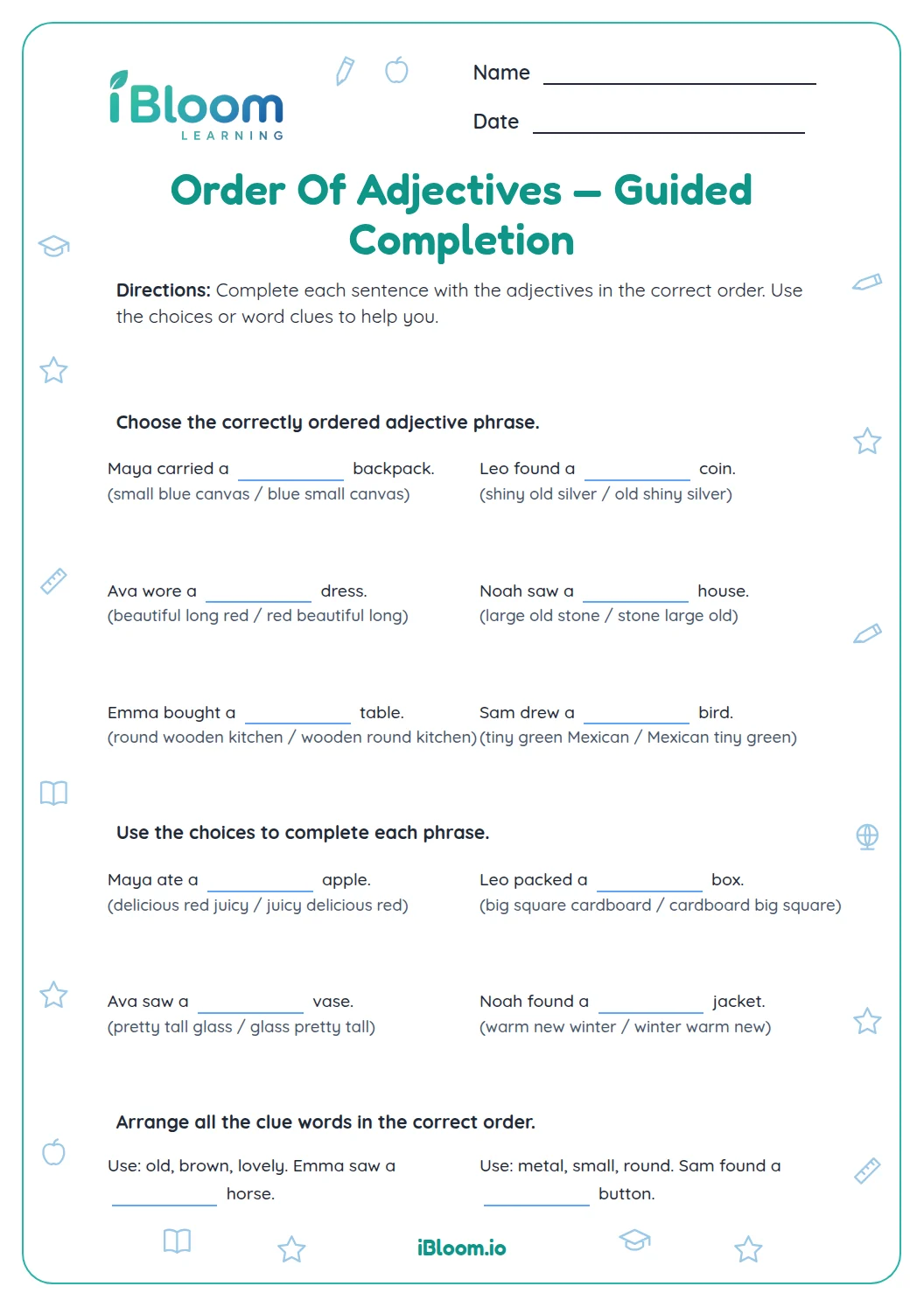
About this worksheet
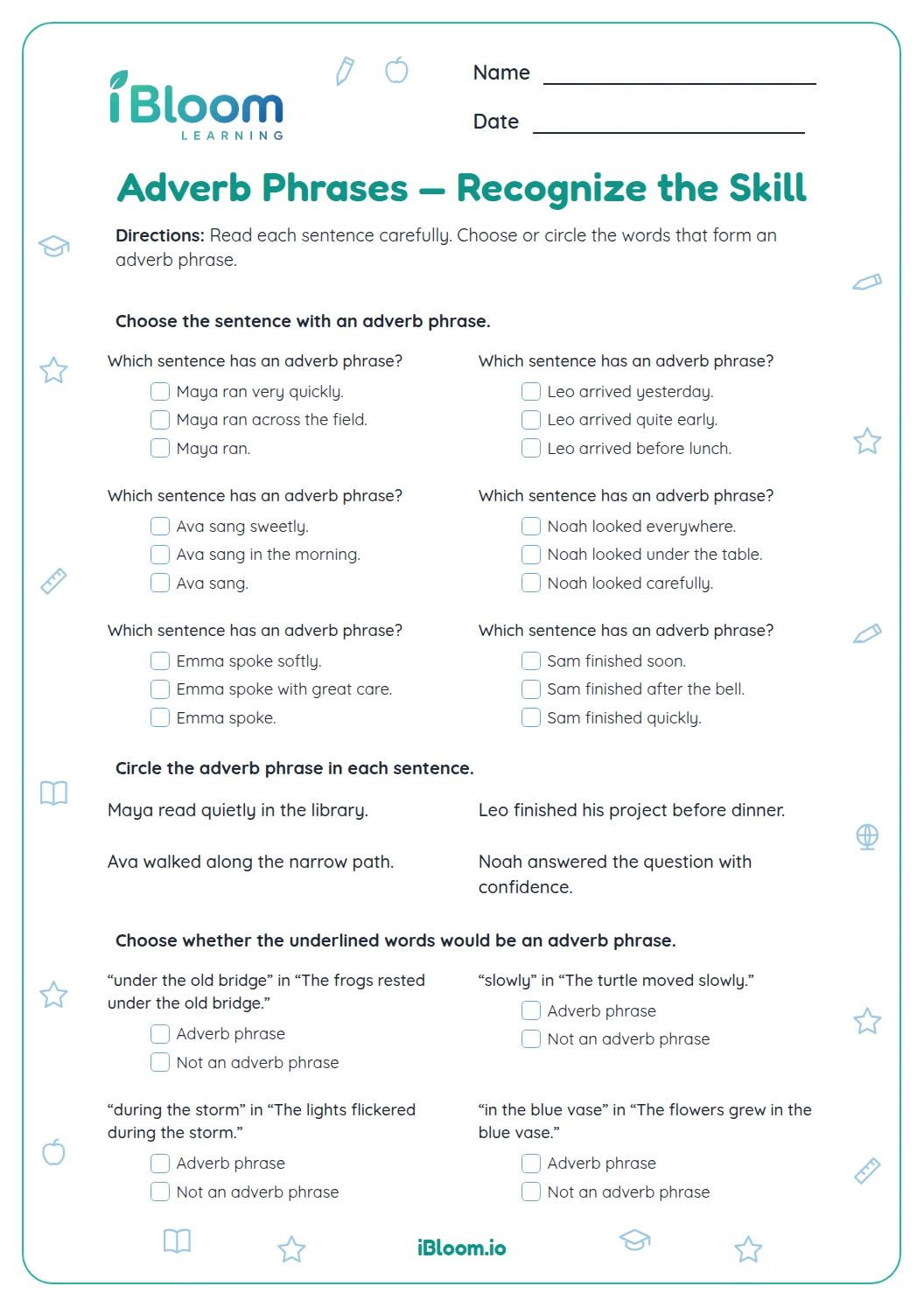
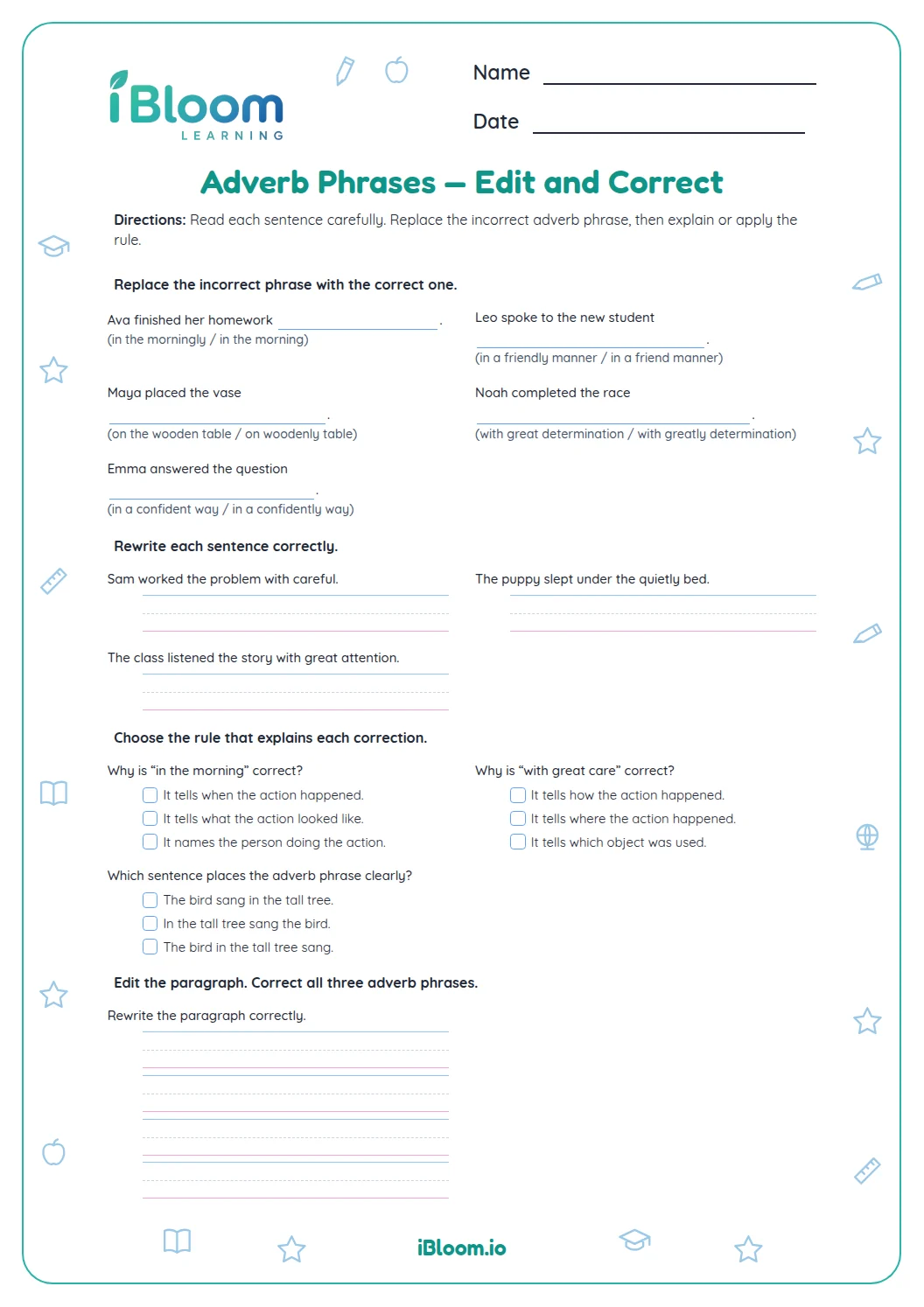
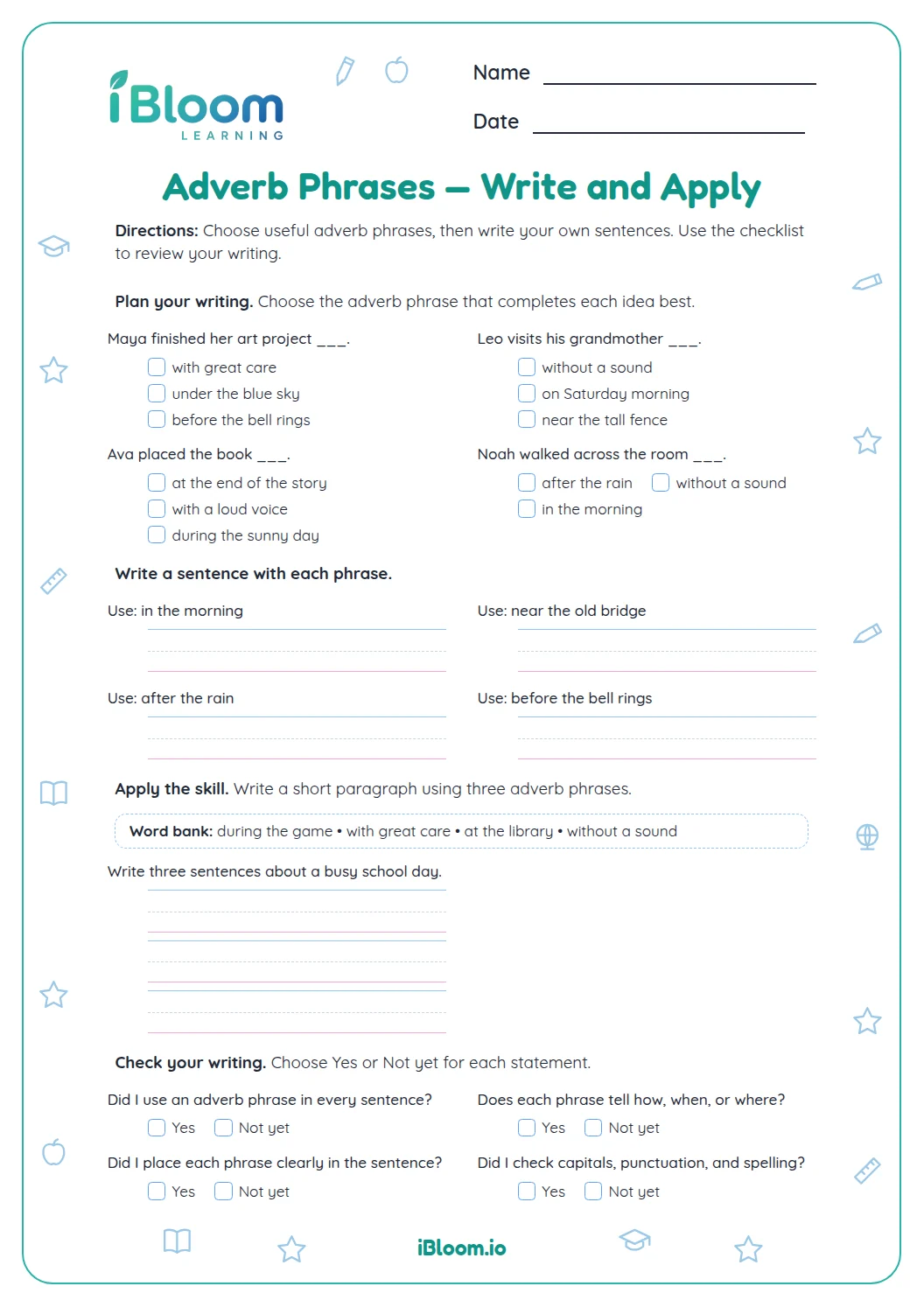
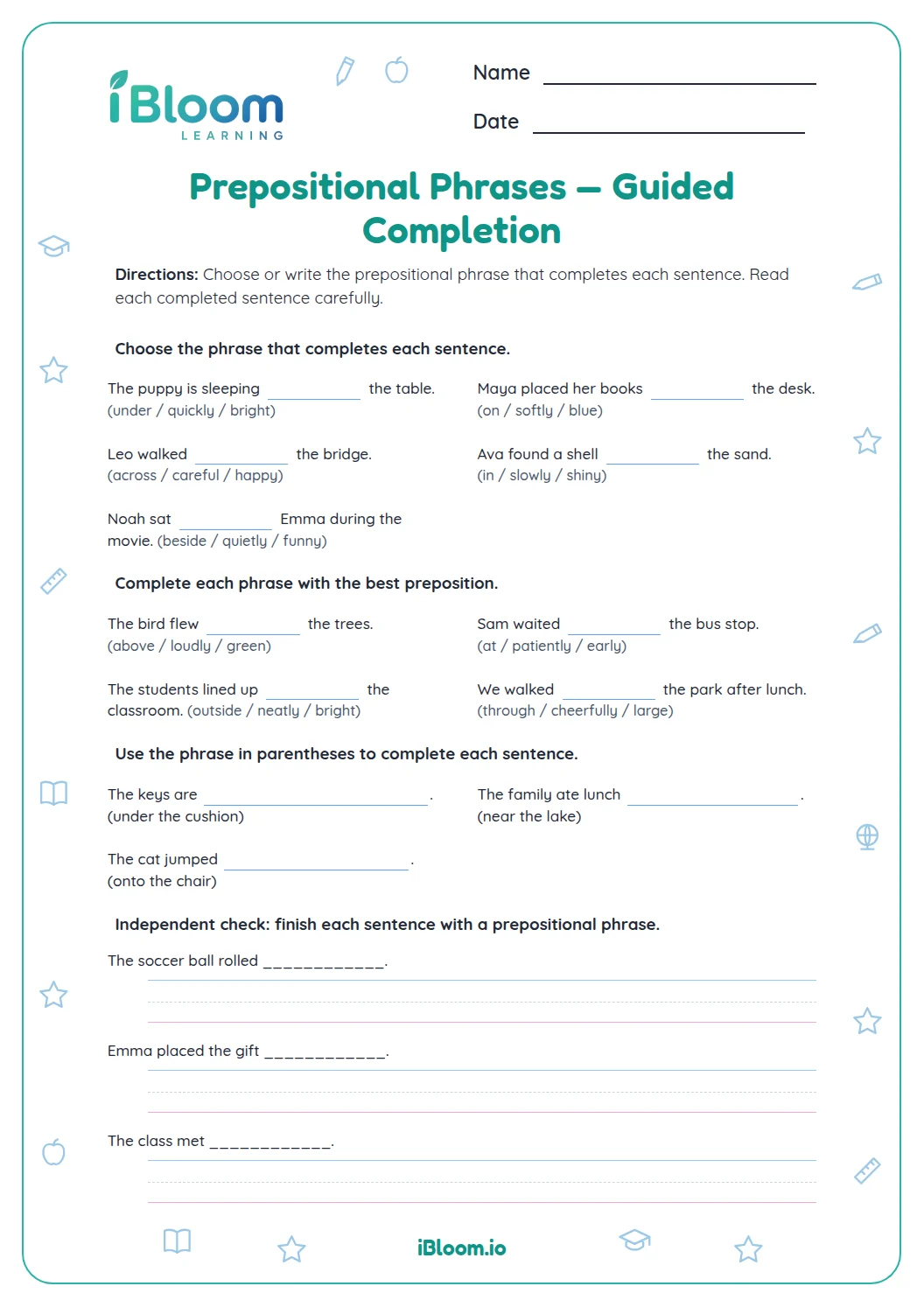
This Grade 5 grammar worksheet gives students 14 sentence-practice questions about adverb phrases. In the first section, students choose a phrase that tells when, where, or how an action happens. In the second, they add a phrase of their own to complete a sentence. The separate answer key provides the selected phrases and sample completions for review.
Aligned to L.5.1
How can you spot an adverb phrase?
Find the action in the sentence, then ask when, where, or how it happens. A group of words that answers one of those questions can function as an adverb phrase. In “The team practiced on the field,” the phrase tells where the team practiced.
- 1Action: practiced
- 2Ask where? on the field
- 3“On the field” tells where the team practiced.
How do you choose a phrase that fits?
Read the full sentence with each option. The correct phrase should fit the meaning and answer the question in the prompt. Other choices may describe a noun or give information that does not answer when, where, or how.
How can you write your own adverb phrase?
Use the question named in the prompt to guide your phrase. For a where prompt, “beside the stream” gives a place. Read the completed sentence to be sure the phrase connects naturally to its action.
What kinds of sentences appear?
The first ten items ask students to identify an appropriate phrase, and the last four provide a short-answer blank for a phrase. The sentences use everyday actions, with when, where, and how prompts throughout.
How to use this worksheet
- 1Locate the action in the sentence.
- 2Ask whether the prompt needs a time, place, or manner.
- 3For a choice question, test each phrase in the complete sentence.
- 4For a written completion, add a phrase that answers the named question.
- 5Read the sentence again to check grammar and meaning.
Common mistakes and quick fixes
The mistake
Choosing a describing phrase for a noun instead of the action.
The fix
Ask when, where, or how the verb happens and choose words that answer that question.
The mistake
Selecting a phrase that does not fit the sentence meaning.
The fix
Read the whole sentence with the phrase inserted before choosing.
The mistake
Writing only one word when the prompt asks for a phrase.
The fix
Add a group of words, such as “after lunch” or “beside the stream.”
Curriculum alignment
The sentence work applies standard English grammar and usage in context.
Use standard English grammar when building sentences with adverb phrases.
On this sheet: Students identify and place adverb phrases in grammatically complete sentences.
Show the official wordingHide the official wording
Demonstrate command of the conventions of standard English grammar and usage when writing or speaking.
What to practice next
Make more practice
Further reading
Questions parents and teachers ask
What is an adverb phrase?
An adverb phrase is a group of words that functions like an adverb by adding information about an action. It can tell when, where, or how something happens. For example, “after lunch” tells when Mina read. Students use the question in each prompt to decide what information the phrase adds.
How many questions are on this worksheet?
There are 14 questions: ten multiple-choice items and four written completions. The selection questions ask students to find a phrase that fits a sentence, and the final prompts ask students to supply a phrase for a named purpose. The answer key lists the choices and sample completions.
Can more than one phrase work for a written prompt?
Yes. The answer key shows one sample phrase for each written prompt. Another phrase can also be correct if it is grammatical, fits the sentence, and answers the named question about when, where, or how. A phrase that merely describes a noun would not meet a prompt asking about the action.
How is an adverb phrase different from an adjective phrase?
An adverb phrase describes an action or adds information about it, such as when or where it happened. An adjective phrase describes a noun. To distinguish them, identify which word or action the phrase explains. If it adds time, place, or manner to the verb, it is working adverbially in that sentence.
What should students do if a phrase sounds awkward?
Read the entire sentence aloud with the phrase included. Check that it answers the prompt and connects naturally to the action. If it sounds awkward, try a clearer group of words that gives the same kind of information. The phrase should make the complete sentence easy to understand and still answer the prompt.
How long does this grammar practice take?
About 20 to 30 minutes is a useful estimate for all 14 questions. The multiple-choice items move quickly; the written completions take longer as students think of a fitting phrase and reread the finished sentence. Students can finish both sections in one sitting or pause between choosing and writing.