




About this worksheet
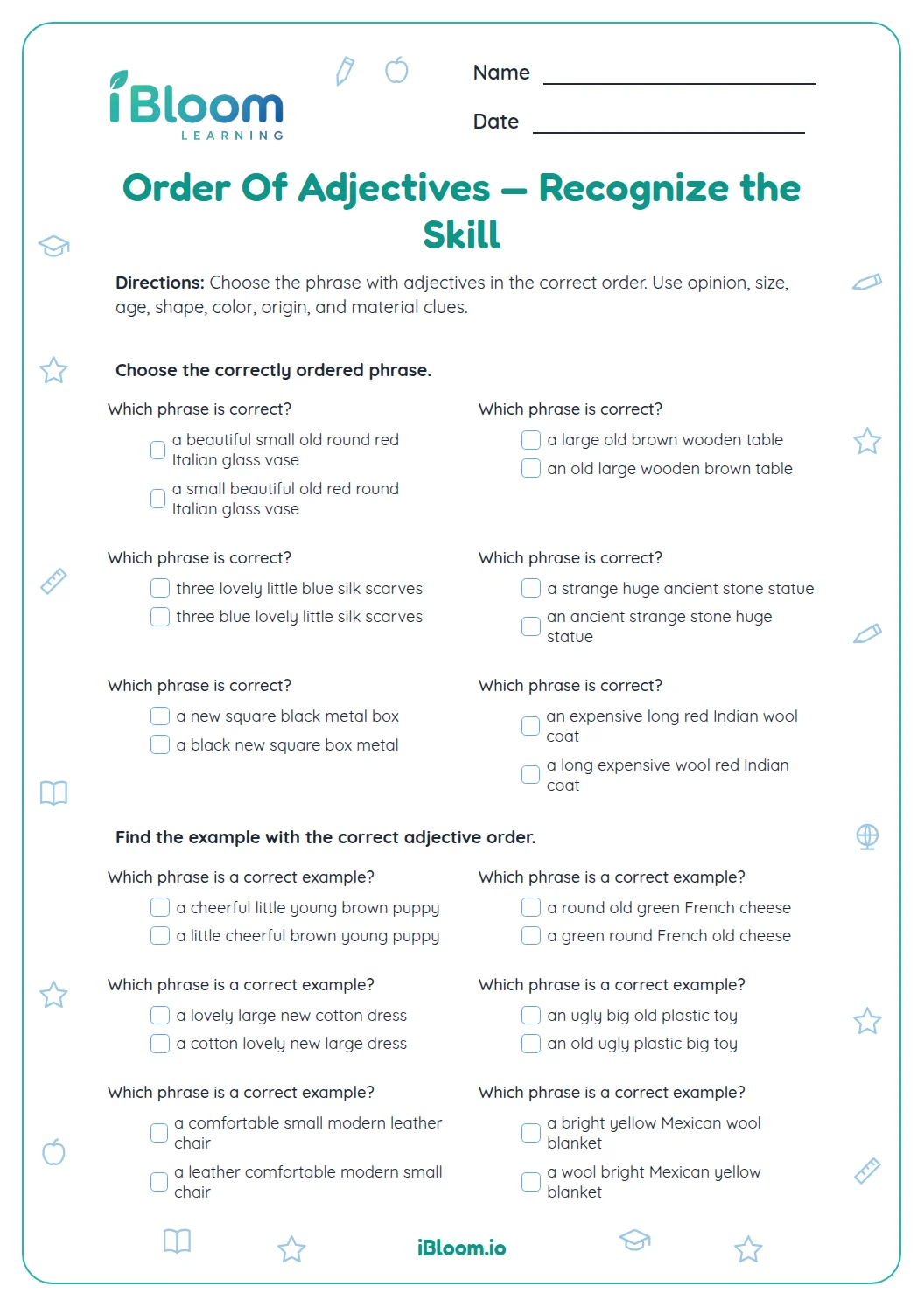
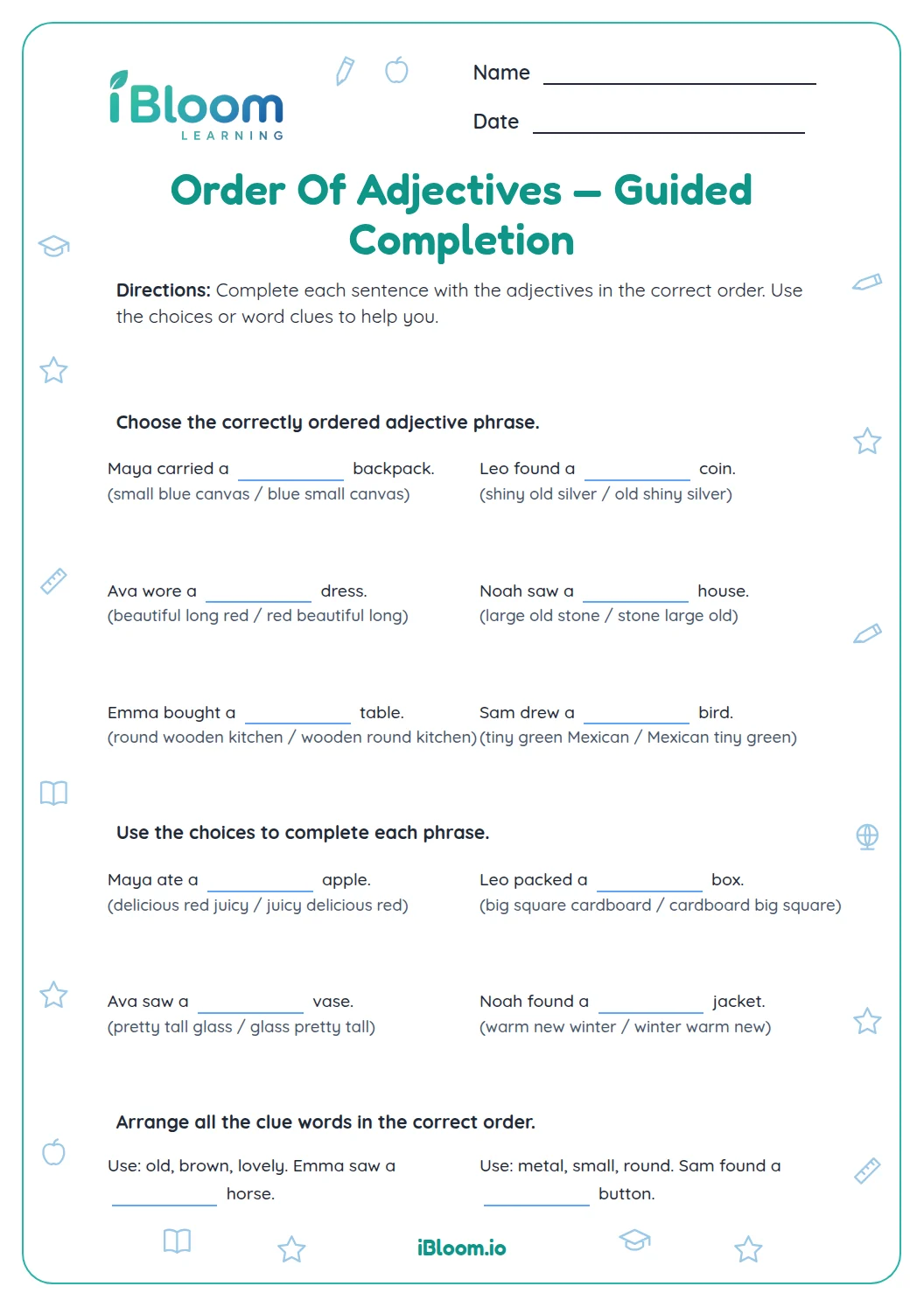
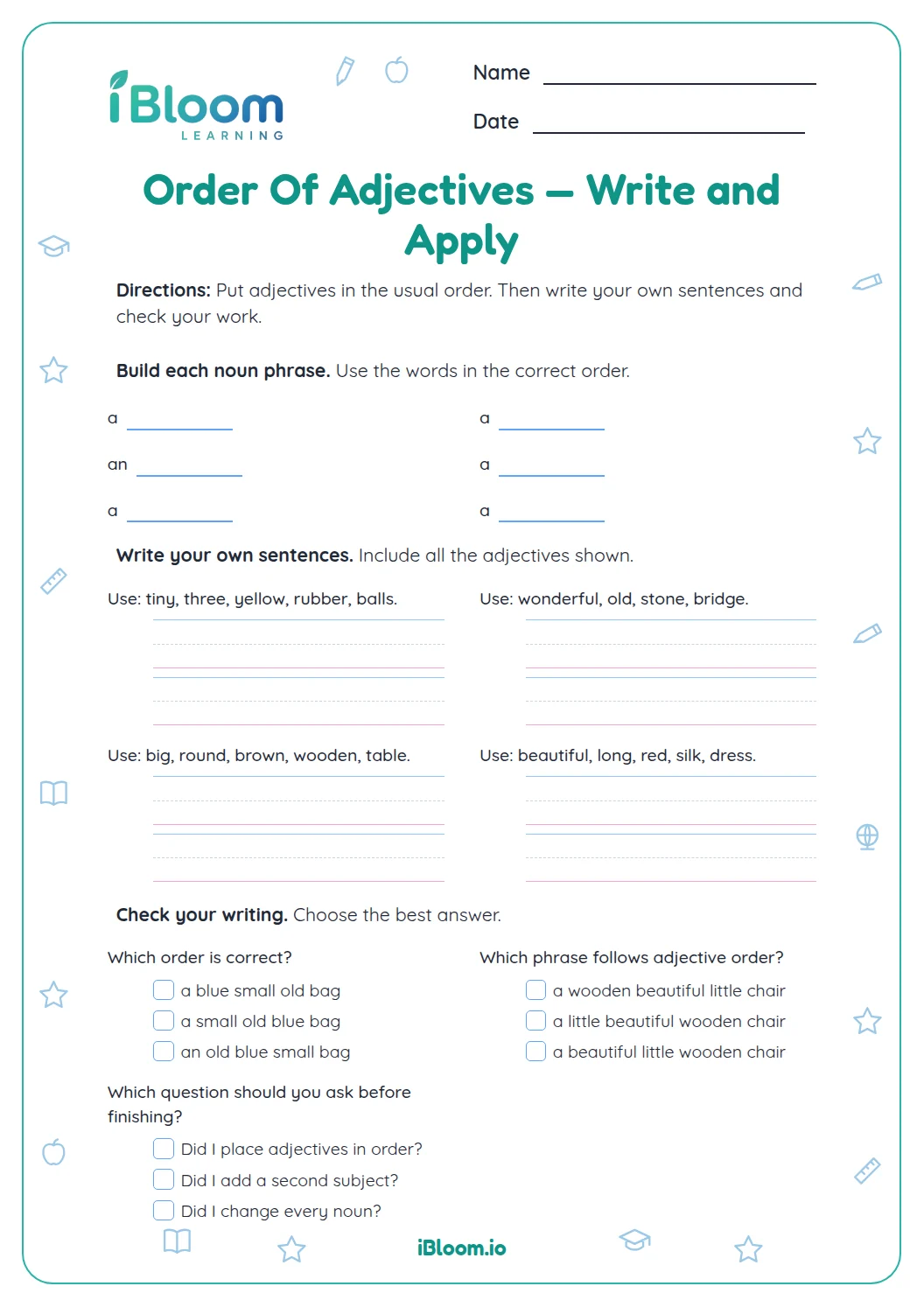
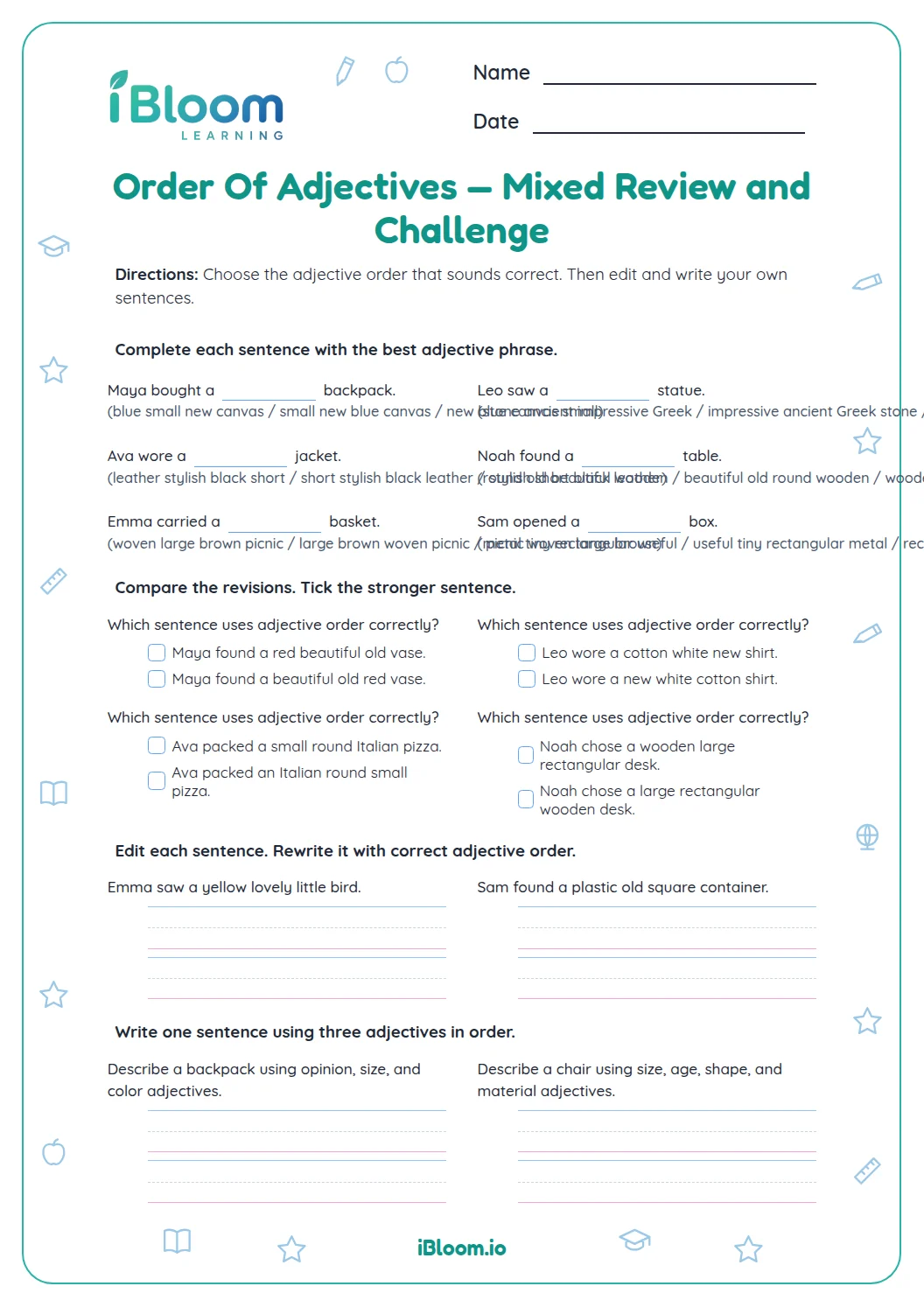
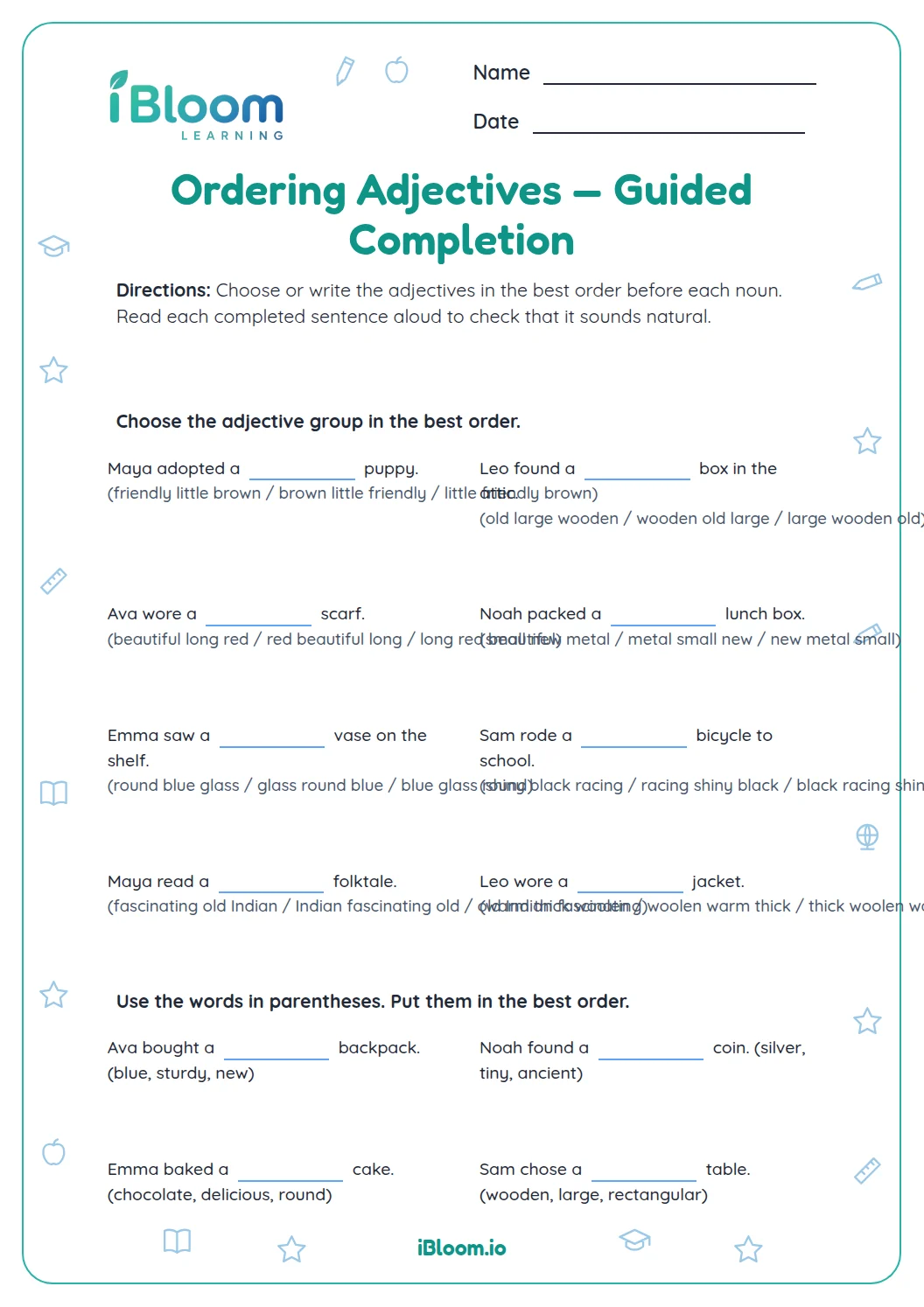
This Grade 5 printable has 14 multiple-choice questions on conventional adjective order. Children choose a natural order in sentences, reorder word groups, and identify clear adjective phrases before a noun. The separate answer key marks the intended order. The sheet aligns with CCSS 4.L.1.d.
Aligned to 4.L.1.d
How can you order adjectives before a noun?
When several adjectives come before a noun, English usually follows a familiar order. A number comes before the noun phrase, and size or opinion generally comes before color or material: “three small red buttons.” Read the complete phrase to check that it sounds clear.
The sheet starts with natural-order choices, then asks children to order adjective groups and correct phrases. Examples include size before color, color before material, and a number before the description.
- 1For “a ___ shell (smooth, tiny),” size usually comes before texture in this exercise, giving “a tiny smooth shell.” The noun shell stays last.
What will children practice?
The sheet starts with natural-order choices, then asks children to order adjective groups and correct phrases. Examples include size before color, color before material, and a number before the description.
How can children check their answers?
Locate the noun first. Put each describing word before it, try the more general description before color or material, then read the complete phrase aloud. Use the intended meaning to resolve close choices.
How to use this worksheet
- 1Find the noun the adjectives describe.
- 2Keep a number before the describing words, as in three yellow buttons.
- 3Place opinion or size words before color or material when that order sounds natural.
- 4Read the full phrase aloud.
- 5Edit only the adjective order; keep the noun and meaning.
Common mistakes and quick fixes
The mistake
Putting a material adjective before a color adjective.
The fix
Try saying the phrase aloud; “blue silk scarf” is the natural order here.
The mistake
Moving the noun into the middle of the phrase.
The fix
Keep the noun after its adjectives: “a square wooden box.”
The mistake
Assuming any order works equally well.
The fix
Some orders sound more conventional; compare the whole phrase and preserve its meaning.
Common Core alignment
This worksheet practices ordering adjectives in sentences through the skills named below.
Place adjectives in conventional order before a noun.
On this sheet: Place adjectives in conventional order before a noun.
Show the official wordingHide the official wording
Order adjectives within sentences according to conventional patterns (e.g., a small red bag rather than a red small bag ).
What to practice next
Make more practice
Further reading
Questions parents and teachers ask
Why does adjective order matter?
Adjective order helps a phrase sound natural and makes it easier to understand which words describe the noun. “A small red wagon” is clearer and more conventional than “a red small wagon.” The worksheet asks children to choose, reorder, and edit such phrases.
What is a simple way to check adjective order?
Read the noun phrase aloud and listen for an order that sounds natural. Then check that the noun remains last and that the adjectives still describe the intended object. The answer key shows the expected version for each closed response.
Where does a number go in a noun phrase?
A number generally comes before the adjectives in these examples, as in “three yellow buttons.” First identify the noun, then place the number and describing words before it. Question 10 practices this pattern with a short reorder task.
Does the worksheet have only multiple-choice questions?
Yes. The sheet includes natural-order choices, short word-group ordering choices, and two phrase edits. Every item is closed choice, and the key gives the intended phrase. Children can read each complete phrase aloud to hear how the adjectives work together.
What counts as a correct original phrase?
A correct response keeps the noun and places its adjectives in a conventional, understandable order. For instance, “a tiny blue bird” places size before color. These are closed-choice questions, so the separate key identifies the intended answer for each phrase.
How many questions are on the printable?
There are 14 questions in two parts: six initial adjective-order choices and eight word-group or editing choices. The answer key marks the intended phrase for each question. The examples use size, opinion, color, material, and number before a noun.