



About this worksheet
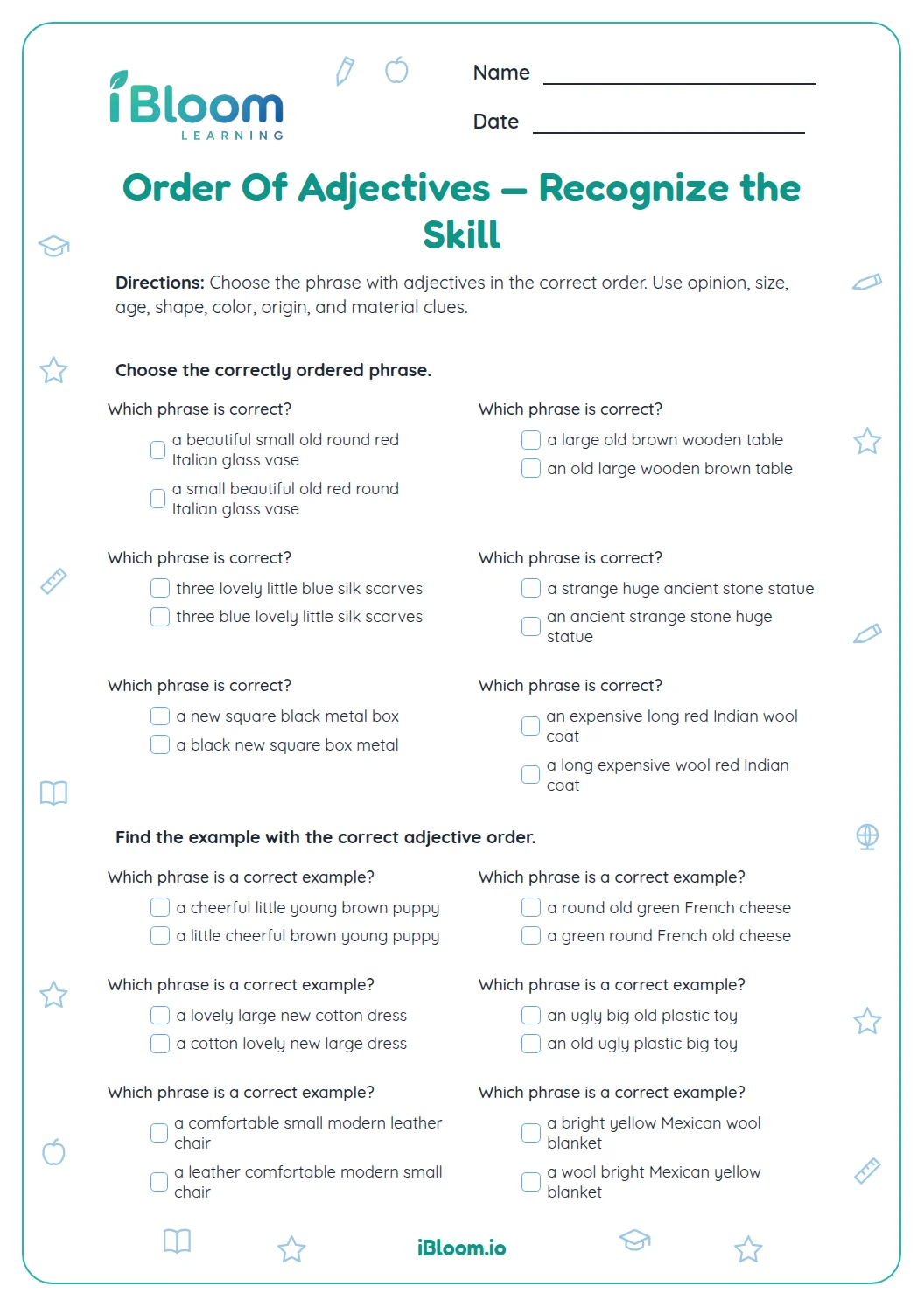
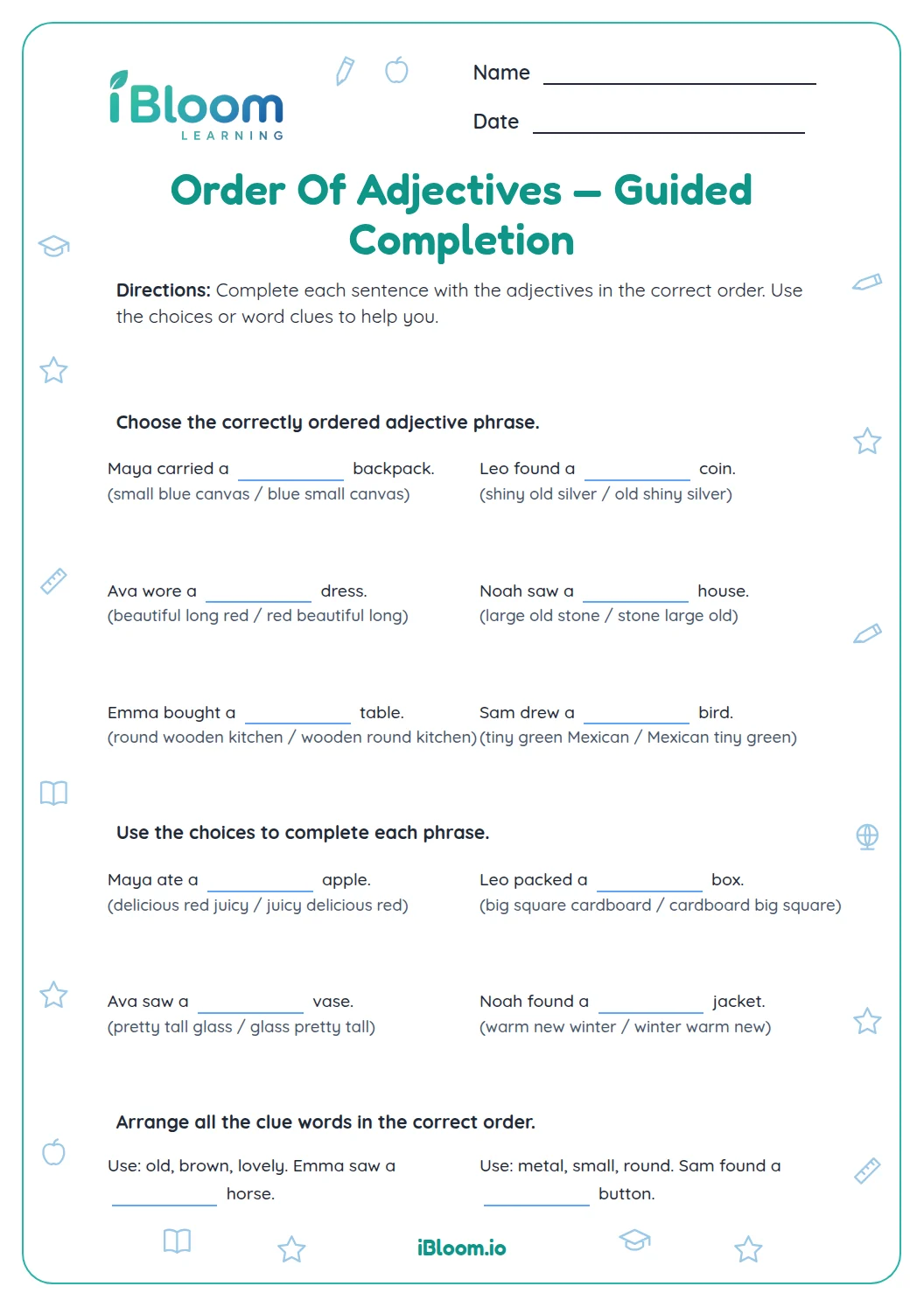
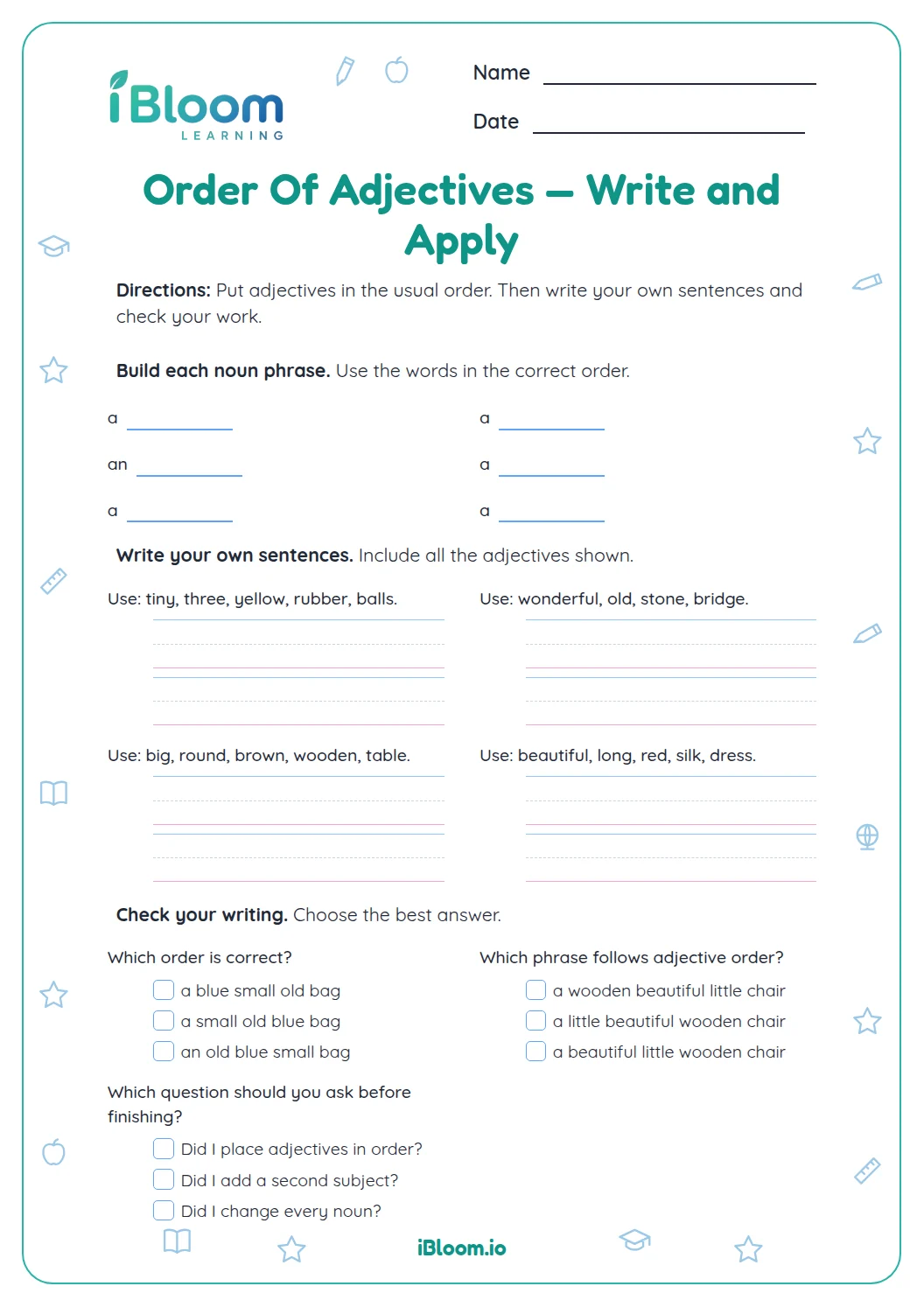
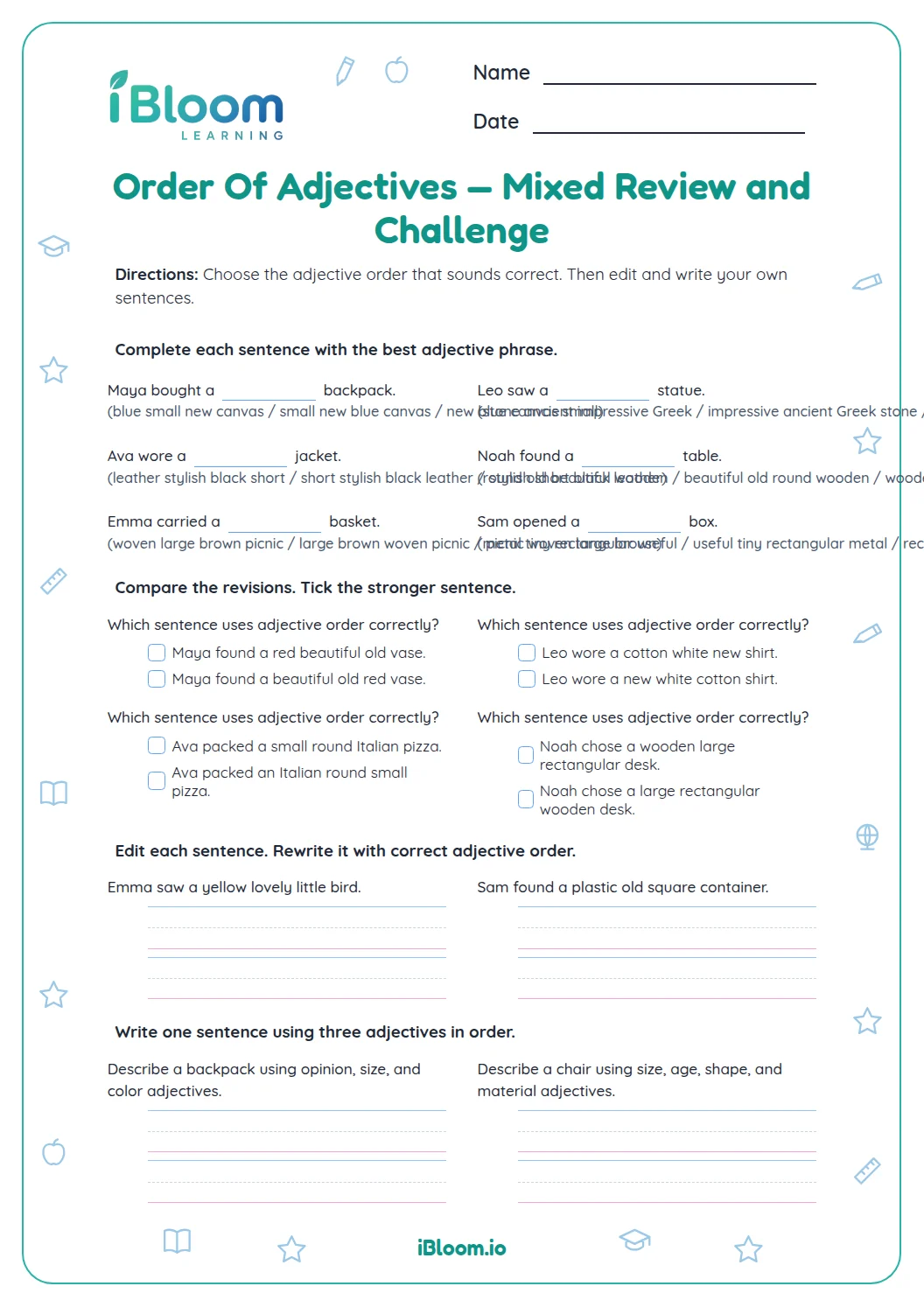
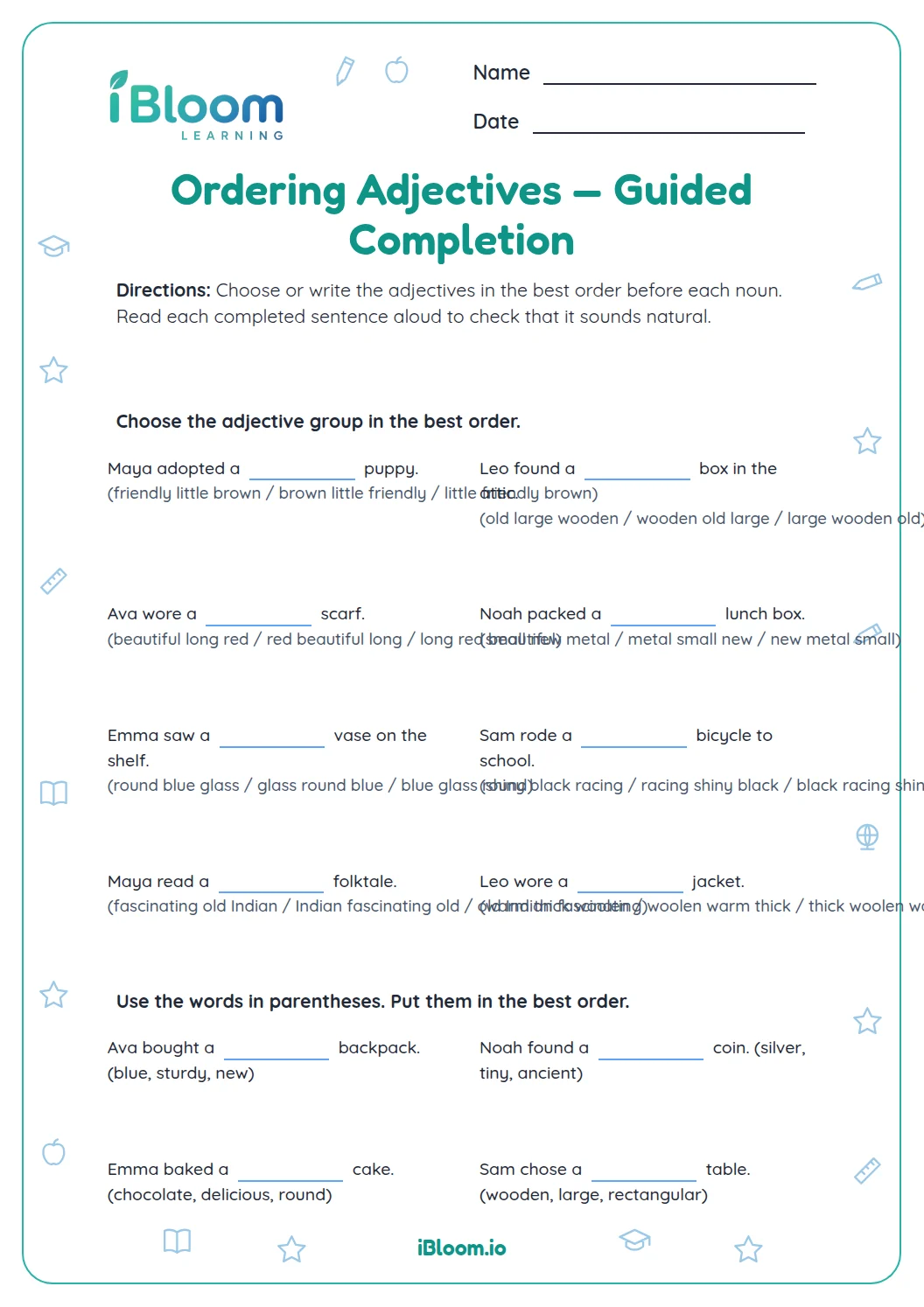
This Grade 5 printable has 16 items in two parts. Students first order adjective groups before nouns, then supply corrected adjective order inside complete sentences. The work supports CCSS L.5.1 by asking students to apply standard English grammar and usage while revising. The answer key includes the ordered phrases and sample sentence corrections.
Aligned to L.5.1
How can you put several adjectives in order?
Name what each adjective tells about the noun. A word may express an opinion, size, age, shape, color, or material. A common sequence moves from opinion and size toward material and purpose.
For question 1, “small” tells size, “old” tells age, and “brass” tells material. The natural phrase is “small, old, brass lantern.”
- 1brass, small, old → small, old, brass lantern
What does editing the full sentence add?
Part B keeps the noun and the rest of each sentence in place. Students move the adjectives into the blank, preserving the sentence’s meaning and punctuation.
For example, “a wooden ancient mask” becomes “an ancient wooden mask”: age comes before material.
How can you check whether the revision sounds right?
Read the noun phrase aloud after rearranging it. Then identify what each adjective describes and make sure no word was dropped. The answer key shows one conventional version for each edit.
How to use this worksheet
- 1Read each adjective group and name the kind of detail each word adds.
- 2Arrange words from general description toward material or purpose.
- 3For Part B, keep the sentence’s noun and meaning.
- 4Fill each Part B blank with the corrected adjective order.
- 5Read the revision aloud and compare it with the key.
Adjective-order mix-ups and fixes
The mistake
Putting material before size, as in “brass small lantern.”
The fix
Place size before material: “small brass lantern.”
The mistake
Changing the noun or dropping an adjective during editing.
The fix
Keep the original noun and check that each descriptive word remains.
The mistake
Treating color and shape as interchangeable.
The fix
Place shape before color in phrases such as “round blue kite.”
Common Core alignment
This editing practice asks students to apply standard English grammar and usage when ordering adjectives.
Edit sentences for standard English grammar and usage, including adjective order.
On this sheet: Children edit adjective strings and full sentences for conventional order.
Show the official wordingHide the official wording
Demonstrate command of the conventions of standard English grammar and usage when writing or speaking.
What to practice next
Make more practice
Further reading
Questions parents and teachers ask
What adjective order does this page practice?
The items use a familiar sequence: opinion, size, age, shape, color, origin, material, and purpose when those categories appear. Not every sentence uses every category. The goal is a natural, conventional order that makes the noun easy to picture. Reread the prompt and use the answer key to check how the clue supports the response.
How is the answer key set up?
The key lists the reordered adjective groups from Part A and the corrected adjective phrases from Part B. Because Part B supplies a phrase inside an existing sentence, students can compare the order without copying every sentence again. Reread the surrounding sentence to check that the phrase fits.
How should a student start editing a string?
First identify what each adjective tells: an opinion, size, age, shape, color, or material. Then arrange the words in that order before the noun, and reread the sentence to make sure it sounds natural. Reread the prompt and use the answer key to check how the clue supports the response.
Can adjectives appear in a different order in real writing?
Writers sometimes shift an adjective for emphasis or style. These practice sentences are designed for the common classroom order, so students can build a dependable editing routine before exploring stylistic choices. Reread the prompt and use the answer key to check how the clue supports the response.
What is a common adjective-order mistake?
Putting material before size is a frequent mix-up in a phrase such as “brass small lantern.” Ask which word describes the lantern’s size and which names what it is made from. “Small brass lantern” places size before material. Reread the prompt and use the answer key to check how the clue supports the response.
What can students practice after this page?
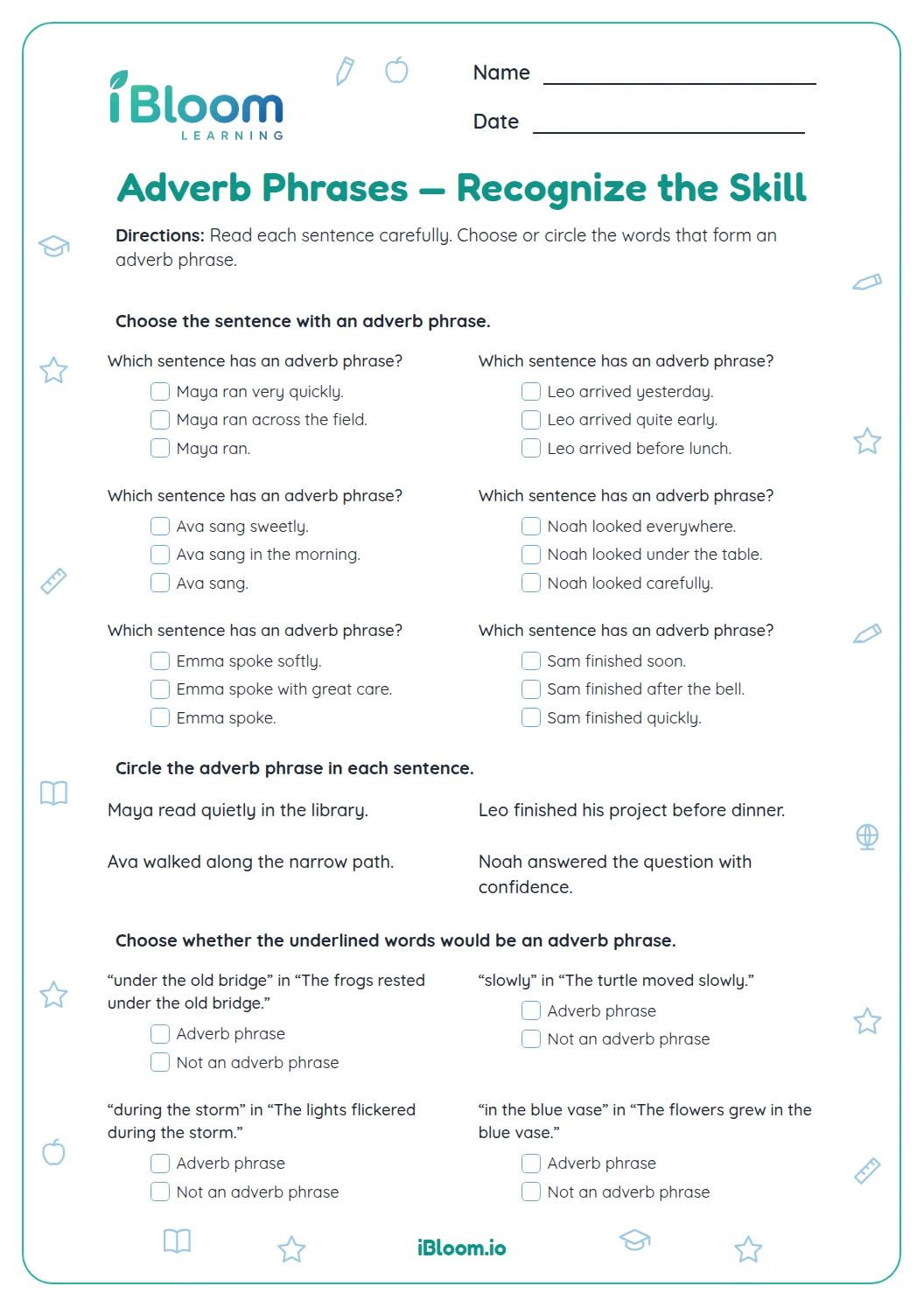
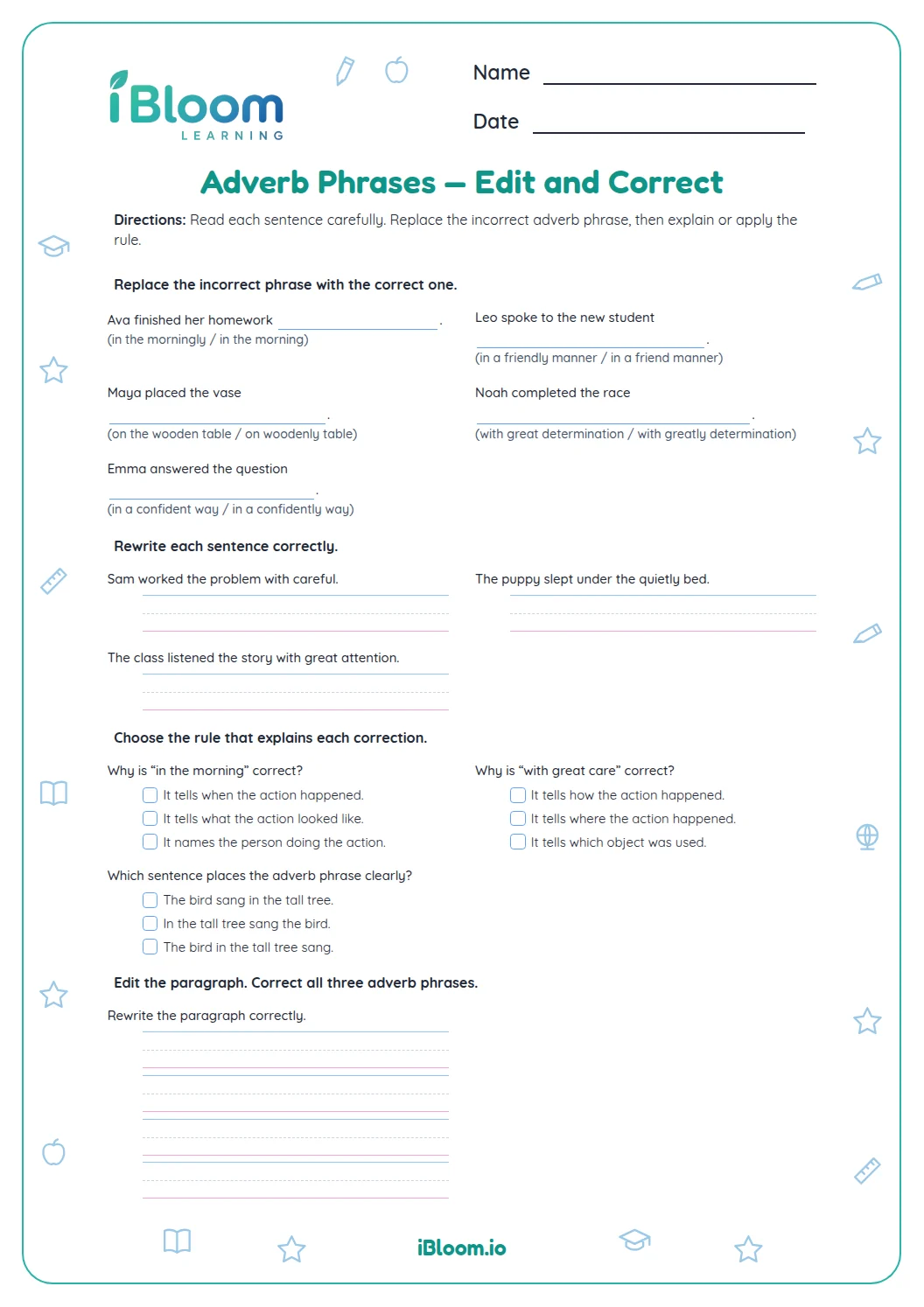
The Ordering Adjectives worksheet offers more sentence-level practice. Comparative and Superlative Adjectives shifts attention to comparing qualities, while Adverb Phrases focuses on words that modify actions and descriptions. Reread the prompt and use the answer key to check how the clue supports the response.