






About this worksheet
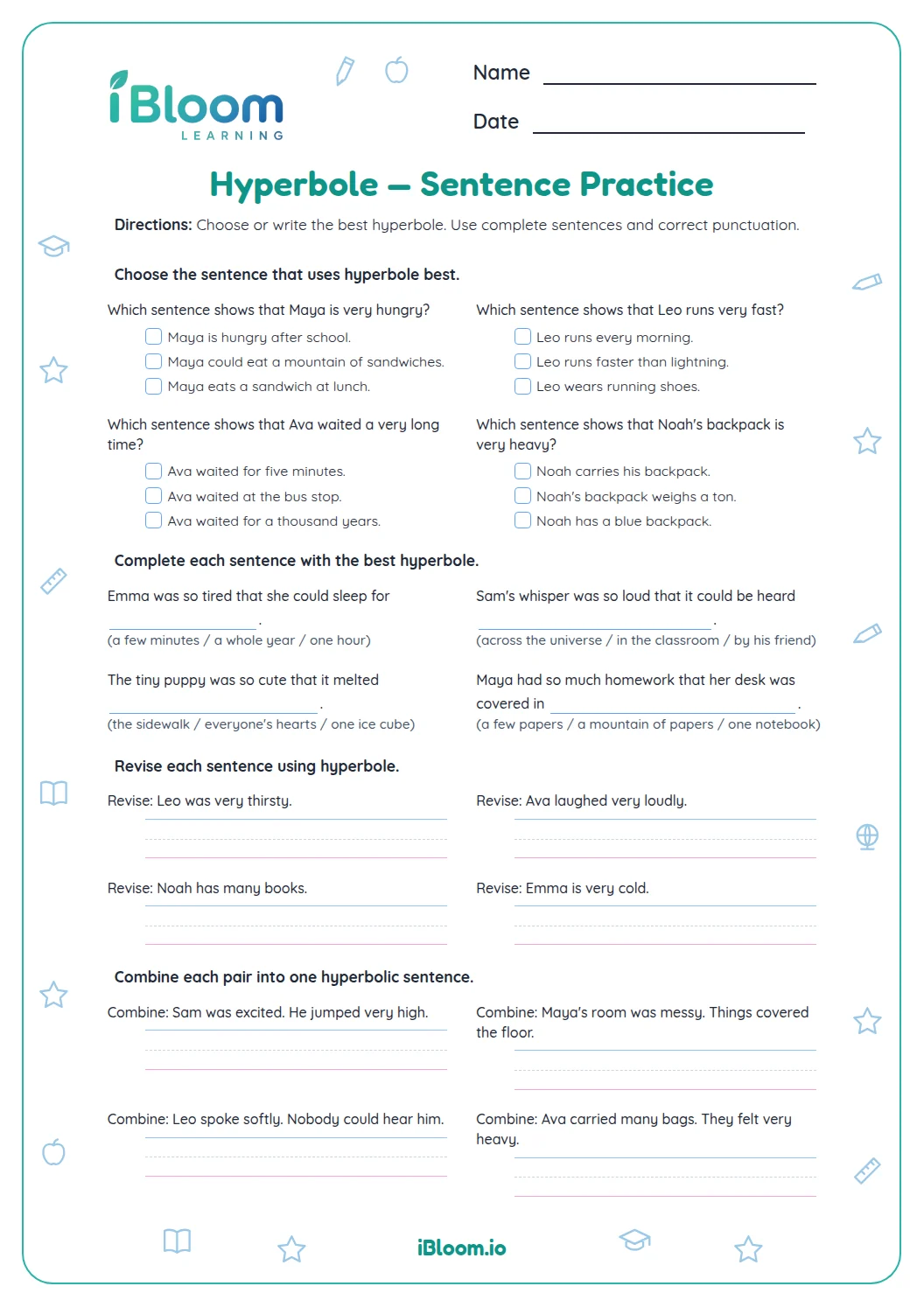
This Grade 5 worksheet focuses on hyperbole, an intentional overstatement used for emphasis or humor. Learners interpret familiar phrases such as “I waited forever,” choose words that complete exaggerations, and identify overstatements in context. In “My backpack weighs a ton,” the speaker means the backpack feels very heavy. The separate answer key lists the best response for each question. It practices CCSS L.5.5a by interpreting figurative language in context.
Aligned to L.5.5a
How can a reader recognize hyperbole?
Ask whether a statement is meant literally or greatly exaggerates an idea. “My backpack weighs a ton” describes how heavy it feels, not an exact weight.
How do you complete a hyperbole?
Choose words that create an obvious, playful overstatement and still make a grammatical sentence. A phrase like “a thousand times” can exaggerate repeated reminders.
What does hyperbole add to a sentence?
It can make a feeling or description more vivid. Read the whole sentence to identify what is exaggerated, such as the cold wind or a very quiet class.
How to use this worksheet
- 1Read the whole phrase or sentence.
- 2Decide whether the statement could be literal or is an overstatement.
- 3For a completion, check both grammar and meaning.
- 4Name the idea being exaggerated.
- 5Compare responses with the answer key.
Common mistakes and quick fixes
The mistake
Taking an exaggerated phrase as an exact fact.
The fix
Ask whether the claim could literally be true in the situation.
The mistake
Choosing any dramatic phrase without checking the sentence.
The fix
Check that the words fit grammatically and exaggerate the intended idea.
The mistake
Naming a detail instead of the exaggerated idea.
The fix
State what is overstated, such as loudness, size, time, or a feeling.
Curriculum alignment
Interpret figurative language in context, including playful overstatement.
On this sheet: Children interpret hyperbole in context as figurative language.
Show the official wordingHide the official wording
Interpret figurative language, including similes and metaphors, in context.
What to practice next
Make more practice
Further reading
Questions parents and teachers ask
What does this worksheet teach about hyperbole?
It practices recognizing a playful overstatement and interpreting what the speaker means. For example, “My backpack weighs a ton” exaggerates how heavy it feels. Other questions ask students to complete an exaggerated phrase or identify the idea being overstated. The examples are printed on the sheet.
How many questions are included?
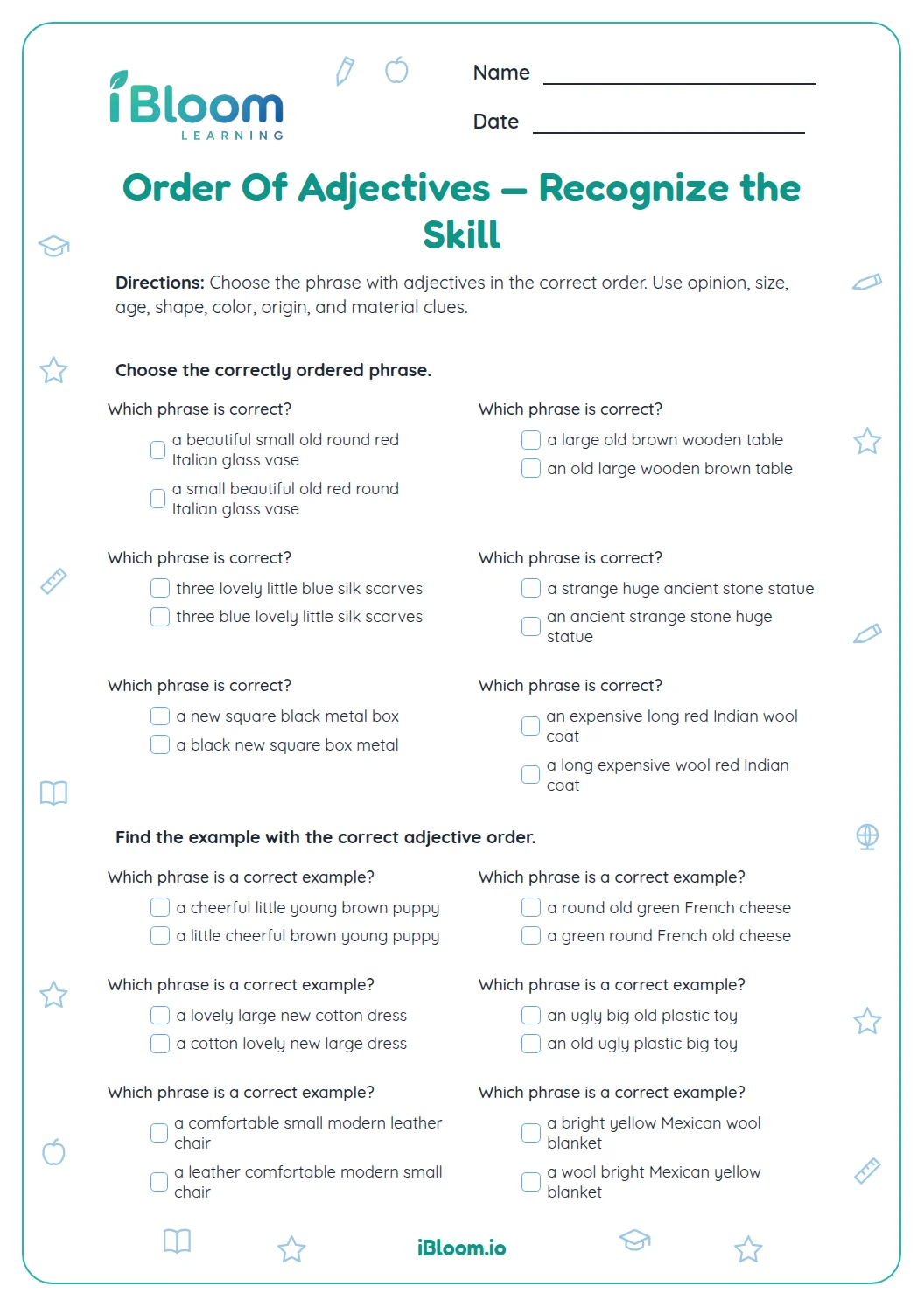
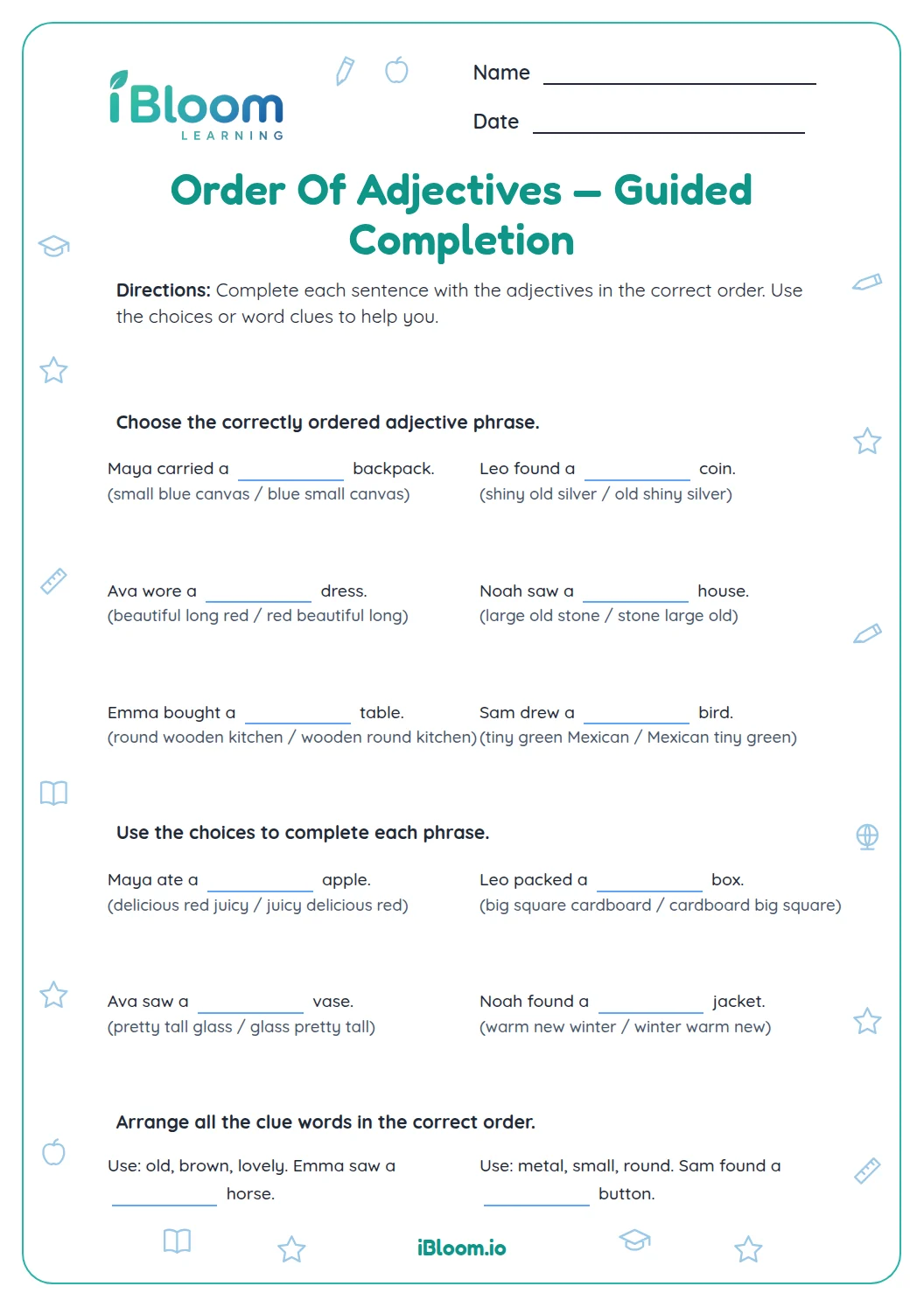
There are 14 multiple-choice questions in two parts, plus a separate answer key. The first part interprets hyperbole and completes exaggerated phrases. The second part identifies overstatements in sentences about cold, length, tiredness, and quiet. Students work with these examples in context.
Is an answer key included?
Yes. The separate answer key marks the best response to all 14 questions. Students can use it after completing the worksheet, then explain which word or phrase signals exaggeration. That review reinforces the difference between a literal statement and an overstatement.
How long does the Grade 5 worksheet take?
Plan for about 15 minutes. Students read each phrase or sentence, choose an interpretation or completion, and then check their work. Allow more time for discussion about what is exaggerated, such as size, sound, hunger, cold, or time. The printable has two full worksheet pages.
Does the worksheet ask students to write their own hyperbole?
No. The questions focus on interpreting, completing, and identifying hyperbole through multiple-choice responses. Students can try writing an original exaggeration as an optional follow-up after finishing, but the printable itself does not require a written response. Students may try this after the multiple-choice work.