





About this worksheet
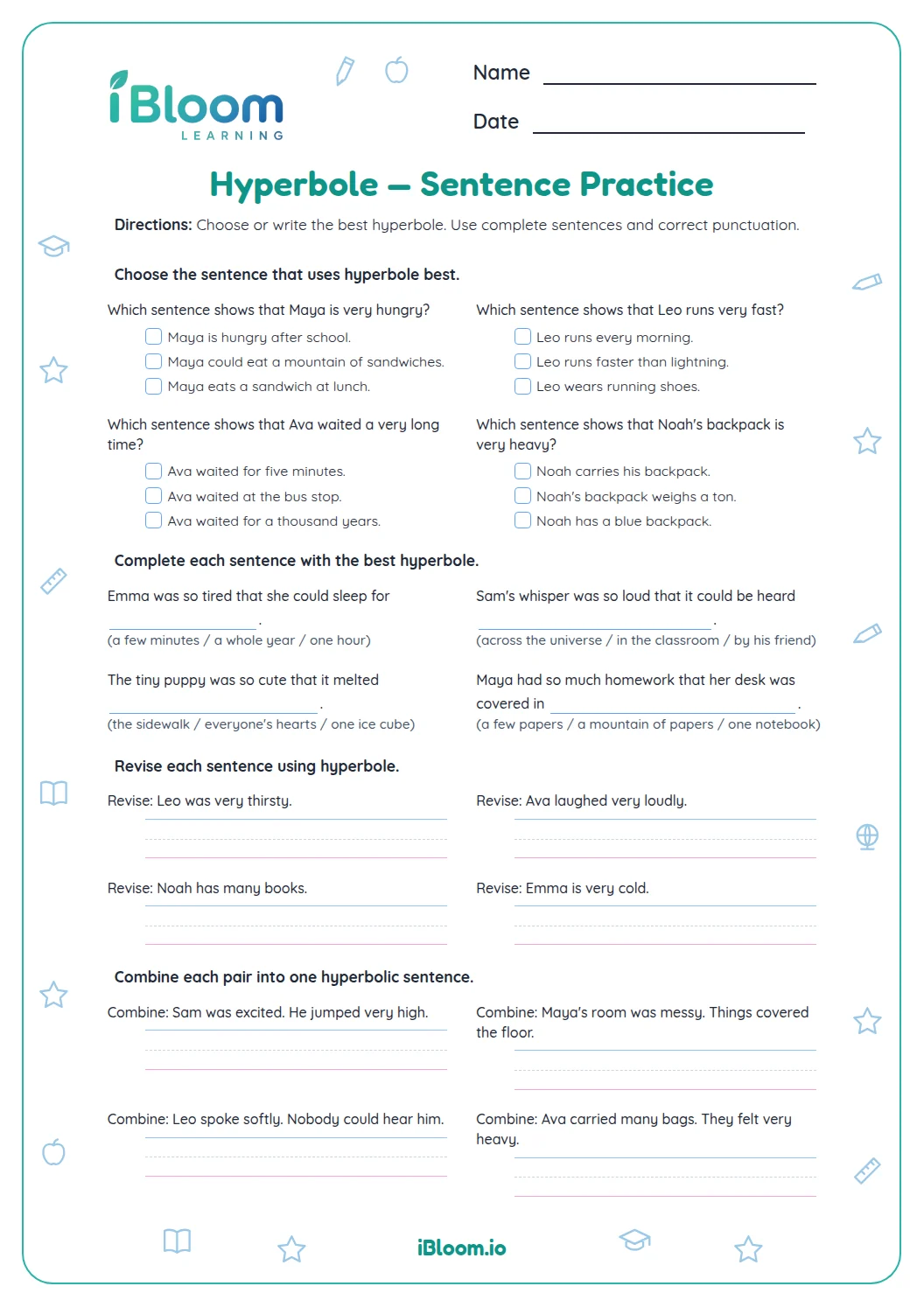
This free two-page Grade 5 worksheet reviews hyperbole as deliberate exaggeration for effect. Part A asks students to label four statements as hyperbole or literal descriptions. Part B gives four questions about intended meaning. Part C compares two sets of revisions to find clear exaggeration. Part D asks students to make two exaggerations literal and write two original hyperboles. These fourteen tasks practice figurative-language understanding in Common Core L.5.5. The separate answer key provides fixed answers for Parts A–C and sample responses for Part D.
Aligned to L.5.5
How can students tell hyperbole from a literal statement?
Ask whether the speaker intends the words as an exact description. “I waited ten minutes for the bus” can report an ordinary measured wait. “I waited a thousand years for the bus” exaggerates the wait to emphasize impatience.
Part A mixes measured statements with extreme exaggerations. A large number alone is not enough to identify hyperbole; the sentence’s meaning matters.
What does the exaggeration really mean?
Part B asks students to keep the underlying idea while dropping the impossible detail. The backpack that “weighs a ton” feels very heavy, and the homework that “will take a century” seems like a great deal of work.
Choosing a meaning checks interpretation, not just the ability to notice dramatic words. Students should be able to point to the phrase that supports their choice.
- 1“My backpack weighs a ton!”
- 2A ton is the exaggerated weight.
- 3The speaker means: It feels very heavy.
What makes a successful hyperbole revision?
Part C asks students to compare possible revisions before writing their own. “I could sleep for years” exaggerates tiredness; “I felt sleepy” and “I went to bed” describe ordinary experiences. Keep both the exaggeration and the original idea in view.
Questions 11 and 12 ask students to make an exaggerated statement literal while keeping its main meaning. The answer should communicate the same feeling in a believable way.
Questions 13 and 14 reverse the task. Students exaggerate the height of a sandwich and the loudness of a cheer while preserving the original topic. Several sentences can work; the key gives one model for each.
How to work through the sheet
- 1Read the Part A reminder: hyperbole means exaggeration for effect.
- 2Label each statement H or L, then explain one choice aloud.
- 3In Part B, identify the impossible or extreme detail before choosing the intended meaning.
- 4In Part C, choose the revision that exaggerates tiredness or crowding without changing the topic.
- 5Write believable versions of questions 11 and 12 without changing their main idea.
- 6For questions 13 and 14, exaggerate the named feature and reread to check that the meaning is clear.
Mistakes to discuss and fix
The mistake
Treating any statement with a number as hyperbole.
The fix
Compare the plausible two-mile walk with the impossible thousand-year wait.
The mistake
Explaining an exaggeration as if it were a measured fact.
The fix
Translate the speaker’s feeling into ordinary language, such as very heavy or very busy.
The mistake
Changing the topic when writing a hyperbole.
The fix
Keep the sandwich tall and the cheer loud; exaggerate the assigned feature rather than adding a new event.
Common Core alignment
Recognize hyperbole and explain the meaning behind an exaggerated statement.
On this sheet: Students distinguish literal statements from hyperbole, interpret exaggeration, and revise sentences.
Show the official wordingHide the official wording
Demonstrate understanding of figurative language, word relationships, and nuances in word meanings.
What to practice next
Make more practice
Further reading
Questions parents and teachers ask
What does hyperbole mean on this worksheet?
Hyperbole means an intentional exaggeration used to emphasize an idea or feeling. The bus wait of a thousand years communicates a very long, frustrating wait. Students label examples, interpret speakers’ meanings, and write revisions so they practice both recognizing the exaggeration and understanding why a writer might use it.
What do H and L stand for in Part A?
H means hyperbole, and L means literal. A literal statement presents its words as a direct description, such as walking two miles on Saturday. A hyperbole deliberately exaggerates, such as a tower of library books reaching the moon. Students write one letter for each of the four statements.
Do writing answers need to match the key exactly?
No. Part D has sample answers because students can express the same idea in different ways. Literal revisions should be believable and keep the original meaning. Original hyperboles should exaggerate the requested feature clearly. Check the meaning and the assigned task rather than requiring the key’s exact words.
How is hyperbole different from a factual error?
Hyperbole uses an obvious exaggeration on purpose to express something, while a factual error gives incorrect information as though it were accurate. The backpack sentence asks readers to understand a feeling of heaviness. It is not asking them to believe that the backpack was actually weighed at a ton.
How can students improve a weak original hyperbole?
Ask them to exaggerate the feature named in the prompt more clearly. For the tall sandwich, “The sandwich was very tall” stays ordinary, while “The sandwich reached the clouds” makes the exaggeration obvious. Then ask what the sentence really means to check that the original idea is still understandable.