






About this worksheet
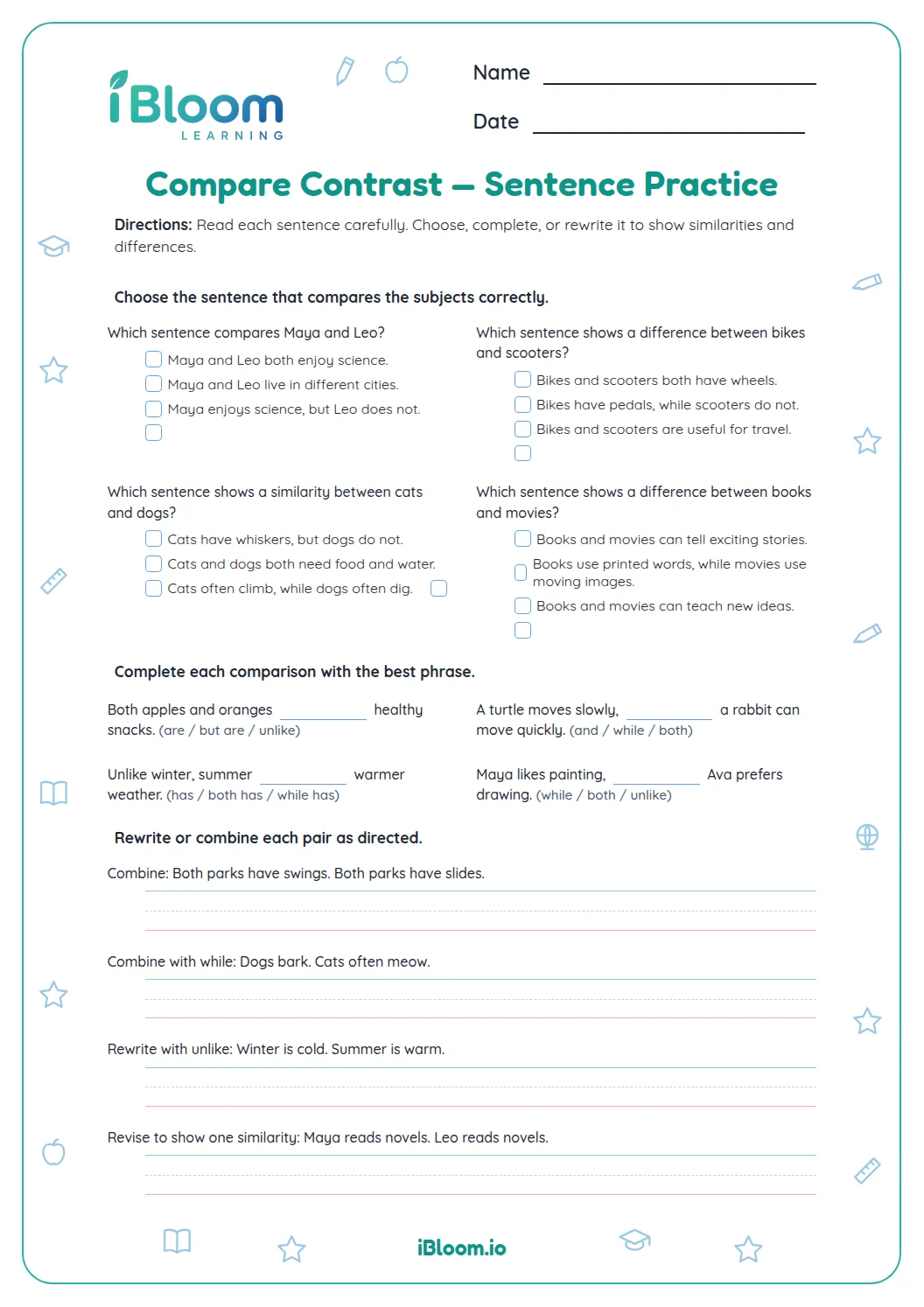
This Grade 5 editing worksheet helps students check whether compare-and-contrast transitions match the ideas around them. Students identify mismatched words, select precise linking phrases, and judge sample sentences about familiar subjects. The practice supports CCSS W.5.2.c by using words and phrases such as “in contrast” to link ideas. The answer key gives the best choices for all 14 questions.
Aligned to W.5.2
How do transition words signal a comparison?
Words such as both, also, and similarly signal a likeness. Words such as unlike, whereas, and in contrast signal a difference. Read both ideas before choosing a transition; a familiar word can still be wrong if the sentence does not support it.
- 1Question 3 uses “similarly” for opposite details; “but” clearly signals their difference.
How can I fix a mismatched transition?
First decide whether the sentence expresses a similarity or a contrast. Then replace the transition or adjust the details so both parts make a true, clear comparison. Check that the subject of each clause is easy to identify.
How do I write a precise comparison?
Choose two subjects and one specific trait they share or do not share. Use a transition to show that relationship, then reread the sentence to make sure the details are accurate.
How to use this compare-and-contrast worksheet
- 1Read both ideas before judging the transition.
- 2Decide whether the ideas show a similarity or difference.
- 3Choose a linking phrase that signals that relationship.
- 4Rewrite any sentence whose detail or transition is inaccurate.
- 5For your own sentences, choose a specific shared or different trait.
Common mistakes and quick fixes
The mistake
Choosing a transition because it sounds familiar
The fix
Name the relationship first, then choose a word that signals it.
The mistake
Treating “both” as proof that every detail matches
The fix
Use both only for a fact that is true of each subject.
The mistake
Writing an unclear contrast
The fix
Name the subjects on both sides and state the specific difference.
This worksheet gives students a concrete way to practice the skill.
Link comparison ideas clearly with transitions such as “in contrast” and “similarly.”
On this sheet:
Show the official wordingHide the official wording
Write informative/explanatory texts to examine a topic and convey ideas and information clearly.
What to practice next
Make more practice
Further reading
Questions parents and teachers ask
What words show similarity?
Both, also, and similarly can signal a likeness. Use one only when the details on each side truly match. “Both maps show roads” is a clear similarity if each map includes roads, as in Question 12. Check that both clauses support the transition.
What words show contrast?
Unlike, whereas, but, and in contrast signal differences. “A pond is still, whereas a stream flows” pairs the contrast word with details that differ. The worksheet asks students to match each signal to the relationship. Read both clauses before choosing.
Can I use “although” to compare two subjects?
Yes, when the sentence sets up an unexpected contrast, as in “Although both teams practiced, only one reached the final.” Check that the second clause completes the thought and makes the relationship clear. A transition should connect complete ideas. That makes the contrast easier for a reader to follow.
What if more than one revision is correct?
Several revisions can be correct if they express a true relationship and use transitions accurately. The key gives the best choice for each item; students can explain why another phrase does or does not fit. Read the sentence aloud to check it.
How can students check their own comparison sentences?
Underline the transition and label the ideas as alike or different. Then ask whether the details support that label. If “similarly” introduces a difference, replace it with a contrast word such as “but.” Recheck that the revised sentence remains clear. The questions on this sheet use the same check.