




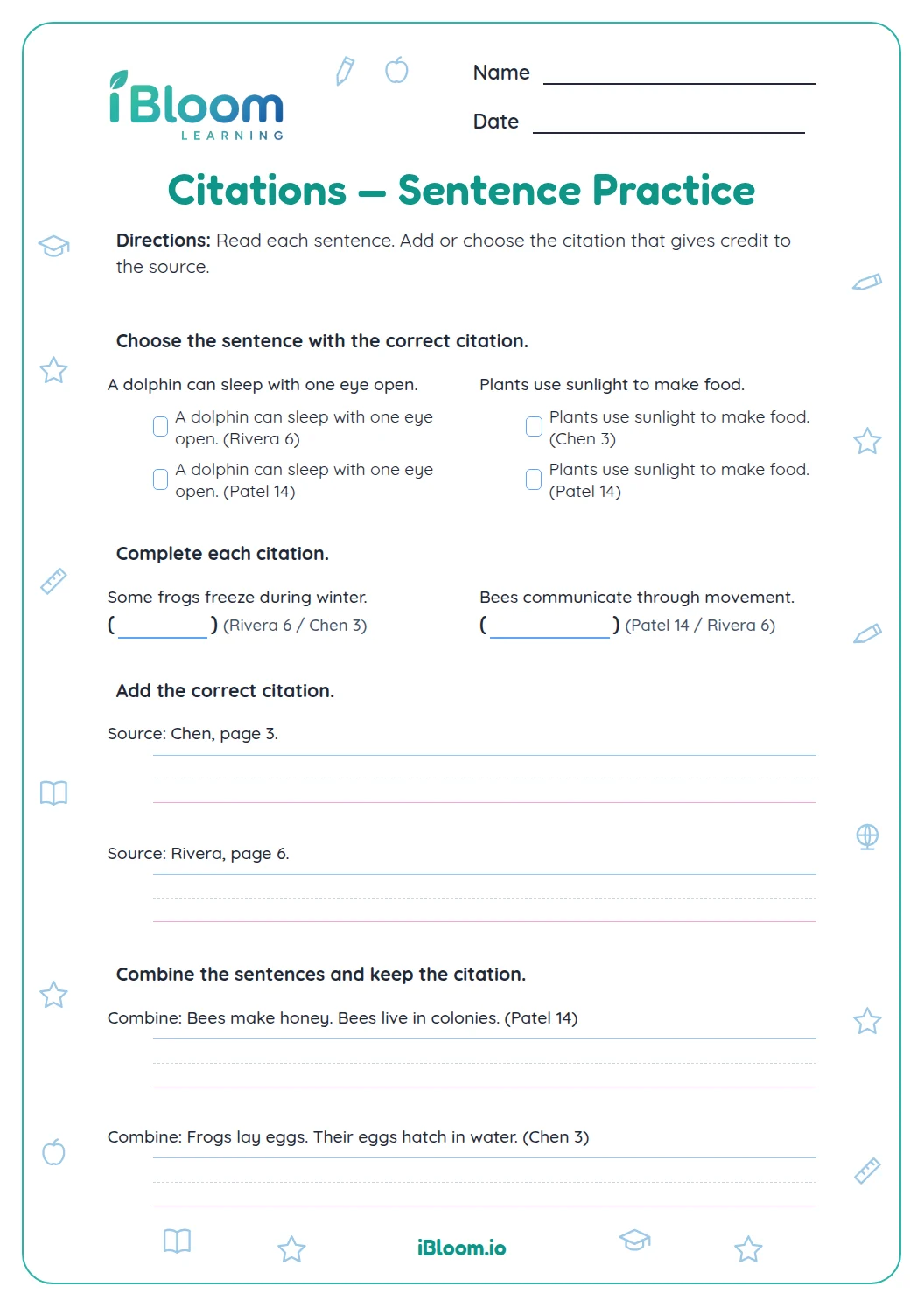
About this worksheet
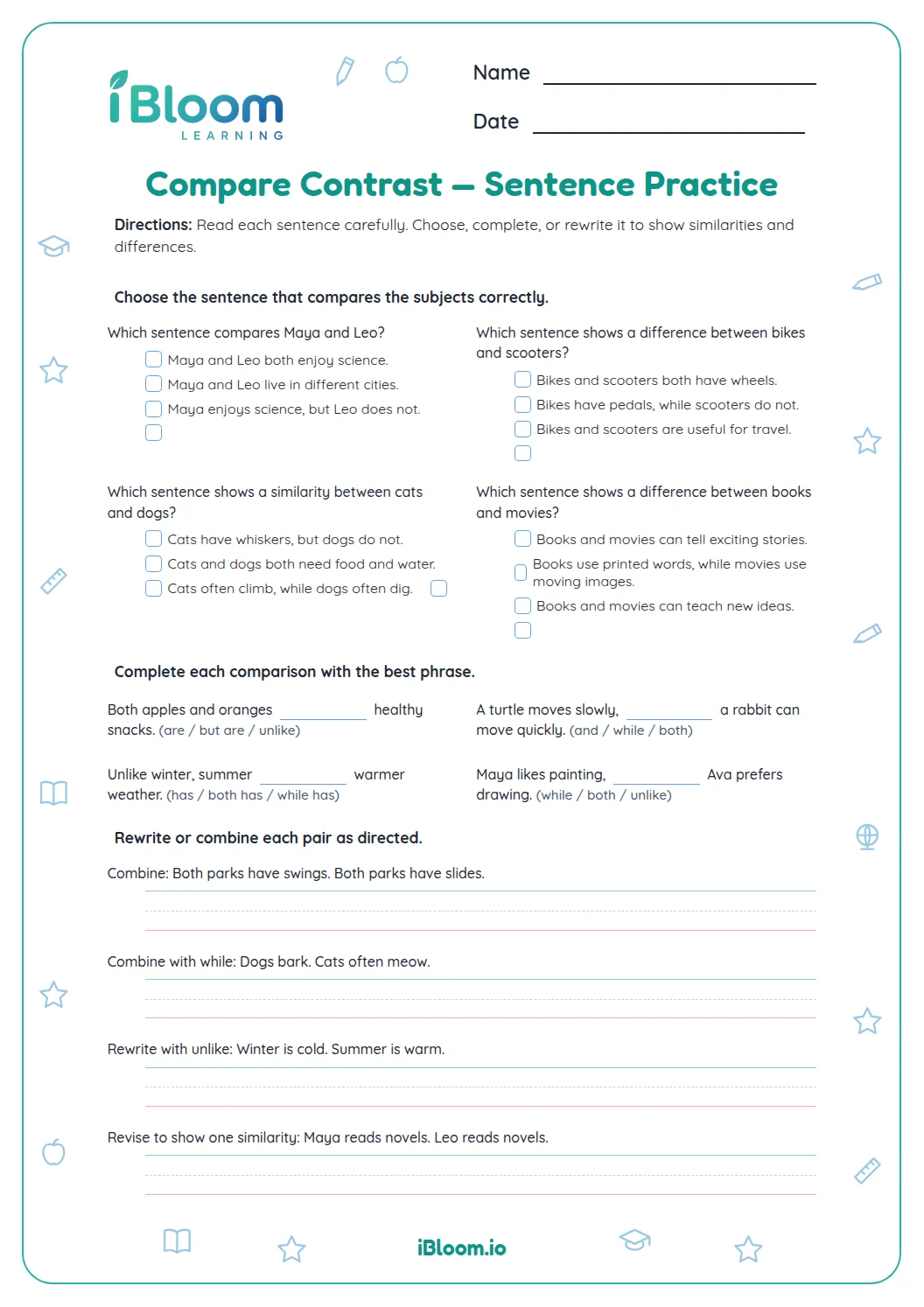
This Grade 5 writing worksheet builds compare-and-contrast sentences and short responses. Students identify similarities and differences, choose linking words such as similarly and however, and write or revise comparisons using specific details. The answer key offers sample responses rather than the only acceptable wording. These tasks practice linking ideas with words and phrases, as described in CCSS W.5.2.
Aligned to W.5.2
What does this compare-and-contrast worksheet include?
The first eight questions ask students to identify shared details, differences, transitions, and strong comparison sentences. The final eight ask them to compose or revise comparisons using facts and linking words.
The prompts name the facts students need, including the honeybee and butterfly details in questions 1 and 2, so each written response can be answered from the page.
- 1Honeybees and butterflies both visit flowers, but only honeybees make honey.
How can students tell a similarity from a difference?
A similarity applies to both subjects; a difference distinguishes one from the other. “Both visit flowers” fits honeybees and butterflies, while “Honeybees make honey” gives a difference. Name both subjects and check that the detail is accurate for each one.
Which linking words help organize a comparison?
Words such as both, similarly, and also connect shared traits. Unlike, however, and in contrast introduce differences. Choose the signal word that matches the relationship, then reread the full sentence to confirm that its details support the connection.
How can students revise a comparison paragraph?
The final challenge begins with an idea repeated in two sentences about cats and dogs. Students combine the shared point and add a specific contrast. A clear revision names both subjects, uses a transition accurately, and keeps each detail relevant to the comparison.
How to use this worksheet at home or in class
- 1Identify the two subjects and the feature being compared.
- 2Separate shared traits from differences.
- 3Use a linking word that accurately signals the relationship.
- 4Support a comparison with specific details.
- 5Reread to see whether the response addresses both subjects.
Common mistakes and quick fixes
The mistake
Calling a difference a similarity
The fix
Check whether the detail applies to both subjects.
The mistake
Using however for a shared trait
The fix
Choose a signal word that matches the relationship.
The mistake
Naming only one subject
The fix
Make sure both sides of the comparison are clear.
Common Core alignment
Students write informative comparison sentences and connect their ideas with transitions.
Write clear compare-and-contrast sentences that connect ideas with transitions.
On this sheet: Students select transitions and use them in written compare-and-contrast responses.
Show the official wordingHide the official wording
Write informative/explanatory texts to examine a topic and convey ideas and information clearly.
What to practice next
Make more practice
Further reading
Questions parents and teachers ask
What does compare and contrast mean?
To compare is to explain how subjects are alike; to contrast is to explain how they differ. This sheet uses honeybees and butterflies: both visit flowers, while honeybees make honey. A strong response names both subjects and supports its relationship with an accurate detail.
Which words can signal a comparison?
Words such as both, similarly, and also can point to shared traits. Unlike, however, and in contrast can introduce differences. The worksheet asks students to choose among these transitions and use them in sentences, then check that the word matches the detail.
Why include similarities and differences?
Including both gives readers a fuller view of the subjects. A comparison that lists only contrasts may miss an important shared trait. The writing prompts ask students to balance the two, such as noting that honeybees and butterflies both visit flowers but differ in making honey.
How long should a written answer be?
Most prompts call for one clear sentence, while questions 9 and 16 ask for both a similarity and a difference. The goal is to answer the specific prompt with accurate information. The key offers a sample, and another response can work if it fits the facts.
How can a student check a comparison sentence?
Underline both subjects, label the detail as a similarity or difference, and check whether the transition agrees. Then confirm the facts. “Both” should introduce a trait shared by both subjects, while “unlike” should introduce a real difference between them.