






About this worksheet
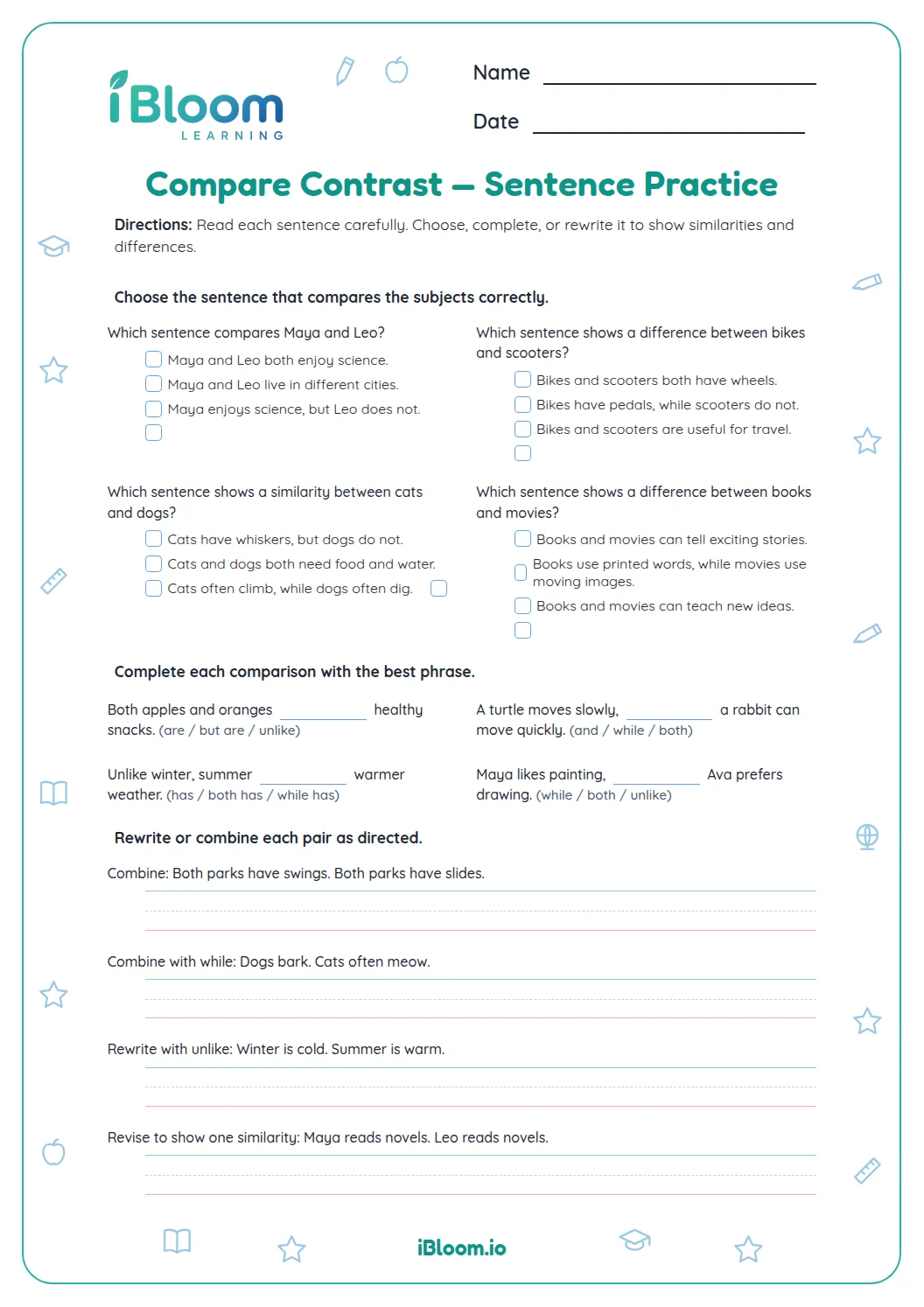
This Grade 5 worksheet uses bicycles and scooters for focused compare-and-contrast practice. Students sort similarities and differences, select linking words, complete brief comparisons, and write one sentence. The answer key includes choices and a sample response. It practices CCSS W.5.2.c by linking ideas within a comparison.
Aligned to W.5.2.c
How do students identify a similarity?
Check that a detail applies to both topics. “Both bicycles and scooters can carry people” is a similarity.
Which phrase signals a difference?
“In contrast” points readers toward a difference, while “similarly” connects alike ideas.
What belongs in a strong comparison?
Name both subjects and include a specific feature that they share or a way they differ. A linking word such as “while” helps readers follow a contrast.
How to use this worksheet at home or in class
- 1Identify the relationship between two details, then choose or write a phrase that makes the connection clear.
- 2Read each comparison statement and decide whether it describes something shared or different.
- 3Use “similarly” to connect alike ideas and “in contrast” to signal a difference.
- 4In open responses, write details that can be checked against the two topics.
- 5Make the linking phrase match the relationship between the sentences.
Common mistakes and quick fixes
The mistake
There are 12 questions in three parts: six sort statements, three linking-phrase choices and three written comparisons. The answer key includes the fixed answers and sample responses.
The fix
Reread the prompt and apply the skill rule that fits before checking the key.
The mistake
How can students extend the practice?
The fix
Reread the prompt and apply the skill rule that fits before checking the key.
The mistake
Invite students to choose two familiar forms of transportation and write a short comparison paragraph with one similarity and one contrast.
The fix
Reread the prompt and apply the skill rule that fits before checking the key.
Common Core alignment
Organize similarities and differences, then use linking words to show how ideas relate.
Link comparison ideas with phrases such as “in contrast” and “similarly.”
On this sheet: Choice and writing items use comparison transitions.
Show the official wordingHide the official wording
Link ideas within and across categories of information using words, phrases, and clauses (e.g., in contrast, especially).
What to practice next
Make more practice
Further reading
Questions parents and teachers ask
What topics do students compare?
Students compare bicycles and scooters throughout the worksheet. The shared topic keeps attention on identifying similarities, noticing differences, and connecting those ideas clearly. Ask the student to name the relationship between the details before choosing or writing a transition; the phrase should match that relationship.
How many questions are included?
There are 14 questions: six similarity-or-difference choices, two linking-phrase choices, three short completions, two detail checks, and one sentence response. The separate key gives the correct choices and a model comparison.
What is a linking phrase?
A linking phrase shows how ideas relate. “Similarly” signals a shared idea, while “in contrast” signals a difference between the two topics. Ask the student to name the relationship between the details before choosing or writing a transition; the phrase should match that relationship.
What should a comparison sentence include?
Name both subjects and give a detail that is true about both or explains how they differ. For example, a sentence can compare how many riders a bicycle and scooter carry. Ask the student to name the relationship between the details before choosing or writing a transition; the phrase should match that relationship.
Can students write different comparison answers?
Yes. The answer key gives a model, but another answer works when it accurately compares bicycles and scooters and uses a linking phrase that fits. Students can name a shared feature or a difference, then check that the sentence identifies both subjects.