



About this worksheet
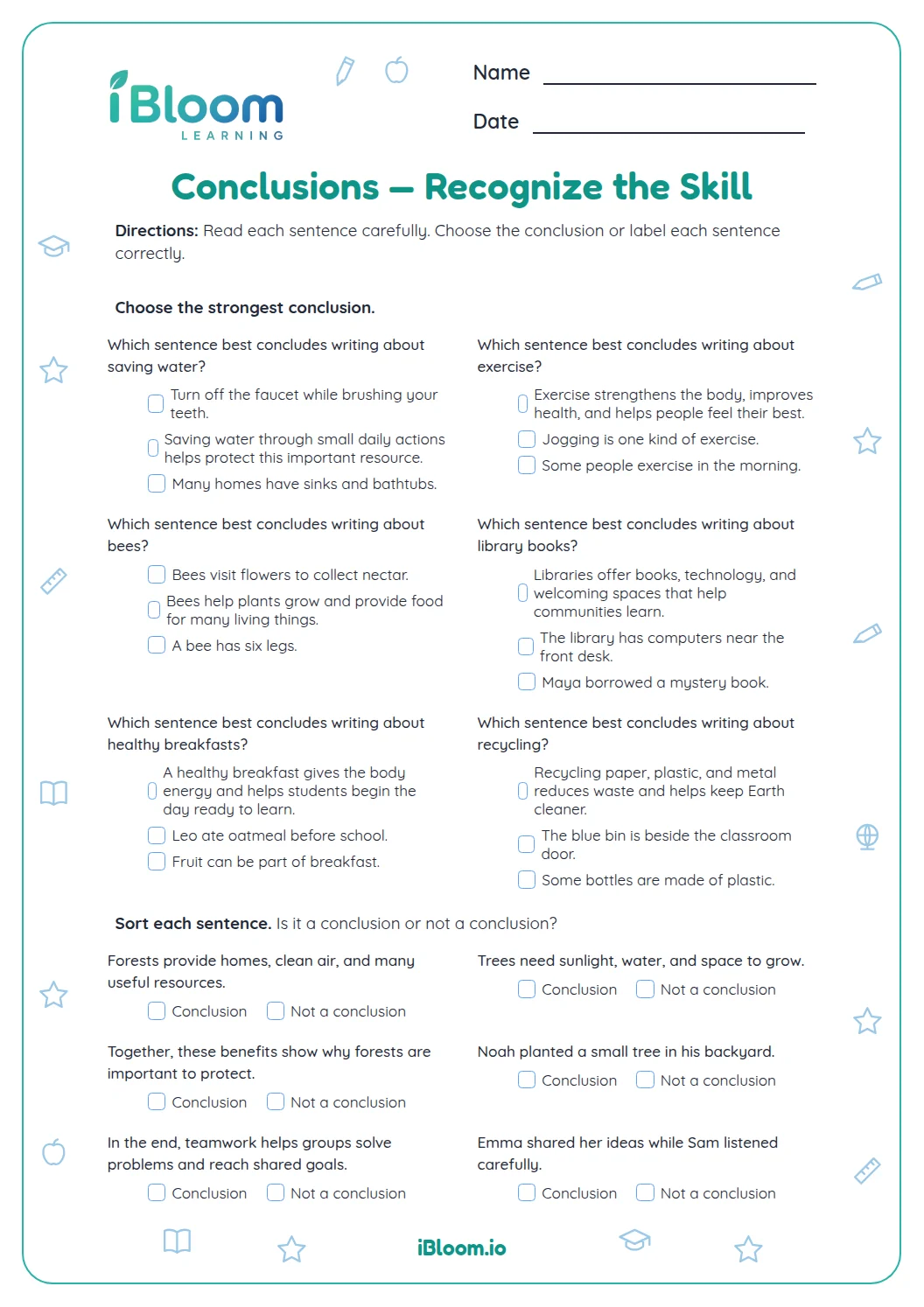
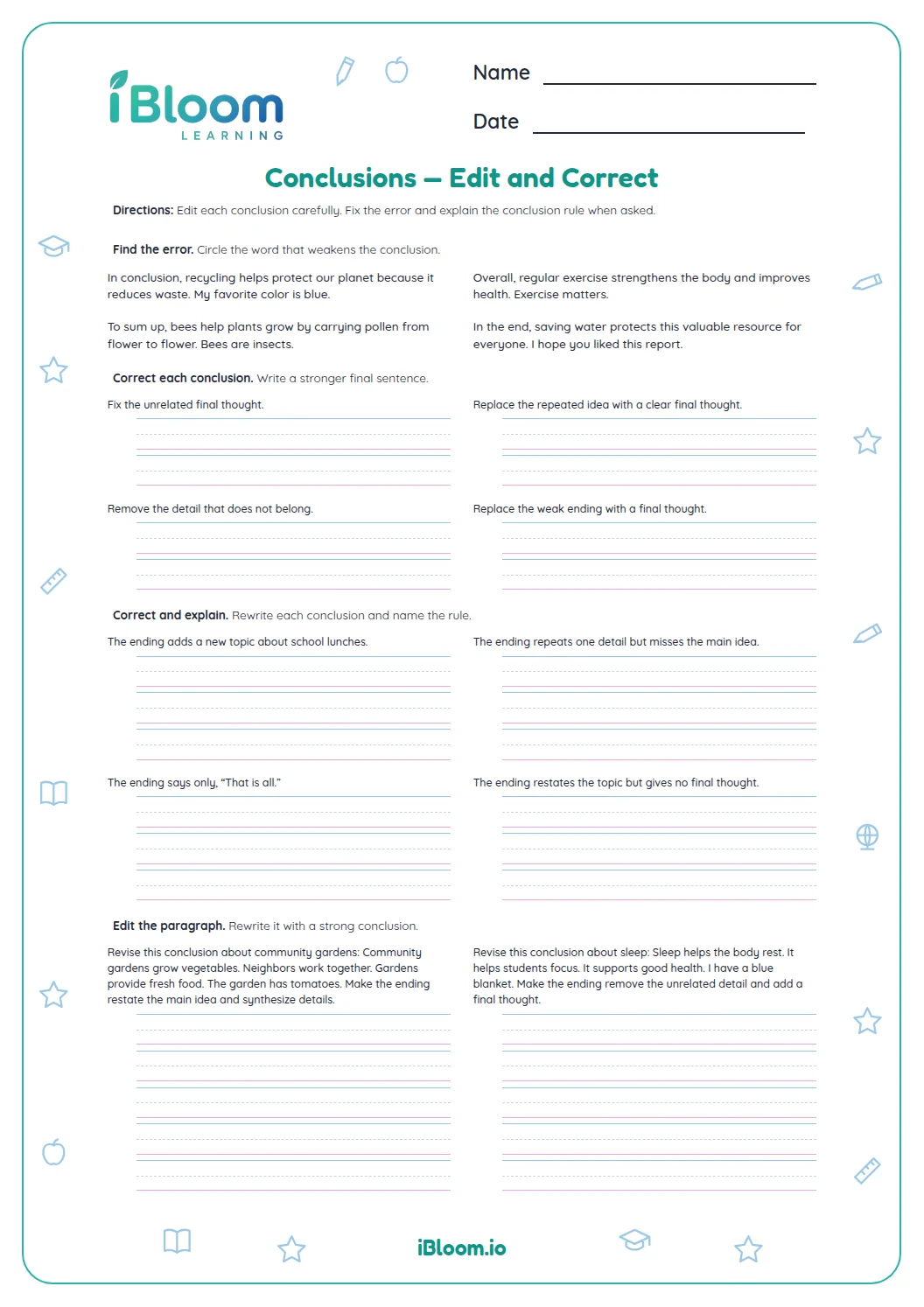
A strong conclusion connects to the information already presented and gives the writing a clear ending. This Grade 5 sheet moves from choosing relevant endings to completing and writing conclusions about topics such as gardens, recycling, and trees. The key includes sample responses when more than one conclusion can work.
Aligned to W.5.2.e
What conclusion skills do the parts practice?
A strong conclusion connects to the information already presented and gives the writing a clear ending. This Grade 5 sheet moves from choosing relevant endings to completing and writing conclusions about topics such as gardens, recycling, and trees. The key includes sample responses when more than one conclusion can work.
- 1Complete: “Recycling paper saves trees. For this reason, ___.”
- 2Sample: Recycling paper is one way people can help conserve forests.
What conclusion skills do the parts practice?
Part A distinguishes connected endings from unrelated ideas. Part B completes conclusion sentences, and the final items ask learners to write original closing thoughts tied to the topic.
How can a writer check a conclusion?
Reread the topic and the information before it. The final sentence should connect to those ideas, use a complete thought, and leave the reader with a sense of closure.
How to use this worksheet
- 1Read the topic and the information before the blank.
- 2Choose or write an ending connected to those ideas.
- 3Make sure the ending is a complete thought.
- 4Remove details that introduce a new topic or simply repeat a phrase.
- 5Check open responses against the key’s sample and revise for clarity.
Common mistakes and quick fixes
The mistake
Adding an interesting detail that changes the topic.
The fix
Check that the ending refers to the subject and information already introduced.
The mistake
Leaving a sentence fragment as the final thought.
The fix
Read the completion aloud and make sure it expresses a complete idea.
The mistake
Repeating the topic without giving closure.
The fix
Add what the information shows or why it matters to the topic.
Common Core alignment
Provide a concluding statement or section related to the information or explanation presented.
On this sheet: Sixteen guided choices and completions practice relevant, connected endings for informative writing.
Show the official wordingHide the official wording
Provide a concluding statement or section related to the information or explanation presented.
What to practice next
Make more practice
Further reading
Questions parents and teachers ask
Is an answer key included?
Yes. The answer key provides the selected answers and sample completions for open writing prompts. Use the samples to check that each response connects to the topic and forms a complete conclusion. Ask the writer to reread the topic and explain how the final thought connects to the information and brings the writing to a close.
How should the learner check an answer?
A strong ending stays connected to the information and gives the reader a clear final thought. On this sheet, learners practice choosing relevant endings and writing their own conclusions. Ask the writer to reread the topic and explain how the final thought connects to the information and brings the writing to a close.
Can this be used for independent practice?
Yes. The worksheet has multiple-choice items, guided sentence completions, and original writing prompts. A learner can attempt each part independently and compare open responses with the sample key. Ask the writer to reread the topic and explain how the final thought connects to the information and brings the writing to a close.
What materials are needed?
A pencil and the printed worksheet are enough. The final prompts provide writing lines for completing or composing conclusions. Ask the writer to reread the topic and explain how the final thought connects to the information and brings the writing to a close.
How long does it take?
Plan for about 25 minutes. Selecting answers is quick; writing original conclusions and reviewing whether each one connects to its topic takes more time. Ask the writer to reread the topic and explain how the final thought connects to the information and brings the writing to a close.