



About this worksheet
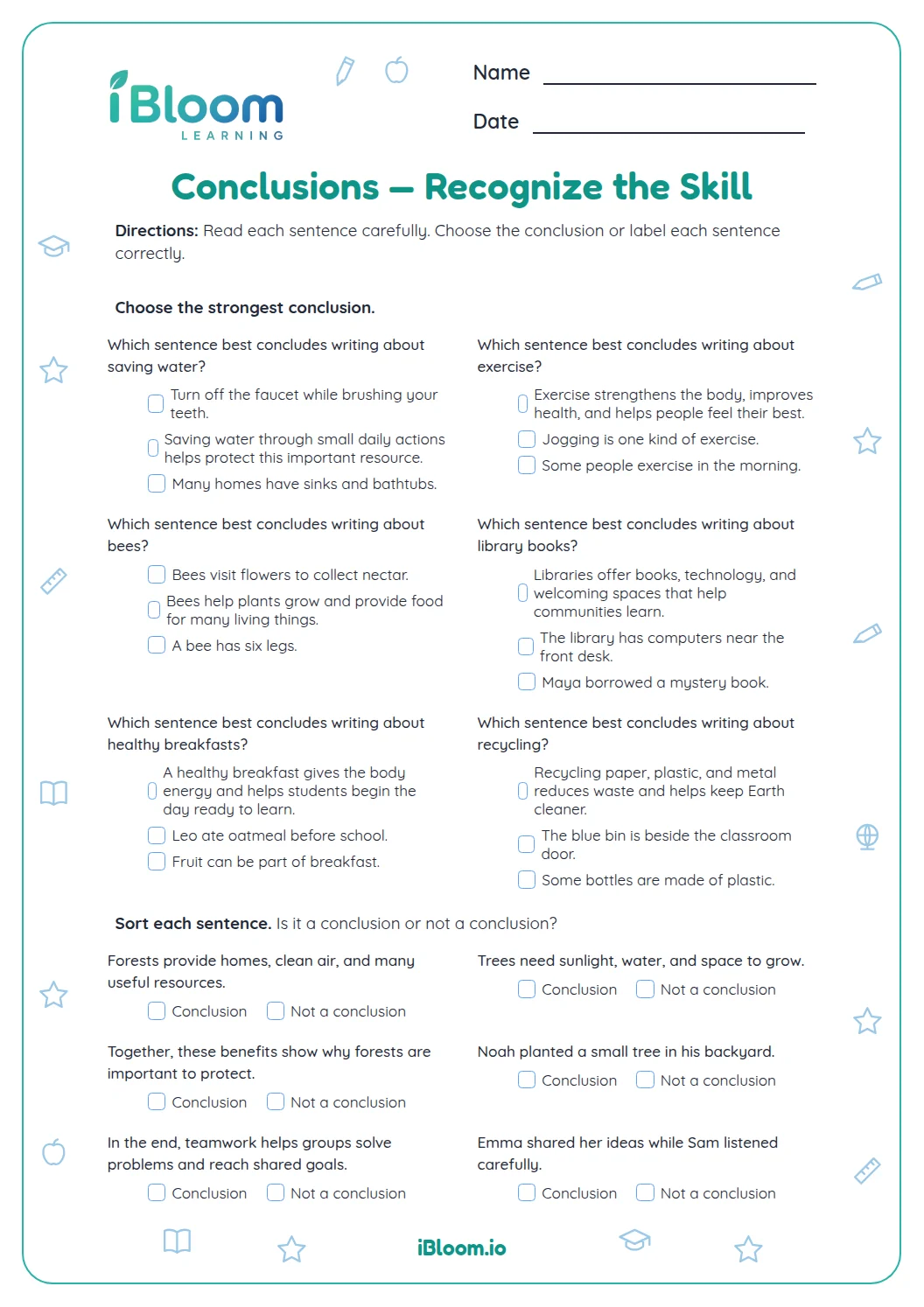
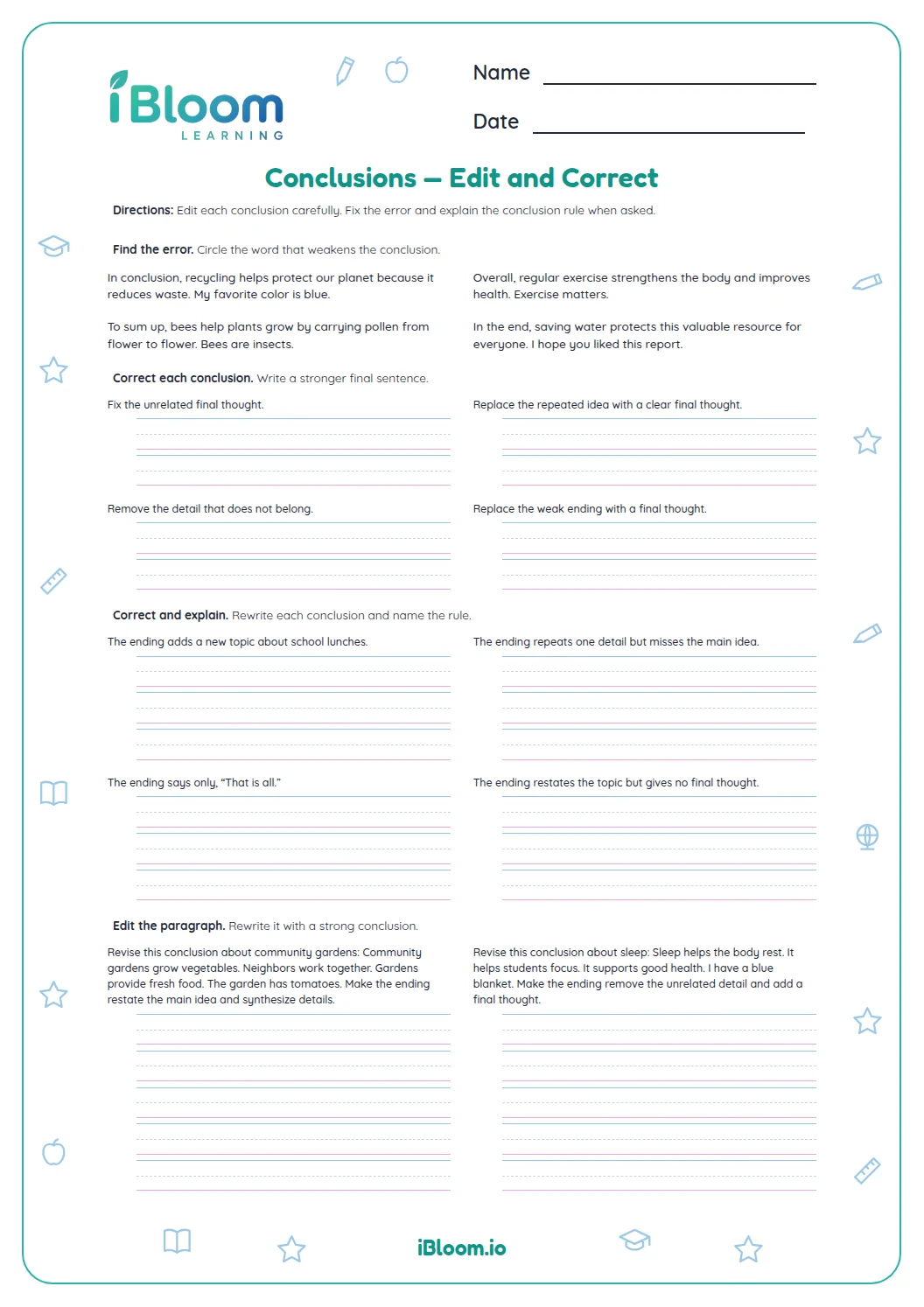
This Grade 5 worksheet gives students 16 opportunities to evaluate and write conclusions for informative essays. They choose endings that connect to an essay’s ideas, identify unrelated or unsupported details, revise a weak ending, and write original final sentences. The separate answer key includes sample responses for writing tasks with more than one sound answer.
Aligned to W.5.2.e
What makes an informative conclusion effective?
A strong conclusion closes the discussion and relates to the information already presented. It may restate the main idea in fresh words or explain why the facts matter. It should not start a new section or introduce an unrelated detail.
- 1An essay about pollinator gardens can close by linking gardens to healthy plant growth. “Bees have six legs” is true, but it does not wrap up that topic.
How can you repair a weak ending?
Replace a disconnected fact with a sentence that brings the essay’s focus back. A stronger ending for “Compost is brown” could explain how compost turns scraps into useful soil and reduces waste.
How can you check a final sentence?
Ask whether the sentence connects to the essay’s central information, sounds complete, and gives a sense of closure. A supported claim about saving energy stays focused; promising to fix every climate problem goes beyond the evidence.
How to use this worksheet
- 1Read the essay topic in the question before judging its ending.
- 2Check whether the sentence wraps up the topic or adds a fresh fact.
- 3Look for a clear connection to details already discussed.
- 4When revising, restate the main idea in new words.
- 5Use the answer key to compare open responses with the sample idea.
Common mistakes and quick fixes
The mistake
Choosing any true fact as a conclusion.
The fix
A true detail still needs to connect the essay’s main idea and close the discussion.
The mistake
Repeating the first sentence word for word.
The fix
Restate the central point in fresh language or show why it matters.
The mistake
Making a final claim bigger than the essay’s evidence.
The fix
Keep the ending proportionate to the facts and explanations presented.
Common Core alignment
Students practice writing a concluding statement related to information already presented.
Students evaluate and write final statements that relate to the essay’s information.
On this sheet:
Show the official wordingHide the official wording
Provide a concluding statement or section related to the information or explanation presented.
What to practice next
Make more practice
Further reading
Questions parents and teachers ask
What makes an informative conclusion strong?
It connects to the essay’s main information and gives the reader a sense that the explanation is complete. The worksheet asks students to recognize fitting endings, spot new or unrelated details, and revise weak conclusions before writing final sentences of their own.
How many items are in the review?
There are 16 questions in three parts: nine multiple-choice choices, three completions, and four short or written responses. The answer key includes sample conclusions for the open-ended writing tasks, where more than one sentence can work. The examples span topics such as gardens, water, libraries, and compost.
Why is “Honeybees also have five eyes” a weak ending here?
It adds a fact about bees but does not bring an essay about bees’ importance to a close. A stronger final sentence would connect pollinators to plants, crops, or another idea already explained in the essay. The conclusion should bring attention back to the essay’s central message.
How can a writer revise “Compost is brown”?
Bring the sentence back to the essay’s central point. For example, a conclusion could explain that compost turns food scraps into useful soil and helps reduce waste, leaving the reader with the purpose of composting. This keeps the final thought connected to the explanation.
Can a conclusion introduce a new fact?
A final sentence should mainly wrap up the information the essay has already presented. A new fact may distract readers from the main idea, so the worksheet asks students to identify and replace that kind of ending with a relevant close.