





About this worksheet
This Grade 5 worksheet helps students apply one important part of informative writing: ending with a statement that follows from the information. Children first compare possible endings, then write their own sentence from short sets of notes. The examples cover school gardens, pollination, water use, maps, and other familiar topics. The practice aligns with Common Core W.5.2.e, which asks writers to provide a conclusion related to the information or explanation. The answer key includes sample responses for the open-ended items.
Aligned to W.5.2.e
What will students do on the sheet?
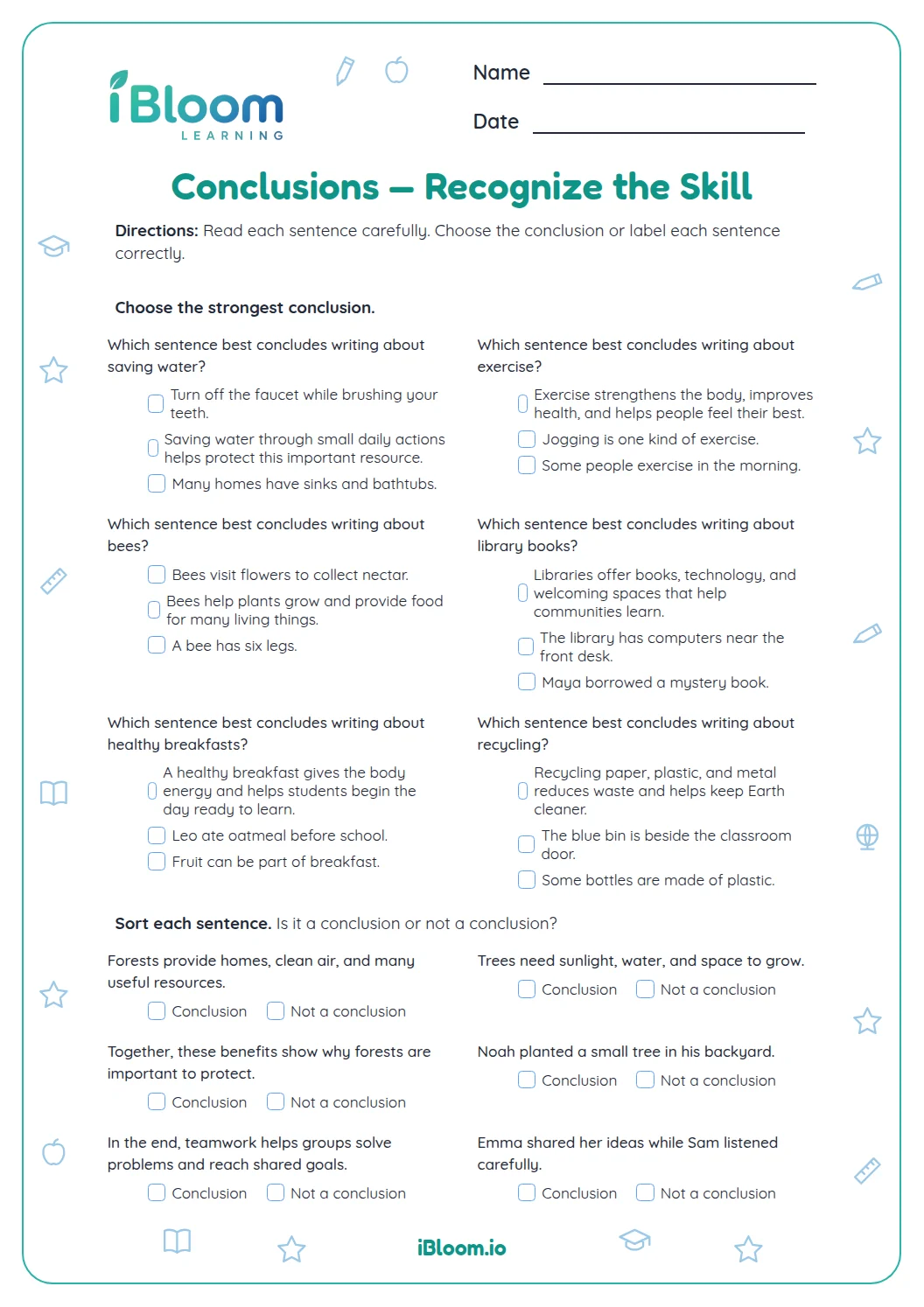
The first items compare a useful ending with sentences that merely repeat a detail, shift topics, or address the reader. In the second part, students turn notes into a concluding statement.
- Choose an ending connected to the facts.
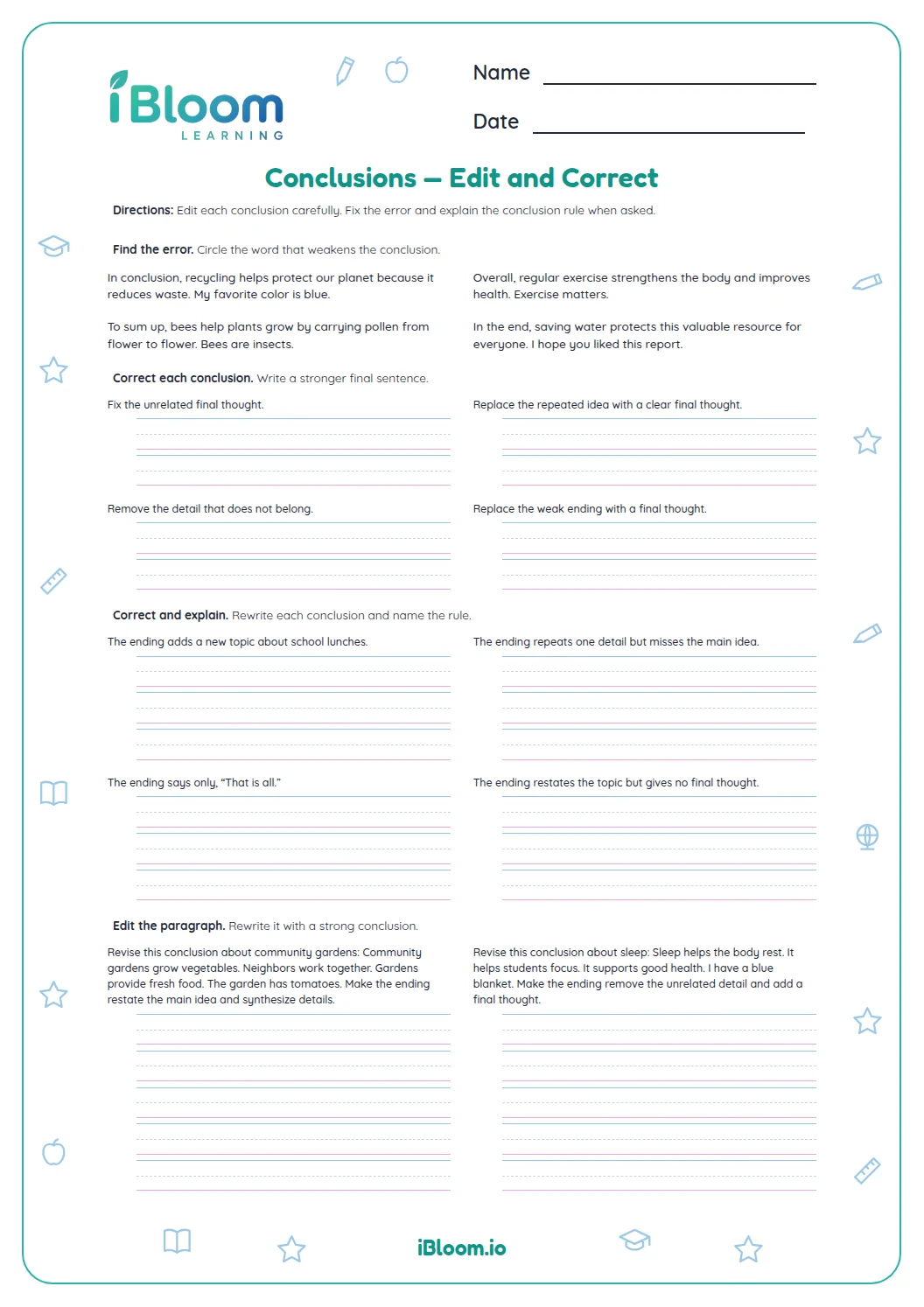
- Write one sentence from a small set of notes.
- Keep the subject steady through the final line.
What makes a conclusion fit?
A conclusion reminds the reader of the information’s main point. It does not add a surprising new fact or begin a different subject.
- 1Notes: A rain barrel collects roof runoff. Gardeners use it during dry weeks.
- 2Sample conclusion: A rain barrel helps gardeners save collected rainwater for dry weeks.
How can a student improve a draft ending?
Compare the ending with the notes. Keep the central idea, combine related details, and remove a new topic that the paragraph has not explained.
How to use this worksheet
- 1Read all of the notes before writing.
- 2Name the main idea shared by those details.
- 3Write one sentence that wraps up that idea.
- 4Check that each part of the sentence connects to the notes.
- 5Remove a new fact or question that opens another topic.
Common mistakes and quick fixes
The mistake
Copying one detail as the whole conclusion.
The fix
Connect the detail to the paragraph’s broader point.
The mistake
Adding a new fact at the end.
The fix
Use information already introduced in the notes.
The mistake
Ending with a question to the reader.
The fix
State what the details show instead.
Write an ending that gathers the informative details without changing the topic.
On this sheet:
Show the official wordingHide the official wording
Provide a concluding statement or section related to the information or explanation presented.
What to practice next
Make more practice
Questions parents and teachers ask
Does a conclusion repeat every fact?
No. A conclusion brings together important information and reminds the reader of the main point. It does not need to list every supporting detail again. Students can use fresh wording while keeping the ending connected to what the paragraph explained and the facts already presented.
Can a conclusion use new wording?
Yes. A writer can restate the main idea in different words so the ending sounds complete rather than copied. Keep the same topic and meaning, using facts already introduced as support. Fresh wording should still make it clear how the details fit together.
What makes an ending unrelated to the paragraph?
An ending is unrelated when it introduces a different topic, gives a new detail the paragraph did not explain, or asks the reader a question instead of wrapping up. Compare the final sentence with the notes to see whether it connects to the information.
What does the answer key show for writing items?
The key provides a sample conclusion for each set of notes. Students may write a different sentence when it restates the central information clearly, follows from the details, and does not begin a new subject. The sample is a guide to the skill.
What makes a conclusion fit an informative paragraph?
A fitting conclusion returns to the paragraph’s main idea and connects its details into a final thought. It does not introduce a new topic. The final questions ask students to write endings from short sets of facts, then review whether the ending stays connected.