
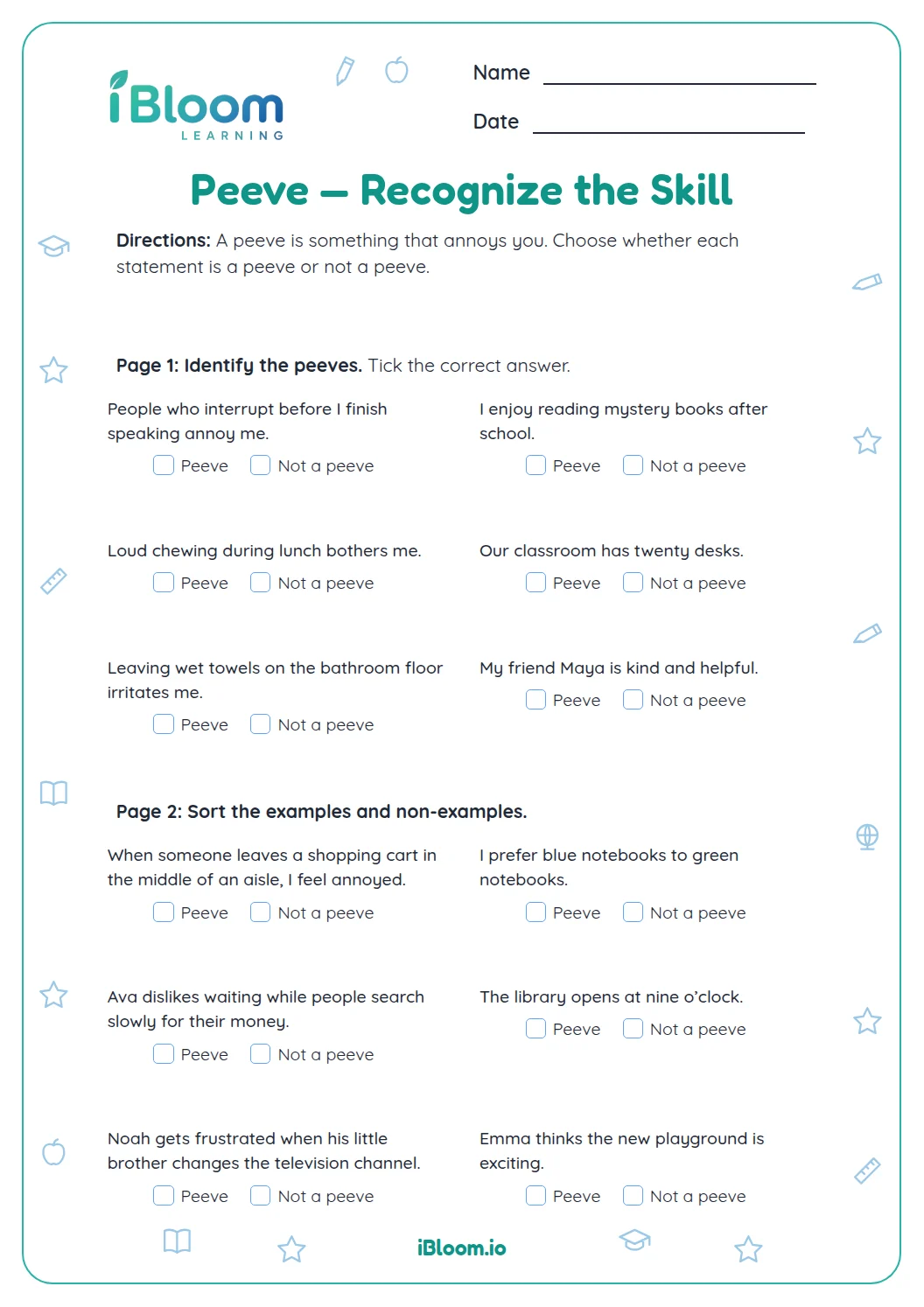

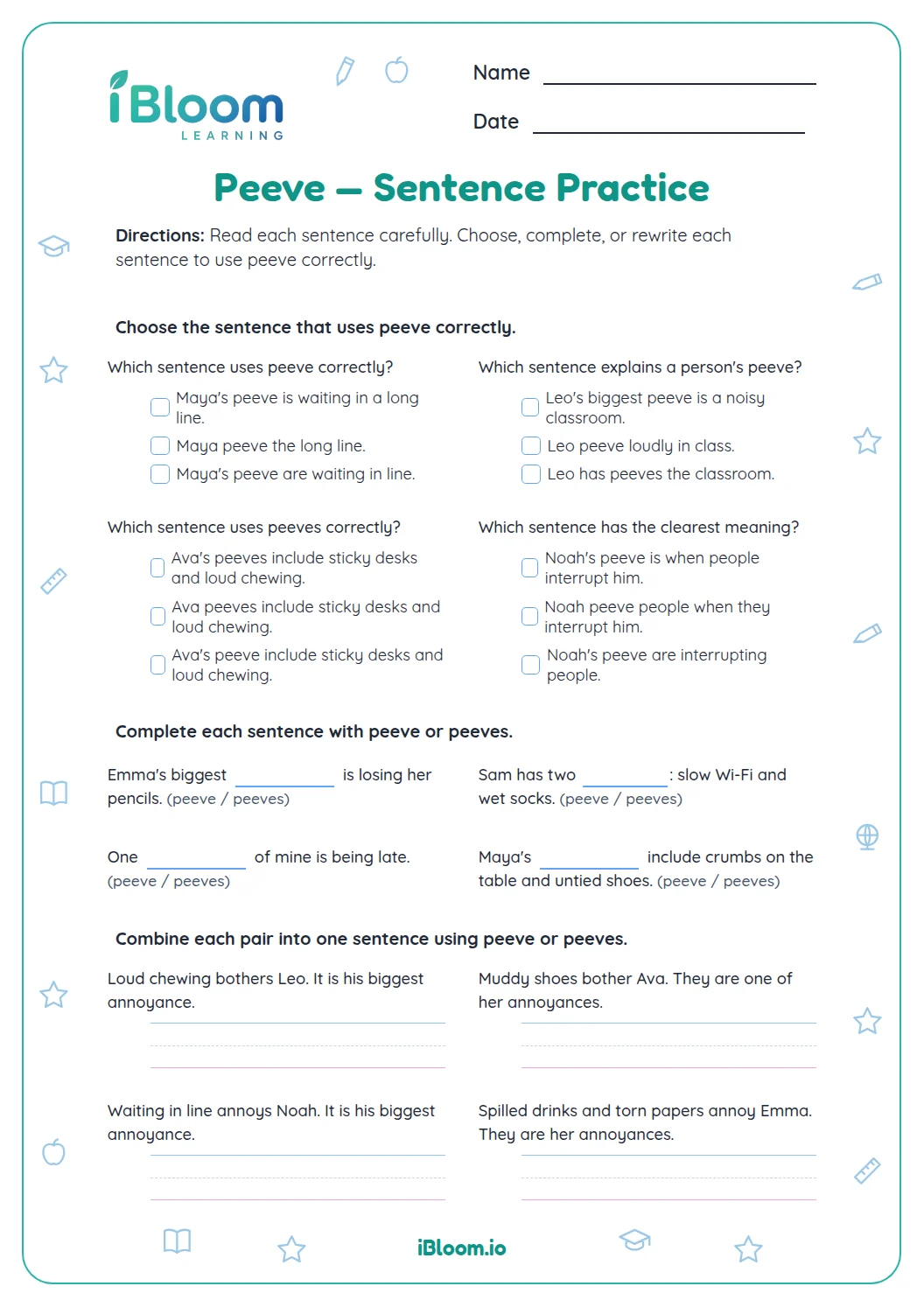
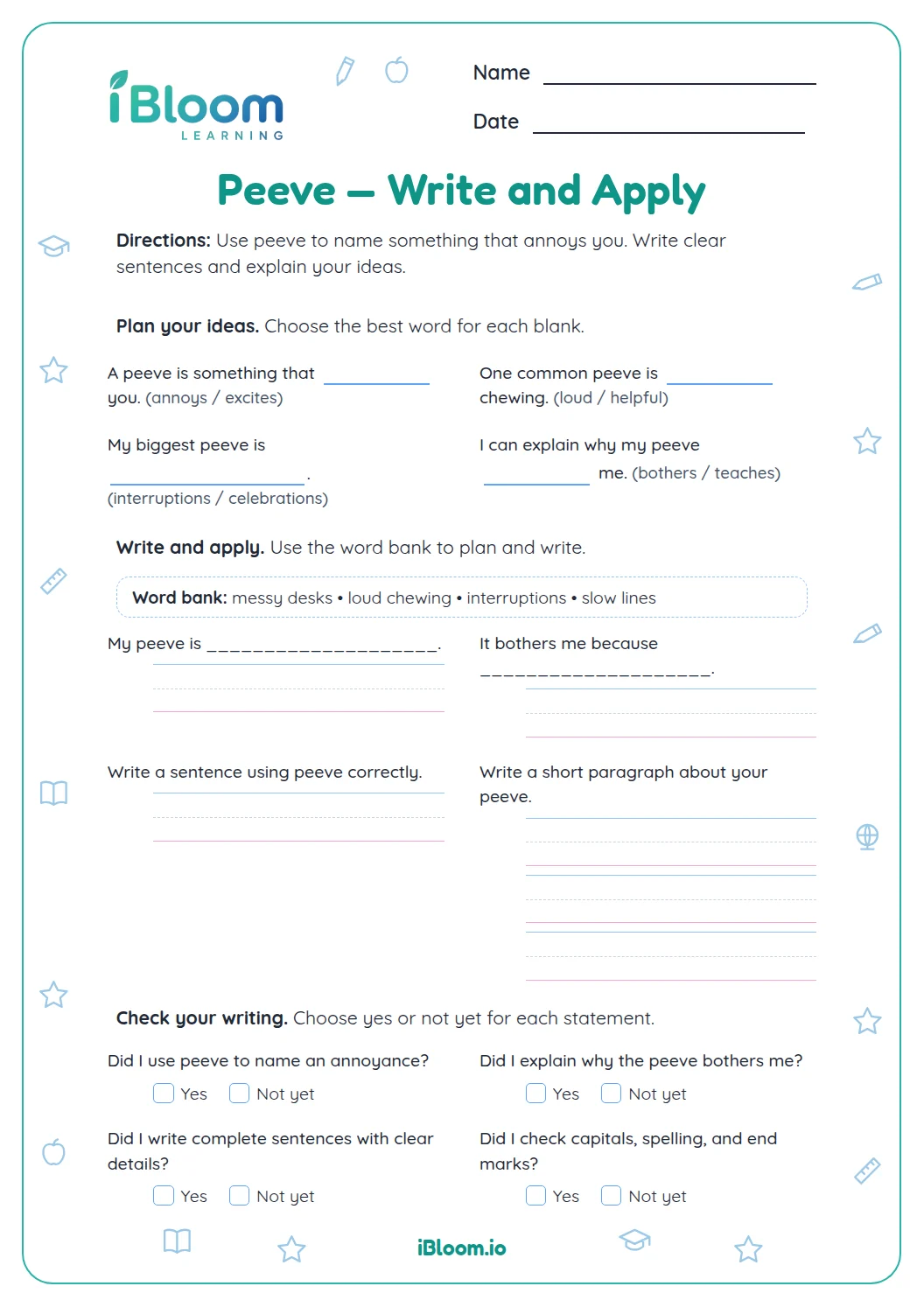

About this worksheet
This free Grade 5 printable gives students focused practice editing sentences about pet peeves. The 14 questions move from word choice, spelling, agreement, and punctuation to clearer sentence revisions and a short paragraph edit about Leo. Each item has a compact answer choice, so students can concentrate on spotting the error and choosing a clean correction. The page supports Common Core W.5.5 and L.5.2 by asking students to edit and rewrite for standard English conventions. A separate answer key lists the correct choices.
Aligned to W.5.5 and L.5.2
What does this worksheet ask students to edit?
The first ten questions target sentence-level edits: subject-verb agreement, spelling, end punctuation, and a connector that states how two ideas relate. The final four work through Leo’s paragraph one sentence at a time, so students check capitalization and verb agreement in connected writing.
The answer choices keep the page compact while still asking students to notice the error and select a complete correction.
How can a student spot an agreement error?
Find the subject first, then check that the verb matches it. A plural subject such as “people” takes “arrive,” while “my brother” takes “leaves.” Read the whole corrected sentence to be sure the meaning still makes sense.
- 1Prompt: “Sam ___ not like loud chewing.”
- 2Correct choice: “does”
- 3“Sam” is singular, so use “does not.”
Why edit one sentence at a time?
A paragraph can hide several small errors because the reader is following the idea. Checking each sentence for capitals, subject-verb agreement, and punctuation makes the proofread manageable. The four Leo questions follow the same paragraph, so the edits build on one context.
How to use this worksheet
- 1Read each sentence aloud once before choosing an edit.
- 2Underline the subject when checking a verb such as “do” or “leave.”
- 3Check the first word and final mark for capitalization and punctuation.
- 4For question 9, look for two complete thoughts joined only by a comma.
- 5Use the key to review each choice and name the correction rule.
Common editing mistakes and quick fixes
The mistake
Matching a verb to the nearest noun instead of the subject.
The fix
Find the sentence subject first: “people arrive,” while “brother leaves.”
The mistake
Choosing a connector without checking how the ideas relate.
The fix
Question 9 asks for the reason: “because” links waiting with impatience.
The mistake
Correcting Leo’s grammar but leaving the first word lowercase.
The fix
Check every sentence opening for a capital letter after the meaning edit.
Common Core alignment
These Grade 5 writing and language standards connect editing choices to clear, conventional writing.
Revise and edit writing with guidance to strengthen it.
On this sheet: Students edit sentences and a connected paragraph for correctness and clarity.
Show the official wordingHide the official wording
With guidance and support from peers and adults, develop and strengthen writing as needed by planning, revising, editing, rewriting, or trying a new approach. (Editing for conventions should demonstrate command of Language standards 1-3 up to and including grade 5 here.)
Use standard capitalization, punctuation, and spelling when writing.
On this sheet: Questions address capitalization, end punctuation, and grade-level spelling.
Show the official wordingHide the official wording
Demonstrate command of the conventions of standard English capitalization, punctuation, and spelling when writing.
What to practice next
Make more practice
Further reading
Questions parents and teachers ask
How many questions are on the Peeve worksheet?
There are 14 multiple-choice edits. Ten questions focus on individual sentences, including spelling, agreement, punctuation, and clarity; four questions edit one sentence at a time in Leo’s paragraph. The answer key gives the corrected word or full sentence for every item.
What kinds of mistakes does the worksheet include?
Students check subject-verb agreement, spelling, capitalization, end punctuation, and a comma splice. They also choose a clearer revision that keeps the original idea. Because the examples all concern pet peeves, students can focus on editing rather than figuring out a new topic.
Does the worksheet ask students to write a full paragraph?
No. Students edit Leo’s paragraph through four compact sentence choices instead of copying a long passage. This keeps the proofreading focused and shows how capitalization and verb agreement work in connected writing. The key gives a model edit for every sentence.
How should students check subject-verb agreement?
First identify who or what the sentence is about, then compare the verb to that subject. In question 8, “Sam” is one person, so the correct phrase is “does not like.” In question 12, “people” is plural, so they “talk” loudly.
What is the answer to question 9?
The reason word is “because”: “I dislike waiting because it makes me impatient.” The prompt asks students to join the ideas by showing why waiting bothers the speaker. “And” adds an idea but does not state the cause as clearly as “because.”