







About this worksheet
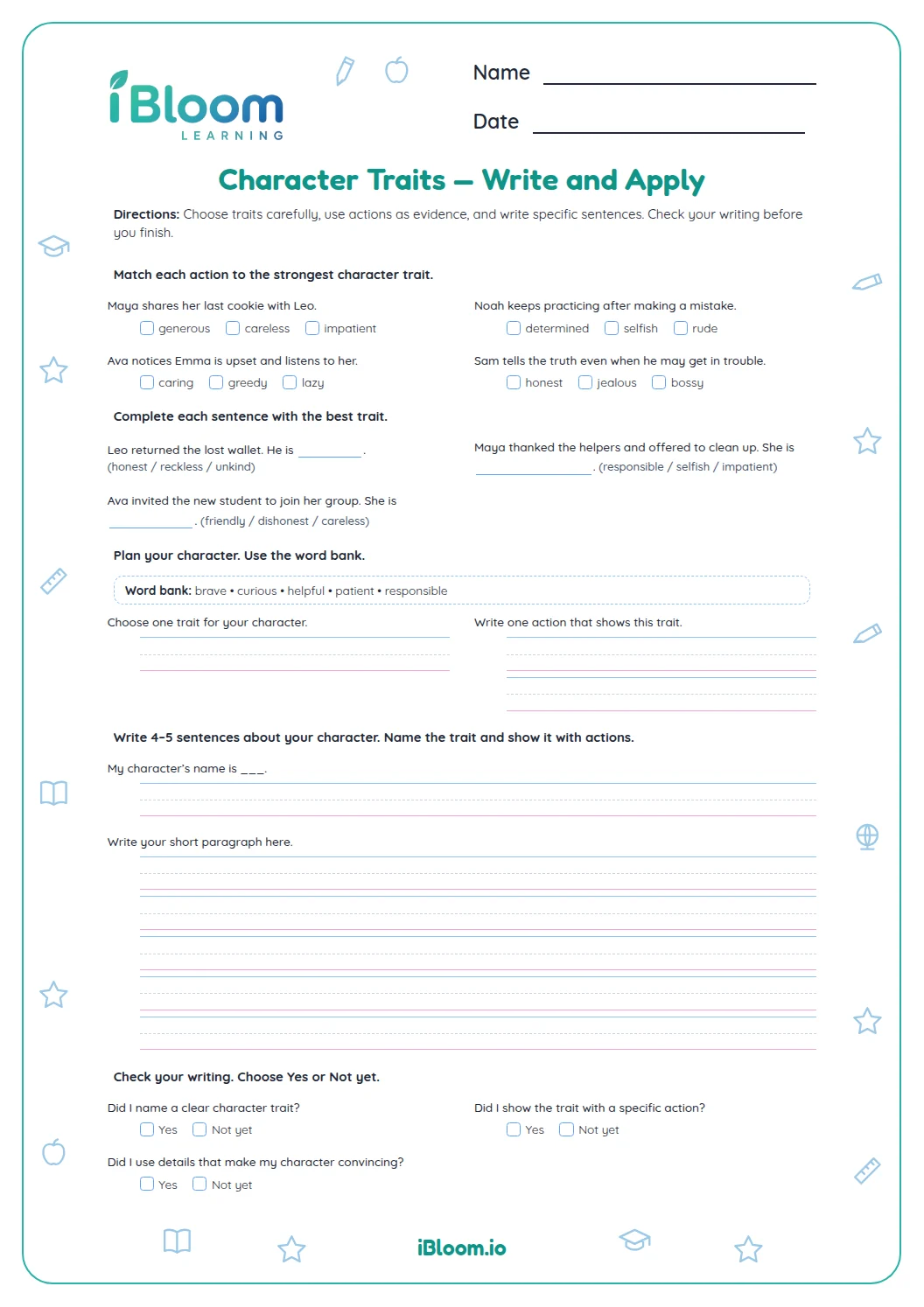
This free printable Grade 5 worksheet helps students infer character traits from actions and dialogue, then show traits through writing. Its 14 questions move from trait inference to evidence-based explanations and original character moments. The work practices CCSS RL.5.1 by using details to draw inferences. The separate key includes sample responses for open-ended items.
Aligned to RL.5.1
What will learners practice in character traits?
The two parts move from inference to application. Part A asks students to infer a trait from an action or thought. Part B asks them to connect a trait to evidence or reveal it through a character’s words and actions.
- 1Question 3: Nora quietly returns a lost wallet without being asked. What trait does she show?
- 2Honest: returning the wallet is evidence that she tells the truth and does what is right.
- Infer a trait
- Explain with evidence
How can learners work through character traits?
The two parts move from inference to application. Part A asks students to infer a trait from an action or thought. Part B asks them to connect a trait to evidence or reveal it through a character’s words and actions.
- 1Question 3: Nora quietly returns a lost wallet without being asked. What trait does she show?
- 2Honest: returning the wallet is evidence that she tells the truth and does what is right.
How can an adult support this character traits practice?
Look at what the character says, chooses, or does. For example, returning a lost wallet without being asked supports the trait honest. Students should name the trait and point to the action that led them to that idea.
How to use this worksheet
- 1Read the character’s action or words carefully.
- 2Choose a trait that fits the detail, not just the situation.
- 3For open responses, name the trait and quote or describe the evidence.
- 4When writing, show the trait through a specific choice or line of dialogue.
- 5Compare with the key and accept another trait when its evidence is convincing.
Common mistakes and quick fixes
The mistake
Naming a feeling instead of a lasting trait.
The fix
Ask what the action suggests about the character’s usual qualities.
The mistake
Naming a trait without evidence.
The fix
Point to the exact action or words that support the inference.
The mistake
Writing the trait word instead of showing it.
The fix
Replace the label with a choice, action, or line of dialogue.
Common Core alignment
This worksheet gives students focused practice with the writing work named in this standard.
Use details from a character’s words and actions to draw an inference.
On this sheet: Questions infer traits from characters’ actions, dialogue, and choices.
Show the official wordingHide the official wording
Quote accurately from a text when explaining what the text says explicitly and when drawing inferences from the text.
What to practice next
Make more practice
Further reading
Questions parents and teachers ask
What does the character traits worksheet ask students to do?
Students infer traits from actions and dialogue, then explain how details support a trait. Later prompts ask them to show traits through dialogue or specific actions. The key gives examples; another reasonable answer works when the evidence supports it. Invite students to connect each answer to the exact actions or words in the prompt.
How many questions and pages are included?
The printable has 14 questions in two parts. The worksheet is three pages, and its answer key is three pages. Part A focuses on inference; Part B asks students to connect a trait to evidence or reveal it through writing.
What is a good way to infer a character trait?
Look at what the character says, chooses, or does. For example, returning a lost wallet without being asked supports the trait honest. Students should name the trait and point to the action that led them to that idea. Invite students to connect each answer to the exact actions or words in the prompt.
Can students use a trait word that differs from the key?
Yes, when the word fits the evidence in the prompt. A response such as diligent or careful may both fit a character who labels seed packets and records changes. Ask the student to cite the detail that makes the trait reasonable.
How long might this worksheet take?
Plan for about 20 minutes, with extra time for the writing prompts. Students can answer the multiple-choice items first, then draft short dialogue or actions that reveal a trait. The included key offers sample responses for open-ended items. Invite students to connect each answer to the exact actions or words in the prompt.