







About this worksheet
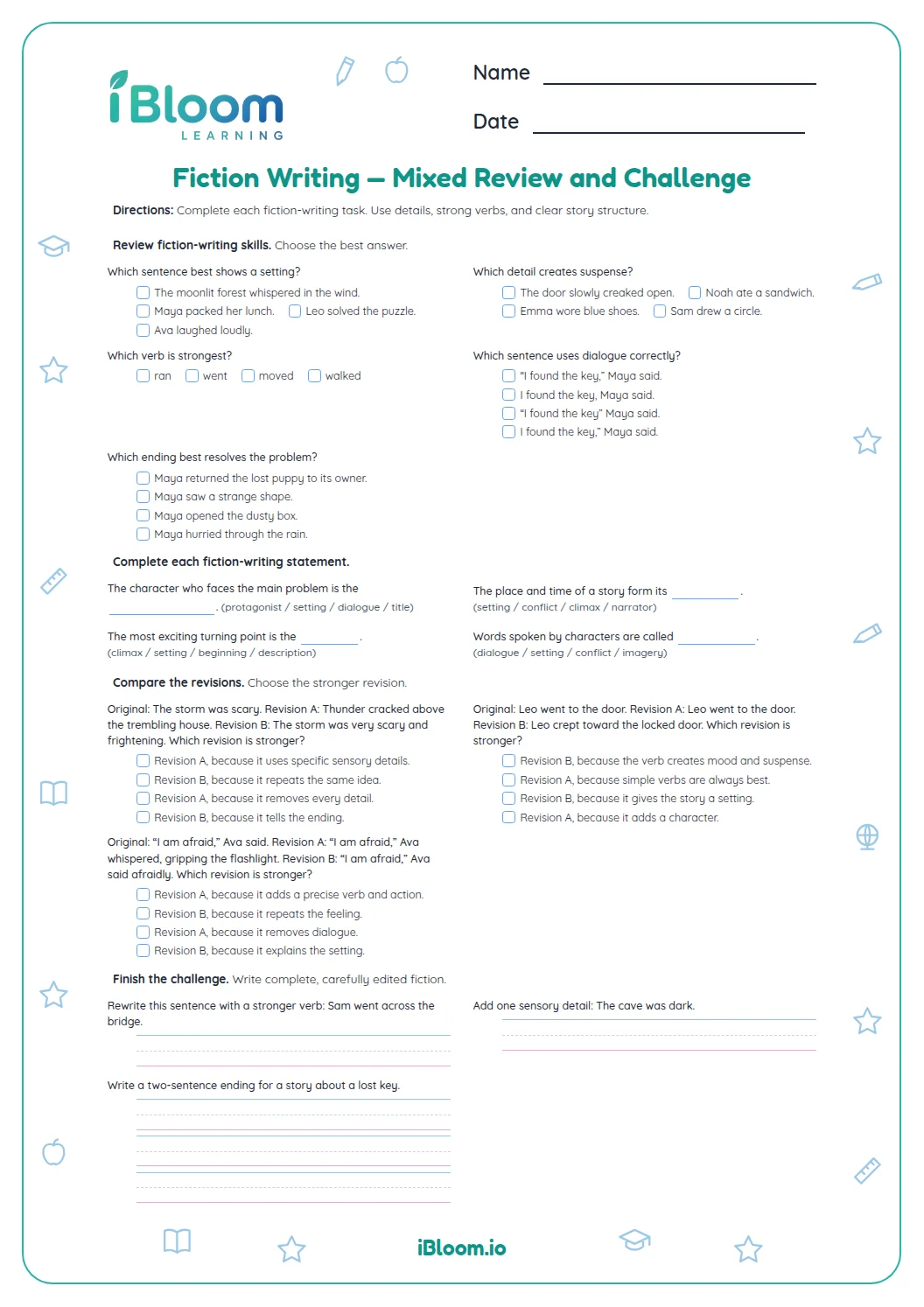
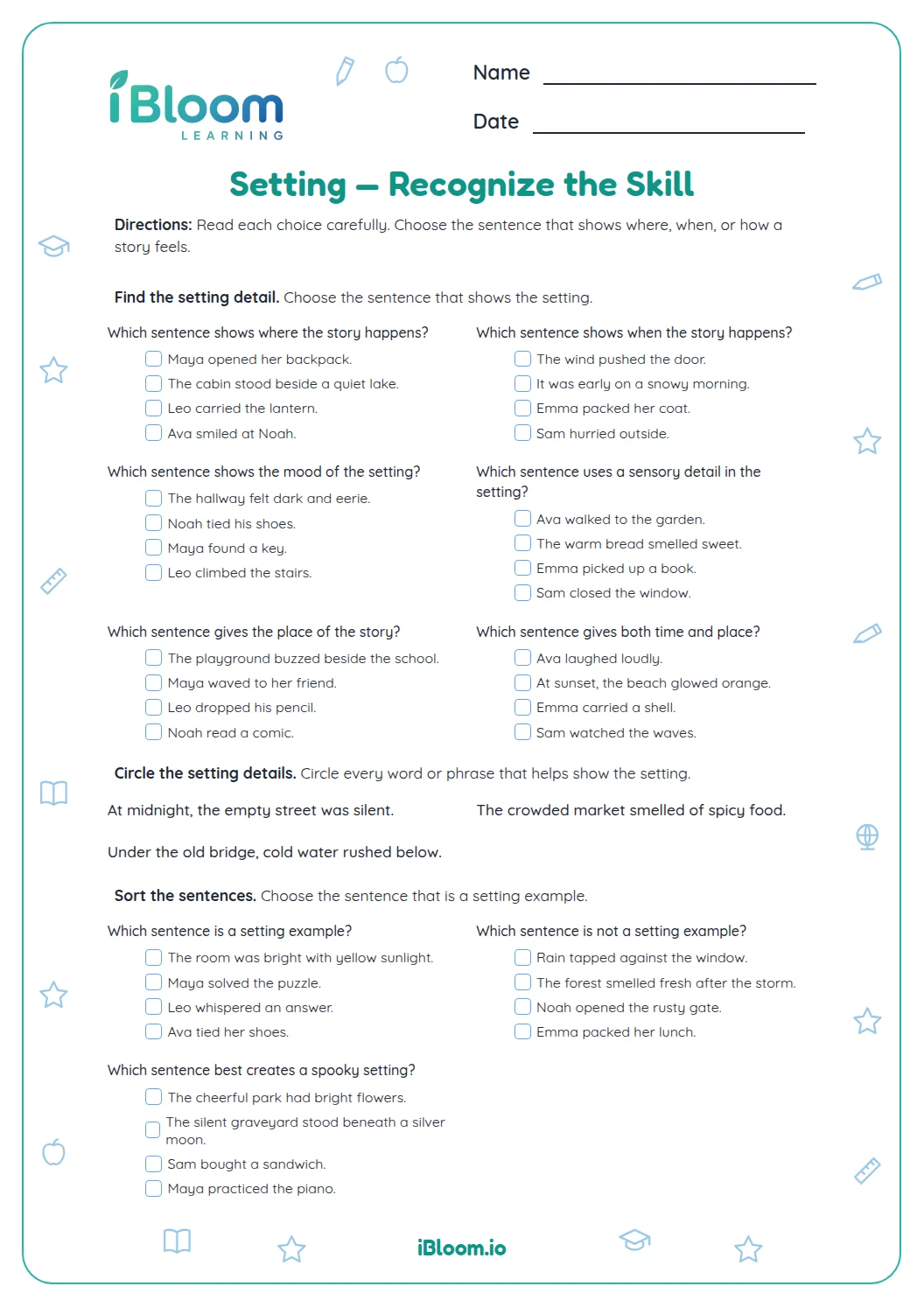
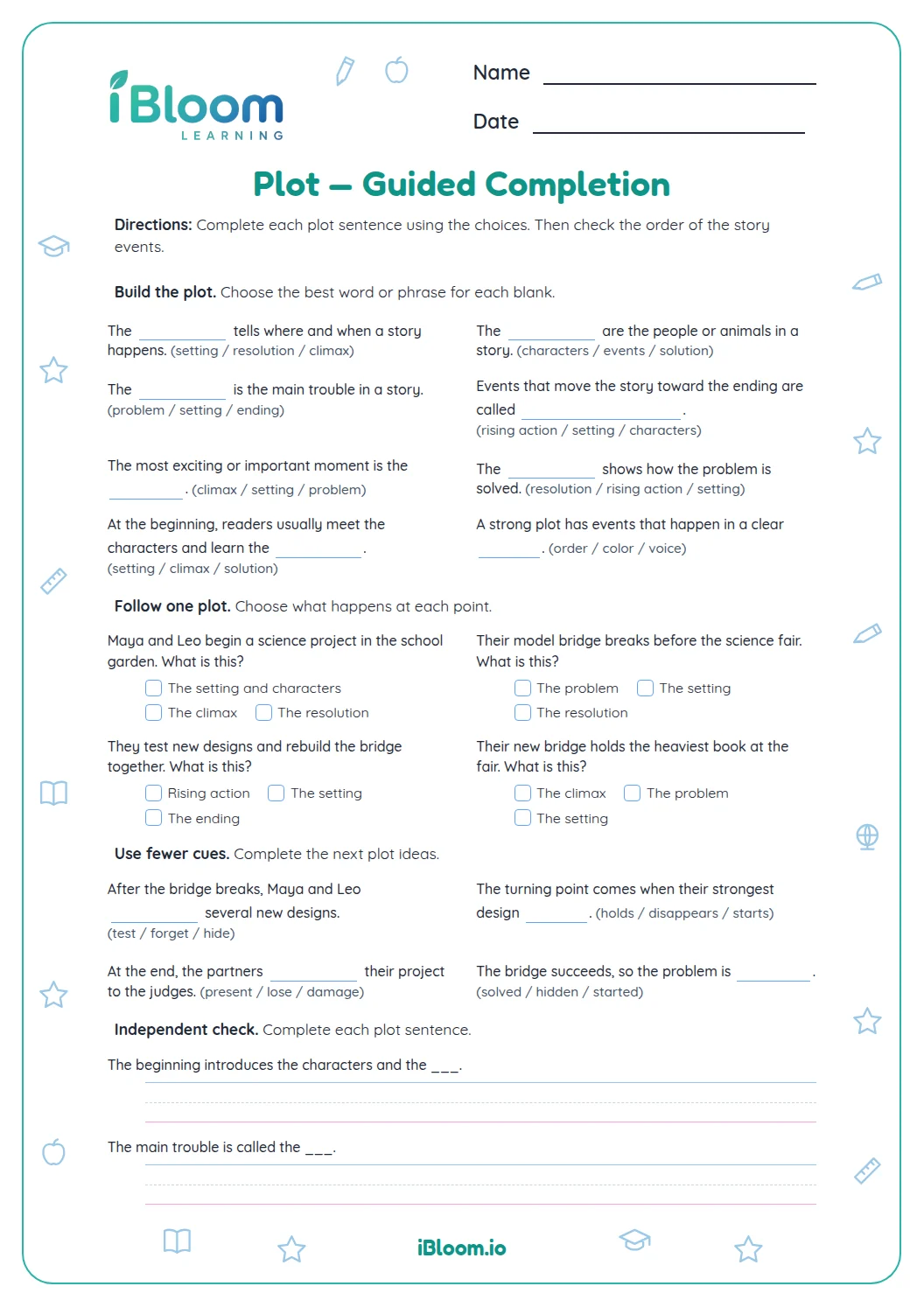
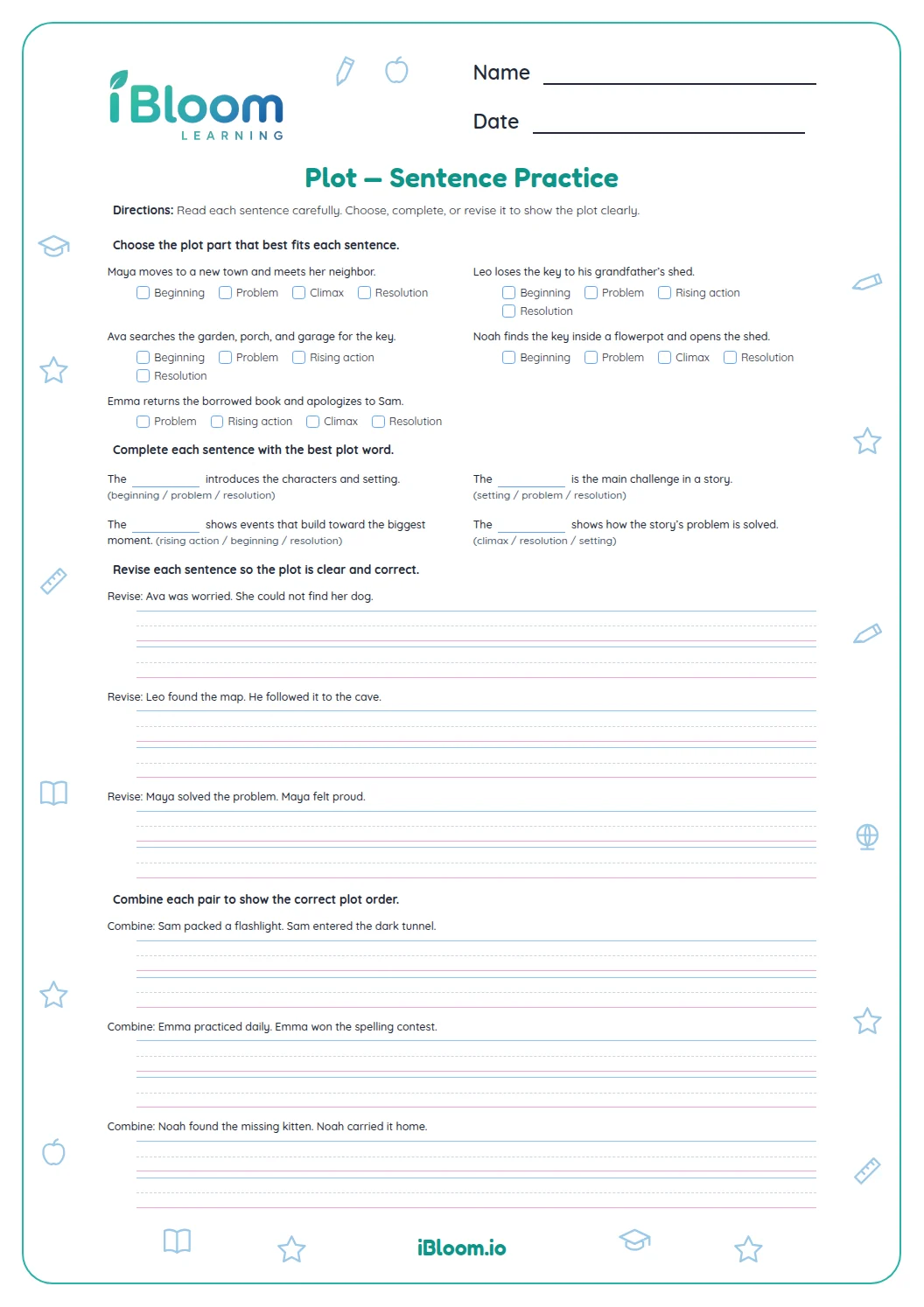
This free Grade 5 fiction writing worksheet gives students 14 short questions about how stories work. Part A focuses on character, setting, goals, and story problems; Part B follows event sequence, point of view, transitions, and concrete details. The separate answer key supports quick checking.
Which details build a fictional story?
Fiction has characters and events created by a writer. The events may be realistic, like missing a bus, or imaginary, like a moving mountain. A writer also helps readers picture a place, understand a character’s goal, and follow a problem.
Question 3 introduces Nora and gives a trait through “careful mapmaker.”
- 1Nora, a careful mapmaker, checked the compass. → character and trait
How can you follow the story sequence?
Notice time words such as “Later” and cause-and-effect clues such as “Because.” A clear sequence connects the problem to what the character does and to the result.
Question 10 names a closed bridge, then shows the hikers’ response: they choose another trail.
- 1Because the bridge was closed, the hikers chose another trail. → cause then response
What makes a detail concrete?
Concrete words name actions or details a reader can picture or sense. “Wet mittens dripped onto the tile” is easier to imagine than a general statement that a room felt different. Dialogue can also reveal how a character reacts.
How to use this worksheet
- 1Read the whole question and each choice.
- 2Identify whether it asks about a character, setting, problem, event, or detail.
- 3Look for words that show a goal, time, cause, or response.
- 4Choose the option that fits the question most directly.
- 5Use the key to explain which words support your choice.
Common mistakes and quick fixes
The mistake
Thinking fiction must always include magic.
The fix
Fiction may describe ordinary events; the writer invents the story.
The mistake
Choosing a detail that describes the place when asked for a character.
The fix
Match the choice to the question: who, where, what happens, or how it feels.
The mistake
Treating events as unrelated facts.
The fix
Look for time and cause clues that connect each action to the next.
What to practice next
Make more practice
Questions parents and teachers ask
Can fiction describe events that could really happen?
Yes. Fiction can be realistic or imaginary because the writer creates the characters and events. A missed bus may happen in a realistic story, while a moving mountain belongs to an imaginary one. Question 2 shows an everyday event that can still be part of fiction.
How is a character trait different from an action?
A trait describes a quality, such as being careful or generous. An action shows what the character does. In question 3, Nora checks a compass, and the phrase “careful mapmaker” names a trait. Readers can use both the trait and the action to understand a character.
What helps an event sequence make sense?
A clear link between events helps the reader understand what happens and why. Time words show when an action occurs; cause-and-effect phrases explain what prompts a response. In question 10, the closed bridge causes the hikers to choose another trail.
What does point of view tell the reader?
Point of view tells whose perspective is used to narrate the story. A narrator who says “I heard the gate” uses first person. A sentence about what “she” or “they” heard uses third person. Question 13 asks students to recognize the first-person clue.
Can a realistic story still be fiction?
Yes. Fiction can describe ordinary events, such as missing a bus or finding a key, if the writer created the characters and events. The worksheet includes both realistic and impossible examples so students can recognize that “fiction” does not mean “fantasy” in every story.